
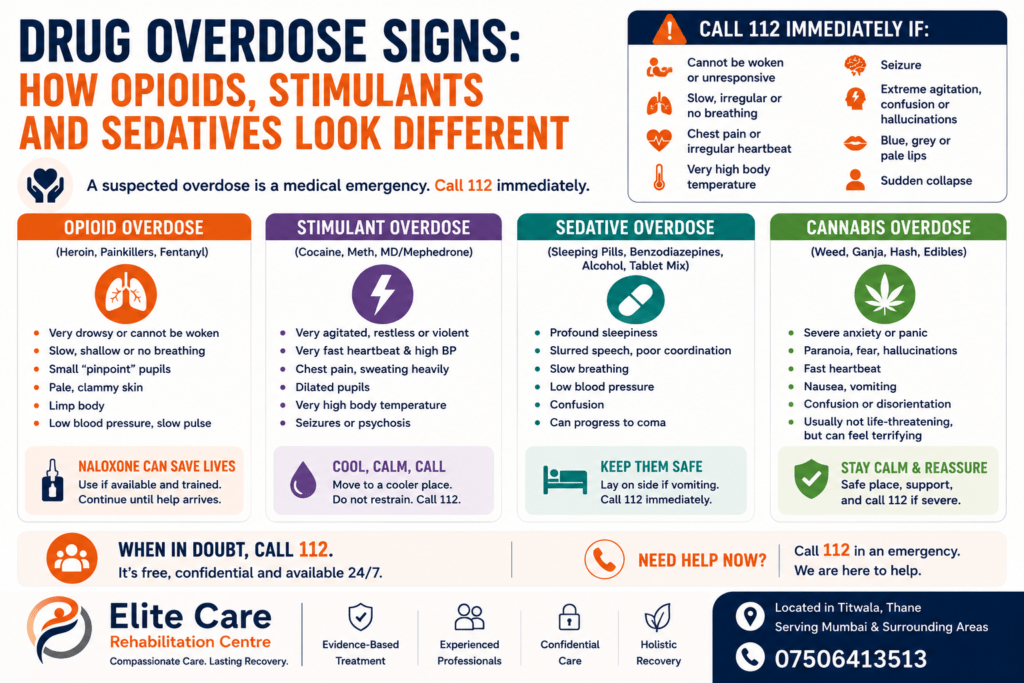
Drug overdose signs can look very different depending on the substance involved. Families seeking guidance from a nasha mukti kendra in India should know that an opioid overdose may cause reduced consciousness and dangerously slow or abnormal breathing, while stimulant toxicity may cause severe agitation, overheating, chest pain, seizures or psychosis. Sedative overdose can cause profound drowsiness and poor coordination, while a severe cannabis reaction may involve panic, confusion, paranoia or hallucinations. Mixed-drug overdoses can combine or mask these patterns.
A suspected overdose is a medical emergency. Do not wait until you know exactly what substance was taken. In India, call 112 for emergency assistance when a person cannot be woken normally, has abnormal breathing, collapses, has a seizure, develops severe chest pain, becomes dangerously overheated or has severe confusion, psychosis or agitation that cannot be managed safely.
Recognising the broad pattern can help a bystander describe what is happening, but it should never delay emergency assistance. The same person may also have taken opioids, stimulants, alcohol, sleeping tablets or another substance together, making the symptoms less predictable.
This guide explains the major differences between opioid overdose symptoms, stimulant overdose symptoms, sedative overdose symptoms, cannabis-related emergencies and polysubstance overdose. It also covers safe first-response steps without attempting to replace emergency medical treatment.
What does drug overdose mean?
A drug overdose occurs when exposure to a drug or medicine causes toxic effects that can seriously harm the body or threaten life. The amount required to produce toxicity differs between substances and between people.
Overdose can occur with:
- Illicit drugs
- Prescription medicines
- Over-the-counter medicines
- Alcohol combined with medicines or drugs
- More than one substance used together
- An unknown or adulterated street product
An overdose does not always mean that someone deliberately took an extremely large quantity. Serious toxicity can occur because of an unexpectedly strong product, reduced tolerance, a drug interaction, underlying illness or exposure to a substance the person did not know was present.
The MedlinePlus guidance on drug-use first aid explains that overdose symptoms vary widely according to the substance and can include drowsiness, breathing difficulty, agitation, seizures, hallucinations, abnormal pupil size and loss of consciousness.
How to know if someone is overdosing
There is no single sign that identifies every overdose.
Possible warning signs of drug overdose include:
- Difficulty waking the person
- Loss of consciousness
- Slow, shallow, irregular or absent breathing
- Severe breathing difficulty
- Blue, grey or unusually pale lips or fingertips
- Severe chest pain
- A very fast or irregular heartbeat
- A seizure
- Very high body temperature
- Extreme agitation
- Severe confusion
- Hallucinations or fixed delusions
- Sudden collapse
- Repeated vomiting with severely altered consciousness
- Profound drowsiness or inability to stay awake
- Marked loss of balance or coordination
The absence of one familiar sign does not make the situation safe. For example, pupils may be very small during opioid overdose, but pupil size alone cannot reliably confirm or rule out an opioid emergency.
Different drugs can produce very different overdose patterns
| Drug type | Possible warning pattern | Major emergency concern |
|---|---|---|
| Opioids | Reduced consciousness, extreme sleepiness, slow or abnormal breathing, sometimes very small pupils | Breathing can become dangerously slow or stop |
| Stimulants | Severe agitation, rapid heartbeat, high blood pressure, overheating, paranoia or chest pain | Heart attack, stroke, seizures, dangerous overheating or cardiac arrest |
| Benzodiazepines and selected sedative-hypnotics | Marked drowsiness, confusion, slurred speech, poor coordination and reduced consciousness | Breathing risk increases substantially when opioids, alcohol or other depressants are also involved |
| Cannabis | Severe panic, confusion, paranoia, hallucinations, rapid heartbeat or vomiting | Psychiatric instability, injury, severe vomiting or accidental ingestion, especially in children |
| Multiple substances | Mixed, changing or contradictory symptoms | One drug may hide the effects of another and deterioration may occur unexpectedly |
This table describes broad patterns, not diagnostic rules. Someone who appears stimulated can still have an opioid in their system, while someone who appears deeply sedated may have taken several drugs.
Opioid overdose symptoms
Opioids include heroin and medicines such as morphine, codeine, tramadol and other opioid pain medicines. Their most dangerous overdose effect is suppression of breathing.
Individual opioids do not always produce an identical presentation. For example, tramadol toxicity can also involve seizures, so an unusual symptom does not rule out opioid exposure or remove the need for emergency assessment.
The World Health Organization guidance on opioid overdose describes three characteristic signs:
- Very small or pinpoint pupils
- Loss of consciousness
- Difficulty breathing
Possible opioid overdose symptoms include:
- Extreme sleepiness
- Inability to wake the person
- Very slow breathing
- Shallow breathing
- Irregular breathing
- Periods when breathing appears to stop
- Choking, gurgling or unusual snoring sounds
- A limp body
- Very small pupils
- Blue, grey or unusually pale lips or fingertips
- Loss of consciousness
The most important warning signs are reduced responsiveness and abnormal breathing. Do not wait for every feature of the classic opioid-overdose pattern to appear.
Why opioid overdose affects breathing
Opioids act on brain systems involved in breathing. During overdose, the drive to breathe can become progressively weaker.
The person may initially appear unusually sleepy. Breathing may then become:
- Slower
- Shallower
- Irregular
- Interrupted by long pauses
This is why someone who appears to be “sleeping heavily” after heroin, an opioid painkiller or an unknown street drug should not simply be left alone.
The related guide to opioid addiction involving heroin, opium and painkillers explains overdose risks, physical dependence and reduced tolerance in more detail.
Heroin overdose symptoms
Heroin overdose symptoms follow the opioid pattern because heroin is an opioid.
Warning signs may include:
- Inability to stay awake
- Loss of consciousness
- Slow or absent breathing
- Very small pupils
- A limp body
- Gurgling or choking sounds
- Blue or grey lips
A product sold as heroin or brown sugar may also contain other substances. Unexpected agitation, seizures or prolonged unusual symptoms may therefore indicate a mixed exposure rather than uncomplicated heroin intoxication.
Painkiller overdose symptoms
Some prescription painkillers are opioids and can produce the same breathing-related overdose pattern as heroin.
Prescription status does not protect a person from overdose. Risk may increase with higher doses, reduced tolerance, certain health conditions or combinations with alcohol, benzodiazepines and other central nervous system depressants.
Possible painkiller overdose symptoms include:
- Extreme drowsiness
- Difficulty waking
- Slow or shallow breathing
- Confusion
- Loss of consciousness
- Very small pupils in some cases
- Blue or grey lips
The article on prescription drug addiction involving painkillers, cough syrups and tablets explains why prescribed use, misuse, dependence and addiction should not be treated as identical.
Naloxone for opioid overdose
Naloxone is an opioid-antagonist medicine that can temporarily reverse the effects of an opioid overdose.
WHO recommends access to naloxone for people who are likely to witness an opioid overdose and recognises its use as an emergency response while medical help is being obtained.
If opioid overdose is suspected and naloxone is available, it can be administered according to the product instructions. Emergency assistance is still required.
Naloxone:
- Works on opioid effects
- Does not reverse cocaine, methamphetamine or cannabis toxicity
- Does not remove other drugs from the body
- May wear off before the opioid has stopped acting
A person who wakes after naloxone still requires emergency medical assessment.
Stimulant overdose symptoms can look completely different
A stimulant emergency may not involve sleepiness at all.
Someone experiencing stimulant toxicity may be awake, frightened, highly agitated or physically overactive while a serious medical emergency is developing.
Stimulants include:
- Cocaine
- Methamphetamine
- Other amphetamines
- Mephedrone and other synthetic cathinones
- Some prescription stimulants when misused or taken in toxic amounts
The CDC guidance on stimulant overdose notes that stimulant toxicity can affect the cardiovascular system, body-temperature regulation and mental state and may contribute to heart attack or stroke.
Common stimulant toxicity symptoms
Possible stimulant overdose symptoms include:
- Severe agitation
- Extreme anxiety or panic
- Rapid heartbeat
- Very high blood pressure
- Chest pain
- Heavy sweating
- Very high body temperature
- Severe headache
- Tremor
- Paranoia
- Hallucinations
- Severe confusion
- A seizure
- Weakness or numbness
- Difficulty speaking
- Collapse
Severe stimulant toxicity can affect the heart, brain and temperature-regulation systems at the same time.
Stimulant overdose does not require unconsciousness
This is an important difference from the familiar opioid-overdose pattern.
A person with dangerous stimulant toxicity may:
- Be fully awake
- Talk rapidly
- Pace continuously
- Appear extremely frightened
- Become suspicious or aggressive
- Complain of chest pain
- Feel intensely hot
Being conscious does not mean that the person is medically stable.
Severe chest pain, marked overheating, seizure, stroke-like symptoms, severe psychosis or uncontrollable agitation after stimulant use requires emergency assistance.
Cocaine overdose symptoms
Cocaine overdose symptoms may include:
- Severe chest pain
- Rapid or irregular heartbeat
- Very high blood pressure
- Severe anxiety or agitation
- Paranoia
- Hallucinations
- High body temperature
- A severe headache
- A seizure
- Stroke-like symptoms
- Collapse
Cocaine can increase heart rate and blood pressure while placing additional strain on the cardiovascular system.
The detailed guide to cocaine addiction, the crash and heart risks explains why chest pain after cocaine use should not automatically be dismissed as anxiety.
Methamphetamine overdose symptoms
Methamphetamine and other amphetamine-type stimulants can produce a similar pattern of severe overstimulation.
Possible methamphetamine overdose symptoms include:
- Extreme agitation
- Rapid heartbeat
- High blood pressure
- Very high body temperature
- Severe anxiety
- Paranoia
- Hallucinations
- Chest pain
- Seizures
- Collapse
Prolonged sleep deprivation can also worsen paranoia, confusion and psychotic symptoms, making the clinical picture more complicated.
MD drug overdose symptoms
In India, the street term MD often refers to mephedrone, although the abbreviation is ambiguous and may be confused with MDMA.
A severe reaction to a product sold as MD may include:
- Marked agitation
- Rapid heartbeat
- Chest pain
- Heavy sweating
- Very high body temperature
- Paranoia
- Hallucinations
- Confusion
- A seizure
- Collapse
The street name cannot confirm the contents of a powder or crystal. A product sold as MD may contain mephedrone, another stimulant or a mixture.
The guide to mephedrone or MD drug addiction explains this terminology and the risks of repeated stimulant dosing in greater detail.
Why overheating is a major stimulant warning sign
Stimulants can increase physical activity, heart rate and body temperature. Prolonged exertion, hot environments and repeated dosing may add to the risk.
Warning signs include:
- Feeling or appearing extremely hot
- Heavy sweating
- Severe agitation
- Confusion
- Muscle rigidity
- A seizure
- Collapse
- Loss of consciousness
Marked overheating is an emergency. It should not be treated as a routine “comedown” or something the person should simply sleep off.
Chest pain after stimulant use needs urgent assessment
Chest pain may occur with cocaine, methamphetamine, mephedrone and other stimulants.
It can reflect anxiety, but it can also occur with serious cardiovascular complications.
Emergency concern increases when chest pain is:
- Severe
- Persistent
- Associated with breathlessness
- Associated with fainting
- Accompanied by a very rapid or irregular heartbeat
- Associated with weakness, numbness or difficulty speaking
Do not attempt to decide at home whether stimulant-related chest pain is “just panic”.
Sedative overdose symptoms
Sedative medicines do not all behave identically. The exact risks depend on the drug involved.
For benzodiazepines and selected sedative-hypnotics, possible overdose symptoms can include:
- Profound drowsiness
- Difficulty staying awake
- Confusion
- Slurred speech
- Poor coordination
- Unsteady walking
- Weakness
- Reduced responsiveness
- Loss of consciousness
Some sedative overdoses can also cause slow or difficult breathing, particularly when large exposures or other depressant substances are involved.
The MedlinePlus information for alprazolam, for example, lists drowsiness, confusion, coordination problems and loss of consciousness among overdose symptoms.
Benzodiazepine overdose symptoms
Benzodiazepine overdose symptoms commonly involve central nervous system depression.
Possible signs include:
- Marked drowsiness
- Confusion
- Reduced alertness
- Poor balance
- Loss of coordination
- Slurred speech
- Loss of consciousness
Serious breathing problems become a particular concern when benzodiazepines are combined with opioids, alcohol or other central nervous system depressants.
The FDA benzodiazepine safety warning specifically cautions about severe respiratory depression and death when benzodiazepines are used with opioids and other central nervous system depressants.
Sleeping pill overdose symptoms
The phrase sleeping pill overdose covers several medicines with different toxic effects.
Possible warning signs may include:
- Extreme sleepiness
- Confusion
- Difficulty waking
- Slurred speech
- Poor coordination
- Loss of consciousness
- Slow or difficult breathing with some medicines or combinations
A person who cannot be woken normally after taking sleeping tablets needs emergency assessment, particularly when alcohol, opioids or other sedatives may also have been used.
Why sedative and opioid overdoses can look similar
Both can cause:
- Profound drowsiness
- Reduced consciousness
- Loss of coordination
- Breathing problems
However, the classic opioid pattern places particular emphasis on respiratory depression and very small pupils.
A bystander should not spend valuable time trying to distinguish a benzodiazepine overdose from an opioid overdose before calling for help.
If opioid exposure is possible and naloxone is available, emergency guidance supports using it according to its instructions while emergency assistance is being obtained.
Mixing sedatives, opioids and alcohol can sharply increase risk
Alcohol, opioids and benzodiazepines can all depress the central nervous system.
The FDA safety information on opioids and benzodiazepines warns that these combinations can lead to extreme sleepiness, slowed or difficult breathing, coma and death.
Warning signs include:
- Unusual difficulty staying awake
- Slurred speech
- Severe loss of balance
- Vomiting while very drowsy
- Slow breathing
- Loss of consciousness
A person should not be assumed to be safely asleep when several depressant substances may be involved.
Cannabis-related emergencies look different again
A fatal overdose caused solely by cannabis is considered unlikely, but cannabis can still produce severe reactions requiring medical attention.
The CDC cannabis guidance describes severe reactions that may include extreme confusion, anxiety, paranoia, panic, rapid heart rate, delusions, hallucinations, increased blood pressure and severe nausea or vomiting.
Possible cannabis emergency symptoms include:
- Severe panic
- Extreme anxiety
- Paranoia
- Marked confusion
- Hallucinations
- Delusional beliefs
- Rapid heartbeat
- Severe vomiting
- Unsafe or unpredictable behaviour
This is different from the typical breathing-suppression pattern of an opioid overdose.
Cannabis overdose symptoms versus a severe cannabis reaction
The phrase cannabis overdose symptoms is commonly searched, but “severe cannabis reaction” or “cannabis intoxication requiring medical attention” may sometimes be more medically precise.
Concern increases when the person:
- Cannot distinguish what is real
- Has severe paranoia
- Has hallucinations
- Becomes extremely confused
- Cannot be kept safe
- Has repeated severe vomiting
- Collapses
- Develops chest symptoms
The article on cannabis addiction, withdrawal and psychosis explains the difference between panic, paranoia and psychotic symptoms in more detail.
Edible cannabis can produce delayed severe reactions
Edible cannabis products can take longer to produce noticeable effects than inhaled cannabis.
This delay can lead a person to consume more before the first amount has fully taken effect.
A severe reaction may then include:
- Extreme anxiety
- Confusion
- Paranoia
- Hallucinations
- Severe vomiting
- Loss of coordination
Accidental ingestion is particularly concerning in children, who may require hospital care even when an adult exposed to a similar product would experience less severe symptoms.
Multiple drug overdose symptoms may not follow any textbook pattern
Polysubstance overdose means that more than one drug is involved, whether intentionally or without the person knowing.
The CDC guidance on polysubstance use explains that combining substances can produce stronger and more unpredictable effects. Stimulants and depressants do not simply cancel each other out.
Possible combinations include:
- Opioids and benzodiazepines
- Opioids and alcohol
- Cocaine and opioids
- Methamphetamine and opioids
- Stimulants and sleeping tablets
- Cannabis and alcohol
- Several prescription medicines
- Unknown substances contained in counterfeit pills or street powders
Why stimulants and depressants do not “balance each other”
A common misconception is that taking a stimulant can counteract an opioid or sedative.
It cannot reliably do so.
A stimulant may make someone feel or appear more awake while an opioid is still suppressing breathing. As the stimulant effect fades, the depressant effect may become more obvious.
Similarly, a sedative may reduce the feeling of stimulant anxiety while cardiovascular or temperature-related toxicity continues.
This is why multiple drug overdose symptoms can appear contradictory.
What mixed overdose can look like
A person may have:
- Severe agitation followed by sudden unresponsiveness
- Rapid heartbeat combined with abnormal breathing
- Paranoia followed by profound drowsiness
- Very small pupils with stimulant-type agitation
- Chest pain and reduced consciousness
- Seizures followed by respiratory depression
These patterns should not be used to guess which drug “won”. They should increase concern that several substances may be involved.
Counterfeit tablets and unknown powders increase uncertainty
A person may believe they took one drug while actually being exposed to another substance or mixture.
The CDC overview of polysubstance overdose notes that unintentional exposure can occur when drugs or counterfeit pills contain substances that the user did not know were present.
Therefore:
- A street name cannot confirm contents.
- A familiar-looking tablet does not guarantee its ingredients.
- A previous experience with a similar product does not establish the safety of the current one.
- Unexpected symptoms should be treated seriously.
Drug overdose breathing problems are especially urgent
Breathing provides one of the most important clues that a person is medically unstable.
Emergency warning signs include:
- Very slow breathing
- Shallow breathing
- Long pauses between breaths
- Irregular breathing
- Gasping
- Choking or gurgling sounds
- No normal breathing
Do not rely on loud snoring as reassurance. Abnormal snoring or gurgling in an unresponsive person may occur when the airway and breathing are compromised.
Drug overdose first aid: what a bystander should do
The purpose of first response is to obtain emergency assistance and support basic safety until trained help arrives, not to treat the overdose at home.
The CDC guidance for suspected overdose advises treating the situation as an overdose when there is uncertainty because delay can cost a life.
For a suspected drug overdose:
- Call 112 in India immediately.
- Tell the emergency operator what the person is doing, especially whether they are conscious and breathing normally.
- If opioid overdose is possible and naloxone is available, administer it according to its product instructions.
- Try to keep the person responsive and breathing while following the emergency operator’s instructions.
- If the person is unconscious but breathing normally, place them on their side when it is safe to do so to reduce choking risk.
- Stay with the person until emergency assistance arrives.
- If the person is not breathing normally, follow the emergency operator’s instructions for resuscitation or CPR.
Do not delay the emergency call while trying to identify every substance involved.
What not to do during a suspected overdose
Do not:
- Assume the person only needs sleep
- Leave an unconscious person alone
- Force them to walk
- Induce vomiting
- Force coffee, food or fluids into someone who is not fully alert
- Give another person’s prescription medicine
- Use alcohol to “balance” stimulant effects
- Wait for severe chest pain or psychosis to wear off
- Delay calling because the exact drug is unknown
What information is useful for emergency clinicians?
Share what you know without delaying the emergency response.
Helpful information may include:
- The substance or street name reported
- Prescription containers or packaging
- Approximate time of use
- Other medicines or drugs that may have been taken
- Alcohol use
- Whether naloxone was administered
- Previous overdose
- Known medical conditions
If the exact substance is unknown, say so. An uncertain history is more useful than false certainty.
Overdose and withdrawal are not the same thing
Overdose occurs when drug exposure produces toxic effects. Withdrawal occurs when the body reacts to stopping or reducing a substance after adaptation has developed.
However, withdrawal can still produce emergencies.
Examples include:
- Seizures during abrupt withdrawal from some sedatives
- Severe depression or suicidal thoughts during stimulant withdrawal
- Severe dehydration during prolonged vomiting or diarrhoea
- Psychiatric deterioration during or after substance withdrawal
The article on drug withdrawal symptoms and timelines explains these differences in detail.
When a person seems asleep after drug use
Families frequently describe someone as “sleeping deeply” after taking a drug or medicine.
Concern increases when the person:
- Does not respond normally to voice
- Cannot be fully awakened
- Has abnormal breathing
- Has blue or grey lips
- Makes choking or gurgling sounds
- Has vomited while barely responsive
These are not signs that should simply be monitored until morning.
When severe agitation is an overdose emergency
Overdose is not always quiet.
Stimulant toxicity and some mixed-drug emergencies can cause extreme agitation.
Call 112 when agitation is accompanied by:
- Very high body temperature
- Chest pain
- Severe confusion
- Hallucinations
- Fixed paranoid beliefs with unsafe behaviour
- A seizure
- Collapse
- Violence that cannot be managed safely
Do not attempt prolonged arguments with someone experiencing severe paranoia or psychosis. Move other people to safety and wait for trained emergency assistance.
Frequently asked questions
What are the most important drug overdose signs?
Major warning signs include inability to wake, abnormal breathing, severe chest pain, seizure, collapse, dangerous overheating, severe confusion, psychosis or extreme agitation. The exact pattern depends on the substance involved.
How do I know if someone is overdosing or just high?
It may be impossible for a bystander to know with certainty. If the person cannot be woken normally, is breathing abnormally, has chest pain, a seizure, severe overheating, psychosis or dangerous confusion, treat the situation as a medical emergency.
What are the main opioid overdose symptoms?
Reduced consciousness and slow or abnormal breathing are particularly important. Very small pupils may also occur, but pupil size alone should not be used to rule an overdose in or out.
What are heroin overdose symptoms?
Possible signs include extreme sleepiness, inability to wake, slow or absent breathing, very small pupils, a limp body and blue or grey lips.
Can an opioid overdose cause seizures?
Some opioid exposures can involve atypical features. Tramadol toxicity, for example, can cause seizures as well as reduced consciousness or breathing problems. A seizure therefore does not rule out opioid exposure, particularly when several substances may be involved.
What does a stimulant overdose look like?
A person may be extremely agitated rather than sleepy. Possible signs include rapid heartbeat, high blood pressure, overheating, chest pain, paranoia, hallucinations, seizures or stroke-like symptoms.
What are cocaine overdose symptoms?
Possible symptoms include severe chest pain, rapid or irregular heartbeat, marked agitation, high body temperature, paranoia, seizures, severe headache, stroke-like symptoms and collapse.
Can an awake person still be overdosing?
Yes. Stimulant toxicity can become life-threatening while a person remains fully conscious and highly agitated.
What are sedative overdose symptoms?
They may include extreme drowsiness, confusion, slurred speech, poor coordination, reduced consciousness and, with some drugs or combinations, slow or difficult breathing.
What are benzodiazepine overdose symptoms?
Possible symptoms include marked drowsiness, confusion, poor coordination and loss of consciousness. Breathing risk becomes particularly concerning when benzodiazepines are combined with opioids, alcohol or other depressants.
What are sleeping pill overdose symptoms?
Symptoms depend on the medicine but may include extreme drowsiness, confusion, poor coordination, slurred speech, loss of consciousness and abnormal breathing.
Can cannabis cause an overdose?
A fatal overdose caused solely by cannabis is considered unlikely, but severe cannabis reactions can still require urgent medical care. Symptoms may include extreme panic, confusion, paranoia, hallucinations, rapid heartbeat and severe vomiting.
What are multiple drug overdose symptoms?
Symptoms may be mixed or change quickly. A person could be agitated and have abnormal breathing, or initially appear stimulated and later become profoundly drowsy. Mixed patterns should increase concern rather than provide reassurance.
Do stimulants cancel out opioids?
No. Stimulants do not reliably reverse opioid effects. A stimulant may temporarily make someone appear more awake while opioid-related breathing suppression remains dangerous.
Can naloxone reverse every drug overdose?
No. Naloxone reverses opioid effects. It does not reverse stimulant, cannabis or sedative toxicity unless an opioid is also contributing to the overdose.
Should naloxone be used if the exact drug is unknown?
If opioid exposure is possible and naloxone is available, recognised overdose guidance supports its emergency use according to the product instructions while emergency assistance is being obtained.
Should I make someone vomit after an overdose?
No. Do not induce vomiting unless specifically directed by a qualified medical or poison-management professional. An impaired person can choke or inhale vomit into the lungs.
Can someone sleep off a drug overdose?
A suspected overdose should not be managed by simply allowing the person to sleep. Inability to wake normally or abnormal breathing requires immediate emergency assistance.
When should I call 112 for a drug overdose?
Call 112 immediately when a person cannot be woken, is breathing abnormally, collapses, has a seizure, severe chest pain, dangerous overheating, severe confusion, psychosis, suicidal behaviour or agitation that cannot be managed safely.
Recognising the pattern can help, but emergency action matters more
Drug overdose symptoms do not follow one universal pattern. Opioids commonly suppress consciousness and breathing. Stimulants may produce severe agitation, cardiovascular strain, overheating or seizures. Sedatives can cause profound drowsiness and loss of coordination, while severe cannabis reactions may involve panic, confusion, paranoia or psychotic symptoms.
Multiple-substance overdose is even less predictable because one drug can alter or mask another drug’s effects.
The safest rule is therefore simple: when serious overdose is suspected, do not wait to identify the exact drug before seeking emergency assistance.
Call 112 in India for abnormal breathing, inability to wake, chest pain, seizure, collapse, dangerous overheating, severe confusion, psychosis or behaviour that cannot be managed safely. If opioid exposure is possible and naloxone is available, use it according to its instructions while emergency help is on the way.
Medical disclaimer: This article provides general educational and emergency-recognition information and does not replace professional medical assessment or emergency treatment. A suspected overdose requires urgent medical assistance. Do not use online information to determine that an unconscious, severely agitated, overheated, psychotic or abnormally breathing person is safe to manage at home.
