
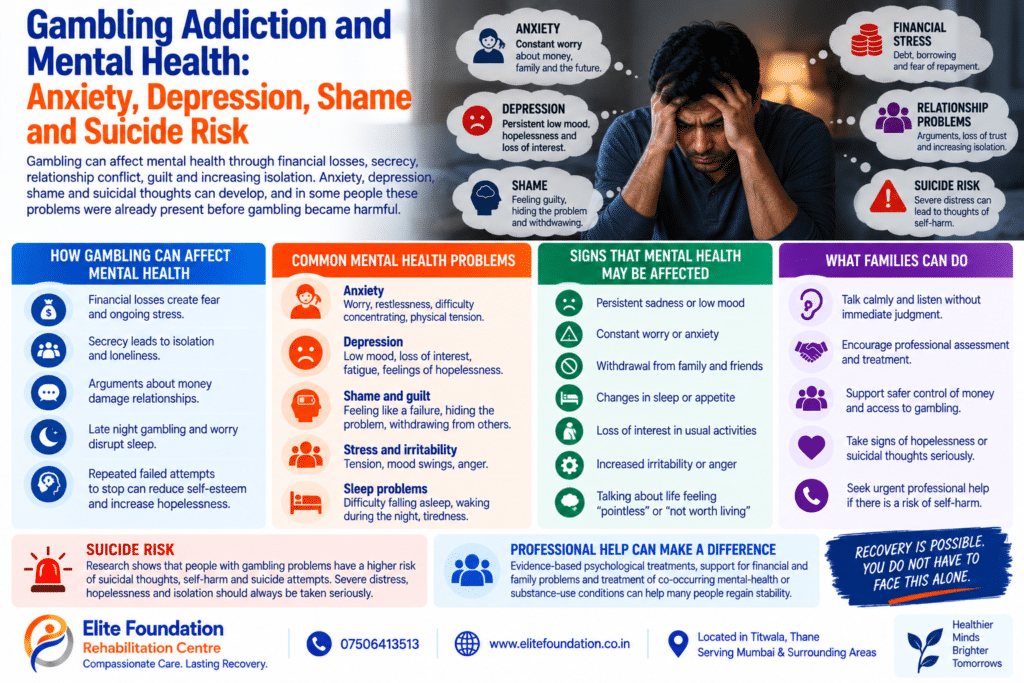
Gambling addiction and mental health can become closely connected when betting losses lead to secrecy, debt, family conflict, shame and increasing isolation. Families looking for Mumbai rehabs may first seek help for anxiety, depression, sleep problems or sudden financial distress before recognising gambling as part of the picture. At Elite Foundation, our gambling rehabs in Mumbai approach considers both the gambling behaviour and the person’s mental health because treating debt or betting alone may miss depression, anxiety, substance use, severe distress or other conditions occurring alongside it.
The relationship is not always simple or one-directional. Gambling losses can contribute to psychological distress, but depression, anxiety, impulsivity, loneliness, substance use or other mental-health difficulties may already have been present before gambling became harmful. In some people, both patterns develop together and begin reinforcing each other.
This matters because a family may see only the final crisis: large debt, lying about money, staying awake at night or suddenly saying that life has become unbearable. The clinical task is to understand how the person arrived there rather than assuming that every symptom has one cause.
How can gambling affect mental health?
Gambling can affect mental health through several routes. Financial losses can create fear about repayments and household responsibilities. Secrecy can make the person increasingly isolated. Arguments about money can damage relationships. Repeated failed attempts to stop can produce hopelessness or self-criticism. Sleep may deteriorate because the person is gambling late at night, monitoring results or worrying about debt.
The World Health Organization identifies mental illness, suicide, financial distress and relationship breakdown among serious gambling-related harms. WHO also notes that gambling can divert household spending away from essential needs and contribute to wider family and social harm.
That does not mean gambling inevitably causes a psychiatric disorder. Millions of people may gamble without developing depression or an anxiety disorder. The concern is the pattern of gambling-related harm and what is happening psychologically alongside it.
The cycle may move from money problems into psychological distress
One possible progression is:
losses → secrecy → debt → conflict → shame → isolation.
This is not a fixed clinical sequence and it does not occur in every person. It is a useful way of understanding how financial harm can gradually become emotional and interpersonal harm.
Someone loses money and believes they can recover it before the family finds out. The losses continue, so borrowing begins. Once debt becomes difficult to hide, explanations are invented. A spouse becomes suspicious. Arguments increase. The person begins avoiding conversations about money and withdrawing from people who may ask questions.
At that point, the distress may no longer be only about gambling. It may involve fear of disclosure, damaged trust, debt repayments, worries about work, shame about lying and anxiety about what will happen when the family learns the full amount.
Gambling and depression can be related in more than one direction
Someone may become depressed after months of gambling-related financial and relationship problems. Another person may already have depression and begin gambling because betting temporarily distracts them from low mood, loneliness or hopelessness.
For some people, the relationship may operate in both directions. Low mood makes gambling more appealing as an escape. Gambling then creates losses and conflict, which make the low mood worse. The person returns to gambling because they want temporary relief from the distress that gambling itself has helped intensify.
This is why the question should not simply be:
“Did gambling cause the depression?”
A fuller assessment asks when the depressive symptoms began, whether they occur independently of gambling losses, whether there have been previous episodes, whether alcohol or other substances are involved and how much the symptoms are affecting everyday functioning.
Feeling terrible after a gambling loss is not automatically clinical depression
A large gambling loss can produce sadness, guilt, anger, panic or regret. Those reactions can be intense without necessarily representing a depressive disorder.
Clinical assessment becomes more important when low mood is persistent, enjoyment has markedly reduced, sleep or appetite has changed, concentration is poor, energy is substantially reduced, hopelessness is developing or work and relationships are becoming difficult to manage.
The distinction matters because telling every distressed gambler that they are “depressed” can medicalise a normal emotional response to a serious problem. The opposite mistake is also dangerous: assuming persistent depression is merely regret about money and therefore does not need treatment.
Gambling anxiety can continue even when the person is not placing a bet
Anxiety linked with gambling is not limited to the moment before a result appears. Someone may spend much of the day worrying about bank balances, creditors, loan repayments, whether a spouse will discover hidden transactions or how they will explain missing household money.
The phone itself can become a source of anxiety. A bank notification, lender call, message from a friend who is owed money or discussion about an upcoming match may immediately increase tension.
Some people respond to this anxiety by avoiding their finances completely. Others repeatedly check accounts, scores or results. A person may appear preoccupied with betting when part of what is actually driving the behaviour is fear about the consequences already created.
Persistent or severe anxiety deserves assessment in its own right, particularly when there are panic symptoms, serious sleep disruption, impaired functioning or a history of anxiety before the gambling problem developed.
Ongoing gambling debt can keep financial anxiety active
A person who owes several lenders may wake up each morning with the same financial problem still present. There may be no simple decision that makes it disappear. Calls arrive, payment dates approach and the person knows that normal monthly income may take considerable time to repair the situation.
That ongoing pressure can produce irritability, poor concentration, sleep difficulty and persistent worry. It can also create the dangerous belief that gambling is the only way to solve the debt quickly.
The separate guide on gambling debt explains how personal loans, credit cards, missed EMIs, informal borrowing and hidden financial obligations can accumulate around gambling.
The mental-health point is important: genuine financial pressure is real, but it does not make another uncertain bet a reliable financial solution.
Shame is different from taking responsibility
After gambling has harmed a family, some degree of regret may be understandable. The person may need to acknowledge lying, borrowing or using money that was meant for other purposes.
Shame goes further. Instead of thinking:
“I did something harmful.”
the person begins thinking:
“I am a terrible person.”
That difference can matter clinically. Responsibility can support change because it focuses on behaviour that can be addressed. Global self-condemnation can increase withdrawal, secrecy and hopelessness.
Humiliating someone is therefore not an evidence-based treatment for gambling problems. Families may be deeply angry and financially harmed, but repeated insults or public shaming are unlikely to provide the structured behavioural and psychological changes needed for recovery.
Secrecy can intensify both shame and isolation
A person may hide gambling because they intend to repair the problem before anyone finds out. When another loss occurs, the amount that needs hiding becomes larger. More lies may be needed to explain missing money or new loans.
The person then has fewer people with whom they can speak honestly.
A family member may think everything is normal while the person gambling is privately calculating debts, avoiding lenders and worrying about discovery. The gap between the public story and the actual financial situation becomes psychologically exhausting.
The Elite Foundation guide on gambling addiction symptoms describes how secrecy, unexplained transactions, borrowing and changing explanations may become visible to families even before the person admits that gambling has become difficult to control.
Isolation can remove exactly the support the person needs
Some people withdraw after gambling losses because they feel ashamed. Others avoid friends or relatives because money has been borrowed from them. Family conversations are avoided because every discussion may turn towards debt or gambling.
This can create a difficult situation: the greater the distress becomes, the fewer people know how serious it is.
Social isolation does not automatically cause depression or suicide. But when somebody is severely distressed, carrying hidden debt and no longer speaking openly with anyone, clinicians and families should take that isolation seriously rather than treating it as simple stubbornness.
Gambling may also be used as an escape from existing distress
Not everyone begins gambling from a psychologically healthy baseline. Someone may already be struggling with loneliness, anxiety, depression, work stress, grief or relationship difficulties.
During gambling, attention becomes narrowly focused on the next event, result or decision. For a period, another problem may feel less prominent.
This temporary absorption can make gambling attractive as a coping behaviour even when the financial outcome is poor. The person may return not because they realistically expect gambling to solve their emotional problem, but because it briefly changes how they feel.
If that function is not recognised, treatment may remove gambling without addressing the distress that repeatedly pulls the person back towards it.
Mental-health problems can occur alongside Gambling Disorder
Depression, anxiety disorders, alcohol problems and other substance-use disorders are commonly reported alongside Gambling Disorder in clinical and population research.
However, “commonly occurring together” does not answer which condition came first or whether one caused the other. Some people may have a longstanding psychiatric condition that predates gambling. Others develop severe symptoms after gambling-related harm. Some have several interacting problems that cannot be reduced to a simple cause-and-effect chain.
This is why treatment should assess the whole clinical picture rather than assuming that gambling is the only diagnosis requiring attention.
Alcohol and substance use can complicate gambling-related distress
Alcohol may lower inhibition and make it harder to follow a decision not to gamble. It may also be used after losses to manage distress. In other people, alcohol or substance use was already problematic before gambling became severe.
When gambling and substance use occur together, the risks can become harder to manage. Financial decisions may be made while intoxicated, conflict may become more severe and symptoms of anxiety or depression may be difficult to interpret accurately.
Each condition needs proper assessment rather than assuming that stopping one behaviour will automatically resolve the other.
Sudden extreme gambling can sometimes point to another psychiatric condition
A sudden and major change in gambling behaviour should not automatically be labelled as ordinary gambling addiction without considering the wider mental state.
For example, unusually risky gambling or spending may occur during mania or hypomania, particularly when it appears alongside markedly reduced need for sleep, unusually elevated or highly irritable mood, racing thoughts, unusually rapid speech, grandiose confidence or several other uncharacteristic high-risk behaviours.
This distinction can materially change treatment. Someone experiencing a major mood episode requires appropriate psychiatric assessment rather than being told only to improve gambling discipline.
Why gambling problems and suicide risk require careful discussion
Suicide risk is one of the most serious areas of gambling-related harm, but it must be discussed accurately and without implying that every person with gambling debt is suicidal.
A 2025 meta-analysis of 14 observational studies on Gambling Disorder and suicide outcomes found associations with suicidal thoughts, suicide attempts and suicide mortality.
The study also showed why simplistic claims are inappropriate. Results varied according to study design and geographic region, and the evidence was observational. That means the research identifies an association; it does not establish that Gambling Disorder alone caused an individual suicide or suicide attempt.
Suicidal behaviour is complex. Depression, substance use, relationship breakdown, debt, previous self-harm, psychiatric illness and other personal and social factors may all be relevant. Assessment needs to consider those factors rather than reducing suicide risk to a single gambling variable.
Do not use suicide statistics to frighten someone into stopping gambling
Fear-based statements such as “gamblers kill themselves” are inaccurate, stigmatising and clinically unhelpful.
Most people experiencing gambling-related harm will not die by suicide. At the same time, suicidal thoughts in somebody facing gambling-related distress must never be dismissed as attention-seeking or simply frustration over money.
Population studies find higher rates of suicidal thoughts, attempts and suicide mortality among people with Gambling Disorder, but an individual’s risk cannot be inferred from gambling status alone.
Warning language deserves attention even without an explicit suicide statement
A person in severe gambling-related distress may not initially say, “I am suicidal.” They may say:
“There is no way out.”
“I have destroyed everything.”
“My family would be better without me.”
“I cannot face anyone.”
Those statements do not prove suicidal intent. They do indicate severe distress and justify a direct mental-health assessment rather than another argument about how the money was lost.
If a person discloses suicidal thoughts, the response should focus first on safety, not blame, debt calculation or punishment.
When gambling-related distress becomes an emergency
Suicidal thoughts require prompt professional mental-health assessment. The situation becomes particularly urgent when there is suicidal intent, a specific plan, a recent suicide attempt, inability to remain safe or another immediate danger.
In that situation, do not leave the person to manage the crisis alone. If it is safe to do so, remain with them or make sure another responsible adult is present while emergency help is arranged.
In India, 112 is the nationwide emergency response number. A person in immediate danger can also be taken to the nearest emergency department or appropriate emergency mental-health service.
The gambling debt can be reviewed later. Immediate safety takes priority.
A family should not turn a suicide disclosure into a financial interrogation
A spouse or parent may understandably feel angry after discovering hidden gambling debt. If the person then expresses suicidal thoughts, the family may wonder whether the statement is being used to avoid responsibility.
That possibility should not be decided during a crisis.
Any credible suicide concern needs appropriate assessment. Financial accountability can be addressed once immediate safety has been established.
Taking a suicide statement seriously does not mean cancelling debts, accepting further gambling or abandoning financial boundaries. It means recognising that a potentially life-threatening mental-health issue has temporarily become the priority.
Families also need support when gambling affects mental health
Gambling problems do not affect only the person betting. A spouse may be dealing with debt, dishonesty and fear about household security. Parents may have used savings to clear loans. Children may be exposed to repeated conflict at home.
Family members can develop anxiety, sleep problems, anger or their own feelings of hopelessness.
Supporting the person who gambles should therefore not require the rest of the household to ignore their own mental health, safety or financial needs.
Where relationships include violence, threats, intimidation, coercive control or economic abuse, personal safety comes before confrontation or attempts to obtain access to accounts.
Why repeatedly asking “How could you do this?” may not move recovery forward
Families need honest explanations, especially when shared money has been lost. But repeatedly returning to moral condemnation can keep everyone trapped in the same argument.
More useful clinical questions include when gambling happens, what triggers it, what happens emotionally before and after betting, how much debt exists, whether the person has tried to stop, what psychiatric symptoms are present and what safeguards are needed now.
Those questions do not excuse harmful behaviour. They identify what must change.
Assessment should separate gambling symptoms from mental-health symptoms
A useful assessment does not treat every symptom as part of Gambling Disorder.
Sleep loss may come from late-night betting, but it may also occur in depression, anxiety or a mood episode. Irritability may follow a gambling loss but can also occur independently. Poor concentration may reflect debt-related worry, depression, substance use or sleep deprivation.
Similarly, impulsive spending could occur as part of a longstanding gambling pattern or during a broader psychiatric episode.
Understanding timing, duration and context is therefore important. The purpose of assessment is not simply to add more diagnoses. It is to avoid missing a condition that changes the treatment plan.
Should depression and gambling be treated together?
When clinically significant depression or anxiety occurs alongside Gambling Disorder, both need attention.
The exact treatment sequence will depend on severity and safety. A person with immediate suicide risk needs urgent mental-health care. Someone with stable but persistent depression and an active gambling problem may need coordinated treatment addressing both areas.
Reducing gambling harm can improve some sources of distress, particularly debt and secrecy. But a pre-existing depressive or anxiety disorder may not disappear simply because betting stops.
The reverse is also true: treating depression does not automatically remove established gambling routines, access to betting, loss chasing or gambling-related beliefs.
Psychological treatment should address more than the number of bets
Gambling treatment may need to examine triggers, urges, distorted beliefs, access to money, secrecy, loss chasing and relapse risk. Mental-health treatment may simultaneously need to address depression, anxiety, trauma, substance use, relationship difficulties or another psychiatric condition.
The goal is not to force every problem into one explanation.
A person may have Gambling Disorder and depression. They may have gambling-related distress without a depressive disorder. They may have longstanding anxiety that predates gambling. They may be experiencing an acute crisis driven primarily by debt and disclosure.
Good treatment begins by distinguishing those possibilities.
Stopping gambling can reduce one source of distress, but consequences may remain
When gambling stops, debt may still exist. Trust may still be damaged. Loans may still need repayment. Employment problems may still require attention.
This is why some people expect to feel dramatically better after stopping and become discouraged when anxiety does not disappear immediately.
Stopping prevents new gambling harm. Repairing the consequences is a separate process.
The person’s psychological recovery may involve facing financial reality, rebuilding routines, restoring trust gradually and learning to tolerate difficult emotions without returning to betting.
Shame can make treatment engagement harder
Someone who expects to be judged may minimise what happened. They may disclose only part of the debt or deny suicidal thoughts because they fear what others will think.
A clinical setting should therefore make room for accountability without humiliation.
The person still needs to acknowledge losses, borrowing and harm. But the purpose of disclosure is to create an accurate treatment and safety plan, not to establish that the person is morally defective.
What families can do when mental health is deteriorating
If the person is distressed but not in immediate danger, encourage professional assessment rather than trying to diagnose depression or anxiety at home. Keep financial conversations factual. Protect essential household money and avoid providing unrestricted funds that could be used for further gambling.
Where possible, reduce secrecy by agreeing on transparent financial information and treatment involvement. If the person becomes more withdrawn, hopeless or begins making statements about death or being better off gone, treat that as a mental-health concern rather than waiting for the next gambling episode to confirm that something is wrong.
If there is immediate suicide risk, switch from ordinary family problem-solving to emergency safety action.
Frequently asked questions
Can gambling cause depression?
Gambling-related losses, debt, secrecy and relationship conflict can contribute to depressive symptoms in some people. However, depression may also have existed before gambling became harmful. Individual assessment is needed rather than assuming one direction of causation.
Can depression make gambling worse?
It can for some people. Gambling may be used to escape low mood, loneliness or hopelessness temporarily. That does not mean everyone with depression is at risk of Gambling Disorder, but the relationship should be assessed when both are present.
Why does gambling cause so much anxiety?
Gambling-related anxiety may come from uncertain outcomes, losses, debt, creditor pressure, fear of disclosure, damaged relationships or repeated attempts to recover money. A separate anxiety disorder may also coexist and should not automatically be attributed to gambling.
What are the mental effects of gambling?
People experiencing harmful gambling may report stress, anxiety, depressed mood, shame, sleep problems, irritability, preoccupation, isolation and relationship distress. These symptoms vary considerably and do not automatically establish a separate psychiatric diagnosis.
Is shame common after gambling losses?
Shame can occur when someone has hidden losses, borrowed money or harmed important relationships. It can increase secrecy and withdrawal. Treatment should encourage responsibility for behaviour without reinforcing global self-condemnation or humiliation.
Why do gamblers isolate themselves?
Some people withdraw because they fear questions about money, feel ashamed, owe money to friends or want to hide continued gambling. Isolation may also reflect depression or another mental-health difficulty and should be assessed in context.
Can gambling affect sleep?
Yes. Late-night betting, live events, financial worry and repeated checking of results can interfere with sleep. Persistent sleep disturbance can also occur in depression, anxiety, substance use or mood disorders, so the wider clinical picture matters.
Are gambling addiction and anxiety commonly seen together?
They can occur together, but that does not establish that one caused the other. Anxiety may predate harmful gambling, develop after financial and relationship harm or interact with gambling behaviour in both directions.
Is gambling associated with suicide?
Yes. Population studies find higher rates of suicidal thoughts, suicide attempts and suicide mortality among people with Gambling Disorder. This does not mean every person with Gambling Disorder is suicidal or that gambling alone causes suicide. Individual risk depends on multiple psychiatric, financial, personal and social factors.
Does gambling debt mean somebody is suicidal?
No. Debt alone cannot establish suicide risk. However, severe debt combined with hopelessness, depression, isolation, substance use or suicidal statements requires careful assessment.
What should I do if a gambler says they want to die?
Take the statement seriously and arrange prompt professional assessment. If there is suicidal intent, a plan, a recent attempt, inability to remain safe or another immediate danger, seek emergency help immediately. In India, call 112 or go to the nearest emergency department.
Should I discuss the gambling debt during a suicide crisis?
Immediate safety comes first. Debt, repayment and financial accountability can be addressed after the person has received appropriate emergency or mental-health assessment.
Can alcohol make gambling-related mental-health problems worse?
Alcohol can reduce inhibition, impair decision-making and occur alongside depression, anxiety or gambling problems. Where harmful alcohol use and gambling occur together, both should be assessed.
Can sudden gambling be caused by bipolar disorder?
Unusually risky gambling can occur during mania or hypomania in some people, particularly when accompanied by reduced need for sleep, elevated or markedly irritable mood, racing thoughts, unusual confidence and other risky behaviour. Sudden major behavioural change warrants psychiatric assessment.
Can treating depression stop gambling addiction?
Not necessarily. Treating depression may improve an important contributing problem, but established gambling habits, triggers, access to money and gambling-related beliefs may still require separate treatment.
Will stopping gambling cure anxiety and depression?
Stopping gambling may reduce distress caused by new losses and secrecy, but existing debt and relationship problems may remain. A separate depressive or anxiety disorder may also require its own treatment.
When should professional mental-health help be considered?
Assessment is important when depression or anxiety is persistent or severe, functioning is deteriorating, substance use is involved, there is a major change in mood or behaviour, attempts to stop gambling repeatedly fail or suicidal thoughts occur.
Mental-health recovery requires more than stopping the next bet
Gambling and mental health can become connected through money, secrecy, relationships and emotional coping. For one person, gambling losses may gradually produce severe anxiety and depression. For another, longstanding depression or anxiety may have made gambling appealing as temporary escape. In many cases, the direction cannot be reduced to one simple explanation.
The sequence of losses, secrecy, debt, conflict, shame and isolation is clinically important because each stage can add another source of distress. But it should not become a formula used to predict what every person will experience.
Stopping gambling is important because it prevents new financial and behavioural harm. It does not automatically erase existing debt, restore trust or treat a psychiatric disorder that existed beforehand.
Likewise, treating depression or anxiety does not automatically remove gambling access, financial secrecy, loss chasing or an established pattern of betting.
A strong assessment therefore looks at both sides of the problem: what gambling is doing to the person’s mental health and what mental-health difficulties may be doing to the gambling behaviour.
Where shame and isolation are increasing, honest disclosure and professional assessment can interrupt a pattern that secrecy tends to strengthen. Where debt is severe, financial problems need their own realistic plan. Where depression, anxiety, substance use or a major mood change is present, those conditions need appropriate clinical assessment.
And where suicidal thoughts appear, the priority changes immediately. Suicide risk should neither be sensationalised nor minimised. The person’s immediate safety comes before debt discussions, blame or questions about how much money was lost.
Medical and safety disclaimer: This article provides general educational information and does not replace individual psychiatric, psychological, medical, financial or emergency assessment. Gambling-related distress varies substantially between people, and an online article cannot determine whether somebody has Gambling Disorder, depression, an anxiety disorder or suicide risk. Suicidal thoughts require prompt professional assessment. Suicidal intent, a specific suicide plan, a recent attempt, inability to remain safe or another immediate danger requires urgent emergency care. In India, call 112 or attend the nearest emergency department when immediate safety is at risk.
