
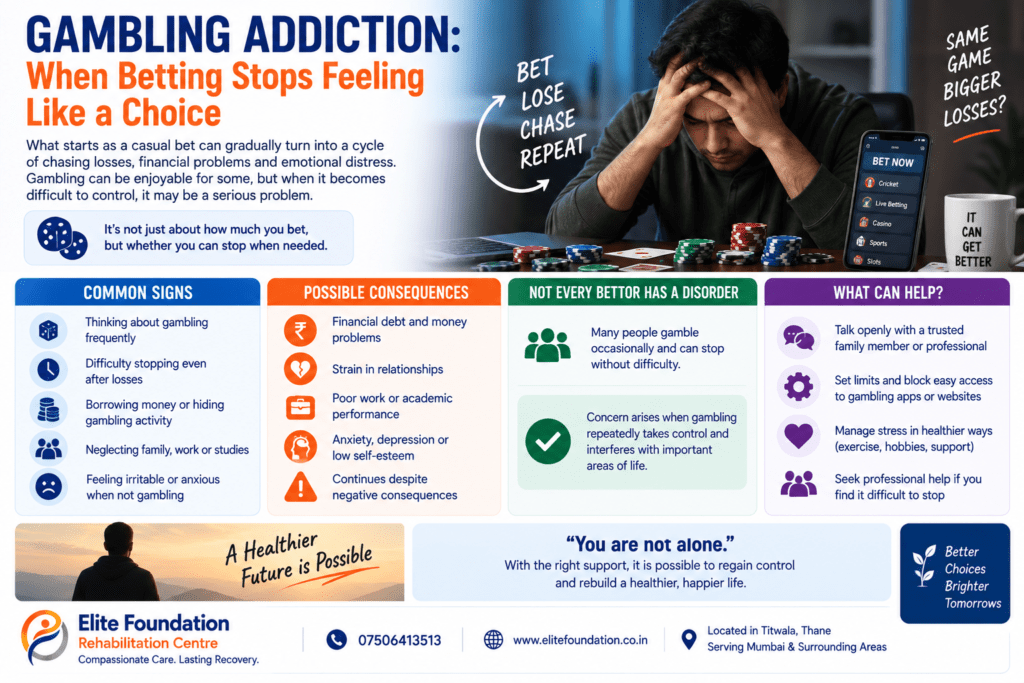
Gambling addiction does not always begin with somebody gambling every day or losing a life-changing amount of money in one night.
It may begin with a bet that feels harmless.
Then another.
A loss follows.
The person believes the money can be recovered.
Another bet is placed.
More money is lost.
Savings begin disappearing. Borrowing starts. Losses are hidden. Family members hear explanations that no longer quite add up.
Eventually, gambling may stop feeling like entertainment and start feeling like something the person has to continue.
The cycle can look like this:
betting → loss → chasing the loss → borrowing → hiding → more gambling → greater financial and relationship harm.
That progression is important because Gambling Disorder is not simply defined by how much somebody bets.
The more important questions are:
Can the person control the gambling?
Has gambling started taking priority over other parts of life?
Does the person continue even when the consequences are becoming obvious?
Families approaching Elite Care FOundation may sometimes be facing a behavioural rather than substance-related addiction. Where betting has become persistently difficult to control, gambling addiction treatment should examine far more than the last amount lost. Assessment may need to look at the pattern of gambling, loss chasing, debt, access to money, emotional triggers, secrecy, relationships, work, sleep and any mental-health or substance-use difficulty occurring alongside it.
This is the central question for the entire article:
When does betting stop being a choice someone is making occasionally and become a pattern they are repeatedly failing to control?
What is gambling addiction?
Gambling addiction is a widely used public term.
The clinically recognised condition is Gambling Disorder.
The World Health Organization describes Gambling Disorder around three central features:
- Impaired control over gambling
- Increasing priority given to gambling so that it takes precedence over other interests and everyday activities
- Continuation or escalation of gambling despite negative consequences
The pattern must also be serious enough to produce significant distress or impairment in important areas of life.
Gambling Disorder can involve predominantly online gambling, predominantly offline gambling or a combination of the two.
ICD-11 generally expects the pattern to have been evident over an extended period, commonly around 12 months, although a shorter duration may be considered when all diagnostic requirements are met and symptoms are severe.
That framework immediately tells us something important:
losing money is not, by itself, the diagnosis.
Someone can lose money gambling without having Gambling Disorder
Consider two people.
Person A places a ₹1,000 bet during a sporting event.
They lose.
They are disappointed.
But they decide:
“That’s enough. I’m not putting more money into this.”
They stop.
Person B also loses ₹1,000.
But the loss creates a different response:
“I need to get that ₹1,000 back.”
They deposit another ₹2,000.
That is lost too.
Now the target changes:
“I need to recover ₹3,000.”
The person continues even though the original intention was to make one small bet.
The important difference is not merely the amount lost.
It is what happens after the loss.
The gambling cycle: how one loss can become a much larger problem
Gambling problems often become easier to understand when viewed as a sequence rather than as isolated bets.
| Stage | What may happen | Possible thought |
|---|---|---|
| Initial betting | Gambling feels recreational or exciting | “I’ll try one bet.” |
| Loss | Money is lost | “That was unlucky.” |
| Chasing | Another bet is placed to recover the loss | “I’ll win it back.” |
| Escalation | Deposits or stakes increase | “A small win won’t be enough now.” |
| Borrowing | Available money is exhausted | “I only need one more chance.” |
| Secrecy | Losses and debts are hidden | “I’ll tell them after I recover it.” |
| Harm | Debt, conflict, stress and impaired functioning grow | “I need a big win to fix this.” |
The final stage creates a dangerous psychological reversal.
Gambling caused the financial problem.
But gambling now begins to feel like the only possible solution to that problem.
Chasing losses is one of the most important gambling warning signs
Chasing losses means continuing or increasing gambling in an attempt to recover money that has already been lost.
Someone who loses ₹5,000 may think:
“If I make one more deposit and win, I can get back to zero.”
The next wager no longer feels like entertainment. It begins to feel like financial repair.
If more money is lost, the amount that apparently needs to be “recovered” becomes larger. The person may then increase stakes because a small win no longer feels sufficient.
The decision can gradually change from:
“Should I gamble?”
to:
“How do I recover my money?”
That change is central to understanding why gambling losses can escalate.
Debt can make stopping feel more urgent — but also psychologically harder
From outside the situation, increasing debt appears to provide an obvious reason to stop gambling.
Inside the gambling cycle, it can create a different thought:
“My normal income cannot fix this quickly. I need a big win.”
The person may be trying to replace savings, repay borrowing or hide the problem before a spouse or family member discovers it.
Gambling then becomes imagined as an escape route from a financial problem created by gambling itself.
A previous loss does not make the next win more likely
A common thought is:
“I have lost so many times that I must be due a win.”
This is related to the gambler’s fallacy.
In situations involving independent uncertain outcomes, previous losses do not create a debt that future outcomes are required to repay.
Needing a win does not make that win more likely.
There is no guaranteed “recovery bet”
Someone facing gambling debt may begin searching for:
- A sure bet
- A safer match
- A guaranteed tip
- A high-confidence prediction
- A final opportunity
The financial need may be genuine.
The wager remains uncertain.
The fact that someone urgently needs ₹2 lakh does not turn an uncertain bet into a reliable way of producing ₹2 lakh.
A recovery plan has to separate:
the money already lost
from:
the decision whether to gamble again.
Borrowing can transform gambling losses into longer-term debt
When personal money runs out, borrowing may begin.
Funds may come from:
- Friends
- Family members
- Credit cards
- Personal loans
- Salary advances
- Other credit sources
The borrowing may be rationalised as temporary:
“Once I win, I will repay everyone.”
If the borrowed money is also lost, the person now faces both the original gambling loss and a new debt.
Why people begin hiding gambling
Secrecy frequently develops because the person believes the problem can still be repaired before anybody discovers it.
They may hide:
- Bank statements
- Loan messages
- Credit-card balances
- Borrowing
- Salary use
- Payment notifications
The underlying belief may remain:
“Once I recover everything, nobody needs to know.”
Repeated secrecy about losses, borrowing and gambling frequency is therefore important information even before a formal diagnosis has been made.
Online gambling can compress the entire cycle into a much shorter period
Traditional gambling often required somebody to travel to a particular place.
Online gambling can potentially place the opportunity to bet on the same device used for:
- Banking
- Payments
- Work
- Communication
This matters because the sequence can become:
lose → deposit → bet again
with very little natural pause.
The availability of online gambling should not be presented as proof that technology causes Gambling Disorder.
But reduced distance between an urge and another wager can be clinically relevant for someone who already struggles to stop.
The gambling environment can also make stopping harder
Gambling problems should not be explained entirely as a failure of individual willpower.
The environment in which gambling occurs can matter too.
Online gambling can provide rapid access to repeated wagering, while advertising, promotions, sporting associations and repeated gambling cues can keep betting highly visible.
The World Health Organization highlights easy accessibility, high-intensity gambling products, online availability and aggressive promotion as important contributors to gambling-related harm.
This does not mean everybody exposed to gambling advertising or an online betting platform will develop Gambling Disorder.
It means assessment should consider both:
the person’s vulnerabilities and behaviour
and:
the gambling environment repeatedly surrounding that behaviour.
Recovery may therefore involve not only changing thoughts and decisions, but also reducing exposure to gambling applications, advertising, notifications, payment access and other high-risk cues.
Online and offline Gambling Disorder are both recognised
ICD-11 allows Gambling Disorder to be specified as predominantly online or predominantly offline.
The diagnosis is not determined by whether the gambling took place:
- On a phone
- On a computer
- At a physical venue
- Through another gambling setting
The central pattern remains impaired control, priority, persistence despite harm and significant functional impairment.
Gambling Disorder and Gaming Disorder are not the same condition
“Gaming” and “gambling” are sometimes used interchangeably in everyday conversation.
Clinically, they refer to different behaviours.
Gambling involves staking money or something of value on an uncertain outcome with the possibility of obtaining something of greater value.
Gaming refers to playing video games.
A person may have Gaming Disorder without gambling money.
A person may have Gambling Disorder without being interested in ordinary video games.
The separate article on Gaming Disorder and gaming addiction explains that distinction in greater depth.
What are the signs of gambling addiction?
Possible warning signs include:
- Gambling with more money than intended
- Gambling for longer than intended
- Repeated inability to stop
- Repeated failed attempts to reduce gambling
- Chasing losses
- Increasing stakes
- Making repeated deposits during one session
- Borrowing money to gamble
- Using money intended for essential expenses
- Hiding gambling from family
- Lying about losses
- Thinking constantly about bets or gambling opportunities
- Gambling when distressed
- Missing work or responsibilities
- Continuing despite financial harm
- Continuing despite serious family conflict
No single sign independently establishes Gambling Disorder.
The overall pattern matters.
Financial harm can occur before someone meets the full threshold for Gambling Disorder
This distinction is extremely important.
WHO notes that gambling-related harm can occur below the clinical threshold for Gambling Disorder.
Someone does not need to wait for a formal psychiatric diagnosis before taking the following seriously:
- Rent money being gambled
- School fees being affected
- Household bills being missed
- Family savings disappearing
- Loans accumulating
- A relationship deteriorating over hidden gambling
Early harm still deserves intervention.
What does international research tell us about how common gambling problems are?
A 2024 systematic review and meta-analysis published in The Lancet Public Health examined representative gambling data from 68 countries and territories.
Across the included adult populations, researchers estimated that:
- 46.2% had gambled during the previous 12 months
- 8.7% were classified as engaging in some level of risk gambling
- 1.41% were engaging in problematic gambling
Problematic-gambling rates were particularly high among people participating in online casino or slot-style gambling.
These figures need context.
The underlying studies used different populations and measures, and much of the available evidence came from high-income countries.
The results should therefore not be used as a precise prevalence estimate for India.
What does Indian research show?
India still does not have the same depth of population-level gambling epidemiology available in some other countries.
One useful but older Indian study examined college students in Ernakulam district, Kerala.
The cross-sectional study included 5,580 completed questionnaires from students across 58 colleges.
In that specific sample:
- 19.5% reported having ever gambled
- 7.4% screened as having problem gambling
Problem gambling was also associated with higher psychological distress, substance use and several other difficulties in that sample.
But these results should not be presented as:
“7.4% of Indians have Gambling Disorder.”
The study:
- Was conducted in one district
- Involved college students
- Was cross-sectional
- Measured problem gambling rather than providing a national clinical prevalence estimate
- Is now more than a decade old
It is useful Indian evidence.
It is not a nationwide prevalence survey.
Gambling may become a way of escaping another problem
Not everyone gambles mainly because they believe they will become wealthy.
Some people begin gambling more frequently when they feel:
- Stressed
- Lonely
- Bored
- Angry
- Depressed
- Anxious
For a period of time, gambling can occupy almost all available attention.
The person is focused on:
- The match
- The odds
- The next result
- The possible payout
The original emotional problem temporarily moves out of awareness.
If the person loses money, however, they may finish the session with:
the original stress + a new financial problem.
A gambling-and-stress cycle can develop
The pattern may become:
stress → gambling → temporary absorption → loss → greater stress → gambling again.
This does not mean stress automatically causes Gambling Disorder.
It means emotional triggers should be examined when gambling repeatedly becomes a person’s preferred way of escaping distress.
Sudden extreme gambling can sometimes have another clinical explanation
A sudden major increase in gambling should not automatically be labelled Gambling Disorder without considering the wider clinical picture.
For example, unusually risky gambling or spending can occur during mania or hypomania, particularly when it appears alongside changes such as:
- Markedly reduced need for sleep
- Unusually elevated or very irritable mood
- Racing thoughts
- Unusually rapid speech
- Grandiose plans or unrealistic confidence
- Several other risky or uncharacteristic behaviours
Some prescribed medicines can also contribute to impulse-control problems in susceptible individuals. Current NICE guidance on gambling-related harms highlights the importance of considering medicines that can affect impulse control, including dopamine agonists used in Parkinson’s disease and, in some circumstances, aripiprazole.
If gambling begins suddenly or changes dramatically after a medicine has been started, stopped or changed, the prescribing clinician should be informed.
Do not stop prescribed medication abruptly without medical advice.
The appropriate treatment may be different when gambling behaviour is occurring as part of another psychiatric or medication-related problem.
Depression and gambling problems can occur together
The relationship can operate in more than one direction.
Someone experiencing depression may gamble because they want:
- Excitement
- Escape
- Distraction
- A hoped-for financial solution
At the same time, gambling losses can contribute to:
- Shame
- Debt
- Relationship conflict
- Fear
- Hopelessness
Depression therefore deserves assessment in its own right rather than automatically being labelled a consequence of gambling.
Gambling harm and suicide risk require particular caution
WHO identifies suicide among the serious harms associated with gambling and also highlights financial stress, relationship breakdown and mental-health problems.
Suicidal thoughts in somebody facing severe gambling debt should never be dismissed as:
“They are only upset because they lost money.”
Suicide risk is complex and can involve several interacting factors.
But serious debt, shame, fear of disclosure and relationship breakdown can create an extremely distressing situation.
If somebody expresses suicidal intent, has a suicide plan, has recently attempted suicide, cannot remain safe or is otherwise in immediate danger, emergency mental-health care should take priority over discussions about gambling debt.
In India, Tele-MANAS can be reached on 14416 for mental-health support. Immediate danger requires emergency services or the nearest appropriate emergency department.
How gambling begins to take priority over the rest of life
WHO’s second central feature of Gambling Disorder is increasing priority.
This may appear gradually.
The person may begin:
- Checking odds during work
- Betting during family events
- Staying awake for gambling opportunities
- Thinking about gambling during conversations
- Using salary day as a gambling trigger
- Choosing gambling over previous hobbies
- Planning how to obtain the next stake
The issue is not merely time.
It is what gambling is beginning to replace.
Continuing despite consequences is different from not knowing the consequences
Many people with serious gambling problems already understand what is happening.
They may know:
“I am losing too much.”
“My spouse no longer trusts me.”
“I cannot afford another bet.”
“I promised I would stop.”
Yet the behaviour continues.
That is clinically more meaningful than simply asking whether the person knows gambling can be harmful.
Repeated failed attempts to stop are important
A person may repeatedly tell themselves:
“This is the last time.”
They stop for three days.
A sporting event starts.
They place another bet.
After another loss:
“Now I really have to stop.”
Then salary arrives.
Gambling begins again.
A repeated pattern of intending to stop but being unable to maintain that change deserves closer attention.
Why telling someone to “just use willpower” can miss the problem
By the time Gambling Disorder is established, the person may have attempted to stop many times.
The difficulty can involve:
- Loss chasing
- Emotional triggers
- Gambling-related beliefs
- Easy access to money
- Established routines
- Secrecy
- Shame
- Debt pressure
A useful treatment plan works on these mechanisms rather than simply repeating:
“Don’t gamble.”
How to stop gambling addiction: the first priority is stopping further financial damage
When loss chasing is active, the person may still be thinking:
“I cannot stop until I recover some of this.”
The recovery direction has to change.
From:
“How do I win back the money?”
to:
“How do I prevent another rupee from being lost and deal with the debt that already exists?”
Depending on the person’s circumstances, early steps may include:
- Stopping further deposits immediately
- Using formal self-exclusion from gambling services where available
- Using blocking software or device-level tools to reduce access to online gambling
- Blocking gambling-related promotional messages and notifications
- Using gambling-payment blocks through a bank or payment provider where such tools are available
- Reducing access to unrestricted credit
- Protecting money needed for food, housing, school fees, medical care and other essential expenses
- Where appropriate and agreed, involving a trustworthy person in temporary financial safeguards
- Disclosing the gambling problem to at least one trustworthy person rather than continuing in secrecy
- Documenting the complete financial position, including loans, cards and informal borrowing
- Identifying situations, emotions and events that repeatedly trigger gambling
- Seeking professional assessment when repeated self-directed attempts to stop have failed
The aim is to make another impulsive gambling episode harder to carry out while the underlying behaviour and financial consequences are being addressed.
Debt should be treated as a real financial problem, not a gambling target
Psychological treatment cannot erase money that has already been lost.
Existing debt may include:
- Bank loans
- Credit cards
- Personal borrowing
- Money owed to friends
- Money owed to relatives
- Unpaid household expenses
The purpose of documenting it is not humiliation.
It is to replace:
“I don’t even know how bad this is.”
with an accurate financial picture.
Family members should be careful about repeatedly financing gambling losses
A parent or spouse may understandably want to rescue the person from immediate financial consequences.
Sometimes essential household finances do need protection.
But giving unrestricted money without addressing the gambling pattern can restart the same cycle.
Useful family principles may include:
- Protect essential household spending
- Understand the complete debt
- Check whether additional borrowing exists
- Avoid giving cash intended for another “recovery bet”
- Set clear financial boundaries
- Encourage appropriate treatment
- Avoid public humiliation and character attacks
The wider guide on family support during addiction recovery explains why support and boundaries often need to operate together.
What does gambling addiction treatment actually involve?
WHO identifies psychological approaches including cognitive behavioural therapy and motivational interviewing among the treatments with the strongest current evidence for Gambling Disorder.
A systematic review and meta-analysis of cognitive-behavioural techniques included 29 studies involving 3,991 participants.
At the end of treatment, CBT-based approaches were associated with reductions in Gambling Disorder severity, gambling frequency and gambling intensity compared with control conditions.
However, the authors also found:
- High heterogeneity between studies
- Evidence of publication bias
- No significant overall effect at follow-up in the analyses reported
The appropriate conclusion is therefore:
CBT is a promising and important evidence-based approach, but no treatment should be presented as a guaranteed cure for every person.
A gambling relapse should trigger a plan, not another attempt to win the money back
Someone may stop gambling for several weeks or months and then place another bet.
That lapse can produce shame and panic.
A particularly dangerous reaction is:
“I have already ruined everything, so I may as well keep gambling and try to recover today’s loss.”
That turns one lapse into another episode of loss chasing.
A better response is to stop the gambling episode as quickly as possible, restore financial and access safeguards, identify what triggered the lapse and reconnect with treatment or support.
A lapse does not erase previous progress, but it should be taken seriously and used to strengthen the relapse-prevention plan.
If relapse occurs alongside severe hopelessness, suicidal thoughts or an immediate safety concern, mental-health assessment takes priority over discussions about the money lost.
Treatment should look beyond gambling frequency
A useful assessment may examine:
- How gambling began
- How often gambling occurs
- How much is being lost
- Loss chasing
- Repeated failed attempts to stop
- Gambling-related beliefs
- Online access
- Credit and borrowing
- Debt
- Secrecy
- Family conflict
- Work functioning
- Sleep
- Depression
- Anxiety
- Bipolar symptoms or other major mood changes
- Medicines that may affect impulse control
- Alcohol or other substance use
- Suicidal thoughts or behaviour
The last gambling session may simply be the event that exposed a problem that had been developing for months or years.
Gambling addiction does not have a substance detox
Gambling Disorder is a behavioural addiction.
There is no gambling substance that has to be medically removed from the body in the way alcohol, opioids or certain sedative drugs may require medically supervised withdrawal management.
A person reducing or stopping gambling may still experience:
- Strong urges
- Restlessness
- Irritability
- Anxiety
- Difficulty knowing what to do with previously gambling-related time
Those experiences can be clinically important.
They should not be described as the same physiological withdrawal process seen with dependence on certain substances.
Residential rehabilitation is not automatically required for every gambling problem
The level of care should match the individual’s needs.
Some people may improve with outpatient psychological or psychiatric treatment combined with strong financial safeguards and family support.
More structured care may be considered where there is:
- Severe and repeated loss of control
- Very substantial financial harm
- Repeated relapse despite outpatient treatment
- Serious co-occurring alcohol or drug problems
- Major psychiatric difficulties
- An unsafe or highly destabilising home environment
The word “addiction” should therefore not automatically be translated into:
“Everyone needs residential rehab.”
Stopping gambling is only the beginning of financial recovery
After gambling stops, there may still be:
- Debt
- Damaged trust
- Relationship conflict
- Work problems
- Anxiety
- Depression
- Financial commitments
Recovery therefore has two connected tasks:
- Prevent further gambling harm
- Repair the consequences that already exist
Stopping the bets does not instantly rebuild trust or eliminate debt.
Those areas usually need their own plan.
A practical gambling self-check
Ask yourself:
- Do I repeatedly gamble more than I intended?
- Do I gamble for longer than planned?
- Do I keep gambling mainly because I want to recover previous losses?
- Have I borrowed money to gamble?
- Have I hidden the amount I lost?
- Have I lied about gambling?
- Have I used money intended for another important purpose?
- Have I seriously tried to stop but repeatedly returned?
- Do I think about gambling for large parts of the day?
- Has gambling affected work, sleep or relationships?
- Do I continue even though I know gambling is harming me?
Several “yes” answers do not independently establish a diagnosis.
They indicate that the pattern deserves closer assessment.
Frequently asked questions
What is gambling addiction?
Gambling addiction is the common public term for gambling that becomes persistently difficult to control and continues despite significant harm. Gambling Disorder is the clinically recognised diagnosis.
What is Gambling Disorder?
WHO’s ICD-11 describes Gambling Disorder through impaired control over gambling, increasing priority given to gambling and continuation or escalation despite negative consequences, with significant distress or impairment in important areas of functioning.
Is compulsive gambling the same as Gambling Disorder?
“Compulsive gambling” is a commonly used term. Gambling Disorder is the current clinical diagnostic term. People searching for compulsive gambling are generally describing a difficult-to-control gambling pattern rather than obsessive-compulsive disorder.
What is problem gambling?
Problem gambling is a broader term used for gambling that is causing harm or difficulty. Someone can experience serious gambling-related harm without necessarily meeting all diagnostic requirements for Gambling Disorder.
What are the signs of gambling addiction?
Possible signs include repeated difficulty stopping, chasing losses, increasing bets, repeated deposits, borrowing, hiding losses, lying about gambling, using essential money, preoccupation and continuing despite financial or relationship harm.
Why do gamblers keep gambling after losing money?
Loss chasing is one important reason. A person may begin viewing another wager as a way to repair money already lost. Debt pressure, gambling-related beliefs, previous gambling experiences and emotional triggers can also contribute.
What does chasing losses mean?
Chasing losses means gambling again or increasing gambling in an attempt to recover previous losses.
Why is chasing losses dangerous?
Each additional wager creates another opportunity for loss. As the financial deficit grows, the person may increase stakes because a smaller win no longer feels sufficient to repair it.
Is it better to gamble again and recover the loss before stopping?
No gambling outcome can be guaranteed to recover previous losses. Continuing to gamble can increase the existing financial damage.
Why do gamblers borrow money?
Some people borrow because they believe one future win will allow them to recover previous losses and repay the loan. If borrowed money is also lost, debt increases further.
Why do gamblers hide losses?
Fear, shame and the belief that the money can be recovered before anyone discovers the problem can contribute to secrecy.
Can gambling addiction cause debt?
Yes. Repeated losses, loss chasing, increasing stakes and borrowing can lead to serious financial harm.
Can someone have gambling problems without Gambling Disorder?
Yes. WHO notes that gambling-related harm can occur below the diagnostic threshold. Financial, family or psychological harm deserves attention even if a person has not received a Gambling Disorder diagnosis.
Is sports betting gambling?
Betting money or something of value on an uncertain sporting outcome with the possibility of gaining a return is a form of gambling.
Can cricket betting become addictive?
A person can develop a Gambling Disorder pattern involving cricket betting if betting becomes persistently difficult to control, increasingly takes priority and continues despite significant consequences.
Is online gambling more addictive than offline gambling?
Online access can reduce the delay between an urge, deposit and another wager and can provide repeated gambling opportunities. However, Gambling Disorder can occur with both online and offline gambling, and the platform alone does not establish the diagnosis.
Is gambling addiction the same as gaming addiction?
No. Gambling involves staking something of value on uncertain outcomes. Gaming Disorder concerns difficult-to-control video gaming. ICD-11 recognises Gambling Disorder and Gaming Disorder as separate disorders due to addictive behaviours.
Can gambling addiction cause depression?
Gambling problems and depression can occur together. Gambling losses and debt may contribute to psychological distress, while some people who are already depressed may use gambling as an escape. The relationship should not be reduced to simple one-way causation.
Can sudden gambling be related to mania?
Unusually risky gambling or spending can occur during mania or hypomania, particularly when it begins suddenly alongside markedly reduced need for sleep, elevated or very irritable mood, racing thoughts, unusual confidence or other major behavioural changes. Such a pattern requires appropriate clinical assessment rather than automatically being labelled Gambling Disorder.
Can medication sometimes contribute to gambling problems?
Yes. Certain prescribed medicines can contribute to impulse-control problems in susceptible individuals, including some dopamine agonists used in Parkinson’s disease and, in some circumstances, aripiprazole. A sudden change in gambling after a medicine is started or changed should be discussed with the prescribing clinician. Prescribed medication should not be stopped abruptly without medical advice.
Is gambling addiction associated with suicide?
WHO recognises suicide among the serious harms associated with gambling. Suicidal thinking is multifactorial and requires appropriate clinical assessment rather than being attributed automatically to one cause.
Can gambling addiction be treated?
Yes. Psychological treatments are available. WHO identifies cognitive behavioural therapy and motivational interviewing among the approaches with the strongest evidence, although individual response varies and treatment should be tailored to the person.
Does gambling addiction need medication?
There is currently no medication specifically approved as a standard cure for Gambling Disorder, and psychological treatment remains central.
However, medication research is not limited only to treating other psychiatric conditions. Opioid-antagonist medicines such as naltrexone and nalmefene have shown some evidence of benefit for Gambling Disorder itself.
A systematic review and network meta-analysis of pharmacological treatments for Gambling Disorder found that nalmefene and naltrexone had the strongest supportive evidence among the medicines studied, while also identifying tolerability concerns and limitations in the evidence.
NICE guidance allows specialist consideration of off-label naltrexone when an appropriate course of psychological therapy has not produced sufficient improvement or when repeated relapse continues.
The evidence remains more limited than for psychological approaches, these medicines are not suitable for everyone and they require proper medical assessment and monitoring.
Medication may also be required separately when depression, anxiety, bipolar disorder, ADHD or another clinically diagnosed condition is present.
No gambling medication should be started or used without an appropriately qualified clinician.
Does gambling addiction require rehab?
Not in every case. Many people can receive outpatient treatment. Residential or highly structured care may be considered when gambling is severe, repeated outpatient attempts have failed, co-occurring conditions are significant or the person’s circumstances require greater structure.
How can I stop gambling addiction?
Stopping further financial exposure is an early priority. Practical safeguards may include formal self-exclusion, gambling-site blocking, marketing blocks, gambling-payment blocks where available, tighter control of credit, protection of essential household money, disclosure to someone trustworthy and professional assessment when attempts to stop repeatedly fail.
What should I do after a gambling relapse?
Stop the gambling episode as soon as possible rather than trying to recover the new loss. Restore access and financial safeguards, identify the trigger and reconnect with treatment or support. Severe hopelessness, self-harm thoughts or suicide risk require prompt mental-health assessment.
Should family members give money to clear gambling losses?
Every financial situation is different. Families should protect essential expenses and be cautious about giving unrestricted money that could be gambled again. Significant debt may require financial advice alongside psychological treatment.
When should professional help be considered?
Professional assessment becomes particularly important when gambling repeatedly feels impossible to control, loss chasing continues, debt or borrowing is increasing, gambling is being hidden, family or work functioning is deteriorating, or serious attempts to stop repeatedly fail.
When betting stops feeling like a choice
A person may begin gambling because it feels exciting.
They may continue because they hope to make money.
But after enough losses, the reason for gambling can change.
The person is no longer necessarily trying to win something new.
They are trying to undo what already happened.
Debt creates urgency.
Shame encourages secrecy.
Borrowing creates another financial obligation.
Advertising, easy access and repeated gambling cues may keep the behaviour close at hand.
Another bet begins to feel less like a choice and more like the only available exit.
That is the point where the family should stop asking only:
“Why don’t you simply stop gambling?”
and start asking:
“What is keeping this cycle going despite everything it is costing?”
The money already lost needs a financial plan.
The gambling behaviour needs a psychological and behavioural plan.
The environment around gambling may need practical restrictions.
Any depression, anxiety, major mood change, medication-related concern, substance use or suicide risk needs its own assessment.
Relapse needs a response plan rather than another recovery bet.
Trust may need to be rebuilt separately.
Another wager cannot reliably perform all of those jobs.
Medical disclaimer: This article provides general educational information and does not replace individual psychological, psychiatric, medical, financial or legal assessment. Gambling-related debt and severe psychological distress can create serious safety risks. Sudden major changes in gambling, mood, sleep or behaviour may require assessment for other psychiatric or medication-related causes. Do not stop prescribed medication abruptly without medical advice. Suicidal thoughts require prompt professional assessment. Suicidal intent, a suicide plan, a recent attempt, inability to remain safe or another immediate danger requires urgent emergency care.
