
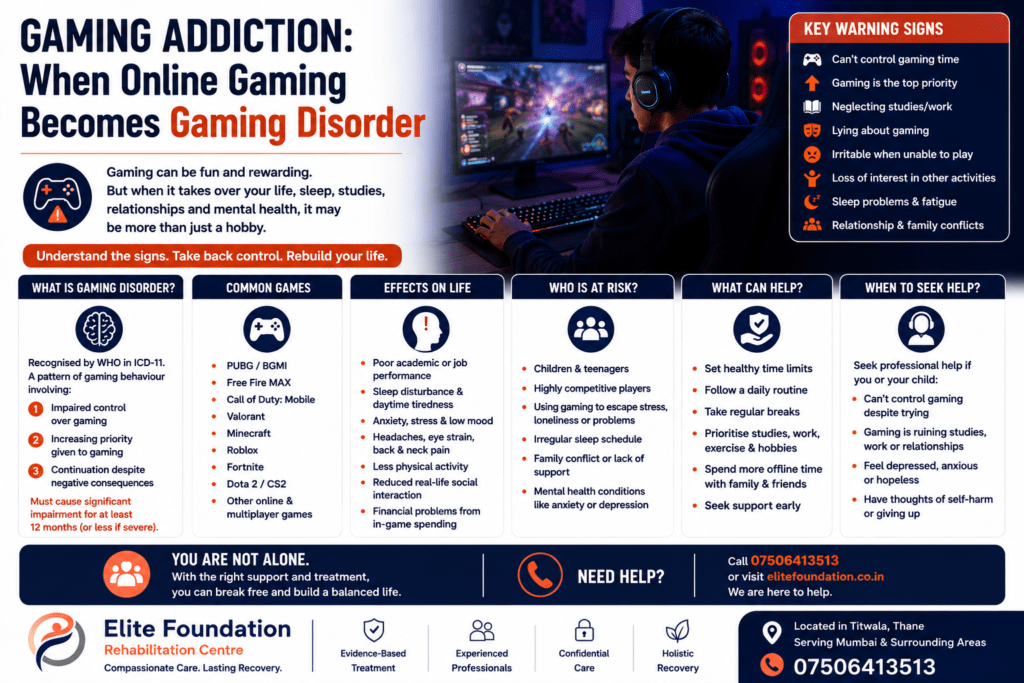
Gaming addiction is a phrase people often use when online or video gaming begins taking priority over sleep, studies, work, relationships or other parts of everyday life. Families approaching a nasha mukti kendra in India may sometimes be seeking help for a behavioural rather than substance-related problem. Where gaming has become persistently difficult to control, gaming addiction treatment should assess the pattern of play, its consequences, sleep, education or employment, family circumstances and any mental-health condition occurring alongside it.
Gaming itself is not a disorder. Millions of people play BGMI, Free Fire MAX, Call of Duty: Mobile, Minecraft, Roblox, Fortnite, Valorant and other games for entertainment, competition, creativity or friendship without developing Gaming Disorder.
The important distinction is not simply which game someone plays or how many hours they play. It is whether control over gaming has become impaired, gaming is increasingly taking priority over other important activities, and play continues despite significant negative consequences.
Unlike many informal terms used around digital behaviour, Gaming Disorder has an important clinical distinction: it is recognised by the World Health Organization in ICD-11.
What is gaming addiction?
Gaming addiction is the phrase most people search for when gaming feels increasingly difficult to control.
It may involve:
- Mobile games
- PC games
- Console games
- Online multiplayer games
- Battle royale games
- Competitive games
- Role-playing games
- Sandbox or creation-based games
In clinical contexts, however, the recognised term Gaming Disorder is more precise.
The broader guide on digital addiction in India explains why problematic gaming should also be distinguished from compulsive smartphone use, social-media use and other digital behaviours.
What is Gaming Disorder?
The World Health Organization recognises Gaming Disorder in ICD-11.
WHO describes the disorder through three central features:
- Impaired control over gaming — difficulty controlling when gaming starts, how often it occurs, how intense it becomes, how long it lasts or when it stops.
- Increasing priority given to gaming — gaming begins taking precedence over other interests and everyday activities.
- Continuation or escalation despite negative consequences — the person keeps gaming even though meaningful harm is occurring.
The pattern must be severe enough to produce significant impairment in personal, family, social, educational, occupational or another important area of functioning.
WHO states that the behaviour would normally have been evident for at least 12 months, although the required duration may be shorter when all diagnostic requirements are met and symptoms are severe.
Gaming Disorder is not simply “playing too much”
This is where many families understandably become confused.
A teenager may spend several hours playing during a holiday, tournament or weekend without having Gaming Disorder.
An adult may spend a long evening gaming with friends and still:
- Go to work normally
- Sleep adequately
- Maintain relationships
- Exercise
- Stop gaming when responsibilities require it
Another person may play fewer hours overall but repeatedly fail to stop even when gaming is causing serious problems.
| Area | Heavy but controlled gaming | Possible Gaming Disorder |
|---|---|---|
| Control | Can stop when necessary | Repeatedly struggles to control starting, duration or stopping |
| Priority | Gaming remains one interest among several | Gaming increasingly displaces important activities |
| Consequences | Responsibilities remain broadly intact | Gaming continues despite meaningful harm |
| Sleep | Can stop to protect necessary sleep | Repeatedly sacrifices sleep to continue gaming |
| School or work | Gaming fits around responsibilities | Gaming repeatedly interferes with attendance or performance |
Gaming addiction symptoms
Possible gaming addiction symptoms should be considered as a pattern rather than a checklist where one behaviour automatically proves a disorder.
Warning signs can include:
- Repeated difficulty stopping at the intended time
- Gaming substantially longer than planned
- Repeated unsuccessful attempts to reduce gaming
- Thinking about gaming throughout much of the day
- Gaming becoming more important than previous interests
- Regularly delaying sleep to continue playing
- Missing school, college or work because of gaming
- Leaving assignments or work unfinished
- Repeated conflict with family or partners about gaming
- Continuing despite recognising serious consequences
- Giving up sport, hobbies or social activities
- Hiding or minimising the true amount of gaming
- Returning quickly to the previous pattern after trying to cut back
No individual symptom independently establishes Gaming Disorder.
The pattern, persistence and degree of functional impairment matter.
Which games can be involved in problematic gaming?
Problematic gaming can develop around many different games. A particular title should not itself be labelled “addictive”, because simply playing that game does not establish Gaming Disorder.
Games currently relevant to gaming conversations among Indian and international players include:
- BGMI — Battlegrounds Mobile India
- Free Fire MAX
- Call of Duty: Mobile
- Roblox
- Minecraft
- Fortnite
- Valorant
- Grand Theft Auto Online
- EA Sports FC
- Other competitive, multiplayer and persistent online games
The clinical question remains the same regardless of the title:
Can the person control their gaming, and what is happening to the rest of their life?
Is BGMI addiction the same as Gaming Disorder?
“BGMI addiction” is a common way people describe difficulty controlling Battlegrounds Mobile India.
But playing BGMI frequently does not itself establish Gaming Disorder.
Concern increases when the person repeatedly:
- Cannot stop after intending to finish
- Plays through the night
- Misses study or work
- Gives up previous activities
- Continues despite serious consequences
The same principle applies to searches such as PUBG addiction, Free Fire addiction, Roblox addiction or Fortnite addiction.
Free Fire addiction: the game name is not the diagnosis
A parent may say:
“My child is addicted to Free Fire.”
That statement describes the parent’s concern, but an assessment still needs to identify what is actually happening.
For example:
- How long does the child play?
- Can they stop at an agreed time?
- Is sleep being sacrificed?
- Has school attendance changed?
- Have other activities disappeared?
- Are there repeated unsuccessful attempts to cut back?
The game matters because it tells us where the behaviour occurs. It does not provide the diagnosis by itself.
Why online games can become difficult to leave
Many modern games are not designed as isolated sessions with one obvious ending.
Players may be involved in:
- Matches
- Ranks
- Teams or squads
- Clans or guilds
- Seasonal events
- Progression systems
- Unlockable rewards
- Competitive ladders
- Regular updates
Stopping may therefore involve more than turning off entertainment.
The player may feel they are:
- Leaving teammates behind
- Giving up progress
- Missing an event
- Losing rank
- Falling behind friends
These experiences help explain why some gaming sessions are harder to end than watching a programme with a fixed final scene.
“Just one more match” can become another hour
A familiar pattern is:
“I’ll stop after this match.”
The player loses.
Now they want one more match to finish on a win.
Or they win.
Now they want another because the session is going well.
Either outcome can create another reason to continue.
The important issue is not that wanting another match is abnormal. Concern begins when this repeatedly overrides the person’s own intention to stop and causes significant consequences.
Online gaming addiction and sleep
Gaming can become particularly disruptive when play extends into the night.
A session may begin after dinner with an intention to finish by 11 p.m.
Then:
- A match lasts longer than expected.
- Friends want another game.
- The player wants to recover a lost rank.
- Another event becomes available.
- Midnight passes.
- Gaming continues.
If school, college or work still begins at the same time the next morning, available sleep becomes shorter.
Gaming late at night may become visible the next day
Families may notice:
- Difficulty waking
- Repeated lateness
- Morning irritability
- Falling asleep during class
- Reduced concentration
- Missing breakfast
- Sleeping for long periods during the day
- Large weekend shifts in sleeping time
Gaming should not automatically be blamed for every sleep problem. Anxiety, depression, insomnia, medicines, academic pressure and irregular routines can also affect sleep.
The useful question is whether gaming is repeatedly postponing sleep even when the person intends to stop.
Gaming addiction and studies
Students can experience two different problems.
The first is time displacement.
Three hours of gaming may directly replace three hours that were intended for assignments or revision.
The second is fragmentation.
A student may technically study for an hour but repeatedly:
- Check gaming messages
- Watch gaming streams
- Join a quick match
- Return to study
- Repeat the cycle
The study period exists on the clock but contains relatively little uninterrupted work.
Poor marks do not automatically prove gaming caused the problem
A student’s performance may also be affected by:
- ADHD
- Anxiety
- Depression
- Learning difficulties
- Bullying
- Academic pressure
- Poor sleep
- Family problems
Gaming may worsen the situation, provide escape from it, or both.
Removing the console or mobile may reduce one distraction while leaving the original educational or mental-health difficulty untreated.
Gaming addiction in teenagers
Gaming Disorder is particularly important to understand in younger people because gaming may occupy a large part of their social and recreational life.
A teenager may play because:
- Friends are online
- The team expects them
- Gaming provides competition
- They enjoy mastering the game
- The online group provides belonging
- They are bored
- Offline social situations feel difficult
Heavy gaming should therefore not automatically be treated as evidence that a teenager is addicted.
The parent-focused guide on phone addiction in teenagers explains why parents should look at sleep, education, relationships and loss of control rather than relying on screen time alone.
Signs parents may notice in a teenager
Parents may notice:
- Repeated gaming late into the night
- Difficulty getting up for school
- Arguments whenever gaming needs to stop
- Homework repeatedly left incomplete
- Previous hobbies disappearing
- Less interest in meeting friends offline
- Meals repeatedly skipped or delayed
- Gaming becoming the dominant topic of conversation
- Repeated promises to reduce gaming followed by rapid return to the same pattern
These signs deserve attention, but they still need context.
Anger when a game stops does not automatically mean Gaming Disorder
A player may become angry because:
- A competitive match was interrupted
- They lost
- A teammate made a mistake
- Internet connectivity failed
- A parent suddenly switched off the device
That reaction alone does not establish a disorder.
Concern increases when intense conflict is part of a persistent pattern involving loss of control and significant impairment in other areas of life.
Are gaming withdrawal symptoms dangerous?
When frequent gaming is interrupted, some people report:
- Irritability
- Restlessness
- Boredom
- Anxiety
- Strong urges to play
These experiences should not be confused with medically dangerous withdrawal from alcohol, benzodiazepines or certain other substances.
Gaming Disorder does not require a medical detoxification process comparable with alcohol or sedative withdrawal.
Gaming and mental health can influence each other
Gaming Disorder may occur alongside:
- ADHD
- Depression
- Anxiety
- Social anxiety
- Sleep problems
- Loneliness
The direction is not always simple.
A young person with social anxiety may find online gaming socially easier than meeting people face to face.
Someone experiencing depression may have little motivation for offline activities but still find gaming immediately engaging.
A person with ADHD may find a rapidly changing gaming environment easier to stay engaged with than a long academic task.
These conditions should be assessed rather than assuming gaming caused all of them.
Gaming may be a social activity, not isolation
A common parent statement is:
“He sits alone in his room gaming all evening.”
Physically, the teenager may be alone.
Socially, they may be speaking continuously with several friends.
This does not mean there is no problem.
It means assessment should distinguish:
- Complete social withdrawal
- Online social interaction
- Loss of offline relationships
They are not the same thing.
What if gaming is the person’s main friendship group?
Suddenly removing gaming can also mean suddenly removing access to friends.
For a teenager whose closest friendships exist through a game, this matters.
A reduction plan should therefore ask:
What social connection will remain when gaming time decreases?
The answer should not automatically be “none”.
Gaming Disorder and e-sports are not the same thing
Competitive gaming can involve:
- Long practice sessions
- Coaching
- Team schedules
- Tournaments
- Performance goals
High involvement alone does not establish Gaming Disorder.
A competitive player who maintains control, fulfils responsibilities and deliberately trains for competition may have a very different pattern from a player who repeatedly loses control and continues despite serious consequences.
Gaming Disorder is also different from gambling addiction
This distinction has become especially important in India.
Traditional video gaming and online money gaming should not automatically be treated as the same behavioural problem.
A game may focus primarily on:
- Entertainment
- Competition
- Skill
- Social interaction
Online money gaming involves a different financial dimension in which money or other stakes are placed with an expectation of monetary gain.
Someone can experience Gaming Disorder without gambling.
Someone can also have serious gambling-related problems without spending large amounts of time playing conventional video games.
India’s online gaming law makes this distinction important
India’s Promotion and Regulation of Online Gaming Act, 2025 distinguishes between e-sports, online social games and online money games.
The Act was enacted in August 2025 and came into force in April 2026.
It prohibits online money games while providing for recognition and promotion of e-sports and online social games.
The Government explained the legislation partly in response to concerns about compulsive money gaming, financial ruin and social distress.
This legal framework should not be confused with the WHO diagnosis of Gaming Disorder.
The law classifies types of online gaming activity.
ICD-11 describes a health disorder based on impaired control, priority and continuation despite negative consequences.
Not every competitive or paid game is gambling
Players may pay for:
- A game itself
- A subscription
- Cosmetic items
- Additional content
Payment alone does not automatically make every game an online money game.
The legal distinction depends on whether money or other stakes are placed in expectation of monetary gain and on the definitions in applicable law.
Families should also separate concerns about:
- Excessive gaming time
- Uncontrolled in-game spending
- Gambling
because these may require different responses.
How many hours of gaming is addiction?
There is no universal number of gaming hours that independently diagnoses Gaming Disorder.
For example, somebody may temporarily play very long hours during:
- A holiday
- A new game release
- A tournament
- A weekend with friends
and then return to their normal routine.
Another person may play fewer hours but repeatedly allow gaming to interfere with school, work, sleep and relationships.
WHO’s diagnostic framing therefore focuses on control and functional impairment, not a simple hours-per-day threshold.
A practical gaming addiction self-check
Ask:
- Do I repeatedly play much longer than I planned?
- Have I seriously tried to reduce gaming and repeatedly failed?
- Does gaming now take priority over activities that used to matter to me?
- Do I continue playing even though I recognise significant harm?
- Is gaming repeatedly interfering with sleep?
- Am I missing school, college or work because of gaming?
- Have important relationships deteriorated partly because of gaming?
- Do I hide the amount of time I spend gaming?
- Have most of my previous offline activities disappeared?
Several “yes” answers do not provide a diagnosis.
They suggest that a more detailed assessment may be worthwhile.
Can a gaming addiction test diagnose Gaming Disorder?
No online questionnaire should be treated as a standalone diagnosis.
Screening tools can help identify:
- Loss of control
- Priority given to gaming
- Consequences
- Functional impairment
But assessment still needs to consider age, context, duration, mental health, education or work, relationships and the person’s wider routine.
Gaming Disorder treatment
Treatment should be individualised rather than based simply on the game being played.
A 2025 systematic review of Gaming Disorder treatment in children and adolescents identified 30 studies involving 2,157 participants. Interventions based on or combined with cognitive behavioural therapy were the most frequently studied.
The review found promising results across several interventions but also highlighted important limitations. The quality of evidence was inconsistent, many studies lacked strong randomisation or control groups, longer-term follow-up was often missing and 19 different assessment tools were used across the included studies.
This means treatment should not be presented as one guaranteed programme that works identically for every person.
What treatment may involve
Depending on the individual, treatment may include:
- Detailed assessment of gaming behaviour
- Identifying gaming triggers
- Cognitive behavioural strategies
- Motivational work
- Improving sleep routines
- Rebuilding offline activities
- Managing gaming-related cues
- Family involvement when appropriate
- Treatment of ADHD, anxiety, depression or another co-occurring condition
- Follow-up to monitor whether functional control is improving
Does Gaming Disorder treatment mean never gaming again?
Not necessarily.
The appropriate goal depends on the person and severity of the problem.
For some, a temporary break may help interrupt a severe pattern.
For others, treatment may work towards structured, controlled gaming.
A clinician should consider:
- Severity
- Previous attempts to reduce gaming
- Triggers
- Age
- Family environment
- Whether the person can maintain controlled play
There should not be one automatic rule for everybody.
How to reduce gaming addiction
If gaming is becoming difficult to control, begin by identifying the specific pattern.
For example:
“I need to stop gaming so much.”
is vague.
Compare it with:
“On school nights I start BGMI at 10 p.m., keep accepting another match and often play until 2 a.m.”
The second description gives you something concrete to change.
Useful first changes can include
- Setting a clear stopping time before play begins
- Protecting sleep
- Keeping gaming out of selected study or work periods
- Taking regular movement and meal breaks
- Avoiding starting a new match immediately before the agreed stopping time
- Reducing gaming notifications during work or study
- Planning offline activity rather than leaving all free time unstructured
- Reviewing what emotional situations trigger prolonged gaming
Do not remove gaming and leave an empty day
If someone has been gaming for five hours every evening and suddenly reduces it to one hour, four hours of the day have become empty.
If nothing replaces that time, returning to gaming is an obvious option.
Possible alternatives might include:
- Sport
- Gym
- Music
- Meeting friends
- Reading
- Learning a skill
- Family activity
- Another hobby the person actually values
The replacement should be meaningful to the person, not merely chosen as a punishment for gaming.
Parents should avoid making every game the enemy
Parents may reach a point where every game name produces an argument.
Try to avoid:
- Calling the teenager an addict during an argument
- Destroying gaming devices
- Comparing them negatively with siblings
- Assuming gaming caused every academic problem
- Humiliating them in front of relatives
- Making restrictions that cannot realistically be maintained
- Removing all online friendships without considering the social consequence
Ask about the game before arguing about it
A parent can ask:
- What do you like about this game?
- Who do you normally play with?
- How long does one match take?
- What makes it difficult to stop?
- What happens if you leave halfway through?
- Which part of gaming would be hardest to reduce?
Understanding the game does not mean approving unlimited play.
It gives the parent a clearer idea of the behaviour they are trying to change.
Family support should focus on behaviour and consequences
Instead of:
“You waste your whole life gaming.”
consider:
“You’ve missed college twice this week because gaming continued until after 3 a.m. We need to work on the night-time pattern.”
The broader principles in Elite Care’s guide on family support in addiction recovery are relevant here too: support works better when expectations and boundaries are clear without relying primarily on shame or confrontation.
When professional help may be useful
Consider professional assessment when gaming:
- Repeatedly feels impossible to control
- Continues despite serious attempts to reduce it
- Regularly prevents adequate sleep
- Contributes to school, college or work absence
- Has substantially damaged academic or occupational functioning
- Has displaced most other activities
- Is causing severe and persistent relationship conflict
- Occurs alongside significant depression, anxiety or ADHD
- Is associated with uncontrolled spending or gambling behaviour
Does everyone with Gaming Disorder need residential rehabilitation?
No.
The appropriate level of care depends on severity and the whole clinical picture.
Some people may improve with:
- Outpatient psychological care
- Family intervention
- Changes in routine
- Sleep treatment
- Management of co-occurring mental-health conditions
More intensive treatment may be considered when functioning has severely deteriorated, several psychiatric or behavioural problems occur together, or previous less intensive care has not been sufficient.
When gaming is not the urgent problem
Gaming Disorder itself is usually not a medical emergency.
Urgent assessment is required when the wider situation involves:
- Suicidal intent or a suicide plan
- A recent suicide attempt or serious self-harm
- Psychosis
- Dangerous aggression
- Severe depression with inability to remain safe
- Several nights with almost no sleep together with markedly abnormal behaviour
- Severe neglect of food, fluids or personal safety
In India, call 112 or seek the nearest emergency department when there is immediate danger to life or safety.
If suicide risk is immediate, do not leave the person alone when it is safe for you to remain with them. If violence or another danger makes staying nearby unsafe, move to safety and contact emergency services.
Frequently asked questions
What is gaming addiction?
Gaming addiction is a common term for gaming that becomes persistently difficult to control and begins causing significant problems in everyday life. Gaming Disorder is the formally recognised ICD-11 diagnosis.
What is Gaming Disorder?
WHO defines Gaming Disorder through impaired control over gaming, increasing priority given to gaming and continued or escalating play despite negative consequences, with significant functional impairment.
Is Gaming Disorder officially recognised?
Yes. Gaming Disorder is recognised by the World Health Organization in ICD-11.
Is Internet Gaming Disorder in the DSM-5-TR?
The DSM-5-TR describes Internet Gaming Disorder as a condition requiring further research rather than as one of its established main disorders. This differs from WHO’s ICD-11 classification of Gaming Disorder.
What are gaming addiction symptoms?
Possible signs include difficulty controlling gaming, repeatedly playing longer than intended, giving gaming increasing priority over other activities and continuing despite significant consequences.
How many hours of gaming is addiction?
There is no universal number of hours that independently diagnoses Gaming Disorder. Control, priority, consequences and functional impairment matter more than gaming time alone.
Is playing BGMI every day gaming addiction?
No. Daily BGMI use does not by itself establish Gaming Disorder. Concern increases when the person cannot control play and gaming repeatedly interferes with important areas of life.
Is Free Fire addictive?
A game title itself should not be diagnosed as addictive. Some people may develop problematic patterns around Free Fire MAX, while many others use it without Gaming Disorder.
Can PUBG or BGMI cause gaming addiction?
Problematic gaming can occur around battle royale games, but playing PUBG-style games or BGMI does not establish Gaming Disorder. Individual control and consequences need to be assessed.
Can Roblox addiction occur in children?
Children can develop problematic patterns around Roblox or other games, but “Roblox addiction” is an informal phrase. Assessment should look at impaired control, displacement of important activities and functional consequences.
Can Minecraft addiction occur?
Some people may spend very long periods playing Minecraft, but high involvement alone does not establish Gaming Disorder. The wider pattern of control and impairment matters.
Can Fortnite addiction occur?
Problematic gaming can occur around Fortnite, but the diagnosis is not determined by the game title. Gaming Disorder depends on the pattern of behaviour and its consequences.
What are signs of gaming addiction in teenagers?
Parents may notice repeated late-night gaming, difficulty stopping, school problems, loss of previous activities, persistent conflict and gaming continuing despite significant consequences.
Does getting angry when gaming stops mean addiction?
No. Anger can occur for many reasons, including interruption of a competitive match. It becomes more concerning when it forms part of a persistent pattern of impaired control and significant functional problems.
Can gaming affect sleep?
Yes. Gaming that repeatedly continues beyond the intended bedtime can reduce available sleep. Existing sleep problems can also contribute to increased night-time gaming.
Can gaming addiction affect studies?
Gaming may displace study time or repeatedly interrupt concentration. Academic difficulties may also have other causes such as ADHD, anxiety, depression or learning problems.
Can ADHD contribute to problematic gaming?
ADHD can coexist with Gaming Disorder and may make sustained academic work or transitions away from highly engaging activities more difficult. Gaming behaviour alone does not diagnose ADHD.
Can depression cause excessive gaming?
Depression can contribute to increased gaming when other activities feel less rewarding or require more effort. The relationship may also work in more than one direction, so depression should be assessed separately.
Is gaming addiction the same as gambling addiction?
No. Gaming Disorder and gambling disorder are distinct. Some online products may combine gaming-like features with financial stakes, but conventional video gaming should not automatically be treated as gambling.
Is online gaming banned in India?
No. India’s Promotion and Regulation of Online Gaming Act distinguishes e-sports, online social games and online money games. The Act prohibits online money games rather than banning every form of online gaming.
How can someone reduce gaming addiction?
Start by identifying when control is usually lost. Protect sleep, create clear stopping points, keep gaming away from study or work periods, rebuild offline activities and address emotional or mental-health triggers that may be maintaining excessive play.
Can therapy help Gaming Disorder?
Psychological treatments, particularly CBT-based approaches, are among the most studied interventions. Current evidence is promising but still variable in quality, and treatment should be individualised.
When should someone seek professional help for gaming addiction?
Professional assessment may be useful when repeated attempts to control gaming fail and play is substantially affecting sleep, education, work, relationships, mental health or ordinary daily functioning.
The question is not simply how long someone plays
Gaming can be competitive, social, creative and genuinely enjoyable.
A long gaming session does not automatically mean someone has Gaming Disorder.
Likewise, the name of the game does not provide the diagnosis. BGMI addiction, Free Fire addiction, PUBG addiction, Roblox addiction and similar phrases may describe what families are worried about, but the clinical assessment must go further.
Can the person control when gaming starts and stops?
Has gaming increasingly taken priority over sleep, education, work, relationships or previous interests?
Does the person continue despite recognising significant harm?
Those questions bring the discussion much closer to the WHO concept of Gaming Disorder than screen time alone.
The aim is also not to turn games into an enemy. A teenager may have genuine friendships in a gaming community. An adult may enjoy competitive gaming after work. An e-sports player may practise for long periods with a specific performance goal.
The problem begins when gaming is no longer fitting into life and life is increasingly being reorganised around gaming despite serious consequences.
Medical disclaimer: This article provides general educational information and does not replace individual psychological, psychiatric, paediatric or medical assessment. Heavy gaming alone does not establish Gaming Disorder. Seek urgent professional assistance if gaming concerns occur alongside suicidal intent, self-harm, psychosis, dangerous aggression, severe depression, prolonged inability to sleep with markedly abnormal behaviour or another medical or psychiatric emergency.
“`