
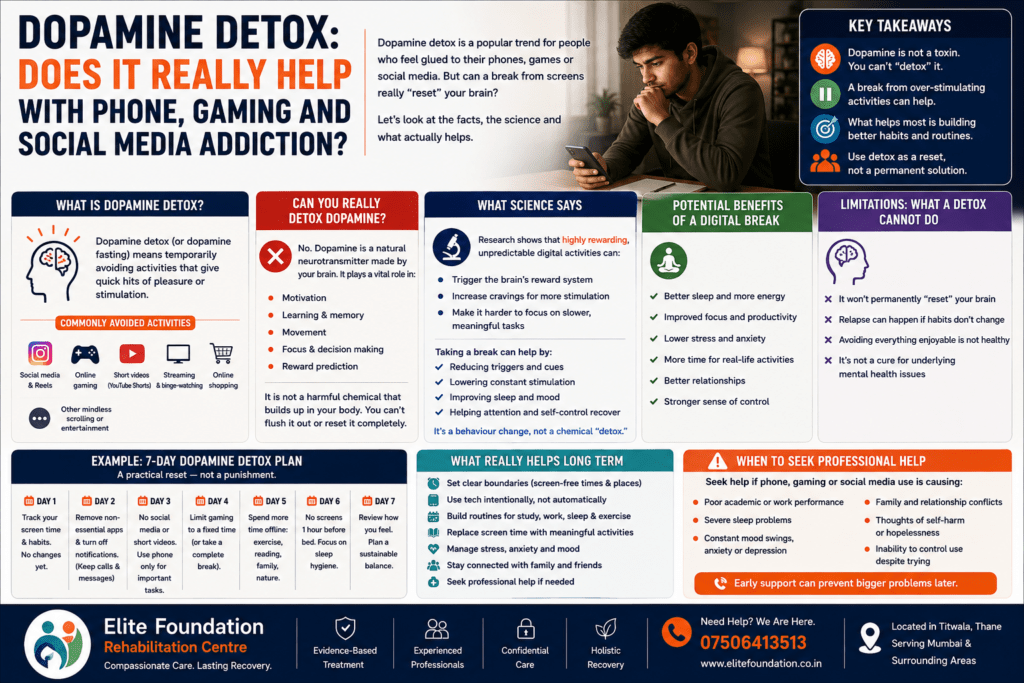
Dopamine detox has become a popular way of describing a break from phones, social media, gaming, short-form videos and other activities that feel difficult to control. People approaching a nasha mukti kendra in India may sometimes ask whether avoiding these activities for a few days can somehow “reset” the brain. Where phone or social-media use has genuinely become difficult to control, mobile phone and social media addiction treatment should focus on the behaviour, its triggers and consequences rather than trying to remove dopamine from the brain.
That distinction is the central point of this article.
A temporary break from a problematic digital behaviour can sometimes be useful.
But it is useful because you are changing what you do, reducing cues, interrupting routines and creating an opportunity to observe your habits—not because dopamine has been “detoxed” from your brain.
Dopamine is not a toxin.
It is also not simply a “pleasure chemical”. It plays important roles in motivation, learning, movement and how the brain responds to potentially important rewards and cues.
So what exactly is a dopamine detox, why has the idea become so popular, what actually happens when you temporarily stop scrolling or gaming, and can any part of the idea genuinely help with problematic digital behaviour?
What is a dopamine detox?
Dopamine detox is an internet and wellness term generally used for temporarily avoiding activities that provide immediate stimulation or gratification.
Depending on who is describing it, a dopamine detox may involve avoiding:
- Social media
- Instagram Reels
- YouTube Shorts
- Gaming
- Streaming
- Unnecessary smartphone use
- Online shopping
- Constant news checking
- Other highly repetitive recreational activities
Some more extreme versions found online go much further and recommend avoiding music, conversation, enjoyable food, exercise or ordinary social contact.
That is where the idea starts moving away from useful behaviour change and towards a misunderstanding of neuroscience.
Can you actually detox dopamine?
No.
Dopamine is a neurotransmitter produced and used naturally by the nervous system.
It is not an unwanted chemical accumulating in the body that needs to be flushed out.
An NIH explanation of dopamine and motivation describes dopamine as being involved in reward-seeking, movement and motivation. Neuroscience research also connects dopamine with learning and with how people evaluate whether an effort is worth pursuing.
You therefore do not want a brain with “no dopamine”.
Nor does spending a day without Instagram switch dopamine production off.
Dopamine is more complicated than “the pleasure chemical”
A common online explanation goes something like this:
Phone → dopamine hit → brain wants more dopamine → addiction.
That is much too simple.
Dopamine does participate in reward-related processes, but it is also involved in:
- Learning
- Motivation
- Movement
- Attention to important cues
- Reward prediction
- Deciding whether effort is worthwhile
Healthy activities also involve dopamine-related systems.
Eating, exercising, learning, achieving goals and interacting with other people do not become unhealthy simply because dopamine participates somewhere in the process.
Why the phrase “dopamine detox” is misleading
The term suggests three things that are easy to misunderstand:
- That dopamine is harmful.
- That modern activities create a toxic excess of dopamine.
- That avoiding stimulation for a period removes or resets that dopamine.
Those ideas do not accurately describe how the brain works.
A Cleveland Clinic review of the dopamine-detox trend explains that a literal dopamine detox is not possible and that dopamine is necessary for normal functioning.
The potentially useful part of the idea is behavioural rather than biochemical.
Then why do some people feel better after a dopamine detox?
Because they may actually have changed several things at once.
Imagine someone who normally:
- Checks Instagram every few minutes
- Receives dozens of notifications
- Watches Reels in bed
- Plays games until after midnight
- Starts every work break by scrolling
They then spend a weekend without those activities.
During that weekend they may:
- Receive fewer interruptions
- Go to bed earlier
- Spend more time outside
- Talk with other people
- Exercise
- Notice how often they normally reach for the phone
They may genuinely feel different.
But those changes do not prove that dopamine levels were “reset”.
The person changed their environment and behaviour.
Does dopamine detox work?
The answer depends on what you mean by “work”.
If you mean:
“Can I remove excess dopamine from my brain and reset my dopamine receptors by avoiding pleasure for a few days?”
There is no established clinical dopamine-detox procedure that does this.
If instead you mean:
“Can temporarily stepping away from a behaviour help me understand and change that behaviour?”
That can be a reasonable behavioural experiment.
The difference is important.
What a temporary break can actually do
Temporarily stopping or reducing one problematic activity may help you:
- Notice how often urges occur
- Identify situations that trigger the behaviour
- Reduce exposure to notifications and other cues
- Interrupt an automatic routine
- Protect selected work or study periods
- Protect bedtime from recreational screen use
- Make room for neglected offline activities
- Find out whether controlled use is difficult after the break
Those are practical behavioural outcomes.
None requires the claim that dopamine has been cleansed from the nervous system.
Dopamine detox benefits: what can reasonably be claimed?
Online lists often promise dramatic dopamine detox benefits:
- Perfect concentration
- Greater motivation
- Complete freedom from addiction
- Permanent productivity
- A completely “reset” brain
Those promises go much further than the evidence allows.
A more realistic list of possible benefits from selectively reducing a problematic activity would be:
- Fewer digital interruptions
- Greater awareness of automatic checking
- More available time
- Better protection of bedtime if late-night use is reduced
- Opportunity to rebuild offline routines
- A clearer picture of which digital behaviour is actually difficult to control
Whether someone experiences these benefits depends on what they change and what problem existed in the first place.
A dopamine detox is not the same as medical detox
This distinction is particularly important on an addiction-treatment website.
Medical detoxification refers to safely managing withdrawal from a substance where stopping or reducing use can produce physical withdrawal and, in some cases, serious medical complications.
A dopamine detox is not that.
Stopping Instagram, gaming or recreational smartphone use does not require the type of medical detoxification used for alcohol or certain sedative drugs.
Do not use an online “dopamine detox challenge” as a reason to:
- Stop prescribed psychiatric medication
- Stop other prescribed medicines
- Restrict necessary food or water
- Deprive yourself of sleep
- Isolate yourself from supportive relationships
Those actions have nothing to do with safely reducing problematic digital behaviour.
Dopamine fasting is not actually fasting dopamine
Dopamine fasting is often used as another name for dopamine detox.
The word “fasting” can create additional confusion.
You do not need to stop eating in order to take a break from social media, gaming or unnecessary smartphone use.
You are also not literally fasting the brain’s dopamine system.
A more accurate description would be:
a planned period of reducing or avoiding one or more behaviours that you want to understand better.
Do you need to avoid everything enjoyable?
No.
A useful behaviour-change plan does not require you to remove:
- Music
- Conversation
- Exercise
- Healthy food
- Reading
- Relationships
- Outdoor activity
- Every form of entertainment
Removing every source of enjoyment may actually distract from the behaviour you originally wanted to change.
If Instagram Reels are disrupting sleep, the problem is not that you also enjoy walking, talking to friends and listening to music.
Dopamine detox rules: there is no medically approved rulebook
There are no universal clinical dopamine detox rules such as:
- Exactly 24 hours
- Exactly seven days
- No music
- No speaking
- No enjoyable food
- No internet whatsoever
Those are internet challenge formats, not validated medical protocols for resetting dopamine.
If you want to use the idea as a structured behaviour experiment, the rules should instead answer practical questions.
A more evidence-informed dopamine detox plan
1. Identify one behaviour
Do not begin with:
“I am removing all dopamine.”
Begin with:
“Instagram Reels after 11 p.m. are repeatedly delaying my sleep.”
Or:
“I keep playing one more gaming match after deciding to stop.”
The second type of statement gives you an actual target.
2. Define the boundary
Examples might include:
- No recreational social media after a chosen evening time
- No gaming during selected study periods
- No Reels in bed
- Remove one particularly difficult app temporarily
The boundary should address the actual behaviour rather than every digital activity.
3. Keep essential phone functions
If you need the phone for:
- Work
- Family communication
- UPI
- Navigation
- School
- Emergency calls
there is usually no reason to remove those functions simply to make the experiment more extreme.
4. Notice the trigger
When you want to return to the behaviour, ask what happened immediately before the urge.
Was it:
- Boredom?
- Stress?
- Loneliness?
- A notification?
- A difficult assignment?
- Bedtime?
- An argument?
The trigger may be more clinically useful than the number of hours you managed to abstain.
5. Replace some of the behaviour
If you remove three hours of evening scrolling, you have created three hours of empty time.
Possible replacements might include:
- Exercise
- Walking
- Reading
- Meeting someone
- A hobby
- Cooking
- Structured work
- Earlier sleep
The replacement should fit the actual situation.
6. Decide what happens after the break
This is one of the most important steps.
If Instagram returns with:
- The same notifications
- The same home-screen position
- The same bedtime routine
- The same unlimited access
the old behaviour may also return.
A useful break therefore ends with a re-entry plan rather than simply reinstalling everything and hoping for the best.
24-hour dopamine detox: is one day enough?
There is no medically established 24-hour dopamine detox.
A day without a particular app can still reveal useful information.
You may notice:
- How often you automatically reach for the phone
- Which moments feel most uncomfortable
- Whether boredom is a major trigger
- Whether you automatically switch to another app
That is useful behavioural information.
It does not tell you that dopamine has been reset after 24 hours.
7-day dopamine detox: does a week reset dopamine?
There is no evidence-based seven-day duration that resets the dopamine system.
A week may simply be long enough for someone to observe patterns that are difficult to see during a single day.
For example, they may notice that:
- Weekday stress is the main scrolling trigger
- Weekend boredom produces more gaming
- Social-media urges are strongest after posting content
- Late-night use returns whenever sleep is already disrupted
Those observations can be useful without making a neurochemical claim.
How long does a dopamine detox take?
There is no scientifically validated dopamine-detox duration.
Twenty-four hours, seven days, 30 days and other challenge lengths should not be interpreted as neurological treatment doses.
If you are using temporary abstinence as a behaviour-change experiment, the duration should be long enough to observe the behaviour while remaining realistic and safe.
The more important question is:
What changes after the experiment ends?
Dopamine detox for phone addiction
For problematic smartphone use, removing the entire phone may be impractical.
Instead, identify the specific part that feels uncontrolled.
It might be:
- Automatic unlocking
- Reels
- YouTube Shorts
- WhatsApp checking
- News
- Shopping
- Late-night scrolling
The practical guide on how to reduce phone addiction explains how notification reduction, app friction, bedtime changes and physical distance from the phone can be used without pretending to “reset dopamine”.
A phone detox should target the unwanted behaviour
If your phone is required for work, banking and family communication, spending a week without the entire device may create unnecessary problems.
If the actual difficulty is Instagram from midnight to 2 a.m., target that period and behaviour.
The more accurately the problem is defined, the more meaningful the experiment becomes.
Dopamine detox for social media
Social-media use can involve several separate behaviours:
- Scrolling
- Short videos
- Repeated message checking
- Checking likes and views
- Doomscrolling
- Social comparison
The article on social media addiction, Reels and compulsive scrolling explains why identifying the specific social-media behaviour matters more than simply counting total app hours.
A temporary break may reduce exposure to the cues that repeatedly start these behaviours.
But the longer-term question is whether you can use the platform more deliberately when access returns.
Does deleting Instagram reset dopamine?
No evidence allows us to say that uninstalling Instagram resets dopamine levels or dopamine receptors in a clinically defined way.
Deleting the app can still change behaviour immediately:
- The icon disappears.
- Notifications stop.
- Opening the feed requires more effort.
- Automatic checking is interrupted.
That is a meaningful environmental change without needing a dopamine-reset explanation.
Dopamine detox for gaming addiction
Gaming requires additional care because Gaming Disorder is formally recognised by the World Health Organization.
A person with severe loss of control over gaming may need more than a self-directed internet challenge.
A temporary break can still reveal:
- How strong gaming urges are
- What times trigger play
- How gaming affects sleep
- Whether another digital behaviour immediately replaces it
The detailed guide on gaming addiction and Gaming Disorder explains the difference between heavy recreational gaming and the clinically recognised pattern involving impaired control, increasing priority and continuation despite significant consequences.
Gaming abstinence is not a dopamine detox treatment
Someone may benefit from temporarily stopping a particular game.
But Gaming Disorder assessment and treatment should not be reduced to:
“Stay away from dopamine for seven days.”
The behaviour may be connected with:
- Friendship
- Competition
- ADHD
- Anxiety
- Depression
- Loneliness
- Sleep problems
Those factors may remain after a game is removed.
What does current treatment research actually support?
A 2026 systematic review and meta-analysis of 125 studies on problematic digital-technology use examined psychological therapies, digital programmes, exercise-based interventions, medication studies and several other approaches.
Across the review, structured psychological interventions showed the most consistent overall benefit. Evidence was clearer for some problems, including problematic internet and smartphone use, while results for Gaming Disorder were more mixed and varied across studies. The authors also reported substantial differences in study quality, intervention methods and outcomes.
The review does not establish dopamine detox as a standard treatment. Instead, it supports structured approaches that address behaviour, cues, control and the wider psychological context.
Dopamine detox versus evidence-based behaviour change
| Popular claim | More accurate interpretation |
|---|---|
| “I need to remove dopamine from my brain.” | Dopamine is necessary for normal brain function and cannot be detoxed like a toxin. |
| “Seven days will reset my dopamine.” | There is no established seven-day dopamine-reset protocol. |
| “I must remove every pleasurable activity.” | Target the specific behaviour that has become problematic. |
| “Feeling bored means the detox is working.” | Boredom may simply reflect the removal of a familiar habit or source of stimulation. |
| “If I feel better afterwards, my dopamine was repaired.” | You may feel better because your behaviour, sleep, routine or environment changed. |
What is “dopamine addiction”?
People sometimes say:
“I am addicted to dopamine.”
That is not a useful medical diagnosis.
You are not normally addicted to the neurotransmitter dopamine itself.
A person may have difficulty controlling a particular:
- Substance
- Gaming behaviour
- Gambling behaviour
- Smartphone habit
- Social-media pattern
These behaviours involve complex learning, motivation, emotions, environment and brain processes.
Reducing them to “too much dopamine” hides much of what actually needs to be understood.
What about “instant gratification addiction”?
Instant gratification addiction is another popular internet phrase rather than a single recognised medical diagnosis.
It can still describe a real experience:
Someone becomes accustomed to reaching for an immediately available activity whenever they are:
- Bored
- Stressed
- Anxious
- Tired
- Trying to avoid a difficult task
The practical question is not whether they have consumed too much gratification.
It is whether one or more behaviours have become automatic, difficult to control or disruptive.
Why boredom feels stronger during a digital break
If every small pause normally involves a phone, removing the phone leaves the pause behind.
A queue is still a queue.
A difficult assignment is still difficult.
Bedtime still contains a period before sleep.
What has changed is that the usual automatic response is unavailable.
The resulting boredom or restlessness does not prove that dopamine has dropped to an unhealthy level.
It may simply reveal how strongly the behaviour had become attached to that situation.
Are dopamine detox symptoms real?
There is no established medical “dopamine detox withdrawal syndrome”.
Someone temporarily stopping a highly habitual digital behaviour may report:
- Boredom
- Restlessness
- Irritability
- Urges to check
- Fear of missing something
- Difficulty knowing what to do with free time
Those experiences should not be confused with dangerous physical withdrawal from alcohol or certain sedative drugs.
Does a dopamine detox improve focus?
It may become easier to focus if you remove something that was repeatedly interrupting your attention.
For example, turning off social-media notifications while studying removes those particular interruptions.
That does not prove that your dopamine system has been reset.
If concentration remains poor after digital distractions are reduced, consider other possible contributors such as:
- Sleep deprivation
- Anxiety
- Depression
- ADHD
- Academic stress
- Burnout
Can a dopamine detox treat ADHD?
No.
A dopamine detox is not an established treatment for ADHD.
Reducing distracting notifications or highly interruptive digital behaviour may make a particular environment easier to manage, but it does not diagnose or treat the underlying condition.
People taking prescribed ADHD medication should not stop or alter medication in order to perform an online dopamine-detox challenge unless the prescribing clinician advises a change.
Can a dopamine detox treat anxiety or depression?
Not as a standalone medical treatment.
Anxiety and depression can sometimes influence how people use phones, gaming or social media.
For example, someone may scroll because they feel lonely or play games to avoid worrying thoughts.
Removing the behaviour may make the underlying emotion more noticeable.
That can be useful information, but the mental-health condition may still require its own assessment and treatment.
Why extreme dopamine detoxes can miss the point
An extreme plan can become:
- No phone
- No music
- No television
- No enjoyable food
- No conversation
- No entertainment
- No social contact
At that point, the person’s entire day has been changed.
If they feel different, it becomes impossible to know which change mattered.
A narrower behavioural experiment often provides more useful information.
Do not turn dopamine detox into punishment
A behaviour-change plan should not be:
“I used Instagram too much, so I am not allowed to enjoy anything for seven days.”
Shame and punishment do not explain:
- Why the scrolling started
- Why stopping is difficult
- What triggers the behaviour
- What will happen when Instagram returns
A more useful approach treats the behaviour as something to understand and change.
Dopamine detox before and after photos do not measure dopamine
Online challenges sometimes present dramatic “before and after” experiences.
Someone may say they feel:
- Clearer
- Calmer
- More focused
- More motivated
The person’s experience may be genuine.
But subjective changes do not measure dopamine concentrations, receptor sensitivity or a neurological reset.
They show that the person feels different after changing their routine.
What if you immediately replace one behaviour with another?
This is one of the most useful observations a digital break can reveal.
For example:
Instagram removed → YouTube Shorts increases.
Or:
Gaming removed → constant Reddit or news checking begins.
Or:
Phone put away → laptop scrolling replaces it.
This suggests that the wider pattern may involve:
- Automatic stimulation-seeking
- Avoidance of boredom
- Anxiety
- Procrastination
- A broader digital-checking habit
The problem may therefore be larger than one application.
How to know whether your digital break was actually useful
Do not judge success by whether you completed an impressive number of dopamine-detox days.
Ask instead:
- Did I identify my main triggers?
- Did I sleep better because I stopped late-night use?
- Did automatic checking decrease?
- Did I replace some digital time with something meaningful?
- Did I discover that one particular app was the main problem?
- Can I now use the activity within boundaries?
Those answers tell you much more than whether you completed a seven-day challenge.
When a dopamine detox is probably not enough
Professional assessment may be useful when:
- Repeated attempts to control phone, social-media or gaming use have failed
- Sleep is seriously disrupted
- School, college or employment is deteriorating
- Important relationships are being repeatedly affected
- Most previous offline activities have disappeared
- Gaming meets warning signs consistent with possible Gaming Disorder
- Severe anxiety, depression or ADHD symptoms are present
- Another compulsive behaviour repeatedly replaces the one that was removed
At that point, the question is no longer simply:
“How long should my dopamine detox last?”
It becomes:
“Why is this behaviour so difficult to control, and what treatment fits the actual problem?”
Frequently asked questions
What is a dopamine detox?
A dopamine detox is a popular term for temporarily reducing or avoiding highly stimulating or difficult-to-control activities such as social media, gaming or unnecessary smartphone use. It is not a literal detoxification of dopamine from the brain.
Does dopamine detox work?
A literal dopamine detox or neurological reset is not an established medical treatment. Temporarily reducing a specific problematic behaviour can still be useful for identifying triggers, reducing cues and changing habits.
What are dopamine detox benefits?
Possible practical benefits of reducing a problematic digital behaviour include fewer interruptions, greater awareness of automatic habits, more available time and better protection of sleep. These benefits should not be described as proof of a dopamine reset.
Can you reset dopamine?
Internet claims that several hours or days without stimulation “reset dopamine” oversimplify how the brain works. Dopamine is a normal neurotransmitter involved in learning, motivation, movement and reward-related processes.
How do I reset dopamine levels?
There is no validated behavioural protocol in which avoiding phones, gaming or enjoyable activities for a set number of days resets dopamine levels. Focus instead on changing the specific behaviour that is causing problems.
What are the rules of dopamine detox?
There is no medically approved dopamine-detox rulebook. A safer behavioural approach identifies one problematic activity, defines a realistic boundary, maintains necessary daily functions, observes triggers and plans how the activity will be managed afterwards.
How long does dopamine detox take?
There is no scientifically established dopamine-detox duration. Twenty-four-hour, seven-day and 30-day challenges are internet formats rather than clinical neurological protocols.
Does a 24-hour dopamine detox work?
A day away from a particular digital behaviour may help reveal how often you normally reach for it and what triggers the urge. It does not establish that dopamine has been reset after 24 hours.
Does a 7-day dopamine detox reset your brain?
There is no established evidence that seven days without selected pleasurable activities resets the brain’s dopamine system. A week may still provide useful information about habits and triggers.
Is dopamine fasting the same as dopamine detox?
The terms are often used interchangeably online. Neither means literally fasting dopamine. Food restriction is not required to reduce problematic smartphone, gaming or social-media behaviour.
Should I stop eating during a dopamine fast?
No. There is no need to restrict necessary food or water in order to change a digital habit. Extreme dietary restriction should not be used as part of an internet dopamine-detox challenge.
Can dopamine detox help phone addiction?
A temporary break from specific unwanted phone behaviours can help some people identify triggers and interrupt automatic checking. The benefit comes from behaviour change rather than removing dopamine.
Can dopamine detox help social media addiction?
Temporarily reducing or removing a problematic social-media platform may help identify patterns such as boredom-triggered checking or late-night scrolling. Sustainable change still depends on what happens after access returns.
Can dopamine detox help gaming addiction?
A temporary gaming break may help reveal triggers and the degree of control, but it is not an established treatment for Gaming Disorder. Significant impairment or repeated failed attempts to control gaming may require professional assessment.
Does deleting Instagram reset dopamine?
No established evidence shows that deleting Instagram resets dopamine. Deleting the app can still remove notifications, visual cues and easy access, which may immediately change checking behaviour.
Can dopamine detox improve focus?
Focus may improve during tasks when distracting apps and notifications are removed. That is not proof of a dopamine reset. Persistent concentration difficulties can also have other causes.
Can dopamine detox cure ADHD?
No. Dopamine detox is not an established treatment for ADHD. Reducing distractions may help structure an environment, but ADHD requires appropriate assessment and treatment.
Can dopamine detox treat depression or anxiety?
It should not be used as a replacement for mental-health treatment. Anxiety or depression may contribute to compulsive digital use and may remain even when the device or app is temporarily removed.
Are dopamine detox withdrawal symptoms dangerous?
Boredom, irritability, restlessness or urges to check can occur when a strong digital habit is interrupted. These experiences are not equivalent to medically dangerous alcohol or sedative withdrawal.
Am I addicted to dopamine?
“Dopamine addiction” is not a useful standalone diagnosis. A person may have difficulty controlling a particular substance or behaviour, while dopamine is one part of the much more complex brain systems involved in motivation and learning.
What is better than a dopamine detox?
For problematic digital behaviour, a more useful approach is to identify the specific behaviour, understand its triggers, reduce cues, build alternative routines, protect sleep and work towards sustainable control. More severe patterns may benefit from structured psychological treatment.
You do not need to detox dopamine—you need to understand the behaviour
The popularity of dopamine detox comes from a real experience.
Many people do feel surrounded by notifications, short videos, games, social feeds and almost unlimited opportunities for immediate stimulation.
Some genuinely struggle to stop.
The mistake is assuming that the solution is to remove dopamine.
Dopamine is part of normal human functioning. You cannot cleanse it out of the brain by spending a weekend without Instagram, and you do not need to eliminate every pleasurable activity in order to change a compulsive digital habit.
What you can do is much more practical.
Identify the behaviour that has stopped feeling voluntary. Find the cue that usually starts it. Remove unnecessary notifications. Create boundaries around sleep, work and study. Make the problematic activity slightly harder to access. Replace some of the time with something meaningful. Then see what happens when access returns.
If the pattern immediately returns, another digital activity takes its place, or important areas of life continue to deteriorate, the issue deserves a fuller assessment rather than a more extreme detox challenge.
The useful question is therefore not:
“How do I reset my dopamine?”
It is:
“Which behaviour am I struggling to control, what keeps triggering it, and what would help me regain choice?”
Medical disclaimer: This article provides general educational information and does not replace individual psychological, psychiatric or medical assessment. “Dopamine detox” is not a substitute for treatment of Gaming Disorder, problematic digital use, ADHD, depression, anxiety or another mental-health condition. Do not stop prescribed medication, restrict necessary food or fluids, or make other potentially unsafe health changes as part of an online dopamine-detox challenge. Seek urgent professional assessment for suicidal intent, serious self-harm, psychosis, dangerous aggression or another immediate mental-health or medical emergency.
“`