
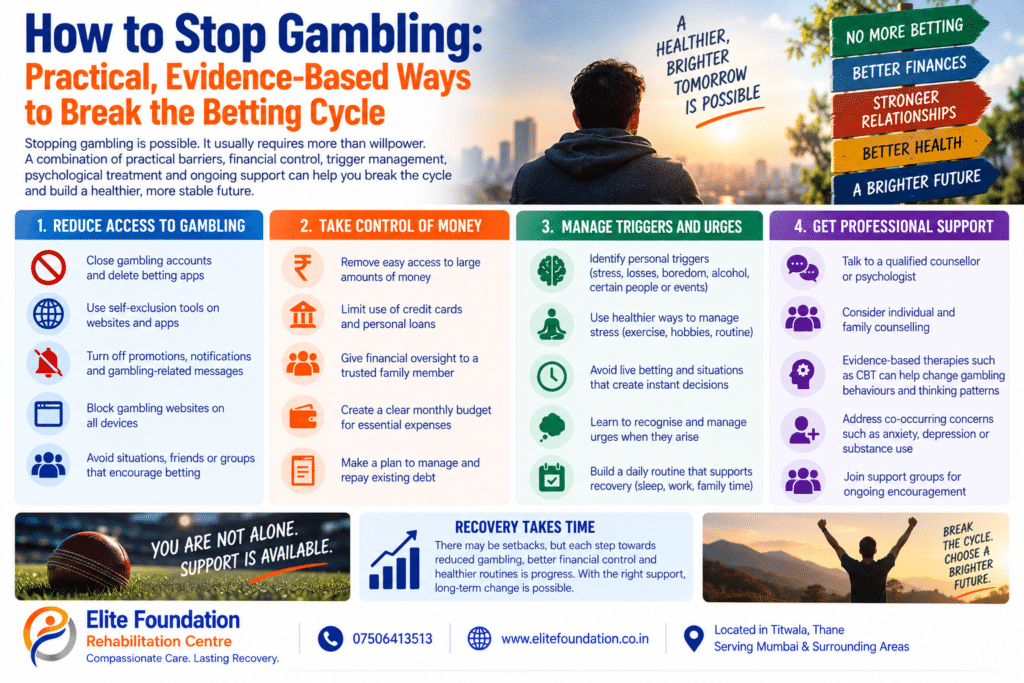
Trying to stop gambling can feel simple in theory and much harder when betting has become tied to money, stress, routine and the hope of recovering losses. Families looking for Mumbai rehabs may reach the point where promises to stop are repeatedly followed by another bet. At Elite Foundation, our gambling rehab centre in Mumbai approach focuses on practical barriers to gambling, safer control of money, trigger management, evidence-based psychological treatment and relapse prevention rather than relying on willpower alone.
Someone may genuinely want to quit gambling and still find themselves betting again later that evening, the following weekend or when another match begins. That does not mean the wish to stop was false. It usually means the person tried to change the behaviour while leaving too many of the conditions that support it unchanged.
The gambling account may still be accessible. Money may still be available instantly. Notifications may still arrive. Friends may still discuss betting. A previous loss may remain mentally unfinished. Debt may create pressure to win money back. Stress, loneliness or boredom may still trigger the same routine.
Stopping gambling therefore requires more than repeating, “I will not do it again.” A stronger plan changes the environment around the behaviour, reduces access to money and gambling opportunities, identifies triggers, addresses gambling-related thinking, treats underlying mental-health problems where present and prepares for the possibility that urges may return.
What does “stopping gambling” actually mean?
For someone whose gambling has become difficult to control, stopping means more than reducing the amount lost on a particular day. The real objective is to break the sequence that repeatedly brings the person back to gambling despite previous intentions to stop.
The World Health Organization describes Gambling Disorder in terms of impaired control over gambling, increasing priority given to gambling over other activities and continuation or escalation despite negative consequences. When those features are present, trying to manage the problem only by setting another informal spending limit may not address the underlying loss of control.
NICE guidance on gambling-related harms states that treatment goals should be discussed with the person and notes that the typical goal is abstinence. This does not mean every individual arrives at treatment ready to stop immediately. It means that where gambling is repeatedly causing serious harm, a clear period without gambling may be more realistic than repeatedly trying to prove that the behaviour can now be controlled.
Do not wait to feel completely ready before changing access
One common mistake is waiting for motivation to become strong enough before putting practical barriers in place. Motivation can change quickly. Someone may feel absolutely certain about quitting immediately after losing money and much less certain several days later when the distress has reduced.
Practical barriers are useful precisely because they do not depend on motivation remaining equally strong every hour of every day.
If access to gambling is immediate, a strong urge can become a transaction within seconds. If access requires several additional steps, the person has more time to reconsider the decision, contact someone or allow the urge to reduce.
The objective is not to prove that the person has enough willpower to keep gambling available and simply refuse it. Early recovery is often safer when the environment does some of the work.
Make the next gambling episode harder to start
Stopping gambling usually begins with reducing access to the routes through which gambling occurs. Depending on the type of gambling and what is available in the person’s jurisdiction, this can include closing or restricting gambling accounts, using self-exclusion systems, blocking gambling websites or applications, blocking gambling-related marketing and reducing access to venues associated with previous gambling.
The World Health Organization specifically identifies effective self-exclusion and pre-commitment tools as measures that can support people who want to control or cease gambling.
NICE similarly recommends discussing practical self-exclusion techniques, including blocking software, blocking marketing messages, land-based self-exclusion systems and payment blocks through banks where such options are available.
Availability differs across countries, banks, gambling products and providers. The principle is broader than any single tool: remove unnecessary pathways back to gambling rather than keeping every pathway open and expecting motivation to defeat each one.
Deleting one app is useful, but it is not a complete recovery plan
Somebody may delete a betting application immediately after a large loss. That can be a useful first step, but it does not necessarily change the behaviour if the person can reinstall it easily, use a browser, switch to another service or move to another form of gambling.
The more useful question is not simply, “Did I delete the app?” It is, “How many realistic routes back to gambling are still available to me when an urge appears?”
Someone trying to stop online gambling may therefore need to think about browser access, saved passwords, promotional messages, payment methods, accounts, gambling-related social groups and the sporting or digital cues that repeatedly lead towards betting.
The purpose is not to eliminate every reminder that gambling exists. It is to reduce the number of situations in which an impulse can become gambling before the person has time to think.
Money access needs its own recovery plan
Access to money is one of the most important practical issues in gambling recovery. A person may have stopped for several days but still have unrestricted access to credit cards, instant loans, savings, overdraft facilities or money intended for household expenses.
When the urge to gamble returns, easy access to substantial funds can turn a brief lapse in judgement into a large financial loss.
Depending on individual circumstances, temporary safeguards may include separating essential household money, reducing access to unrestricted credit, lowering available spending limits where appropriate, using gambling-payment blocks where available and involving a trusted person in agreed financial oversight.
These safeguards should be proportionate, lawful and safe. They should not become coercive control or punishment. Where there is domestic violence, intimidation, economic abuse or coercion, family members should not place themselves at risk by trying to seize control of accounts or money.
Stopping gambling is not the same as solving gambling debt
Debt creates one of the strongest reasons people give for continuing to gamble: “I cannot stop until I get the money back.”
That thinking needs to be separated into two different problems. Gambling is creating or risking new losses. Debt is a financial obligation that already exists.
The debt may require budgeting, repayment arrangements, financial advice or legal guidance depending on its size and complexity. Gambling is not a reliable debt-repayment method.
The mistake is allowing the financial plan to depend on a future win. A realistic debt plan uses actual income, actual assets, actual liabilities and money that genuinely exists.
Where the person keeps returning to gambling specifically to recover previous losses, the separate guide on chasing losses in gambling explains why “getting back to zero” can become a psychological trap.
Stopping becomes easier when the person knows what usually happens before a bet
“I suddenly gambled” is often not the complete sequence.
There may have been several earlier steps: an argument, boredom after work, salary being credited, seeing a cricket notification, remembering a previous win, drinking alcohol, checking a live score, talking to a friend about betting or feeling overwhelmed by debt.
These are triggers. A trigger does not force someone to gamble, but it can increase the probability that gambling thoughts and urges appear.
A useful recovery assessment asks what tends to happen before gambling, not just what happens after money has been lost.
Triggers can be emotional, financial, social or environmental
Some people gamble when they are excited. Others gamble when they are distressed. The same person may have several different pathways into the behaviour.
Emotional triggers can include stress, boredom, loneliness, anger, low mood or the desire to escape another problem. Financial triggers may include receiving salary, owing money or seeing available credit. Social triggers can include conversations about gambling, friends who bet or groups where wins are repeatedly discussed. Environmental triggers may include sporting events, advertisements, notifications or being in locations previously associated with gambling.
The goal is not to construct a life in which no trigger ever appears. That is rarely realistic. The goal is to identify predictable situations early enough to respond differently.
An urge to gamble is not the same thing as a decision to gamble
Many people interpret an urge as evidence that they are about to relapse. That can make the urge itself frightening.
An urge is better understood as a temporary internal event: thoughts, physical tension, excitement, restlessness or mental images of gambling can become stronger and then weaker without requiring action.
Rather than arguing with every gambling thought, the person can learn to create time between the urge and any financial decision.
That may mean leaving the triggering situation, contacting a trusted person, changing the immediate activity, moving away from devices or money access, or reminding themselves of what happened during the previous gambling episode.
The important skill is not learning how to guarantee that gambling thoughts never occur again. It is learning that a gambling thought does not have to become a gambling transaction.
Identify what gambling is doing for you psychologically
Stopping becomes more difficult when gambling is serving another emotional function that has not been replaced.
For one person, gambling may create excitement during otherwise repetitive days. For another, it may provide temporary escape from anxiety. Someone else may use it to feel socially connected, to avoid loneliness or to create hope during financial stress.
If treatment focuses only on removing the gambling behaviour while ignoring the function it was serving, the person can be left with the same boredom, distress or isolation and no alternative way of responding to it.
A proper assessment therefore asks not only, “How much are you gambling?” but also, “What tends to change emotionally when you start gambling?”
Gambling-related beliefs need to be examined, not simply argued away
Some gambling behaviour is maintained by thoughts that feel highly convincing in the moment. A person may believe they are due a win, that their sporting knowledge gives them reliable control, that an almost-win proves their method is working or that stopping after a large loss would make the loss permanent.
Simply telling somebody that these beliefs are irrational may create an argument rather than change.
A more useful approach examines the evidence behind the thought and its consequences. Has the belief repeatedly led to more gambling? Did previous attempts to recover losses actually reduce the debt? Does knowing a sport well reliably control uncertain financial outcomes? What happens when wins are remembered more clearly than losses?
This is one area where structured psychological treatment becomes important.
CBT currently has some of the strongest treatment evidence for gambling problems
Cognitive behavioural therapy, or CBT, is one of the best-studied psychological approaches for problem gambling and Gambling Disorder.
A 2023 systematic review and meta-analysis of 29 studies involving 3,991 participants found that cognitive-behavioural techniques reduced gambling-disorder severity, gambling frequency and gambling intensity at the end of treatment compared with minimal or no treatment.
The research also requires caution. The authors found substantial variation between studies, evidence that treatment effects may have been overestimated and no significant effect in the pooled follow-up outcomes. CBT should therefore not be presented as a guaranteed cure or as something that works equally well for everyone.
A separate 2023 umbrella review covering 56 unique studies and 5,389 participants also found that higher-quality meta-analyses supported CBT for reducing gambling severity, frequency and intensity after treatment.
Current NICE guidance recommends gambling-specific CBT and states that it should include relapse-prevention work.
What does gambling-focused CBT actually work on?
CBT is more than talking about gambling once a week. Treatment can examine the interaction between situations, thoughts, emotions, urges and behaviour.
For example, the trigger may be a ₹50,000 loss. The thought is, “I cannot stop until I recover it.” That thought produces urgency and anxiety. The behaviour is another deposit. Another loss then strengthens the financial pressure, which becomes a new trigger.
Therapy can work on recognising that cycle earlier, testing gambling-related beliefs, developing alternative responses to urges, changing access to gambling and money, and preparing for high-risk situations before they occur.
A 2024 systematic review and meta-analysis also found preliminary evidence that CBT can improve gambling-related cognitions, coping and self-efficacy, although the authors noted substantial heterogeneity and measurement limitations.
Motivational interviewing can help when part of you wants to stop and another part does not
Ambivalence is normal in behavioural change. Somebody may want the debt and arguments to stop while still missing the excitement of gambling. They may want recovery but also believe they could gamble differently next time.
Motivational interviewing is designed to explore that ambivalence without turning treatment into an argument.
WHO currently states that cognitive behavioural therapy and motivational interviewing are among the therapies with the strongest evidence for Gambling Disorder. However, newer evidence adds an important qualification.
A 2025 systematic review and meta-analysis of seven studies involving 796 participants found almost no difference between motivational-interviewing-informed interventions and control conditions for gambling frequency, expenditure or Gambling Disorder severity, and the authors concluded that the isolated effect of MI may previously have been overestimated.
NICE therefore positions motivational interviewing primarily as a way of strengthening confidence, commitment and engagement—particularly when someone is unsure about treatment—rather than treating it as a guaranteed standalone solution.
A person does not have to feel 100% motivated before entering treatment
Some families wait for the person gambling to say, “I completely accept that I have a problem and I am ready to change.” That moment may not arrive in such a clear form.
Someone may enter treatment because of debt, relationship conflict or pressure from work while still having doubts about giving up gambling.
Those doubts can be addressed inside treatment. Readiness to change is not always something that must be fully completed before treatment begins.
Trusted support can reduce secrecy and create accountability
Gambling often becomes easier to continue when nobody else knows what is happening. A person can lose money, obtain more funds and plan another gambling episode without having to explain any of those decisions.
Involving a trustworthy person can reduce that isolation. Support might involve discussing urges, reviewing agreed financial safeguards, attending treatment discussions where appropriate or helping the person respond after a lapse without immediately returning to gambling.
NICE recommends involving partners, family members or other people close to the individual where both parties agree and also recommends support for affected family members in their own right.
The Elite Foundation guide on family support in addiction recovery explains why family involvement works best when support does not become surveillance, humiliation or repeated financial rescue.
Support does not mean giving unrestricted money after a gambling loss
A person may ask for financial help because creditors are calling or household payments are due. Those problems may be genuine and urgent.
However, giving unrestricted cash without knowing whether gambling is still active can expose additional money to the same behaviour.
Financial support, where appropriate, should be separated from gambling access. Essential bills may sometimes be paid directly or finances temporarily structured in a safer way rather than handing over money intended to be used freely.
Every family situation is different, and substantial debts may require qualified financial or legal advice.
Replacing gambling matters because stopping creates empty time
Gambling can occupy far more time than the actual betting transaction. A person may spend hours researching matches, watching live scores, checking results, discussing predictions, thinking about previous losses or waiting for another opportunity to gamble.
When gambling stops, that time becomes visible.
If nothing replaces it, boredom itself can become a relapse trigger. Recovery therefore needs ordinary activities that provide structure, social contact, achievement or enjoyment without gambling.
The replacement does not need to reproduce the intense stimulation of betting. Ordinary activities may feel less immediately stimulating at first, and rebuilding enjoyment, routine and interest can take time.
Alcohol and other substances can weaken a gambling recovery plan
For some people, gambling and alcohol occur together. Alcohol may reduce inhibition, weaken previously made decisions or reconnect the person with people and settings associated with betting.
Others may have a separate alcohol or drug problem that needs treatment in its own right.
NICE recommends coordinated treatment when gambling-related harms occur alongside alcohol dependence, substance dependence or mental-health conditions rather than treating each problem as though the others do not exist.
Depression, anxiety, ADHD, bipolar disorder and other conditions may need separate assessment
Gambling behaviour can occur alongside several psychiatric conditions, but co-occurrence does not mean one diagnosis automatically caused the other.
Someone may gamble to escape anxiety or depression. Another person may experience worsening anxiety after debt develops. Impulsivity associated with ADHD may be relevant for some individuals. Periods of unusually elevated mood, reduced need for sleep, increased spending and risky behaviour may require assessment for mania or hypomania rather than being assumed to represent ordinary gambling behaviour.
Certain medications can also be associated with impulse-control problems in some people. A clinician should therefore review the broader psychiatric and medication history where the pattern suggests this may be relevant.
Treating Gambling Disorder without recognising a significant co-occurring condition can leave an important driver of behaviour untreated.
Medication is not a do-it-yourself way to stop gambling
There is no medication that should be casually started as a self-treatment for gambling addiction.
NICE’s 2025 guideline says naltrexone may be considered by appropriately experienced specialists when a suitable course of psychological therapy has not achieved the desired outcome or when repeated relapse continues despite psychological treatment. In the UK guideline, this is an off-label use.
That recommendation does not mean naltrexone is appropriate for every person who gambles, nor does it automatically establish how it should be used in India. Medication decisions require individual medical assessment, review of other medicines and health conditions, and appropriate specialist supervision.
Psychological treatment and practical behavioural safeguards remain central.
Self-exclusion works best as part of a wider plan
Self-exclusion can be valuable because it converts an intention—“I do not want to gamble”—into an external barrier.
But self-exclusion should not be mistaken for a complete treatment programme. Someone may exclude themselves from one route while retaining access elsewhere, or may continue struggling with debt, gambling-related thinking and powerful triggers.
That is why practical blocking measures work best alongside treatment and financial safeguards. They reduce opportunity while psychological work addresses why gambling keeps regaining importance.
Removing gambling marketing can reduce unnecessary triggers
Someone trying to stop gambling does not benefit from repeatedly receiving prompts inviting them back into the behaviour.
Where possible, unsubscribe from gambling-related marketing, disable promotional notifications, leave betting-focused message groups and reduce exposure to accounts or feeds that repeatedly encourage gambling activity.
This does not mean every sporting discussion or advertisement must be avoided forever. Early recovery is about reducing avoidable triggers while new habits are becoming stronger.
Sports fans may need to temporarily change how they watch matches
A person who previously bet on cricket may discover that live scores, match previews or discussions immediately trigger gambling thoughts.
Some people can continue watching sport without gambling. Others may benefit from temporarily reducing exposure to particular matches, tournaments or betting-related discussions until the connection becomes weaker.
The decision should be based on the individual’s trigger pattern rather than assuming cricket, football or another sport is itself the problem.
If someone repeatedly moves from match → prediction → urge → bet, reducing exposure to the first part of that sequence may be useful during early recovery.
Stopping gambling does not require recovering previous losses first
Many people delay quitting because they believe they need one final successful gambling session before they can stop.
The proposed sequence is:
recover money → repay debt → stop gambling.
The safer sequence is usually the opposite:
stop creating new gambling losses → establish the real debt → build a realistic repayment plan.
Previous losses do not make another uncertain wager financially necessary.
The emotional and financial pressure may be very real. The solution still needs to be separated from further gambling.
Relapse prevention should begin before a relapse happens
A relapse plan is not an admission that treatment will fail. It recognises that gambling urges and high-risk situations may return.
NICE recommends that gambling-focused CBT include relapse prevention. That can involve identifying triggers, planning how to respond to cravings, recognising early warning signs and deciding in advance what should happen after a lapse.
Someone who has stopped betting during ordinary weeks may still be at greater risk around salary day, a major sporting tournament, financial stress, alcohol use, relationship conflict or contact with former gambling friends.
The time to decide how to handle those situations is before they occur.
A lapse does not have to become a full return to gambling
Suppose someone has not gambled for three months and then places one bet.
One dangerous thought is:
“I’ve ruined everything. I might as well continue.”
Another is:
“I need to recover today’s loss before I stop again.”
Both can turn a single lapse into a much longer episode.
A better response is to stop the episode quickly, restore any barriers that were removed, identify what changed before the lapse, inform appropriate support and return to treatment rather than trying to repair the lapse through further gambling.
Recovery progress is not erased by one event, but the event should still be taken seriously because it provides information about where the recovery plan failed.
Ask what barrier failed before asking why you had no willpower
After relapse, people often judge themselves rather than analyse the sequence.
A more useful review asks practical questions. Was a self-exclusion period over? Was unrestricted money available again? Did a major trigger occur? Had treatment stopped? Was alcohol involved? Had the person stopped telling family members about urges? Were they trying to recover an old loss?
The purpose is not to excuse the gambling. It is to identify the part of the system that needs strengthening.
Peer support can help some people maintain recovery
NICE recommends offering peer support to people who wish to use it as part of treatment. Speaking with people who have experienced similar problems can reduce isolation and make subjects such as relapse, debt and shame easier to discuss.
Peer support is not a replacement for professional mental-health treatment when that treatment is needed. It can be one part of a broader recovery plan.
Different people also respond differently to group settings. Someone who does not find one group useful should not conclude that recovery itself is impossible.
How long does it take to stop gambling?
There is no clinically meaningful universal answer such as seven days, 21 days or 90 days.
Someone may stop placing bets immediately but continue experiencing urges, debt stress, gambling-related thoughts and relapse risk for much longer.
Another person may require several treatment attempts before sustained change develops.
Recovery is therefore better measured through changes in behaviour and functioning: no new gambling losses, improved control of money, reduced secrecy, better response to triggers, engagement with treatment, repaired routines and increasing stability in relationships and daily life.
Does every person need residential gambling rehabilitation?
No. Many people experiencing gambling-related harm can receive outpatient psychological or psychiatric treatment, together with financial safeguards, peer support and family involvement where appropriate.
Some people may need a more intensive level of care when gambling remains difficult to control or when there are significant psychiatric, substance-use, safety, environmental or functional concerns. However, there is no universal threshold based on the amount of debt, number of relapses or frequency of betting that automatically determines the need for residential treatment.
Whether outpatient, intensive outpatient or residential care is appropriate should be decided through individual clinical assessment; gambling debt or repeated betting alone does not automatically establish a need for residential admission.
The treatment setting should match the person’s clinical needs, mental-health status, safety, level of functioning, home environment, available support and response to previous treatment.
When should someone seek professional help rather than trying to stop alone?
Professional assessment becomes increasingly important when attempts to quit repeatedly fail, gambling continues despite serious debt, the person is borrowing or hiding money, household finances are being affected, relationships or work are deteriorating, or depression, anxiety, substance use or another mental-health problem is present.
Professional help is also appropriate when the person technically stops gambling but remains intensely preoccupied with returning to it, repeatedly removes self-imposed barriers or begins planning how they will gamble “more carefully” in the future.
The broader Elite Foundation guide on addiction treatment and long-term recovery explains why assessment, treatment, aftercare and relapse planning need to work together rather than treating the first few gambling-free days as the end of recovery.
What should someone do today if they genuinely want to stop gambling?
The first objective is not to solve every consequence immediately. It is to stop the situation from becoming larger.
Make gambling less accessible. Protect money needed for essentials. Do not borrow for another attempt to recover previous losses. Tell an appropriate trusted person where it is safe to do so. Write down the real debts rather than estimating them mentally. Identify what normally happens immediately before gambling. Arrange professional assessment if previous attempts to stop have repeatedly failed or if significant mental-health problems are present.
These actions are more useful than making another promise while leaving every gambling account, credit facility, trigger and financial pathway unchanged.
Frequently asked questions about how to stop gambling
How do I stop gambling?
Stopping usually requires more than willpower. Reduce access to gambling, protect money, identify triggers, use self-exclusion or blocking tools where available, separate gambling from debt repayment, involve trustworthy support and consider gambling-focused psychological treatment if stopping has repeatedly failed.
How do I quit gambling permanently?
No method can guarantee that a person will never experience another gambling urge. Long-term recovery is built by maintaining practical barriers, changing gambling-related behaviour and thinking, dealing with triggers and having a plan for relapse risk.
How do I stop betting when I keep going back?
Review what happens before each return to betting. Repeated relapse may indicate that access to gambling or money remains too easy, triggers are not being managed, debt is driving loss chasing or the person needs structured psychological treatment rather than another informal promise.
Can I stop gambling by myself?
Some people do stop without formal treatment. However, repeated failed attempts, substantial debt, severe urges, secrecy, psychiatric symptoms or serious family consequences are reasons to consider professional assessment and additional support.
What is the first step to stop gambling?
A practical first step is to make another gambling episode harder to begin. Reduce access to gambling opportunities and protect money that could otherwise be used during an urge. This can be done while arranging further treatment and support.
Should I delete gambling apps?
Deleting gambling applications can reduce immediate access, but it may not be enough if the person can reinstall them easily or gamble through other routes. Account restrictions, self-exclusion, blocking tools and financial safeguards may provide stronger barriers where available.
Does self-exclusion help with gambling addiction?
Self-exclusion can help by creating an external barrier between an urge and gambling. WHO and NICE both recognise self-exclusion as a useful harm-reduction or cessation tool. It works best as part of a wider recovery plan rather than as the only intervention.
How can I stop gambling urges?
The goal is not necessarily to eliminate every urge immediately. Learn to identify triggers early, create time between the urge and access to money, leave triggering situations, use planned alternative activities and contact support rather than acting automatically.
Why do I still want to gamble after losing money?
Previous losses can themselves become a trigger because the person wants to recover the money. This is known as loss chasing. Debt, shame, gambling-related beliefs and memories of previous wins can also contribute.
Should I win my money back before quitting gambling?
No future gambling outcome can reliably recover previous losses. Continuing exposes additional money to risk. Stopping new losses and dealing with existing debt separately is a safer approach.
How can I stop online gambling?
Reduce the routes through which online gambling occurs: accounts, websites, applications, marketing messages and payment access. Blocking and self-exclusion tools may be useful where available, together with financial safeguards and psychological treatment where needed.
How can I stop sports betting?
Identify sporting triggers that lead directly to betting. Some people may temporarily need to reduce live-score checking, betting-related discussions or particular sporting events while strengthening recovery. The sport itself is not the disorder; the target is the gambling behaviour attached to it.
Does CBT work for gambling addiction?
CBT has some of the strongest research support among psychological treatments for gambling problems. Meta-analyses show reductions in gambling severity, frequency and intensity after treatment, although results vary and long-term outcomes are less certain.
Does motivational interviewing help gambling addiction?
Motivational interviewing can help people explore ambivalence and strengthen commitment to change. Current NICE guidance uses it particularly to improve motivation and treatment engagement. Newer research suggests its effectiveness as a standalone gambling treatment is less certain than earlier reviews implied.
Can medication stop gambling addiction?
Medication is not appropriate for everyone and should not be self-started. NICE says specialist-supervised naltrexone may be considered in some circumstances when psychological treatment has not produced the desired outcome or repeated relapse continues. Treatment decisions require individual medical assessment.
Do I need rehab to stop gambling?
Not necessarily. Many people can receive outpatient psychological or psychiatric treatment alongside financial and behavioural safeguards. Whether outpatient, intensive outpatient or residential care is appropriate should be decided through individual clinical assessment. Gambling debt, repeated betting or relapse alone does not automatically establish a need for residential admission.
Should my family control all my money?
Temporary agreed financial safeguards can be useful when unrestricted access to money repeatedly leads to gambling. Arrangements should be proportionate, safe and respectful, and should not become coercive control. Complex family or financial situations may require professional advice.
What should I do with gambling debt after I quit?
Deal with debt as a separate financial problem. Establish the true amount owed, protect essential household money and seek qualified financial or legal guidance where necessary. Do not base the repayment plan on hoped-for gambling winnings.
What if I gamble again after stopping?
Stop the episode as quickly as possible rather than trying to recover the new loss. Restore gambling and financial barriers, identify what preceded the lapse and reconnect with treatment or support. A lapse does not need to become a prolonged relapse.
How do I know whether my gambling is serious enough for treatment?
Seek assessment when gambling repeatedly exceeds intended limits, attempts to stop fail, borrowing or secrecy develops, household money is affected, gambling continues despite major consequences or mental-health and relationship problems are worsening.
Can someone recover from gambling addiction?
Yes. Recovery is possible, although the pathway varies between individuals. Treatment can involve reducing access to gambling, financial safeguards, CBT, motivational work, peer and family support, treatment of co-occurring conditions and structured relapse prevention.
What if gambling has caused suicidal thoughts?
Gambling-related distress can occur alongside suicidal thoughts and should be taken seriously. Suicidal thoughts require prompt professional assessment. Suicidal intent, a suicide plan, a recent attempt, inability to remain safe or another immediate danger requires urgent emergency mental-health care.
Stopping gambling works better when the system changes, not just the promise
Someone can sincerely promise to stop gambling and still relapse if nothing around the behaviour changes. The account remains accessible. Credit remains available. The debt is still being mentally assigned to the next win. The same triggers occur. Nobody else knows what is happening. Treatment has not begun.
That is why a stronger recovery plan changes several things at once.
Gambling opportunities become harder to access. Essential money is protected. Debt is separated from gambling. Triggers are identified before they become crises. Gambling-related beliefs are examined rather than automatically followed. Professional treatment is used when self-directed attempts are not enough. Family or peer support reduces secrecy. A relapse plan exists before the next high-risk situation appears.
Recovery is not demonstrated by how strongly someone says, “I will never gamble again.” It is demonstrated by what happens when an urge actually returns.
Can the person still access money immediately? Can they still place a bet within seconds? Do they recognise the trigger? Is there somebody they can contact? Can they tolerate the thought of an old loss without trying to recover it? Is there a plan for debt that does not depend on another win?
Those are practical recovery questions.
The aim is not to create a life in which gambling never enters the person’s mind again. It is to build enough behavioural, financial and psychological protection that the thought no longer automatically controls what happens next.
Medical disclaimer: This article provides general educational information and does not replace individual psychological, psychiatric, medical, financial or legal assessment. Gambling-related harm varies substantially between individuals, and treatment should be based on a professional assessment of gambling severity, mental health, finances, relationships, safety and any co-occurring substance-use or medical conditions. Medication should not be started, stopped or changed without appropriate medical supervision. Where gambling occurs alongside violence, threats, coercive control or economic abuse, personal and family safety takes priority over financial confrontation. Suicidal thoughts require prompt professional assessment; suicidal intent, a suicide plan, a recent attempt, inability to remain safe or another immediate danger requires urgent emergency care.
