
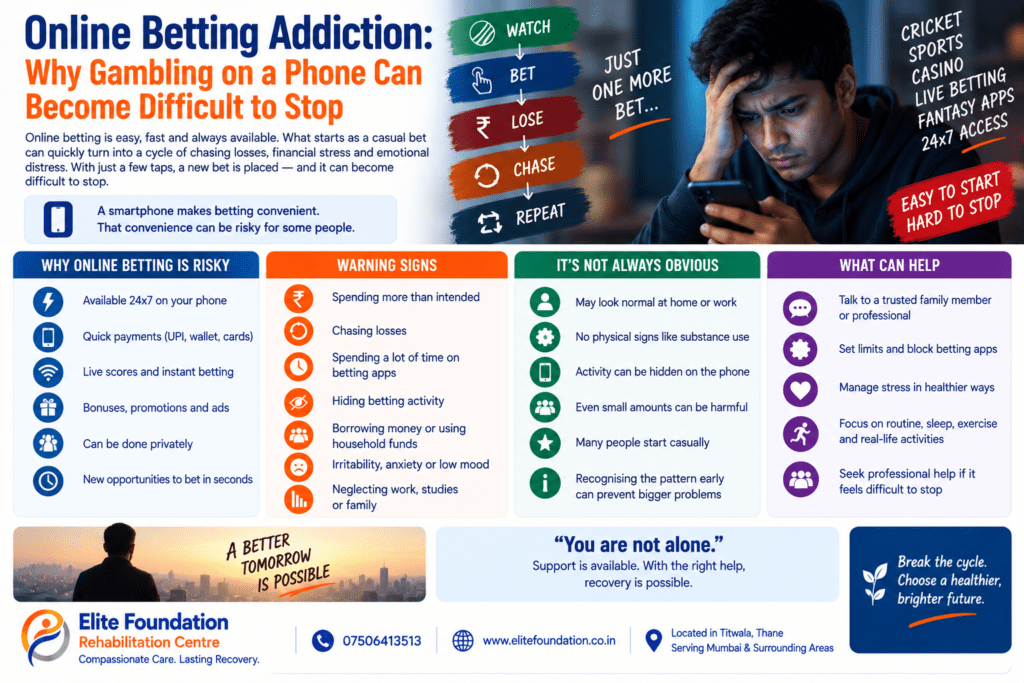
Online betting addiction can develop without somebody ever entering a casino or leaving home to place a wager.
The entire gambling environment can sit inside a phone.
A sporting event begins.
The person checks the score.
A betting opportunity appears.
Money can be transferred electronically within moments.
The bet loses.
Instead of having to travel somewhere or wait until another day, the person may be able to place another wager almost immediately.
The sequence can become:
phone → payment → bet → result → another payment → another bet.
For somebody who is already struggling with gambling control, that reduction in time and friction can matter.
But an important distinction needs to be made from the beginning:
a smartphone does not itself cause Gambling Disorder.
Millions of people use smartphones, digital payments and sports applications without developing gambling problems.
The concern is what happens when the phone combines several features that make gambling particularly easy to access:
- Constant availability
- Privacy
- Rapid payments
- Repeated opportunities to wager
- Live sporting events
- Immediate results
- Promotions and gambling cues
Families approaching a Elite Care Nasha Mukti Kendra in Thane may sometimes be dealing with this kind of behavioural addiction rather than alcohol or drug dependence. Where online betting becomes repeatedly difficult to control, gambling addiction treatment should examine not only how much money has been lost, but also how the person accesses betting, when urges occur, how payments are made, whether losses are chased, what is being hidden and what consequences have already developed.
What is online betting addiction?
“Online betting addiction” and “online gambling addiction” are common search terms rather than separate formal diagnoses.
The clinically recognised condition is Gambling Disorder.
The World Health Organization describes Gambling Disorder through three central features:
- Impaired control over gambling
- Increasing priority given to gambling over other activities and responsibilities
- Continuation or escalation despite negative consequences
Online access changes the environment in which these problems may develop.
It does not change the basic clinical question:
Can the person control the gambling, or has gambling started controlling important parts of the person’s life?
Online betting is not automatically Gambling Disorder
This distinction matters.
Someone placing an occasional online wager does not automatically have an addiction.
Someone losing money on one occasion does not automatically have Gambling Disorder.
Someone using their phone frequently during a sporting event does not automatically have a gambling problem.
The concern increases when there is a repeated pattern of:
- Trying to stop but continuing
- Betting more than intended
- Chasing losses
- Borrowing
- Hiding betting activity
- Using essential household money
- Losing sleep
- Ignoring work or family responsibilities
- Continuing despite obvious harm
Why can gambling on a phone feel different?
Think about the steps that traditional gambling may once have required.
A person might have needed to:
- Decide to gamble
- Travel somewhere
- Carry or obtain money
- Place the wager
- Wait for the outcome
Those steps created natural pauses.
With online betting, several of those pauses can disappear.
The person may already be:
- Holding the device
- Logged into a payment service
- Following the sporting event
- Receiving gambling-related cues
- Able to act on an urge immediately
That does not make every online user vulnerable to addiction.
It does mean that somebody who is already losing control may have fewer practical barriers between:
urge and action.
Research has identified specific features of smartphone betting associated with harm
A study examining smartphone betting in 267 young adults across 1,378 betting sessions identified several situational features of digital betting.
These included:
- Quick and easy access from home
- Ability to bet anywhere and at almost any time
- Privacy while betting
- Greater access to promotions and betting options
- Electronic financial transactions
Greater short-term betting harm was associated particularly with:
- Anywhere-anytime access
- Privacy
- Access to promotions and betting options
The study also found links between these situational features and behaviours such as impulsive betting and using multiple betting operators.
However, there are important limitations.
The participants were aged 18–29, the study concerned sports betting and related activities, and it was not an Indian population study.
It should therefore not be interpreted as:
“smartphones cause gambling addiction.”
A more accurate conclusion is:
certain features that smartphones can combine may make harmful betting easier for some people who are vulnerable to losing control.
1. Constant access removes distance from the next bet
One of the biggest changes created by online gambling is geographical access.
The person does not necessarily need to go anywhere.
Gambling may potentially occur:
- At home
- At work
- On public transport
- During a family function
- While watching television
- Late at night in bed
This means the opportunity to gamble can exist in places that were previously unrelated to betting.
A stressful day at work can become:
stress → phone → bet.
A loss during a match can become:
loss → phone → payment → another bet.
The physical distance between the urge and the gambling opportunity has become very small.
2. A phone can make gambling unusually private
A person sitting beside their family may appear to be:
- Checking messages
- Following cricket scores
- Using social media
- Reading news
while actually placing bets.
This makes online gambling easier to conceal than many traditional forms of gambling.
Family members may not discover the activity until they notice:
- Missing money
- Unexpected payments
- Loan messages
- Late-night phone use
- Unusual mood changes around sports results
Privacy itself is not harmful.
The concern is when privacy allows a worsening gambling pattern to continue without normal financial or social feedback.
3. UPI and other electronic payments can shorten the pause after a loss
UPI and other digital payment systems are ordinary, useful parts of everyday financial life in India.
They do not cause Gambling Disorder.
However, when somebody is already caught in a gambling cycle, the speed of an electronic payment can reduce the practical pause between losing money and attempting another wager.
Imagine someone loses ₹5,000.
There is a moment when they could stop.
Instead, they think:
“I only need another ₹5,000 to recover this.”
If money can be transferred immediately, there may be very little time for the emotional intensity of the loss to settle before another decision is made.
The cycle can become:
loss → urgency → digital payment → another wager.
The relevant problem is not UPI itself. It is the use of rapid access to money to continue gambling after the person had intended to stop.
Under India’s current online-gaming framework, facilitating fund transfers towards prohibited online money gaming services is itself prohibited. Illegal or offshore operators may nevertheless continue to create enforcement challenges, which is another reason behavioural-health advice and legal advice should remain separate.
4. Repeated betting events can turn one match into many gambling decisions
Sports betting is not always limited to predicting who will win the final match.
Depending on the product, betting opportunities can arise around multiple events.
During cricket, for example, someone may focus on:
- Toss outcomes
- Runs
- Wickets
- Overs
- Individual player performance
- Match result
The important behavioural point is not the sport itself.
It is the number of opportunities to make another financial decision.
A person can therefore move through several wagers during the same sporting event rather than making one decision and waiting until the end.
5. Live betting can reduce the time available for reflection
Some online betting environments are built around rapidly changing events.
The person sees:
a new event → a new price → a new opportunity.
That speed can encourage decisions based on immediate emotion rather than a previously planned limit.
After a loss, the next opportunity may appear before the person has emotionally accepted the previous result.
This becomes especially important during loss chasing.
6. Online betting can blend into ordinary phone habits
Phones are checked repeatedly throughout the day for completely normal reasons.
Messages.
Email.
Banking.
News.
Work.
Social media.
If gambling also lives on the same device, ordinary phone checking can become linked with gambling cues.
The person unlocks the phone to answer a message.
A few moments later, they are checking a score.
Then thinking about a bet.
This does not mean ordinary smartphone use is an addiction.
The separate guide on reducing compulsive phone use explains why a phone can act as a gateway to several very different behaviours and why the underlying activity needs to be identified rather than treating all screen use as one condition.
Phone addiction and online betting addiction are not the same thing
This distinction is particularly important.
A person may use their phone excessively because of:
- Social media
- Short videos
- Messaging
- Gaming
- Work
- Gambling
If gambling is the behaviour causing loss of control and financial harm, simply telling the person to:
“use your phone less”
may miss the real problem.
The relevant treatment target is gambling.
The phone is part of the environment through which the behaviour is being accessed.
Late-night betting can create a second problem: disrupted sleep
Online availability can extend betting into hours when traditional routines would normally have stopped.
Someone may:
- Follow international sporting events
- Stay awake checking results
- Continue gambling after the family has gone to sleep
- Wake during the night to check outcomes
The next day may bring:
- Fatigue
- Poor concentration
- Irritability
- Reduced work performance
The separate article on screen use, sleep and late-night phone habits explains the wider sleep issue in more detail.
Again, poor sleep does not diagnose Gambling Disorder.
But repeated sleep loss caused by gambling is evidence that the behaviour is beginning to interfere with normal functioning.
Online betting can make loss chasing happen faster
Loss chasing occurs when somebody keeps gambling because they are trying to recover money already lost.
Suppose the evening begins with:
“I’ll risk ₹2,000.”
The ₹2,000 is lost.
Now:
“I’ll put another ₹2,000 in and get back to zero.”
That loses too.
Now the person is ₹4,000 behind.
The goal changes again.
A small win no longer feels useful.
The person begins searching for a larger wager.
Online access can compress this sequence into a short period because another payment and another opportunity may be immediately available.
“One more bet” can become a repeating decision
Many gambling sessions do not begin with the intention to lose a large amount.
The financial damage grows through a series of smaller decisions.
For example:
₹1,000 → ₹2,000 → ₹2,000 → ₹5,000 → ₹10,000.
At each stage:
“one more”
feels smaller than the total amount eventually lost.
This is one reason transaction history can tell a different story from the person’s memory of the session.
Winning can also make stopping difficult
Online betting problems are not driven only by losing.
A memorable win can become powerful evidence in the person’s mind that:
“I know what I’m doing.”
A person may remember winning ₹30,000 in one match.
They may pay much less attention to the smaller deposits made across the previous several weeks.
A win can therefore strengthen confidence even when the overall financial result remains negative.
Sports knowledge is not the same as control over an outcome
Someone who follows cricket closely may genuinely understand:
- Player form
- Pitch conditions
- Team selection
- Weather
- Previous records
Knowledge can inform a prediction.
It cannot control what happens during the match.
Unexpected injuries, tactical decisions, individual performances or other events remain possible.
The dangerous shift is from:
“I know a lot about cricket.”
to:
“Because I know cricket, I can reliably recover gambling losses.”
Privacy can allow debt to grow before the family understands what is happening
A phone-based gambling problem may remain hidden while someone continues to:
- Go to work
- Attend family events
- Look outwardly well
- Use the same phone everybody else uses
The first clear warning may therefore be financial:
- Borrowing
- Missing household payments
- Credit-card balances
- Loan messages
- Money disappearing soon after payday
That is one reason online gambling can be discovered much later than families expect.
How can you tell if online betting has become a problem?
Possible signs include:
- Betting more than originally planned
- Repeated attempts to stop that fail
- Betting through the night
- Checking gambling opportunities throughout the day
- Making repeated deposits during one session
- Borrowing money to continue gambling
- Chasing losses
- Hiding transactions
- Deleting betting or payment evidence
- Becoming defensive when asked about gambling
- Using money intended for household expenses
- Continuing despite debt or relationship conflict
No individual sign establishes a diagnosis.
The pattern of impaired control and harm matters.
Someone can be addicted to betting without betting every day
Daily gambling is not required for a serious problem to exist.
Someone may mainly lose control around:
- Major cricket matches
- Tournaments
- Payday
- Weekends
- Periods of stress
The pattern may therefore look intermittent.
The relevant question is whether those episodes repeatedly involve loss of control and serious consequences.
Online betting can become emotional escape
Not everybody who gambles excessively is focused only on money.
Some people turn to betting when they are:
- Bored
- Stressed
- Lonely
- Angry
- Anxious
- Low in mood
For a period, the match, wager and possible result occupy attention.
The original problem moves into the background.
If money is then lost, the person may finish with:
the original emotional problem + a new financial problem.
Why deleting one betting app may not solve the whole problem
Removing access can be useful.
But if treatment consists only of deleting one application, the person may still have:
- The urge to gamble
- Loss-chasing thoughts
- Debt
- Sports-related triggers
- Emotional triggers
- Access through another route
The practical environment needs attention.
So does the behaviour underneath it.
The broader guide on how addiction treatment moves from assessment to longer-term recovery explains why changing access alone does not necessarily address the reasons a compulsive behaviour keeps returning.
Reducing friction can be part of recovery
If online access has made gambling almost automatic, recovery often involves deliberately putting friction back into the process.
Depending on the individual situation, that may include:
- Removing gambling access
- Using blocking tools
- Using formal self-exclusion where available
- Stopping gambling-related notifications or promotional messages
- Reducing access to unrestricted credit
- Protecting household money
- Separating essential expenses from easily accessible funds
- Involving a trusted person in agreed temporary financial safeguards where appropriate
The principle is simple:
make an impulsive decision harder to complete while the underlying gambling problem is being addressed.
The aim is not to remove the smartphone from somebody’s life
For most adults, permanently avoiding smartphones is neither realistic nor necessary.
The same device may be needed for:
- Work
- Banking
- Communication
- Navigation
- Healthcare
Treatment therefore needs to distinguish between:
necessary digital life
and:
the specific pathways that lead back to gambling.
The objective is not:
“never use a phone again.”
It is:
“stop the phone from being an immediate route from urge to wager.”
India’s law governing online money games has changed substantially
The legal environment around online money gaming in India changed significantly through the Promotion and Regulation of Online Gaming Act, 2025 and the Promotion and Regulation of Online Gaming Rules, 2026.
The Ministry of Electronics and Information Technology’s official Online Gaming Act and Rules page contains the notified framework.
The 2025 Act extends across India and defines an online money game as an online game involving payment, deposits or other stakes in expectation of monetary or other enrichment, irrespective of whether the game is based on:
- Skill
- Chance
- Or a combination of both
The Act separately excludes qualifying e-sports from that definition and provides a different framework for online social games.
Among other provisions, the Act prohibits the offering of online money games and online money gaming services, advertisements promoting them and facilitation of fund transfers towards such services.
The 2026 Rules were notified on 22 April 2026 and came into force on 1 May 2026, operationalising the regulatory framework. The Online Gaming Authority of India was also formally constituted.
The current law is in force, but its constitutional validity is being challenged
The Promotion and Regulation of Online Gaming Act, 2025 is currently in force together with the 2026 Rules.
However, constitutional challenges to the Act are pending before the Supreme Court of India.
In an order dated 8 September 2026, the Competition Commission of India noted that the validity of the Act was under challenge before the Supreme Court but that no order staying its operation had been brought to the Commission’s notice.
Accordingly, as of September 2026, the Act continues to operate as the governing national framework for online money games.
This legal position may change as the court proceedings develop.
For that reason, anyone seeking advice about whether a particular platform, game, transaction or activity is lawful should check the latest official legal position rather than relying on an older article, advertisement or platform claim.
The law and Gambling Disorder answer different questions
This article is not a legal guide.
The law asks:
How is a particular online gaming activity classified and regulated in India?
A clinical assessment asks:
Does this person’s gambling show impaired control, increasing priority and continuation despite significant harm?
Those are different questions.
A person may still need psychological or psychiatric help for gambling-related harm even after access to a particular online platform has stopped.
Debt, urges, learned behaviour, anxiety, depression, family conflict and loss-chasing thoughts do not automatically disappear because the legal environment changes.
Anyone needing advice about the legality of a particular platform, transaction or activity should obtain current legal guidance rather than relying on a behavioural-health article.
Illegal or offshore access does not remove the behavioural-health risk
Online services can cross geographical boundaries.
WHO notes that illegal, unlicensed and offshore gambling creates substantial enforcement challenges internationally.
From a clinical perspective, however, the key concern remains the same.
If somebody is repeatedly finding new routes to gamble after accounts are blocked or services become unavailable, that repeated effort may itself demonstrate how strongly gambling has begun to take priority.
What should families look for with phone-based betting?
Families may notice:
- Constant score checking
- Repeated digital transactions
- Late-night phone activity
- Phone secrecy
- Unexplained loans
- Money disappearing after payday
- Sudden irritability after sporting results
- Unusual confidence after wins
- Promises that one future result will solve existing debt
The separate guide on family support during addiction recovery explains why relatives may need both compassion and clear financial boundaries when addictive behaviour begins affecting the whole household.
Do not fund a “final online bet”
A family may hear:
“I know the next match.”
“This is the safest one.”
“Give me one last amount and I can clear everything.”
Urgent financial need does not make the next uncertain outcome reliable.
If ₹1 lakh has already been lost, another wager is not a debt-management strategy.
The direction needs to change from:
“How do we win it back?”
to:
“How do we stop another loss and manage the money already owed?”
When online betting stops, the triggers may remain
A person may remove betting access but still react strongly to:
- A cricket match
- Payday
- Financial stress
- A remembered big win
- Discussion about odds
- Friends associated with betting
This is why relapse prevention needs more than account closure.
The person needs to understand:
- What usually starts the urge
- What thoughts make betting seem justified
- How money becomes available
- What happens after a loss
- Who can be contacted before another wager is made
What can online betting addiction treatment address?
Treatment can examine:
- Loss of control
- Loss chasing
- Gambling-related beliefs
- Sports and payment triggers
- Easy digital access
- Borrowing and debt
- Secrecy
- Stress and emotional escape
- Sleep disruption
- Depression or anxiety
- Alcohol or other substance use
- Relationship conflict
- Relapse prevention
The aim is not simply to keep somebody away from an application for a few weeks.
It is to understand why gambling kept returning and create a realistic plan for managing the situations that previously led from:
urge → phone → payment → bet.
Does online betting addiction require residential rehab?
Not automatically.
Some people may be treated through outpatient psychological or psychiatric care alongside financial and digital safeguards.
More structured treatment may be considered when:
- Loss of control is severe
- Debt is substantial
- Repeated outpatient attempts have failed
- The person repeatedly finds new ways to access gambling
- Serious mental-health or substance-use problems are also present
- The home environment is unsafe or unable to support recovery
The level of care should be based on the individual clinical and safety picture rather than the word “addiction” alone.
A practical online-betting self-check
Ask:
- Do I place more bets than I originally planned?
- Do I make another deposit immediately after losing?
- Do I repeatedly try to win previous losses back?
- Do I check betting opportunities throughout the day?
- Do I gamble late at night?
- Have I borrowed to gamble?
- Have I hidden online transactions?
- Do I use money intended for something else?
- Have I deleted one account and then found another way to bet?
- Have I promised to stop but returned repeatedly?
- Is online betting affecting sleep, work, relationships or finances?
Several “yes” answers do not independently establish Gambling Disorder.
They indicate that the behaviour deserves closer assessment.
Frequently asked questions
What is online betting addiction?
Online betting addiction is a common term for gambling conducted online that becomes persistently difficult to control and continues despite financial, psychological, relationship or other significant consequences. The recognised clinical condition is Gambling Disorder.
Is online gambling addiction different from Gambling Disorder?
Online gambling describes the setting or method through which gambling occurs. Gambling Disorder is the clinical condition. A person can develop Gambling Disorder through predominantly online or offline gambling.
Can gambling on a phone become addictive?
Some people can develop difficult-to-control gambling through a smartphone. The phone itself is not the cause of Gambling Disorder, but constant access, privacy, electronic transactions and repeated betting opportunities can reduce barriers to continued gambling.
Why is online betting difficult to stop?
For some people, immediate access can allow an urge to turn into a wager very quickly. Loss chasing, previous wins, emotional triggers, privacy, repeated betting opportunities and rapid access to money can also contribute.
Does having a betting app mean someone has gambling addiction?
No. Having an application or having gambled online does not diagnose Gambling Disorder. The important issues are impaired control, increasing priority and continuation despite significant harm.
Can UPI or instant payments make gambling problems worse?
UPI itself does not cause Gambling Disorder. However, when someone is already struggling to control gambling, rapid access to money can reduce the pause between a loss and another wager, particularly during loss chasing.
Why does someone keep depositing after losing?
The person may be chasing losses. Another deposit begins to feel like an opportunity to recover money already lost rather than a new gamble carrying additional risk.
Can someone be addicted to betting only during cricket matches?
A serious gambling problem does not require daily betting. Someone can repeatedly lose control around particular sporting events or tournaments and still experience significant financial and relationship harm.
Does cricket knowledge protect someone from betting losses?
No. Knowledge can inform a prediction, but it cannot control future events or guarantee a profitable wager.
Is online betting addiction the same as phone addiction?
No. A person can have problematic smartphone use without gambling, and Gambling Disorder can occur without general phone overuse. When the main harm comes from betting, gambling should be assessed directly.
Can online betting cause debt?
Repeated losses, rapid redepositing, loss chasing and borrowing can produce serious debt. Financial harm can occur even before someone meets the full diagnostic threshold for Gambling Disorder.
Can online betting affect sleep?
Yes. Someone may stay awake following events, checking results or continuing to wager. Repeated gambling-related sleep loss can then affect concentration, mood and daytime functioning.
Can somebody stop online betting simply by deleting the app?
Deleting access can be useful, but it may not be sufficient when the person still has strong urges, loss-chasing beliefs, financial triggers or alternative routes to gamble. A broader recovery plan may be needed.
How can someone make online betting harder to access?
Depending on circumstances and available services, strategies can include account closure or self-exclusion, blocking tools, reducing gambling-related notifications and promotions, restricting easy access to credit and protecting essential household money.
Are online money games prohibited in India?
India’s Promotion and Regulation of Online Gaming Act, 2025 establishes a national framework that prohibits the offering of online money games and related services, advertisements and facilitation of fund transfers. Its definition covers games based on skill, chance or both when money or other stakes are involved in expectation of monetary or other enrichment, subject to the Act’s specific definitions and exclusions. The 2026 Rules operationalise that framework.
The constitutional validity of the Act is currently being challenged before the Supreme Court. As of September 2026, no stay on its operation had been brought to the notice of the Competition Commission of India, and the Act continued to operate. Individual legal questions should therefore be checked against the latest official position.
Did India’s online gaming rules change in 2026?
Yes. The Promotion and Regulation of Online Gaming Rules, 2026 were notified on 22 April 2026 and came into force on 1 May 2026, operationalising the framework under the 2025 Act.
Is the 2025 Online Gaming Act being challenged in court?
Yes. Constitutional challenges to the Promotion and Regulation of Online Gaming Act, 2025 are pending before the Supreme Court of India. The Competition Commission of India recorded on 8 September 2026 that no order staying the Act’s operation had been brought to its notice, so the Act continued to operate at that time.
Does banning or blocking a betting platform cure gambling addiction?
No. Reduced access may prevent further immediate gambling, but a person can still have urges, debt, emotional triggers and gambling-related beliefs that require attention.
When should professional help be considered?
Professional assessment becomes particularly relevant when online gambling repeatedly feels impossible to control, attempts to stop fail, losses are chased, debt or borrowing increases, gambling is being hidden or work, sleep, relationships or mental health are deteriorating.
What if gambling losses cause severe hopelessness or suicidal thoughts?
Gambling-related financial distress can become a serious mental-health safety issue. Suicidal thoughts require prompt professional assessment. If there is suicidal intent, a suicide plan, a recent attempt, inability to remain safe or another immediate danger, urgent emergency mental-health care should take priority. In India, Tele-MANAS can be reached on 14416 or 1800-89-14416 for mental-health support.
Why the phone matters — without blaming the phone
The smartphone did not invent gambling.
It did change how easily gambling can potentially fit into everyday life.
A person can carry:
the sporting event, the gambling opportunity and access to money
in the same device.
That can make the journey from:
thought → urge → wager
extremely short.
For most people, that still does not become Gambling Disorder.
For somebody who is already struggling with control, however, constant access, privacy, rapid electronic transactions and repeated opportunities to wager can make stopping harder.
The recovery task is therefore not to declare technology the enemy.
It is to understand exactly how technology fits into the gambling cycle.
Sometimes that means blocking access.
Sometimes it means changing financial arrangements.
Sometimes it means avoiding sporting or emotional triggers temporarily.
And when the gambling pattern has become persistent despite debt, secrecy, failed attempts to stop or damage to everyday life, the problem needs to be treated as more than excessive phone use.
Medical and legal disclaimer: This article provides general educational information about gambling-related behaviour and does not replace individual psychological, psychiatric, medical, financial or legal advice. Smartphone use, UPI, digital payments or online access alone do not establish Gambling Disorder. India’s online money-gaming framework is currently in force but is subject to constitutional challenge before the Supreme Court, and the legal position may change as proceedings develop. Anyone relying on the legal status of a particular platform, game, payment or activity should check current official sources or obtain qualified legal advice. Gambling-related debt and severe psychological distress can create serious safety risks. Suicidal thoughts require prompt professional assessment; suicidal intent, a suicide plan, a recent attempt, inability to remain safe or another immediate danger requires urgent emergency care.
