
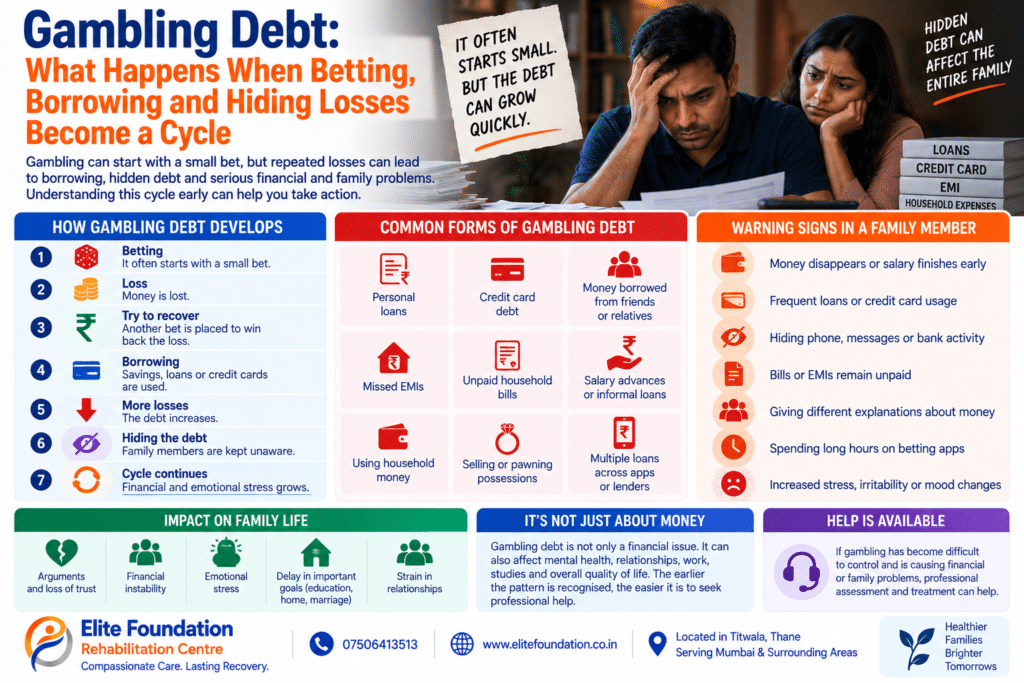
Gambling debt often becomes visible to families only after betting losses have already turned into personal loans, credit-card balances, missed EMIs and repeated borrowing. Families searching for rehabs in Mumbai may first notice money disappearing, hidden bank activity or urgent requests for cash before they realise gambling is involved. At Elite Foundation, our gambling rehab in Mumbai approach looks at the full financial cycle: betting, borrowing, hiding losses, protecting household money and addressing the behaviour that keeps creating new financial harm.
Gambling debt rarely begins with somebody deciding that they want to owe several lakhs. It may begin with a relatively small loss, followed by another deposit, then another. Savings may be used first. Credit cards, personal loans, borrowing from friends or money intended for household expenses may follow.
By the time a family discovers what is happening, they may not be looking at one gambling loss at all. There may be several debts created at different times, money owed to different people, missed household payments and financial information that has never been fully disclosed.
The pattern can become:
betting → loss → borrowing → more financial pressure → hiding the debt → missed obligations → further borrowing.
This article focuses on that financial and family cycle: how gambling debt develops, why it can remain hidden, what families may discover and why dealing with the debt requires more than simply finding enough money to clear one loan.
What is gambling debt?
Gambling debt is money owed, unpaid or financially displaced because of gambling activity or its consequences. It can include money directly borrowed to gamble, but it can also include debt created indirectly because money intended for another responsibility was lost through gambling.
For example, somebody may not technically take a “gambling loan”. They may gamble the money intended for an EMI and later take a personal loan to cover that missed payment. The loan is still part of the wider gambling-related financial problem because it became necessary after money intended for another purpose was lost.
Gambling debt can therefore involve personal loans, credit-card balances, informal borrowing, salary advances, unpaid household bills, missed EMIs or money owed to friends and relatives. In more severe cases, assets may also be sold or pawned to generate cash.
Financial harm can begin before somebody has a formal Gambling Disorder diagnosis
A person does not need to meet every diagnostic requirement for Gambling Disorder before the financial situation becomes serious. The World Health Organization identifies financial distress, relationship breakdown and diversion of household spending from essential goods and services among important gambling-related harms. WHO also notes that gambling can contribute to poverty when essential household spending is displaced.
This matters because families may become caught up in the question, “Is this really addiction?” while school fees remain unpaid, an EMI has bounced or household savings have disappeared.
Diagnosis matters for treatment, but financial harm does not need to wait for a formal label before it is taken seriously.
How gambling and debt begin feeding each other
In the early stages, gambling may be funded from disposable income. The financial situation becomes more serious when the person starts using money that already has another purpose or begins borrowing because available funds have run out.
A ₹20,000 loss may initially feel manageable. If more money is then lost, the financial gap increases. When savings are no longer enough, borrowing may begin to look like a temporary bridge rather than another financial commitment.
The problem is that borrowed money is not replacement income. If it is lost through further gambling, the original loss remains and a repayment obligation has been added to it.
Personal loans can turn a gambling loss into a fixed monthly obligation
A personal loan changes the nature of the problem. The gambling loss may have happened during one evening, but the repayment obligation can continue for months or years.
Once an EMI is attached to the debt, less monthly income may remain available for household expenses and other commitments. If gambling continues during this period, the family may face two pressures at once: new gambling losses and repayment of previous gambling-related borrowing.
That is why gambling debt cannot be assessed only by asking how much was lost on one particular day.
Repeated loan applications can be a warning sign families notice late
A spouse or parent may initially know about one loan. Later they discover another application, another lender or another repayment obligation. The debts may have been created at different times, which makes the total difficult for the family—and sometimes the person gambling—to calculate accurately.
The explanations may also vary. One loan is described as a business expense, another as an emergency and another as temporary help until salary arrives. No single explanation proves gambling, but unexplained repeated borrowing alongside known betting activity deserves attention.
The wider guide on gambling addiction symptoms and warning signs explains how repeated borrowing, hidden transactions and unexplained financial changes may appear before the full gambling problem is disclosed.
Credit cards can hide the size of gambling financial problems
Credit can delay the point at which somebody appears to have run out of money. A person may have no meaningful savings remaining but still have access to a card limit, cash advance or other credit facility.
The financial problem becomes more visible when repayment falls due. What looked temporarily like available money was actually borrowed money that must now be repaid, potentially together with interest or other charges depending on the arrangement.
If several cards or credit facilities are involved, the family may not immediately know the total amount outstanding.
Borrowing from friends can spread debt across several relationships
Informal borrowing can be particularly difficult to identify because there may be no single statement showing the entire financial picture. Somebody may borrow ₹10,000 from one friend, ₹15,000 from a colleague, ₹20,000 from a relative and another amount elsewhere.
Each person may believe they are helping with a one-off emergency. Nobody sees the total debt.
This fragmentation can allow the situation to grow while also turning financial harm into relationship harm. Calls may be avoided, repayment promises may be broken and the person may begin distancing themselves from people who are asking for their money back.
Missed EMIs can be the point when hidden gambling debt becomes visible
A family may not know where money has been going until a regular payment fails. A housing EMI, vehicle repayment, insurance premium or another important commitment suddenly remains unpaid even though income has not obviously changed.
This often produces the first difficult financial question: “Where did the money go?” If gambling has been hidden, the person may still try to cover the missing payment without revealing the underlying loss. That may lead to another loan or further borrowing.
One missed EMI does not prove gambling. The concern is the wider pattern of gambling activity, disappearing money, unexplained borrowing and important financial obligations being missed at the same time.
Household money can quietly become gambling money
One of the most serious changes occurs when the person stops separating disposable money from money intended for ordinary family life. Rent, school fees, groceries, healthcare expenses or savings may begin being treated as temporarily available because the person believes the money can be replaced later.
If that money is lost, the household now has two problems: the gambling loss itself and the essential expense that still needs to be paid.
This is why diversion of household money is not merely a private financial decision. The consequences can affect spouses, children, parents and other people who had no involvement in the gambling.
Selling assets can signal that ordinary sources of money have been exhausted
A person experiencing escalating gambling debt may begin selling possessions. Jewellery may be pawned, a phone or laptop may be sold, or a vehicle may suddenly be discussed as something that could be converted into cash.
People sell assets for many legitimate reasons, so this behaviour alone does not establish a gambling problem. Context is important.
The concern becomes much stronger when asset sales appear alongside unexplained borrowing, missed payments, hidden transactions and repeated gambling losses.
Hidden bank accounts can make the true financial position difficult to calculate
When gambling becomes difficult to disclose, financial activity may be moved away from accounts that family members normally see. A person may hide statements, create additional accounts, use separate payment routes or delete transaction notifications.
The purpose may be to prevent others from discovering how much money has been lost or how much has been borrowed.
This becomes a major problem when the family eventually tries to calculate the debt. One visible account may appear manageable while significant financial obligations exist elsewhere.
Lying about gambling losses often develops gradually
Financial secrecy does not always begin with one enormous lie. The person may first understate the amount: “I only lost ₹5,000,” when the actual figure is much higher. Later they disclose one loan while another remains hidden.
Each disclosure may therefore contain only part of the financial picture.
Shame, fear of conflict and genuine confusion about multiple debts can all affect what is disclosed. The objective should be to establish an accurate financial position, not simply to force a confession through humiliation.
Gambling debt can create pressure to gamble again
Once debt becomes substantial, the person may begin seeing another gambling attempt as a possible shortcut out of the financial problem. That is where the financial consequences of Article 6 connect with the psychology covered separately in Article 5.
The dedicated guide on chasing losses in gambling explains why previous losses can become a reason to keep gambling and why “getting back to zero” can become psychologically difficult to abandon.
For this debt article, the important financial point is simpler: existing debt is real, while future gambling winnings are uncertain. A repayment plan should therefore not depend on another wager succeeding.
Trying to win gambling debt back can create more debt
If somebody borrows additional money and then loses it through gambling, both the previous financial obligation and the new borrowing remain. The debt has increased rather than been repaired.
The psychology behind repeated attempts to recover losses belongs to the separate loss-chasing article. Here, the practical financial principle is that money required for debt repayment should not be exposed to another uncertain gambling outcome.
Paying off gambling debt does not automatically treat the gambling problem
Families often face difficult decisions after discovering debt. Parents may want to clear loans immediately. A spouse may consider using savings because of missed payments or pressure from lenders.
Urgent financial obligations may need attention, but paying off debt does not automatically change the behaviour that created it.
If gambling continues, new borrowing can appear after the previous debt has been cleared. This is why debt management and gambling treatment should be viewed as connected but separate tasks.
Repeated family bailouts can unintentionally hide the scale of the problem
Helping somebody through a financial crisis is understandable. The problem arises when gambling-related debts are repeatedly cleared without any change in gambling behaviour, financial transparency or access to money.
The family may repeatedly sacrifice savings, investments or other resources while the underlying behaviour continues.
This does not mean relatives should abandon somebody who is struggling. It means financial support needs boundaries that also protect the people affected by the gambling.
The Elite Foundation guide on family support in addiction recovery explains why compassion and accountability need to work together rather than becoming repeated financial rescue.
What if your husband has gambling debt?
“Husband gambling debt” is an important family-search concern because spouses may be the first people to discover the financial consequences. The same principles apply when the person gambling is a wife, partner or another family member.
A spouse may discover credit-card balances, loan repayments, hidden transfers or money missing from a joint account. The immediate priority is to understand what financial obligations actually exist and whether essential household money or joint liabilities are affected.
If the relationship is safe, specific financial questions are usually more useful than general accusations. Ask about known loans, outstanding cards, missed payments, informal borrowing and whether additional accounts or debts exist.
If there is violence, intimidation, coercive control or economic abuse, personal safety takes priority over obtaining financial information or forcing disclosure. Professional safeguarding, legal or domestic-abuse support may be required.
Gambling debt can damage a marriage even after the money is repaid
The financial amount is only one part of the harm. Hidden loans and undisclosed losses can damage trust between partners.
A spouse may begin wondering whether new disclosures are complete or whether another loan remains hidden. Ordinary conversations about money can become emotionally charged.
Repaying the debt therefore does not automatically repair the relationship. Trust may need to be rebuilt through consistent financial behaviour, honest disclosure and time.
How should a family calculate the real gambling debt?
The first objective is accuracy. The calculation should include more than the amount the person remembers losing directly through gambling.
A full picture may include personal loans, credit-card balances, informal borrowing, unpaid EMIs, money owed to relatives, missed household expenses and assets that have been sold or pawned.
It can also help to distinguish between money that has already been permanently lost and money that remains an outstanding debt requiring repayment.
The purpose is not shame. It is to replace uncertainty and fragmented disclosures with one realistic financial picture.
Do not include hoped-for gambling winnings in the debt plan
A debt calculation should be based on actual income, existing assets, genuine available funds and real repayment obligations.
A statement such as “We owe ₹3 lakh, but I should be able to win ₹1 lakh back” does not reduce the current debt. The hoped-for ₹1 lakh is not existing income.
Keeping uncertain gambling outcomes outside the repayment plan makes the financial position clearer and prevents the debt strategy itself from depending on further gambling.
Another personal loan is not automatically a gambling debt solution
Whether refinancing, restructuring or taking another loan is appropriate depends on the person’s overall financial circumstances and should be considered carefully with qualified financial advice where necessary.
The gambling-specific concern is that new borrowing should not create additional money that is then exposed to further gambling.
If gambling remains active, increasing available credit can increase the amount of money at risk rather than solving the existing debt.
What should happen to household money while gambling is still active?
Essential expenses need protection. Housing, food, healthcare, children’s education and unavoidable household bills should not be treated as temporary gambling capital.
Depending on the circumstances, safeguards may involve separating money required for essential expenses, reducing access to unrestricted credit or using agreed temporary financial oversight with a trustworthy person.
Such arrangements should be proportionate and safe. The objective is protection of household finances, not punishment or coercive control.
NICE recommends assessing borrowing and the wider financial impact
NICE guidance on gambling-related harms recommends assessing the financial impact of gambling, including money spent relative to income and borrowing associated with gambling. It also considers effects on relationships, mental health and safeguarding.
This broader assessment matters because gambling debt rarely exists in isolation. The person may simultaneously be dealing with family conflict, anxiety, sleep problems, work difficulties or pressure from people who are owed money.
A useful assessment therefore asks not only how much debt exists, but how it developed, whether borrowing is continuing and what risks now exist for the individual and family.
When gambling debt and mental-health distress begin reinforcing each other
As debt grows, so can fear. The person may worry about family discovery, creditor contact, missed payments, work performance or losing important assets. Sleep and concentration may deteriorate.
Significant financial distress can also occur alongside depression, anxiety or other mental-health problems. These should be assessed rather than assuming every emotional symptom is caused by debt alone.
The financial crisis and the person’s psychological health may therefore need attention at the same time.
Gambling debt can become a serious mental-health safety issue
Large debts, shame and fear of disclosure can be associated with severe psychological distress. Statements such as “I have ruined everything”, “There is no way out” or “My family would be better without me” should be taken seriously.
Debt itself does not allow anyone to predict suicide, and suicidal behaviour has multiple causes. However, gambling-related financial distress can occur alongside self-harm or suicide risk.
Suicidal thoughts require prompt professional assessment. Suicidal intent, a suicide plan, a recent attempt, inability to remain safe or another immediate danger requires urgent emergency mental-health care. Financial discussions should not delay emergency support when immediate safety is at risk.
Stopping gambling and resolving debt are two different recovery tasks
The debt may remain after gambling stops. That can be discouraging because somebody may expect the financial problem to disappear immediately once betting ends.
In reality, the two tasks need separate plans. Treatment focuses on stopping new gambling losses, reducing relapse risk and addressing the behaviour that contributed to borrowing and secrecy. The financial plan addresses the debt that already exists.
Separating those tasks is important because otherwise the person may keep treating gambling as part of the financial solution.
What can gambling treatment address when debt is already severe?
Treatment cannot erase existing loans. What it can address is the behaviour that may otherwise continue creating new debt.
Assessment may examine access to money, borrowing patterns, financial secrecy, gambling triggers, repeated attempts to stop and beliefs that encourage continued gambling. Depression, anxiety, substance use, sleep disturbance, relationship strain and safety concerns may also need assessment where relevant.
Some people may be treated through outpatient psychological or psychiatric care. More structured treatment may be considered when gambling repeatedly remains out of control, financial harm continues or serious psychiatric and safety concerns are present.
A practical first response when gambling debt is discovered
The first financial objective is to stop the debt from continuing to grow through further gambling. The next step is to establish what is actually owed.
Identify known loans, credit-card balances, informal debts, overdue payments and essential household expenses. Protect money needed for immediate necessities and keep uncertain future gambling winnings completely outside the repayment calculation.
If debts are substantial or complicated, qualified financial or legal advice may be appropriate. If repeated gambling continues despite the financial consequences, professional behavioural or mental-health assessment should also be considered.
If the family is facing threats, violence, coercion or financial abuse, safety should come before attempts to investigate accounts or confront the person.
Frequently asked questions about gambling debt
What is gambling debt?
Gambling debt is money owed, unpaid or financially displaced because of gambling. It can include personal loans, credit-card balances, informal borrowing, missed payments or other obligations created after gambling losses.
Why do gamblers get into debt?
Debt can develop when gambling losses exceed available disposable money and the person begins borrowing, using credit or diverting money intended for other expenses.
Why does someone borrow money after losing at gambling?
There can be several reasons, including covering previous losses, meeting household obligations after money has been lost or continuing gambling. Repeated borrowing can turn a temporary loss into a longer-term repayment problem.
Can gambling debt include credit cards?
Yes. Credit-card balances can form part of gambling debt when cards are used directly for gambling or indirectly to cover expenses after other money has been lost.
Can gambling cause missed EMIs?
Yes. If money intended for an EMI is diverted to gambling or earlier losses reduce available household funds, repayments can be missed. One missed EMI alone does not prove gambling, but it can form part of a wider pattern.
Why do gamblers hide debt?
Shame, fear of relationship conflict, fear of losing access to money and hope that the financial problem can be repaired before anyone notices can all contribute to secrecy.
Why does gambling debt keep increasing?
Debt may increase through continued gambling, new borrowing, credit use, missed repayments and additional financial charges. Trying to recover earlier losses through further gambling can add still more debt.
Can someone have gambling debt without Gambling Disorder?
Yes. Financial harm can occur even when somebody does not meet the full diagnostic threshold for Gambling Disorder. Repeated borrowing, inability to stop and continuation despite serious consequences should nevertheless prompt closer assessment.
Should family members pay gambling debt?
There is no single answer for every situation. Urgent obligations may require attention, but repeatedly clearing debts without addressing ongoing gambling can allow new financial problems to develop. Significant debt should be considered with appropriate financial advice alongside treatment where necessary.
What should I do if my husband has gambling debt?
Try to establish the known debts, whether joint accounts or household obligations are affected and whether additional borrowing exists. If the relationship is safe, discuss specific financial facts rather than relying only on accusation. Where violence, intimidation or coercive control is present, personal safety should come first.
Should I lend money so someone can win gambling debt back?
Another gambling outcome cannot reliably repair an existing debt. Lending additional money specifically for another wager exposes more money to the same uncertainty.
Can selling assets solve gambling debt?
Selling an asset may generate cash, but it does not address the gambling behaviour. Major asset decisions should form part of a realistic financial plan rather than creating more money for gambling.
Can taking another loan solve gambling debt?
That depends on the person’s wider finances and may require qualified financial advice. If gambling remains active, additional borrowing can increase the money available to lose rather than resolving the problem.
How do I get gambling debt help?
Begin by stopping new gambling losses, identifying all known debts and protecting essential household money. Complex or substantial debt may require qualified financial or legal advice, while repeated gambling may require psychological or psychiatric assessment.
Does gambling debt treatment mean residential rehab?
Not automatically. Some people may receive outpatient treatment alongside financial safeguards. More structured care may be appropriate when gambling remains severe, repeated attempts to stop fail or major psychiatric or safety concerns are present.
Can gambling debt cause depression or anxiety?
Gambling-related financial distress can contribute to anxiety, shame, sleep problems and relationship conflict. Depression and anxiety may also have other causes or may have existed beforehand, so individual assessment is important.
Can clearing the debt cure gambling addiction?
No. Repaying debt can reduce financial pressure, but it does not automatically change gambling urges, secrecy, access to money or other behaviours that contributed to the debt.
What is the biggest mistake after discovering gambling debt?
One major risk is allowing the repayment plan itself to depend on future gambling winnings. Debt planning should be based on actual income, available assets and realistic repayment options.
When should professional gambling help be considered?
Professional assessment becomes increasingly important when debt continues to grow, borrowing remains hidden, household money is affected, attempts to stop repeatedly fail or significant mental-health and relationship problems are developing.
What if gambling debt causes suicidal thoughts?
Suicidal thoughts require prompt professional assessment. Suicidal intent, a suicide plan, a recent attempt, inability to remain safe or another immediate danger requires urgent emergency mental-health care.
The debt needs a financial plan; the gambling needs a treatment plan
Gambling debt becomes particularly difficult when the financial consequences are spread across loans, credit cards, unpaid bills, informal borrowing and hidden transactions. By the time a family understands the situation, the debt may already be affecting several areas of household life.
The first question therefore should not be how to win the money back. It should be how to stop new financial harm, establish the true amount owed and protect essential household expenses.
The existing debt may require realistic repayment planning, accurate financial disclosure and qualified financial or legal advice where appropriate. The gambling behaviour may require separate psychological or psychiatric assessment, changes to access to money and a plan to prevent further gambling-related borrowing.
For families, the goal is not to shame somebody over every rupee lost. It is to stop the financial situation becoming larger, protect people who depend on the household income and ensure that clearing today’s debt does not simply create space for another hidden loan tomorrow.
Medical and financial disclaimer: This article provides general educational information and does not replace individual psychological, psychiatric, medical, financial or legal advice. Debt arrangements, lending obligations and repayment options vary according to individual circumstances and should be discussed with appropriately qualified professionals where necessary. Gambling-related debt does not by itself establish Gambling Disorder. Where gambling occurs alongside violence, threats, coercive control or economic abuse, family safety should take priority over confrontation or attempts to control finances. Gambling-related financial distress can also occur alongside self-harm or suicide risk. Suicidal thoughts require prompt professional assessment; suicidal intent, a suicide plan, a recent attempt, inability to remain safe or another immediate danger requires urgent emergency care.
