
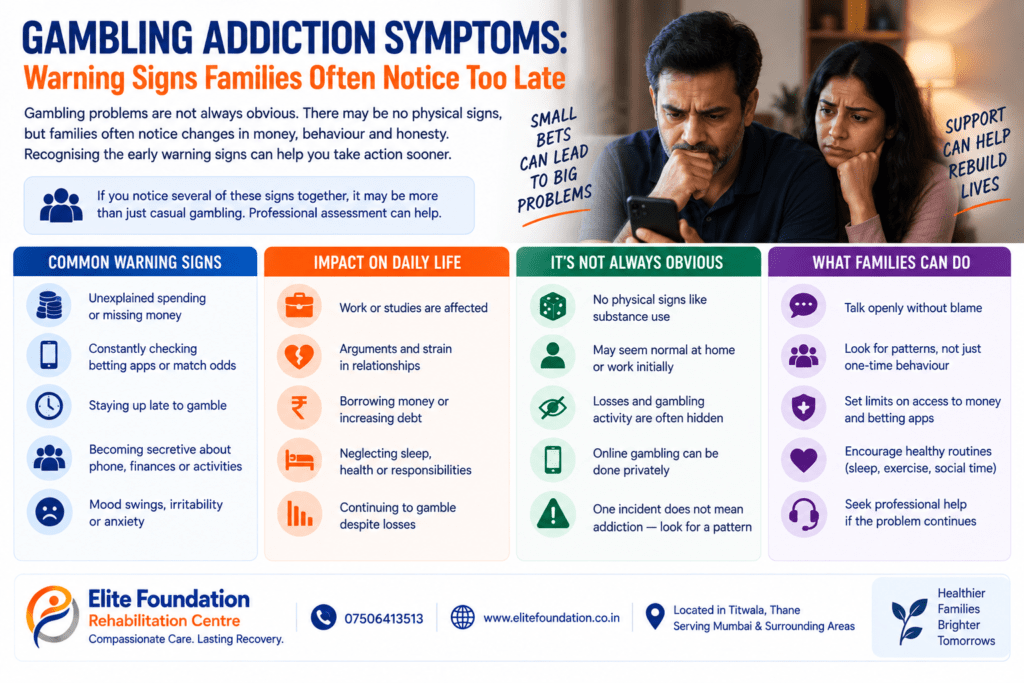
Gambling addiction symptoms can be difficult for families to recognise because there may be no obvious physical sign that immediately explains what is happening.
There may be no smell of alcohol.
No bottle to discover.
No obvious intoxication.
No visible substance.
Instead, families may notice something much less specific at first:
money is disappearing.
A salary seems to finish unusually early.
A bill that was supposed to be paid is still outstanding.
A family member suddenly needs to borrow ₹10,000.
Then another ₹20,000.
The explanation changes each time.
Someone who used to leave their phone anywhere now keeps it constantly in their hand.
They stay awake late at night.
They become unusually tense after checking a match result or their mobile screen.
A few days later, they are suddenly confident that:
“Everything will be sorted soon.”
For families, gambling problems often reveal themselves through these small inconsistencies long before anybody openly says:
“I cannot control my gambling.”
Families approaching a Elite Care Rehab in Mumbai may sometimes be dealing with a behavioural addiction rather than alcohol or drugs. Where gambling has become persistently difficult to control, gambling addiction treatment should examine the financial pattern, betting behaviour, loss chasing, borrowing, secrecy, relationships, emotional health and any other condition occurring alongside it.
But no single suspicious transaction, bad mood or late night proves Gambling Disorder.
The important thing is the pattern developing across money, behaviour, honesty, relationships and control.
What do gambling addiction symptoms actually look like?
People often expect addiction symptoms to be physical.
With gambling, many of the earliest signs are behavioural or financial.
The World Health Organization describes Gambling Disorder around impaired control, increasing priority given to gambling and continuation despite negative consequences.
Families, however, may not directly observe “impaired control”.
They observe what impaired control leaves behind.
For example:
| Underlying problem | What the family may actually notice |
|---|---|
| Loss chasing | Repeated urgent requests for money shortly after a previous loss |
| Increasing priority | Phone use, betting or checking odds begins interrupting meals, work, sleep or family time |
| Financial harm | Bills remain unpaid despite regular income |
| Secrecy | Banking screens, messages or transactions are suddenly hidden |
| Repeated loss of control | Promises to stop are followed by another episode of betting |
| Continuation despite consequences | Gambling continues despite debt, arguments or previous serious losses |
This is why gambling recognition often requires looking at several areas of life together.
1. Secret or unexplained bank transactions
This can be one of the clearest financial clues.
A spouse or family member may notice:
- Repeated transfers of similar amounts
- Frequent small digital transactions
- Unexpected withdrawals
- Multiple deposits into unfamiliar accounts or platforms
- Transactions occurring late at night
- Money moving soon after salary is received
- Credit-card cash advances
One unfamiliar transaction does not establish a gambling problem.
But repeated unexplained transactions combined with secrecy, borrowing or obvious betting activity deserve closer attention.
A large UK study using anonymised retail-bank data found that greater gambling expenditure relative to monthly income was associated with greater financial distress and poorer financial outcomes.
The practical lesson for families is straightforward:
look at the overall pattern, not only the single largest payment.
Repeated small transactions can hide a much larger loss
Someone may say:
“I only put ₹1,000 in.”
That statement may technically describe one transaction.
But the evening may actually look like:
₹1,000 + ₹2,000 + ₹2,000 + ₹5,000 + ₹5,000.
Each amount feels separate in the moment.
Together, they tell a different story.
If a family is trying to understand what has happened, total deposits and total withdrawals over time usually provide more useful information than asking:
“What was your biggest bet?”
2. Repeated borrowing without a convincing explanation
A person may begin borrowing from:
- Parents
- Siblings
- Friends
- Colleagues
- A spouse
- Credit cards
- Personal-loan services
At first, the amount may be small.
The explanation may sound ordinary:
“My salary is delayed.”
“There was an unexpected expense.”
“I just need this until next week.”
The concern increases when borrowing becomes frequent and the reason remains vague.
A particularly important pattern is:
borrow → promise repayment → money disappears → borrow again.
This may occur when gambling money has been lost and the person is trying either to continue gambling or replace money that should never have been used.
3. Unexplained debt appearing suddenly
Families sometimes discover gambling only when debt is already substantial.
They may find:
- A personal loan they did not know existed
- Several credit-card balances
- Money owed to friends
- Repeated payment reminders
- Overdue instalments
- Loan messages on the phone
The immediate question is often:
“Where did all this money go?”
Debt does not prove gambling.
Many people develop debt for medical care, business losses, emergencies or ordinary overspending.
But unexplained debt occurring alongside betting, hidden transactions and repeated attempts to recover money should raise concern.
4. Household payments suddenly being missed
This can be especially important because the money may have existed.
The salary came in.
But:
- Rent was not paid
- An EMI bounced
- A school payment was delayed
- An electricity or mobile bill remained unpaid
- Groceries were suddenly being bought on credit
WHO recognises the diversion of money from essential household spending as an important gambling-related harm.
Someone does not need to meet every diagnostic requirement for Gambling Disorder before missing essential payments becomes serious.
Financial harm can exist below the formal diagnostic threshold.
5. Selling, pawning or suddenly disposing of possessions
A family may notice that:
- A mobile phone has been sold
- A watch has disappeared
- Jewellery has been pawned
- A laptop is suddenly “with a friend”
- A vehicle is being considered for sale without a clear reason
Selling possessions does not automatically mean gambling.
People may sell things because of genuine financial difficulty.
The warning becomes stronger when:
possessions disappear + debt is unexplained + gambling is suspected + borrowing continues.
6. Suddenly trying very hard to “recover” money
This is one of the most important signs families can miss.
The person may not say:
“I am gambling again.”
Instead, they say:
“I have a way to fix this.”
“Give me one week.”
“I can recover everything.”
“There is one good opportunity coming.”
What sounds like optimism may actually be another attempt to chase previous gambling losses.
The person may feel that accepting the loss is impossible.
Another bet is imagined as financial repair.
This is especially concerning when the “recovery” plan itself requires more money.
7. Mood changes that follow wins and losses
Families may notice that mood seems unusually connected to the phone or to sporting results.
After a win, the person may appear:
- Excited
- Highly confident
- Generous
- Convinced they have found a reliable strategy
After a loss, they may become:
- Irritable
- Quiet
- Restless
- Agitated
- Preoccupied
One bad mood after losing money is understandable.
It does not establish gambling addiction.
The concern is a repeated pattern where emotional state begins closely tracking gambling outcomes and then influences the next gambling decision.
8. Irritability may appear when someone is interrupted
A spouse may ask:
“What are you doing on your phone?”
The response is unusually sharp.
Or a family member interrupts a match and is told:
“Don’t disturb me now.”
Again, irritation itself is not diagnostic.
People can become annoyed while watching sport, working or playing a game.
But repeated defensiveness about the phone combined with financial secrecy and betting behaviour may become meaningful.
9. Late-night phone use that becomes difficult to explain
Online gambling can happen without anybody leaving home.
A family member may notice someone:
- Staying awake long after everybody else sleeps
- Repeatedly checking a phone during the night
- Following overseas sporting events at unusual hours
- Making repeated payments late at night
- Sleeping poorly the next morning
Late-night phone use is extremely common and by itself proves nothing.
The relevant question is:
what is happening on the phone, and what other consequences are appearing?
Late-night use becomes much more significant when it accompanies:
betting + repeated deposits + sleep disruption + money problems.
The separate guide on late-night phone use and sleep explains why repeated screen use around bedtime can also become relevant when sleep starts deteriorating.
10. Suddenly protecting the phone much more than before
A person may begin:
- Keeping the phone face-down
- Taking it everywhere
- Changing passwords
- Closing screens quickly when someone approaches
- Deleting messages
- Hiding payment notifications
Privacy is normal.
Every adult is entitled to reasonable privacy.
A password change does not mean gambling.
The concern is the change from previous behaviour, particularly when other financial warning signs appear at the same time.
11. Lying may begin with small amounts
Families often imagine gambling secrecy as one enormous lie.
It may develop much more gradually.
A person says:
“I spent ₹2,000.”
The actual amount was ₹5,000.
Later:
“I didn’t gamble today.”
There was one bet.
Then:
“The loan is only ₹20,000.”
There are two other debts.
Each piece of information is slightly incomplete.
Over time, family members stop knowing which version is accurate.
Why does someone hide gambling?
It is easy to conclude:
“They are simply dishonest.”
The reality can be more complicated.
Secrecy may involve:
- Shame
- Fear of anger
- Fear that access to money will be restricted
- Fear of relationship consequences
- A belief that the loss can still be recovered before anybody finds out
Clinical guidance recognises shame and fear of disclosure as barriers that can prevent people experiencing gambling-related harm from talking about what is happening.
Understanding that does not mean accepting continued lying.
Financial transparency and boundaries may still be necessary.
But shame-based confrontation can sometimes create even more secrecy.
12. The explanations around money stop adding up
One week the missing money was for:
a business expense.
The next week:
a friend needed help.
Later:
the bank charged something incorrectly.
The explanations may all be possible individually.
The warning sign is inconsistency.
Family members may repeatedly feel:
“There is something I am not being told.”
13. Gambling begins appearing during ordinary family time
The person may still be physically present.
But during:
- Dinner
- A family function
- A conversation
- A holiday
- A child’s event
their attention repeatedly returns to:
- Odds
- Scores
- Betting applications
- Live results
This can be an early sign of increasing priority.
Gambling has not necessarily taken over the whole day.
But it is beginning to intrude into activities that previously had the person’s full attention.
14. Work or studies begin being affected
Possible changes include:
- Difficulty concentrating
- Coming late to work
- Missing work after a late gambling session
- Checking betting applications during work
- Declining productivity
- Missing college classes
- Using study time for gambling
None of these proves gambling addiction.
Work and academic difficulties have many possible causes.
They become more informative when they develop alongside an obvious gambling pattern.
15. Normal activities begin disappearing
A person who previously:
- Exercised
- Met friends
- Spent time with family
- Watched sport simply for enjoyment
may gradually organise more of their time around betting.
WHO describes increasing priority given to gambling as one of the core features of Gambling Disorder.
Families may experience that clinically worded criterion as:
“Everything seems to come second to this now.”
16. Someone may still look completely functional
This is one of the reasons gambling problems can remain hidden.
The person may still:
- Go to work
- Dress normally
- Attend family functions
- Drive
- Hold normal conversations
There may be no obvious outward sign of intoxication.
Meanwhile:
the financial situation is deteriorating privately.
Functioning in one part of life does not automatically mean there is no serious problem elsewhere.
17. A person may have money one day and none the next
Salary arrives.
For a brief period, everything looks normal.
Then suddenly:
there is no money available.
If this happens repeatedly, ask where the money is going.
The important issue is not whether the person earns enough.
Someone with a high income can still experience gambling-related financial harm if losses rise with available income or credit.
18. A big win does not rule out a gambling problem
Families can become confused when the person sometimes brings money home.
They may think:
“If they are winning, maybe this isn’t addiction.”
But a win is not the same as a long-term profit.
A person may proudly remember winning ₹50,000 while forgetting that ₹1 lakh had already been deposited over previous sessions.
To understand financial impact, the relevant calculation is:
total money deposited versus total money withdrawn over time.
19. Promises to stop repeatedly fail
One of the more meaningful signs is not simply gambling.
It is:
recognising the harm + genuinely intending to stop + repeatedly returning to gambling anyway.
The person may say:
“I know this has gone too far.”
“I will never do it again.”
Then another match, payday, stressful evening or gambling cue appears.
Betting resumes.
Repeated failed attempts to change deserve more concern than one isolated episode of excessive betting.
20. Borrowing may spread across different people
A person may avoid borrowing repeatedly from the same relative because the pattern would become obvious.
Instead:
₹5,000 from one friend.
₹10,000 from a sibling.
₹15,000 from a colleague.
No single person sees the entire debt.
This fragmentation can allow the problem to grow for much longer before the family understands its true size.
Families sometimes discover only the first layer of debt
Suppose someone finally admits:
“I owe ₹1 lakh.”
The family clears it.
Two weeks later another loan appears.
Then a credit card.
Then money owed to a friend.
This does not necessarily mean every disclosure is deliberately manipulative.
Shame, panic and poor record-keeping can also mean the person themselves has stopped accurately tracking the total.
But when gambling and debt are significant, families may need a complete financial picture rather than relying on one verbal estimate.
Gambling problems can affect the family long before treatment begins
Financial loss is only one part of the impact.
Partners, parents and other family members may experience:
- Chronic anxiety about money
- Loss of trust
- Repeated arguments
- Difficulty knowing what information is accurate
- Pressure to repay debts
- Fear about what may happen next
Gambling-related harm can therefore extend well beyond the person placing the bets.
The family has legitimate needs of its own even if the person gambling is not yet ready to seek help.
Not every unexplained financial problem is gambling
This article should not encourage families to diagnose somebody from suspicion.
Money problems can also result from:
- Ordinary debt
- Business losses
- Online shopping
- Trading losses
- Medical expenses
- Fraud or scams
- Other addictions
Late nights can be caused by work.
Irritability can be caused by stress.
A password change may simply reflect privacy.
The stronger signal is:
multiple gambling-compatible warning signs developing together and repeatedly.
A sudden dramatic change in gambling behaviour deserves a wider assessment
Not every burst of risky betting should automatically be interpreted as a long-standing Gambling Disorder.
Unusually risky gambling or spending can sometimes occur during mania or hypomania, particularly when it appears alongside:
- Markedly reduced need for sleep
- Unusually elevated or intensely irritable mood
- Racing thoughts
- Rapid speech
- Unrealistic confidence
- Several other sudden risky behaviours
Certain prescribed medicines can also contribute to impulse-control problems in susceptible people, including some dopamine agonists used for Parkinson’s disease and, in some circumstances, aripiprazole.
If gambling changes suddenly after a medicine has been started or altered, the prescribing clinician should be informed.
Prescribed medication should not be stopped abruptly without medical advice.
Where gambling occurs alongside major mood, behavioural or psychiatric changes, the broader mental health and addiction assessment may need to examine the full clinical picture rather than treating gambling in isolation.
How should a family raise the subject?
A direct conversation is usually more useful than an accusation.
Compare:
“You are gambling again. You’re lying to us.”
with:
“Three household payments were missed this month, you borrowed money twice and there are several transactions we don’t understand. We need to understand what is happening.”
The second approach focuses on observable facts.
It does not require the family to prove the diagnosis before asking about the behaviour.
Ask direct questions rather than trying to decode every clue
Current gambling guidance supports asking direct questions when gambling-related harm is suspected.
A family conversation might include:
- Have you been gambling?
- How much money has gone into gambling recently?
- Have you borrowed money because of gambling?
- Are there debts we do not know about?
- Have you tried to stop?
- Are you trying to win previous losses back?
The answers may not immediately be complete.
But asking clearly avoids months of arguments around unrelated behaviour while nobody names the actual concern.
Should family members secretly inspect every phone and bank account?
Blanket surveillance can create additional conflict and may not be appropriate.
However, where shared household finances are being affected, financial transparency may become necessary.
That can include agreed review of:
- Loans
- Credit cards
- Shared accounts
- Household payments
- Outstanding debts
The objective is not punishment.
It is to understand whether essential finances are at risk.
Safety comes before confrontation when there is aggression, coercion or abuse
A direct conversation about gambling is not appropriate in exactly the same way for every household.
If the person has become threatening, violent, intimidating or financially controlling, a spouse or family member should not put themselves at risk simply to obtain an admission about gambling or inspect financial records.
Gambling-related harm can occur alongside domestic abuse, coercive behaviour or economic abuse.
In these situations, the priority is personal and household safety.
This may require confidential support from an appropriate healthcare, safeguarding, domestic-abuse, legal or financial service rather than confronting the person alone.
Similarly, taking over another adult’s finances should not become coercive control in the opposite direction. Financial safeguards should be proportionate, lawful and agreed where this can be done safely.
Family members and affected others can also seek professional support for themselves even if the person who is gambling is not yet willing to seek treatment.
Protect essential household money first
If gambling is actively affecting finances, practical safety may need to begin before every psychological question has been resolved.
Current NICE guidance on gambling-related harms includes practical measures such as self-exclusion, blocking online gambling and marketing, bank gambling-payment blocks where available and methods of limiting access to money. It also specifically highlights safeguarding concerns, domestic abuse, economic abuse and coercive behaviour.
Depending on the circumstances, a family may need to protect money for:
- Housing
- Food
- School fees
- Medical care
- Utilities
- Existing legitimate debt repayments
This does not mean permanently taking financial control away from another adult.
Safeguards should be proportionate, lawful and agreed where this can be done safely.
Do not give money for a “final recovery bet”
Families may hear:
“Give me ₹50,000. I know exactly what I need to do.”
“If this one bet works, the whole debt disappears.”
The pressure can be intense.
The person may genuinely believe the plan will work.
But another uncertain wager cannot reliably repair an existing gambling loss.
Giving unrestricted money specifically to chase losses can deepen the problem.
Family support needs boundaries as well as concern
Helping somebody does not require repeatedly paying every gambling debt or placing the entire household’s finances at risk.
Depending on the situation, family members may need to:
- Protect essential expenses
- Ask for accurate disclosure of known debt
- Avoid funding further gambling
- Set practical financial boundaries
- Seek professional advice for their own wellbeing
The separate guide on family support in addiction recovery explains why support, boundaries and recovery planning often need to work together.
Gambling problems can create risk for the whole household
Financial damage can spread into:
- A spouse’s savings
- Parents’ retirement money
- Children’s education funds
- Shared property
- Joint credit obligations
The emotional effects can include fear, anger, loss of trust and chronic uncertainty about whether another debt may appear.
Protecting the household is therefore not simply about controlling the person who gambles.
It is about preventing further harm while creating conditions in which proper assessment and treatment can occur safely.
When should gambling warning signs become an urgent mental-health concern?
Gambling debt can be accompanied by severe shame, fear and hopelessness.
Clinical guidance recommends asking directly about suicidal thoughts and intent where gambling-related harm is severe.
Families should take statements such as:
“There is no way out.”
“Everyone would be better without me.”
“I have ruined everything.”
seriously.
If someone has suicidal intent, a suicide plan, has recently attempted suicide, cannot remain safe or presents another immediate danger, urgent emergency mental-health care takes priority over discussing the debt.
In India, Tele-MANAS provides 24-hour mental-health support through 14416 or 1800-89-14416.
When should professional assessment be considered?
Assessment becomes increasingly important when several warning signs occur together, particularly:
- Repeated inability to stop gambling
- Loss chasing
- Borrowing
- Growing debt
- Hidden transactions
- Money diverted from essential expenses
- Repeated lying about gambling
- Serious family conflict
- Work or study problems
- Depression, anxiety or severe distress
A useful assessment should look beyond:
“How much money did you lose?”
It should also examine:
- Ability to control gambling
- Frequency and type of gambling
- Chasing losses
- Borrowing and credit
- Total debt
- Access to online gambling
- Psychological triggers
- Sleep
- Relationships
- Work or academic functioning
- Depression and anxiety
- Alcohol or other substance use
- Possible mania or medication-related changes
- Safeguarding or domestic-abuse concerns
- Suicide and self-harm risk
The broader guide to addiction assessment and treatment explains why treatment planning should begin with the whole clinical and family picture rather than one symptom or one crisis.
A family gambling-warning-sign check
Ask whether you have noticed a repeated pattern of:
- Unexplained bank transactions
- Frequent requests for loans
- Several separate debts
- Missing household payments
- Money disappearing soon after payday
- Possessions being sold or pawned
- Hidden phone activity
- Late-night betting or score checking
- Marked mood changes around wins and losses
- Attempts to recover previous losses
- Lying about amounts gambled
- Repeated promises to stop followed by further gambling
- Work, study, sleep or relationship problems
Several warning signs do not automatically confirm Gambling Disorder.
They indicate that a direct conversation and proper assessment may be justified, provided that doing so is safe.
Frequently asked questions
What are the main gambling addiction symptoms?
Common warning signs include difficulty controlling gambling, chasing losses, increasing financial involvement, borrowing, hiding gambling, lying about losses, using money intended for essentials, repeated failed attempts to stop and continuing despite financial or relationship harm.
What are the first signs of gambling addiction?
Early signs may include increased preoccupation with betting, repeated checking of odds, gambling for longer or with more money than intended, secrecy around transactions and attempts to recover losses through further gambling.
How do I know if someone has a gambling problem?
Look for a repeated pattern rather than one isolated behaviour. Concern increases when gambling becomes difficult to control and is occurring alongside borrowing, unexplained debt, secrecy, missed payments, loss chasing or harm to work and relationships.
Can someone have a gambling problem without gambling every day?
Yes. Daily gambling is not required. Someone may gamble intensely around particular sporting events, paydays or other triggers and still experience serious loss of control and harm.
Is borrowing money a sign of gambling addiction?
Borrowing alone is not proof of gambling addiction. Repeated unexplained borrowing becomes more concerning when it occurs alongside gambling losses, secrecy, debt and attempts to win previous money back.
Why do gamblers hide bank transactions?
Possible reasons include shame, fear of family conflict, fear that access to money will be restricted and the belief that losses can be recovered before anybody discovers them.
Why does someone with a gambling problem keep lying?
Secrecy can develop as financial losses become harder to disclose. Shame and attempts to hide or repair the problem may contribute. This does not make continued dishonesty harmless; financial transparency and appropriate boundaries may still be necessary.
Can selling possessions be a gambling warning sign?
It can be, particularly when possessions are sold or pawned alongside unexplained debt, borrowing and known gambling. Selling an item by itself does not establish a gambling problem.
Why do gamblers keep trying to recover lost money?
This is known as chasing losses. The person begins viewing another wager as a possible way to undo the previous financial damage. Additional gambling can instead increase the loss.
Is being irritable after gambling a symptom of addiction?
Not by itself. Anyone can be upset after losing money. Repeated irritability becomes more meaningful when it occurs with loss of control, further gambling, debt, secrecy and other consequences.
Is late-night phone use a sign of online gambling addiction?
Late-night phone use alone proves nothing. It becomes more concerning when the person is repeatedly betting, transferring money, checking results or losing sleep because of gambling.
Can gambling addiction be hidden for years?
Yes. Gambling may leave fewer obvious physical signs than many substance problems, and a person may continue working and appearing outwardly functional while debt and secrecy increase privately.
Can someone have a good salary and still have gambling addiction?
Yes. Income does not determine whether Gambling Disorder is present. Someone earning a high income can still experience impaired control, escalating stakes, debt and serious relationship harm.
Does a big gambling win mean the person does not have an addiction?
No. A person can have significant gambling problems while occasionally winning substantial amounts. The overall pattern of deposits, withdrawals, control and consequences matters more than one memorable win.
Are missed household bills a serious gambling warning sign?
Yes, when money intended for essential expenses is being diverted to gambling. Diversion of household money from essentials is an important form of gambling-related harm.
Should I confront someone if I think they are gambling?
If the relationship is safe, a calm discussion based on specific observations can be more useful than accusation. However, direct confrontation may be unsafe where there is violence, intimidation, coercive control or economic abuse. In that situation, personal safety and confidential professional support should come first.
Should I demand access to someone’s bank accounts?
Not automatically. Where shared finances are being harmed, agreed financial transparency may be useful. But demanding access or taking control of another adult’s finances can be unsafe or inappropriate in relationships involving coercion or abuse. Safeguards should be proportionate, lawful and safe.
Should the family pay off gambling debt?
There is no one answer for every household. Families may need to protect essential obligations, but repeatedly providing unrestricted money without addressing continued gambling can allow the same cycle to restart. Significant debt may require professional financial advice alongside gambling treatment.
Can gambling addiction affect the whole family?
Yes. Serious gambling problems can contribute to emotional distress, damaged trust, relationship conflict and financial insecurity for partners, parents, children and other affected people.
Can family members get help if the gambler refuses treatment?
Yes. Family members and affected others can seek professional support for their own emotional, financial and safety needs even when the person who is gambling is unwilling to engage in treatment.
When does gambling need professional treatment?
Professional assessment becomes especially relevant when repeated attempts to stop fail, loss chasing continues, debt or borrowing increases, essential expenses are affected, gambling is being hidden or mental health and relationships are deteriorating.
What should families do if someone is suicidal after gambling losses?
Take the situation seriously. Suicidal intent, a plan, a recent attempt, inability to remain safe or another immediate danger requires urgent emergency mental-health care. In India, Tele-MANAS can be reached on 14416 or 1800-89-14416 for 24-hour mental-health support.
The most important warning sign is usually not one behaviour
One late night is not Gambling Disorder.
One loan is not Gambling Disorder.
One lie about money is not Gambling Disorder.
One bad betting loss is not Gambling Disorder.
The more important pattern is:
money becomes harder to explain.
borrowing becomes more frequent.
losses are followed by attempts to recover them.
phone behaviour becomes more secretive.
promises to stop repeatedly fail.
household, work or relationship consequences appear.
And despite those consequences:
gambling continues.
Families do not need to diagnose Gambling Disorder themselves.
But they also do not need to wait until every account is empty before taking a repeated pattern seriously.
Where confrontation itself may be unsafe, recognising the signs early should lead to confidential support and safety planning rather than greater personal risk.
Recognising the pattern early can mean the difference between addressing a developing problem and discovering it only after debt, secrecy and damaged trust have become much harder to repair.
Medical disclaimer: This article provides general educational information and does not replace individual psychological, psychiatric, medical, financial, safeguarding or legal assessment. Financial problems, secrecy, sleep disturbance, mood changes and borrowing can have causes other than gambling. Sudden major changes in gambling, mood, sleep or behaviour may require assessment for other psychiatric or medication-related causes. Do not stop prescribed medication abruptly without medical advice. If gambling occurs alongside threats, violence, coercive control or economic abuse, personal safety should take priority over confrontation or financial investigation. Gambling-related financial distress can also be associated with self-harm or suicide risk. Suicidal intent, a suicide plan, a recent attempt, inability to remain safe or another immediate danger requires urgent emergency care.
