
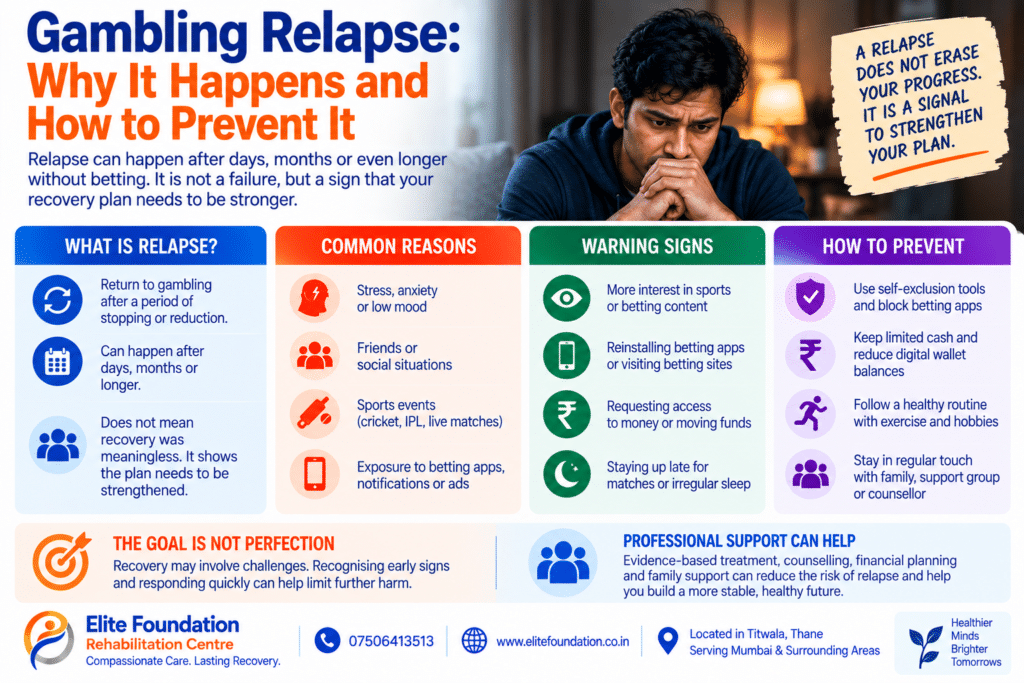
Gambling relapse can happen after days, months or longer without betting, and it is often preceded by changes that are visible before money is lost again. Families searching for Titwala Rehab may notice renewed secrecy, sports-related preoccupation or unusual money access before gambling resumes. Elite Foundation is physically located in Titwala, Thane and supports families from Mumbai and surrounding areas. Its gambling rehab in India information reflects an important recovery principle: relapse prevention may need to address financial access, phones, betting-related content, triggers and mental health—not just the person’s intention to stay away from gambling.
A person may stop gambling and sincerely believe the problem is behind them. For a period, this can be true in practical terms: there are no new bets, no new losses and perhaps less conflict at home. The difficulty is that the situations previously connected with gambling do not necessarily disappear.
Salary still arrives. Cricket tournaments still begin. Friends may still discuss betting. Old debt remains. Gambling-related content may reappear online. A stressful argument can happen. Boredom can return. A memory of a previous large win can suddenly feel more important than months of losses.
Relapse prevention therefore asks a different question from “How did you stop gambling?” It asks:
“What could bring gambling back, and what needs to be in place before that situation occurs?”
What is gambling relapse?
In everyday clinical use, gambling relapse generally refers to a return to gambling after a period in which the behaviour had stopped or substantially reduced.
Some clinicians and treatment programmes distinguish a brief “lapse” from a more sustained “relapse”. For example, one isolated bet followed by an immediate return to recovery may be described differently from several weeks of renewed gambling.
There is no single universal number of bets, rupees or days that creates a precise boundary between those terms. The more useful question is what happened after gambling resumed.
Did the person stop quickly? Did they try to recover the new loss? Were previously agreed financial safeguards removed? Did secrecy return? Did one gambling episode become several?
Those details are more clinically useful than arguing over terminology.
A relapse does not mean the previous recovery was meaningless
People can interpret relapse in all-or-nothing terms:
“I stayed away for six months and ruined everything in one night.”
That thought can itself become dangerous because it may lead to another conclusion:
“If I have already failed, there is no point stopping now.”
Current NICE guidance on gambling-related harms specifically recommends discussing relapse without shame and having a plan for recovering quickly after it occurs. NICE also recognises that relapse may arise from individual or environmental factors and recommends identifying triggers, using blocking tools, stimulus control and strategies for high-risk situations.
The aim is not to minimise renewed gambling. A relapse can create serious financial and psychological harm very quickly. The aim is to respond in a way that limits further damage rather than turning one episode into a prolonged return to gambling.
Gambling relapse can happen quickly because money is immediately involved
Relapse in gambling has a practical feature that deserves special attention: access to money can determine how much harm occurs during a short period.
A person may have remained gambling-free for months but still have access to a salary account, savings, credit cards, personal-loan offers or other available funds.
If gambling resumes, the consequences do not necessarily build slowly.
One evening can involve several deposits. A large amount of accessible money may be lost before family members or treatment providers know that gambling has returned.
This is why gambling relapse prevention often needs explicit financial planning rather than relying entirely on psychological coping skills.
Psychological coping is important, but it is only one part of the plan
Learning to recognise urges, challenge gambling-related thoughts and tolerate difficult emotions can be valuable.
But a person can understand their triggers very well and still be at risk if unrestricted money and instant gambling access remain available during a high-risk moment.
Effective planning therefore considers several layers together:
trigger → urge → access to gambling → access to money → gambling episode → response after the first bet.
Every extra barrier creates another point at which the sequence can be interrupted.
There may be warning signs before the first new bet
Relapse does not always begin with money being deposited.
It may begin several days earlier with changes in attention or behaviour. The person starts checking scores more frequently. Gambling-related accounts appear again on the phone. Old betting conversations restart. They begin calculating how a previous debt could be recovered. A self-exclusion period is allowed to expire without discussion.
Other warning signs may be more psychological. The person becomes nostalgic about a previous win, minimises how serious the old gambling problem was or starts saying they now understand how to control it.
These signs do not prove that relapse is about to occur. They are useful because they create an opportunity to strengthen the recovery plan before gambling resumes.
Major cricket tournaments can become predictable high-risk periods
For somebody whose previous gambling was strongly connected with cricket, a major tournament may be more than a sporting event.
The advertising, conversations, match schedules, live scores and excitement may recreate an environment that was repeatedly associated with betting.
This does not mean cricket causes gambling relapse. Many people in recovery can watch cricket without gambling.
The relevant question is personal history.
If previous gambling consistently intensified during the IPL, international tournaments or particular cricket series, those events are foreseeable high-risk periods for that individual.
Relapse planning can therefore begin before the tournament starts rather than waiting until the first strong urge appears.
A recovery plan should include the calendar
People often think of relapse triggers as emotional states such as anger or anxiety. Gambling triggers can also be predictable dates and events.
A salary date is known in advance. A major cricket tournament has a schedule. A festival bonus may be expected. A birthday, holiday or work incentive may bring additional money.
If those periods have previously been linked with gambling, they can be planned for.
The question becomes:
“What needs to be different before this date arrives?”
That might involve reviewing financial safeguards, removing gambling-related content, discussing the risk with a trusted person or arranging additional treatment contact around a known high-risk period.
Salary day can be a gambling trigger
For some people, relapse risk changes when money becomes available.
During the final week before salary, gambling may seem impossible simply because there is little money left. When salary enters the account, that practical barrier disappears.
The person may think:
“I have money again. I can afford one small bet.”
That first bet may reconnect them with the behavioural pattern they had stopped.
Salary day is not a universal gambling trigger. It becomes clinically relevant when a person’s previous gambling repeatedly clustered around payday or when access to newly available money has preceded previous relapses.
Unexpected money can create another high-risk moment
A bonus, refund, repayment from a friend, sale of an asset or unexpected transfer can feel psychologically different from ordinary salary.
The person may regard it as “extra money” rather than money that needs the same protection as the rest of their finances.
If gambling was previously associated with available cash, unexpected money can create a sudden opportunity that the recovery plan did not anticipate.
This is why financial relapse planning should cover both regular income and unplanned money.
Debt pressure can become a trigger even after gambling has stopped
Stopping gambling does not erase existing debt.
EMIs continue. Friends may still be owed money. Credit-card statements still arrive. Family members may expect repayment.
After several gambling-free months, the person can become discouraged by how slowly the debt is reducing.
The thought may return:
“If I could just win enough once, I could finally clear this.”
This is a particularly important relapse pathway because the person may believe they are gambling for a responsible reason: repaying debt.
In reality, old debt remains a financial problem and a new bet remains an uncertain financial risk.
Trying to recover old debt can reactivate loss chasing
A person does not need to have gambled yesterday to begin chasing losses again.
A large loss from six months earlier can remain psychologically unfinished.
After a period of abstinence, the person may think that they are calmer, more disciplined and therefore now capable of recovering some of the money safely.
That idea reconnects present gambling with an old financial loss.
The Elite Foundation guide on chasing losses in gambling explains the psychology behind trying to “get back to zero”. In relapse prevention, the important point is to recognise old losses as a possible future trigger rather than assuming that their influence ended when gambling stopped.
Seeing betting-related content can reactivate attention before it creates an urge
Digital relapse triggers can be subtle.
A person may not deliberately search for gambling. They may see a betting-related discussion, promotional message, sports prediction, old group chat or social-media post connected with previous gambling.
The first effect may simply be renewed attention.
They check one score. Then another. They look at an old account. They begin thinking about what they would have predicted.
By the time a clear urge appears, the person may already have spent significant time mentally reconnecting with gambling.
Digital-environment planning is therefore part of relapse prevention
Current NICE guidance explicitly includes exposure to advertising and marketing among factors that may contribute to relapse and recommends practical approaches such as blocking tools and stimulus control.
For an individual, this may mean keeping gambling accounts closed or restricted, maintaining blocking software where useful, continuing to block promotional messages and leaving betting-focused groups that repeatedly act as triggers.
The exact tools available vary by platform, provider, bank and jurisdiction.
The principle is more important than any single technology: if a digital pathway repeatedly leads back towards gambling, relapse prevention should address that pathway rather than pretending it does not matter.
Boredom can become a relapse trigger after the crisis has passed
During the early phase of recovery, gambling may stop because the consequences are very painful. Debt has been discovered. Family members are angry. The person is frightened by what happened.
Several months later, the emotional intensity may be lower.
Life can begin to feel ordinary again.
For somebody who previously spent hours watching matches, checking scores, planning bets and waiting for results, ordinary evenings may feel comparatively empty.
Boredom does not force relapse. But if gambling previously provided stimulation and routine, unstructured time can become a high-risk context.
Relapse prevention therefore includes building a life in which gambling is not the main source of anticipation.
Arguments can trigger gambling for reasons that have little to do with money
Not every relapse begins with the desire to win.
A person may gamble after conflict with a spouse, parent or employer because gambling temporarily redirects attention away from anger or distress.
Someone who has previously used betting as emotional escape may be particularly vulnerable after an argument.
The relevant treatment question is therefore:
“What do you usually do with the emotion that gambling used to interrupt?”
If there is no alternative response, the old behaviour can regain its previous function.
Confidence after a long period without betting can become a warning sign
Recovery usually increases confidence, and that is positive.
The risk arises when confidence changes into the belief that previous safeguards are no longer necessary.
The person may say:
“I haven’t gambled for eight months. Clearly I can control it now.”
They reinstall an application, remove a financial restriction or decide that one small bet will prove the problem is over.
A period without gambling demonstrates that change is possible. It does not automatically establish that returning to gambling is safe.
Relapse prevention should not depend on testing yourself
Some people want to prove recovery by deliberately exposing themselves to the behaviour they previously struggled to control.
They may keep a gambling account active to demonstrate that they can ignore it or place a small bet to prove they can stop at one.
Recovery does not require that test.
The goal is not to demonstrate superior resistance in the presence of gambling opportunities. It is to maintain the conditions that support the person’s chosen recovery goal.
A previous large win can remain powerful long after the losses are forgotten
People may remember one dramatic win very clearly.
The amount, match and excitement can remain vivid even after many smaller losses.
During a difficult financial period, that memory can return as evidence:
“I did it once before.”
The memory itself is real. The conclusion drawn from it may be misleading.
A previous win does not make another uncertain outcome more controllable, and it does not show what will happen if gambling resumes.
Relapse planning should include the person’s own warning language
General warning signs are useful, but an individual’s repeated phrases may be even more informative.
For one person, the warning phrase may be:
“Just ₹1,000.”
For another:
“This tournament is different.”
Another may say:
“I am not addicted anymore.”
Or:
“I only need to clear the old debt.”
These phrases are not diagnostic tests. They become relevant when they have repeatedly appeared before gambling episodes in that particular person’s history.
Financial warning signs may appear before gambling is admitted
A family may notice changes in money before the person acknowledges renewed gambling.
Examples can include unexplained withdrawals, increased interest in available credit, moving money between accounts, sudden requests for cash or becoming unusually secretive about banking.
None of those signs proves gambling.
But when they appear in someone with a previous gambling problem—especially alongside renewed sports or betting-related preoccupation—they justify a calm discussion rather than waiting for a major loss.
Financial safeguards should not disappear merely because recovery is going well
One challenge in relapse prevention is deciding when restrictions can safely change.
There is no universal timetable.
A person may gradually resume greater financial independence as recovery becomes more stable, but changes should be deliberate rather than occurring simply because the original crisis feels distant.
If unrestricted credit, large account balances or easy borrowing were repeatedly involved in previous gambling episodes, removing every safeguard at once can recreate the financial environment in which the problem developed.
The purpose of safeguards is not permanent punishment. It is to reduce avoidable risk while recovery becomes more established.
Financial safeguards must remain proportionate and consensual where possible
Family involvement with money needs careful boundaries.
Temporary agreed oversight can be useful for some people, particularly where easy access to money has repeatedly preceded gambling.
That does not justify coercive control, humiliation or permanently removing an adult’s financial autonomy without appropriate legal or clinical basis.
Where there is violence, intimidation or economic abuse within a relationship, safety takes priority over attempts to manage gambling through family control of money.
Self-exclusion and blocking tools can remain useful after the urge has reduced
The World Health Organization identifies effective self-exclusion and pre-commitment tools among measures that can support people who want to control or stop gambling. WHO also notes that gambling treatment has low uptake and that shame and stigma can interfere with help-seeking.
A common mistake is treating blocking measures as something needed only during the first few weeks.
When urges become less frequent, the person may conclude that the tools are no longer necessary.
Whether they should remain in place depends on individual circumstances, but reduced craving is not the same thing as eliminating future exposure to high-risk situations.
Relapse prevention should ask what happens in the first ten minutes
A general instruction such as “call someone if you want to gamble” can be too vague during a strong urge.
A more useful plan specifies the immediate sequence.
What device will be moved away? What account should not be accessed? Who will be contacted? What money should be protected? What situation should the person leave? What reminder from previous treatment should be read?
The plan should be simple enough to use when judgement is already under pressure.
It should also ask what happens after the first bet
Relapse prevention is not complete if it only explains how to avoid the first bet.
It also needs to answer:
“What do you do if the first bet has already happened?”
The most dangerous response may be to continue gambling in order to recover the new loss.
A safer response is to stop the episode, restore financial and digital barriers, disclose the event to appropriate support and review what changed before gambling resumed.
Responding quickly may reduce the chance that one gambling episode develops into a larger financial crisis.
Do not try to repair a relapse by winning the new loss back
Suppose someone places one bet after six months without gambling and loses ₹10,000.
They may immediately think:
“I need to recover the ₹10,000 before anyone finds out.”
That thought combines relapse with loss chasing and secrecy.
The ₹10,000 loss is now real. Another bet creates another uncertain financial exposure.
The correct relapse response is not to make the relapse invisible. It is to stop further gambling and address the loss honestly.
Secrecy can turn a small relapse into a longer one
A person may feel ashamed to tell their family or therapist that gambling has happened again.
They may decide to wait until they have “fixed” the loss.
That creates a private period in which further gambling can continue without anybody knowing that the recovery plan has broken down.
Relapse plans work better when they include a pre-agreed disclosure process: who should be told, how quickly and what happens next.
This does not require public confession or humiliation. It creates an agreed route back into support.
Family members should avoid turning disclosure into punishment
A spouse or parent may understandably feel angry when gambling returns, particularly after earlier financial harm.
Accountability is still necessary.
But if every disclosure leads immediately to humiliation, threats or repeated statements that treatment has failed, the person may become more likely to hide the next lapse.
A more useful first response is to establish whether gambling is continuing, how much money is at risk, whether immediate safeguards need restoring and whether the person is psychologically safe.
The consequences and trust issues can then be addressed without losing the opportunity to stop the relapse quickly.
Relapse may require rapid re-entry into treatment
NICE recommends continued follow-up and rapid re-entry to therapy according to the person’s needs after treatment. It also recommends considering additional treatment or support when outcomes have not been achieved, relapse risk is high or gambling has resumed.
This is important because relapse does not necessarily mean starting recovery completely from the beginning.
The person may already understand many of their triggers and have useful skills. Treatment can examine what was missing or what changed.
For some people that may mean additional CBT sessions. Others may need renewed financial safeguards, peer support, assessment of depression or substance use, or a different level of clinical care.
The evidence for gambling-specific relapse interventions is still developing
Relapse prevention is clinically important, but evidence should not be overstated.
The NICE rationale and impact statement notes that there was only a very small amount of evidence suggesting that individual and group relapse-prevention approaches based around stimulus control reduced relapse at some time points and improved some outcomes. NICE continues to identify prevention of gambling relapse as an area needing further research.
That means clinicians should not promise that any single technique guarantees that gambling will never return.
The stronger position is to use relapse planning as part of broader evidence-informed treatment while monitoring what actually works for the individual.
CBT should include relapse prevention rather than ending when gambling stops
NICE recommends gambling-focused CBT and specifically states that it should include a relapse-prevention component covering triggers and how to respond if relapse occurs.
This matters because reducing gambling during treatment is only one phase of recovery.
The person still needs to return to ordinary life where money, sport, advertisements, arguments, boredom and previous gambling memories exist.
Treatment therefore needs to prepare for those situations before therapy ends.
Relapse planning should be individual, not copied from another person
One person’s main trigger may be cricket. Another person’s may be loneliness. A third person may relapse after salary day. Another may be most vulnerable when they receive an unexpected bonus.
Generic advice such as “avoid stress” is too broad to guide behaviour.
A stronger plan identifies the person’s actual history:
What happened before previous gambling episodes?
What money became available?
What content was being viewed?
Who was present?
What thought justified the first bet?
Which safeguard was missing or removed?
Not every urge means relapse is about to happen
People can experience gambling thoughts without gambling.
A cricket match can remind someone of betting. A previous win can enter their mind. An advertisement can briefly trigger curiosity.
The presence of a thought is not the same thing as loss of control.
The clinical concern increases when the person begins moving towards action: reopening accounts, arranging money, hiding behaviour, following betting content for long periods or mentally planning how much to wager.
Relapse prevention is therefore not about becoming frightened every time gambling enters the person’s mind. It is about recognising when thoughts are becoming behaviourally organised.
Sleep, alcohol and mental health can affect relapse vulnerability
For some people, poor sleep, depression, anxiety or alcohol use makes it harder to follow a recovery plan.
Alcohol may reduce inhibition. Severe anxiety may increase the desire for distraction. Depression may create hopelessness about slow debt repayment. A major mood change can alter judgement and risk-taking.
These factors should be assessed rather than assuming that relapse is purely a failure of motivation.
Treating a co-occurring condition does not automatically treat Gambling Disorder, but leaving a significant condition untreated may weaken the overall recovery plan.
A relapse review should investigate the sequence without excusing the behaviour
After gambling resumes, the purpose of review is not to construct an excuse.
It is to identify information that can prevent repetition.
For example:
salary arrived → argument at home → cricket match → betting group reopened → old account accessed → first small bet → loss → attempt to recover loss → larger gambling episode.
If the family focuses only on the final amount lost, several earlier intervention points are missed.
The review can instead identify which parts of the sequence can realistically be changed before the next high-risk situation.
Families should review access to money after relapse
If significant gambling has resumed, the immediate financial question is whether additional money remains at risk.
Available credit, accessible savings or borrowed money may allow the episode to continue even after the original funds are gone.
Where safe and agreed, temporary financial safeguards may need to be restored or strengthened.
Existing gambling debt should then be handled as a separate financial problem rather than through further betting.
A period without gambling does not automatically erase debt-related vulnerability
Someone may be abstinent while still carrying loans created during the gambling period.
Every repayment can remind them of previous losses.
That does not mean debt inevitably causes relapse.
It means debt may continue functioning as a psychological trigger long after betting has stopped.
Recovery planning should therefore include realistic expectations about how long financial repair may take.
Peer support can make relapse easier to disclose
NICE recommends offering peer support to people who want it and specifically notes that peer settings can provide a place to discuss topics that may feel stigmatising, including relapse.
Some people find it easier to disclose a gambling episode to others who understand the experience of returning to an old behaviour.
Peer support is not a replacement for professional assessment when significant psychiatric, financial or safety problems are present.
It can be one layer of an aftercare plan.
Relapse does not automatically mean residential treatment is required
A return to gambling should trigger reassessment, not an automatic assumption about treatment setting.
Some people may benefit from renewed outpatient CBT, closer follow-up, stronger financial barriers or peer support.
Others may have additional psychiatric, substance-use, environmental or safety needs requiring more intensive care.
Whether outpatient, intensive outpatient or residential treatment is appropriate should be determined through individual clinical assessment. The number of relapses, the amount lost or the fact that gambling has returned does not by itself establish a need for residential admission.
Repeated relapse may mean the recovery environment needs changing
When gambling repeatedly returns, the question should not always be:
“Why doesn’t this person want recovery badly enough?”
It may be necessary to examine whether the current plan is realistic.
Are gambling routes still open? Is money still instantly available? Does the person continue spending time in betting-focused groups? Is debt driving attempts to win money back? Is treatment addressing the actual triggers? Is alcohol use undermining decisions? Has follow-up stopped too early?
Repeated relapse can provide information about what the current recovery system is failing to contain.
What helps people stay away from betting over the longer term?
There is no single technique that guarantees permanent abstinence.
A more realistic long-term plan combines several protections: reduced gambling access, thoughtful financial arrangements, awareness of personal triggers, treatment of relevant mental-health or substance-use problems, structured psychological treatment where indicated, supportive relationships and a clear response plan if gambling resumes.
Recovery also becomes more sustainable when life contains meaningful routines that are not organised around avoiding gambling every hour.
Work, relationships, exercise, hobbies, social connection and ordinary responsibilities can gradually become more important than monitoring whether an urge is present.
The aim is not permanent fear of relapse
Relapse prevention should make life safer, not create constant anxiety that any cricket match, disagreement or bank notification means disaster is about to happen.
Over time, many triggers may become less powerful.
The goal is to understand the situations that genuinely matter for the individual and maintain enough protection that they do not automatically lead back to gambling.
A recovery plan can become less intensive as circumstances change, but those changes should be deliberate and based on stability rather than overconfidence.
When a gambling relapse becomes a mental-health emergency
Relapse can produce intense shame and fear, particularly when substantial money is lost after the family believed the gambling had stopped.
NICE specifically warns that relapse may be highly distressing and can be associated with self-harm or suicide risk.
A person saying, “I have destroyed everything”, “There is no way out” or “My family would be better without me” should not be dismissed as simply upset about money.
Suicidal thoughts require prompt professional mental-health assessment. Suicidal intent, a specific plan, a recent attempt, inability to remain safe or another immediate danger requires urgent emergency care.
In India, call 112 or attend the nearest emergency department when immediate safety is at risk.
Debt calculations and arguments about the relapse can wait. Immediate safety comes first.
Frequently asked questions about gambling relapse
What is gambling relapse?
Gambling relapse generally means returning to gambling after a period of stopping or substantially reducing the behaviour. The exact boundary between a brief lapse and a more sustained relapse is not universally defined.
What are common gambling relapse triggers?
Triggers vary between individuals. They can include access to money, salary day, unexpected money, debt pressure, sports events, betting-related content, boredom, arguments, alcohol use, memories of previous wins or confidence that gambling can now be controlled.
Can cricket trigger gambling relapse?
For someone whose previous gambling was strongly connected with cricket, major tournaments, live scores or betting-related discussions may act as triggers. Cricket itself does not cause relapse, and the relevance depends on the person’s previous gambling pattern.
Why can salary day be risky after gambling recovery?
If previous gambling frequently occurred when salary became available, payday can remove the practical barrier created by having little accessible money. This makes salary day a personal trigger for some people, not a universal one.
Can unexpected money trigger betting?
It can for some people, particularly when bonuses, refunds or other unexpected money are mentally treated as disposable. A relapse plan can include how unplanned money will be handled before it arrives.
Can gambling debt trigger relapse?
Yes, for some people. Slow debt repayment can bring back the belief that gambling offers a quicker solution. Existing debt should be dealt with through a realistic financial plan rather than future gambling winnings.
Why do people gamble again after months without betting?
There may be many reasons, including renewed access to money, exposure to previous triggers, overconfidence, stress, boredom, sports events, memories of past wins or unresolved debt. A relapse review should identify the individual’s sequence rather than assuming one universal cause.
Does one bet mean a complete relapse?
Not necessarily. Terminology varies, and one episode may be described as a lapse in some settings. What matters is stopping quickly, preventing further gambling and reviewing what allowed the episode to happen.
What should someone do immediately after gambling again?
Stop the episode rather than trying to recover the loss. Restore gambling and financial barriers, protect remaining money, disclose the relapse to appropriate support and reconnect with treatment if needed.
Should I try to win back money lost during a relapse?
No gambling outcome can reliably repair the new loss. Trying to recover it can turn one episode into sustained loss chasing and larger financial harm.
Can blocking gambling websites prevent relapse?
Blocking tools can add useful friction and are recommended by NICE as one possible relapse-prevention measure. They are not a guaranteed standalone treatment because other gambling routes, financial triggers and psychological factors may remain.
Should gambling accounts stay closed after recovery?
For many people whose goal is abstinence, maintaining restrictions may remove an unnecessary route back to gambling. The appropriate long-term arrangement should be considered individually rather than assuming barriers must be removed simply because urges have decreased.
Can social media trigger gambling relapse?
Betting-related advertisements, sports predictions, gambling discussions or old betting groups may trigger renewed attention for some people. The effect depends on the individual’s history, but digital-environment planning can be useful when these exposures have repeatedly preceded gambling.
Can boredom cause gambling relapse?
Boredom does not force someone to gamble. It can become a high-risk context when gambling previously provided stimulation, anticipation or structure and no alternative routines have been established.
Can an argument trigger gambling?
Yes, for some people who previously used gambling to distract themselves from anger or emotional distress. Treatment can help identify alternative ways of responding to conflict.
Why does confidence after recovery sometimes become risky?
Confidence supports recovery, but problems can arise when it leads someone to remove safeguards or deliberately test whether they can gamble in a controlled way. Time without gambling does not automatically prove that returning to it is safe.
Does relapse mean treatment failed?
No. Relapse requires attention, but it does not erase previous progress. NICE recommends using relapse planning, ongoing support and rapid re-entry into therapy where needed rather than treating relapse as shameful individual failure.
Can CBT help prevent gambling relapse?
NICE recommends that gambling-focused CBT include relapse-prevention work, including recognising triggers and planning how to respond if gambling returns. Evidence for specific relapse-prevention interventions remains limited, so no approach should be presented as a guarantee.
Do repeated gambling relapses mean residential rehab is necessary?
Not automatically. Repeated relapse warrants reassessment, but the appropriate treatment setting depends on the person’s overall clinical needs, mental health, safety, substance use, environment, functioning and response to previous treatment.
Should family members control money after a relapse?
Temporary agreed financial safeguards may help when access to money repeatedly precedes gambling. They should be proportionate and safe and should not become coercive control. Complex family or financial situations may require professional advice.
When should relapse trigger professional reassessment?
Reassessment is particularly important when gambling rapidly escalates, borrowing returns, substantial money is at risk, previous treatment strategies are no longer working, significant depression or substance use is present or the person expresses hopelessness or suicidal thoughts.
Relapse prevention for gambling must protect both behaviour and access
Gambling relapse is not only a psychological event.
It occurs within an environment of money, phones, sport, advertising, credit, previous debt, relationships and remembered wins.
That is why a relapse plan that says only “manage stress” or “use more willpower” is incomplete.
For somebody whose gambling previously escalated around cricket, the calendar matters. For somebody who repeatedly gambled on payday, salary access matters. For somebody who borrowed after losses, credit matters. For somebody who re-entered gambling through online content, the digital environment matters.
The strongest plan identifies those individual pathways before they become crises.
It also plans for imperfection. If gambling happens again, the person should already know how to stop the episode, protect remaining money, restore barriers, disclose what happened and return to treatment or support without trying to repair the relapse through another bet.
Recovery is not strengthened by pretending relapse is impossible. It is strengthened by understanding what has previously led back to gambling and making those pathways harder to follow.
Medical and safety disclaimer: This article provides general educational information and does not replace individual psychiatric, psychological, medical, financial or legal assessment. Gambling relapse varies substantially between individuals, and no particular trigger or warning sign proves that relapse will occur. Treatment and relapse-prevention plans should reflect the person’s gambling history, finances, mental health, substance use, relationships, safety and response to previous treatment. Suicidal thoughts require prompt professional assessment. Suicidal intent, a specific plan, a recent attempt, inability to remain safe or another immediate danger requires urgent emergency care. In India, call 112 or attend the nearest emergency department when immediate safety is at risk.
