
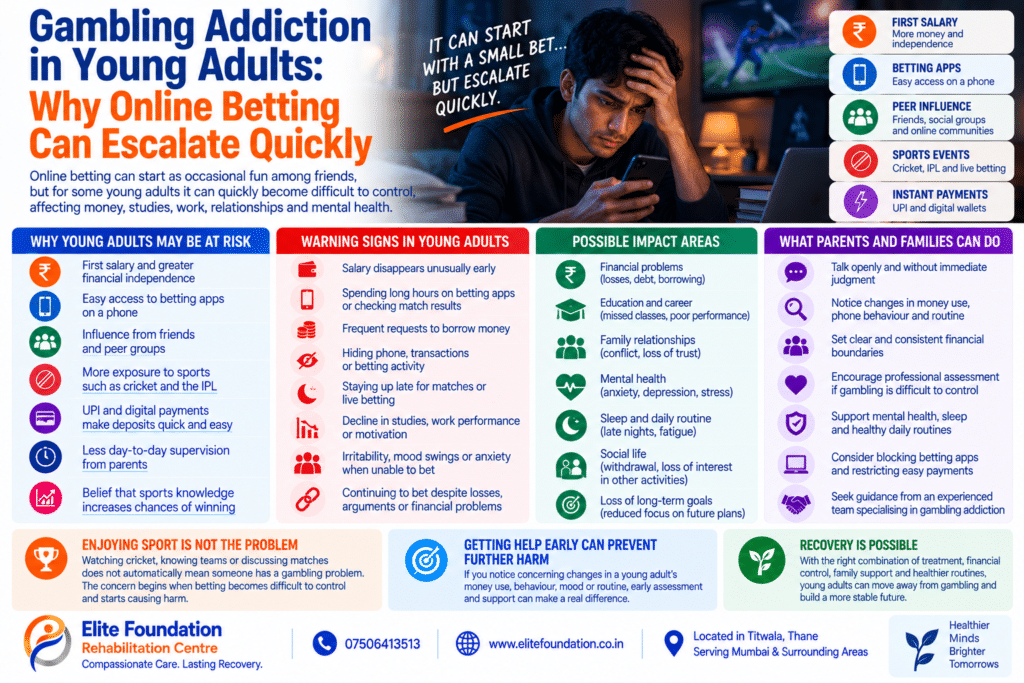
Gambling addiction in young adults can develop around online betting, sports, peer groups and easy digital payments, sometimes before families realise money is being borrowed or hidden. Families searching for rehab centre in Mumbai may first notice salary disappearing, secret transactions or sudden requests for money. Elite Foundation is located in Titwala, Thane and serves families from Mumbai and surrounding areas. Its gambling rehabs in India support considers betting behaviour, financial access, peer and digital triggers, mental health, substance use and family concerns rather than assuming every young person who bets has Gambling Disorder.
Young adulthood can create a combination that did not exist a few years earlier: greater independence, a first salary, personal bank accounts, credit access, UPI and other digital payments, less day-to-day parental supervision, new social groups and constant access to sport and online content through a phone.
None of these things causes Gambling Disorder by itself. Millions of young adults receive their first salary, use digital payments, watch cricket and spend time online without developing a gambling problem.
The concern begins when betting becomes difficult to control and starts affecting money, work, college, sleep, relationships or mental health. A person who originally placed occasional bets with friends may begin betting alone, using increasingly important money, borrowing after losses and hiding the scale of the behaviour from parents or partners.
Why young adults deserve a separate gambling article
Gambling in a 21-year-old may develop in a different practical environment from gambling in someone who has been financially independent for twenty years.
A young adult may be earning their own money for the first time while still having relatively limited experience managing rent, savings, credit, EMIs and long-term financial consequences. They may also remain partly dependent on parents while simultaneously wanting privacy and independence.
This creates a particular family problem. Parents may assume their son or daughter is financially independent because they have started working. The young adult may assume their salary is private and that occasional borrowing from home does not need explanation.
If gambling begins to consume that salary, the problem can remain hidden for some time.
Young adult gambling is not the same as every form of risky behaviour
Risk-taking is sometimes discussed as though young adults are naturally reckless and therefore gambling problems are inevitable. That is too simplistic.
A young person can enjoy competition, invest money, play games, follow sport and take ordinary life risks without having Gambling Disorder.
The more important clinical questions are whether betting can be controlled, whether it is becoming increasingly important, whether the person repeatedly returns after deciding to stop and whether gambling continues despite clear financial, occupational, educational or relationship harm.
The World Health Organization describes Gambling Disorder through impaired control, increasing priority given to gambling and continuation or escalation despite negative consequences.
A first salary can increase the amount of money available for betting
A first salary is an important milestone. It brings independence and the ability to make financial decisions without asking a parent for every purchase.
For someone who already bets occasionally, that independence can also increase the amount of money available.
A person who previously gambled ₹500 from pocket money may suddenly have ₹25,000, ₹40,000 or more entering their own account each month. That does not mean receiving a salary causes gambling. It means the financial limit imposed by dependence on parents has changed.
The person may initially decide that only a small percentage of salary will be used for betting. After a loss, however, another deposit may be made because salary has just arrived and the person believes the money can be recovered.
If this repeats across several months, payday itself can become associated with gambling.
A salary disappearing early can be one of the first signs families notice
Parents may become concerned when a working son or daughter repeatedly needs money soon after salary day.
The explanation may be ordinary at first: an unexpected expense, a payment to a friend or a temporary cash-flow problem.
Concern increases when this becomes a pattern and the person cannot clearly explain where the salary went.
Repeated borrowing after payday does not prove gambling. But when it occurs alongside betting, hidden transactions, unusual secrecy, changes in mood after sporting events or repeated promises to repay money after the next salary, the financial pattern deserves closer attention.
Easy digital transactions can reduce the pause between an urge and a bet
Digital payments are a normal and useful part of everyday life in India. UPI, mobile banking and instant transfers do not cause Gambling Disorder.
However, for someone already struggling to control gambling, fast access to money can reduce the practical delay between deciding to bet and transferring funds.
In the past, obtaining additional money might have required leaving home, finding cash or waiting for another opportunity. On a smartphone, banking, communication, sports information and gambling-related access can exist close together.
That shorter pathway matters when decisions are being made during excitement, frustration or immediately after a loss.
The broader guide on online betting addiction explains how digital access can compress repeated gambling decisions without implying that smartphones themselves cause Gambling Disorder.
First salary plus easy credit can create a larger problem than salary alone
A young adult may initially lose only money they have earned. The financial risk becomes more serious when the available salary is exhausted and borrowing begins.
Credit cards, personal loans, salary advances, money borrowed from friends or money requested from parents can extend the amount available beyond actual monthly income.
This changes the financial situation significantly. The person is no longer gambling only with money they currently have. Future income is being committed to repay previous decisions.
If gambling continues while repayments are already due, the next salary may arrive partly spent before the month begins.
Peer betting can make gambling feel socially ordinary
Betting does not always begin as an isolated activity.
A group of friends may discuss a match, compare predictions or talk about who won money the previous night. One person places a bet and others join. The behaviour becomes part of a social conversation rather than something that feels unusual.
That does not mean having friends who bet automatically causes a gambling problem. Peer groups influence many behaviours without determining them.
The concern is when the young adult begins to experience betting as an expected part of watching sport, socialising or participating in the group.
Someone who originally had little interest in gambling may start because “everyone is doing it”. Someone already struggling to stop may find that every group discussion creates another trigger.
Wins are usually more visible socially than losses
A friend may proudly announce that they won ₹20,000.
They may not announce every ₹2,000 or ₹5,000 loss that happened before or after it.
This creates an incomplete social picture. The group sees screenshots of wins, celebrates successful predictions and remembers dramatic successes. The total money lost over several months may remain private.
A young adult comparing themselves with those visible wins can therefore believe other people are consistently succeeding while they personally are unusually unlucky.
The comparison is not necessarily between one person’s results and another person’s complete financial record. It may be between one person’s complete losses and another person’s selected wins.
Sports-related betting can attach gambling to something the person already loves
Cricket, football and other sports can become powerful gambling cues because the sporting interest existed before the betting behaviour.
A young adult may already know the teams, players and statistics. Betting is then added to an activity that already occupies attention and social conversation.
This can make gambling feel different from entering a casino or deliberately seeking a traditional gambling environment. The person may think of themselves primarily as a sports fan who occasionally bets.
Concern increases when the relationship reverses and sport increasingly becomes an opportunity to gamble.
The person begins following matches they previously would not have watched, checking live scores because money is involved or feeling that watching a major match without betting is incomplete.
Gambling marketing can become part of the sporting environment
The World Health Organization warns that heavy gambling promotion online and through sport can contribute to the normalisation of gambling among children and young people. WHO also identifies sports sponsorship, social-media promotion and easy online availability as important public-health concerns.
Normalisation does not mean an advertisement automatically causes someone to gamble or develop Gambling Disorder.
It means gambling can become presented as an ordinary part of sport, entertainment or social life rather than as a financial activity involving uncertain outcomes and potential harm.
This distinction matters for young people who may encounter sports content, betting discussion, promotional material and influencer-style content in the same digital environment.
Influencers and social content can make betting outcomes look easier than they are
Social exposure does not need to look like a conventional advertisement.
A young person may see screenshots of wins, reactions to matches, betting-related jokes, predictions, lifestyle content or people discussing money supposedly made from sport.
People are often more likely to share an exciting win than an ordinary loss.
A large win creates something worth sharing. A routine loss often does not.
This can leave the viewer with an incomplete picture of another person’s actual gambling results. Seeing selected successes does not reveal how much that person deposited, lost or borrowed over time.
Young adults may overestimate how much control knowledge provides
A person who follows cricket closely may genuinely understand player form, team selection and match conditions better than their parents.
That knowledge is real.
The mistake occurs when knowledge about sport becomes confidence that gambling outcomes can therefore be reliably controlled.
A young adult may tell a parent:
“You don’t understand cricket. I know what I’m doing.”
The first sentence may be true. The parent may know very little about cricket.
The second claim does not automatically follow.
Understanding a sport does not remove uncertainty from future sporting events or guarantee profitable betting outcomes.
Online betting can become private much faster than families realise
Traditional family monitoring often relies on visible behaviour: where the person goes, who they meet and when they return home.
Online betting can occur while the person appears to be sitting in their bedroom, commuting to work or watching television with the family.
There may be no obvious external sign.
The first evidence may therefore be financial rather than behavioural: unexplained transfers, salary disappearing, new borrowing, requests for money or unpaid responsibilities.
Concealment from parents may begin because the young adult expects to fix the loss
A young adult may initially hide a loss because they believe it is temporary.
The thought may be:
“There is no reason to worry my parents. I will recover this myself.”
If more money is lost, telling the family becomes harder.
The person may then borrow from a friend, use the next salary or obtain credit because disclosure feels more frightening than another attempt to repair the problem privately.
The longer that continues, the larger the difference between what the family believes and the actual financial situation can become.
Parents may discover borrowing before they discover gambling
A parent may first notice that their son or daughter is asking for ₹5,000, then ₹10,000, then another amount a week later.
Alternatively, the family may receive a call about money owed to somebody else or discover a loan application.
Borrowing has many possible explanations and should not automatically be attributed to gambling.
However, repeated unexplained borrowing combined with known betting activity should prompt specific financial questions rather than another unrestricted family loan.
Young adults can hide debt across several small sources
Gambling debt does not always appear as one ₹3 lakh personal loan.
It may be spread across a credit card, two friends, a salary advance, an app-based loan and money borrowed from parents.
No single lender sees the complete problem.
The young adult may also mentally separate each debt and underestimate the total amount owed.
The separate Elite Foundation guide on gambling debt explains how borrowing, missed obligations and hidden losses can develop into a wider family financial problem.
Parents should ask about the total financial picture, not just the biggest bet
If gambling is suspected, asking “What was the most you ever bet?” may not reveal the true financial exposure.
Repeated smaller deposits can create a much larger loss over time.
More useful questions concern total money deposited, total withdrawals, current loans, credit-card balances, informal borrowing, money owed to friends and whether any household or salary obligations are unpaid.
The aim is not to conduct an interrogation. It is to establish whether the family is dealing with an occasional betting episode or a larger pattern of financial harm.
Teenage gambling addiction requires slightly different language
“Teenage gambling addiction” and “youth gambling addiction” are common search phrases, but teenagers are not the same population as financially independent young adults.
Some teenagers are minors. Their access to money, family dependence, developmental stage and safeguarding needs are different.
A teenager who repeatedly gambles money, steals or borrows to continue betting, hides gambling, misses school or becomes unable to control the behaviour deserves careful professional assessment.
At the same time, one adolescent bet or an interest in sports predictions does not independently establish Gambling Disorder. The broader pattern of control, persistence and harm matters.
Young adulthood should not become an excuse to ignore serious harm
Families sometimes dismiss repeated betting as a phase:
“He is young. He will understand once he loses money.”
Small mistakes can certainly be part of learning financial responsibility.
The situation changes when losses are repeatedly followed by more betting, borrowing, secrecy and failed attempts to stop.
At that point, simply waiting for the person to “grow out of it” may allow the financial and psychological consequences to become larger.
Equally, parents should not call every young bettor an addict
Overreaction can make disclosure less likely.
A parent who discovers one bet may immediately search the phone, accuse the young adult of addiction and threaten extreme restrictions.
That response can turn a financial conversation into a battle about privacy and control before the actual gambling pattern has been established.
A better first step is to understand frequency, amount, control, borrowing, losses, attempts to stop and effect on daily life.
Gaming and gambling are not interchangeable diagnoses
This distinction is essential.
Gaming generally refers to playing video or digital games. Gambling involves staking money or something of value on an uncertain outcome in the hope of receiving something of greater value.
Gaming Disorder and Gambling Disorder are both recognised within the broader field of addictive behaviours, but they are separate clinical conditions.
A young adult can have Gaming Disorder without gambling. Another can have Gambling Disorder while rarely playing video games.
The fact that both behaviours may occur on the same phone, involve online communities or appear repetitive does not make them the same diagnosis.
Gaming and gambling can still coexist
Keeping the diagnoses separate does not mean the behaviours never overlap.
A young adult may spend substantial time gaming and also bet on sport. Another may move between games, social media and online gambling during the same evening.
The relevant assessment asks which behaviour is difficult to control, what money is involved, what consequences are occurring and whether more than one problem needs attention.
Parents should avoid saying, “Everything on the phone is one addiction.” That can hide important differences in treatment needs.
Substance use can also occur alongside young adult gambling
Alcohol or other substance use may occur in the same social settings as betting. For some people, drinking lowers inhibition and makes it harder to stick to previously decided financial limits.
In other cases, substance use and gambling are separate problems that happen to coexist.
Neither should automatically be assumed to have caused the other.
Clinical assessment becomes particularly important when repeated gambling is accompanied by heavy alcohol use, other drug use, worsening mood, aggression, major sleep disruption or significant impairment in college or work.
Young adults with mental-health difficulties may use betting as temporary escape
A young person may already be dealing with anxiety, depression, loneliness, relationship problems, academic pressure or work stress.
Betting can temporarily narrow attention onto the match, prediction or possible win.
This may provide a short period in which another problem feels less prominent.
If gambling then creates debt and secrecy, the original distress may return together with a new financial problem.
Treatment therefore needs to ask what role gambling is serving rather than assuming that removing betting access will automatically resolve every underlying difficulty.
College students and young adults are a recognised prevention priority
A 2025 systematic review of gambling interventions for college students described college populations as a group of public-health concern and highlighted increased independence, peer influence and widespread online gambling access as relevant factors.
The review reported high levels of problem gambling and Gambling Disorder across the college-student literature it examined, but those figures should be interpreted carefully. The included evidence did not represent all young adults worldwide and should not be converted into a prevalence estimate for India.
The more defensible conclusion is that university and young-adult populations deserve targeted prevention, early recognition and access to treatment when gambling becomes harmful.
Risk perception can change after an early win
A young adult who wins during an early betting experience may form a very different impression of gambling from someone whose first few attempts lose.
The win may produce confidence:
“I seem to be good at this.”
It may also make future losses feel temporary:
“I’ve won before, so I can recover this.”
An early win does not automatically lead to Gambling Disorder. But it can become one of the experiences the person remembers when deciding whether another bet feels reasonable.
Borrowing from parents can accidentally delay recognition of the problem
Parents naturally help young adults with genuine emergencies.
The concern is repeated borrowing when the reason remains unclear.
If a parent repeatedly transfers money without understanding why salary has disappeared, the immediate shortage may be solved while the gambling pattern remains hidden.
This does not mean parents should refuse every request for help. It means that repeated unexplained requests should eventually lead to financial transparency rather than automatic transfers.
Paying every gambling debt does not automatically solve the problem
Families may discover debt and immediately want to clear it to protect the young person’s credit, job or relationships.
There may be legitimate financial reasons to address urgent obligations.
But clearing a loan does not automatically change the gambling behaviour that created it.
If betting access, financial secrecy, peer triggers and beliefs about recovering losses remain unchanged, another debt can appear after the family has resolved the first one.
Parents need to balance support with adult autonomy
Supporting a 22-year-old is different from supervising a 12-year-old.
An adult child has privacy and autonomy, even when parents remain financially involved.
Families can still set boundaries around their own money. A parent does not have to provide unrestricted cash simply because the young adult requests it.
Where the relationship is safe, transparent conversations about loans, debts and treatment are usually more constructive than secret surveillance.
If there is violence, intimidation, coercion or another safety concern, personal safety comes before obtaining financial information or forcing disclosure.
What should parents look for?
The strongest warning sign is rarely one isolated behaviour. It is a cluster of changes.
A young adult may repeatedly run out of money soon after payday, borrow without a clear explanation, become unusually protective of the phone, stay awake for matches or betting-related activity, become distressed after sporting outcomes, hide bank information, make repeated promises that money is “coming back soon” or withdraw from family discussions about finances.
None of these observations independently diagnoses Gambling Disorder.
Together, particularly when known betting is present, they justify a more direct conversation and possibly professional assessment.
Parents should ask about control, not only money
A young person may argue that the amount lost is small compared with their salary.
The amount matters, but it is not the only issue.
Ask whether they intended to bet that much, whether they can stop for a meaningful period, whether they have repeatedly returned after deciding not to, whether they think about betting throughout the day and whether the behaviour is changing sleep, work, relationships or finances.
A person can have significant loss of control before catastrophic debt appears.
What if the young adult says, “Everyone bets”?
The exact prevalence within their social group may be impossible to know.
Even if several friends do gamble, that does not determine whether this individual’s pattern is safe.
The useful question is not how many people in the group bet. It is whether this person’s gambling remains controlled and whether it is creating harm.
Social normality and clinical safety are different questions.
What if they say they can stop whenever they want?
A claim of control can be tested without turning the conversation into a challenge.
Has the person previously decided to stop and then returned? Have they removed gambling access and later restored it? Do they repeatedly exceed the amount they planned to spend? Does another match, salary payment or group discussion restart the behaviour?
Repeated inability to maintain a genuine decision to stop is more informative than confidence that stopping would be easy.
Early intervention does not automatically mean residential rehabilitation
A young adult who has developed gambling-related harm does not automatically need residential admission.
Some people may benefit from outpatient psychological or psychiatric treatment together with financial safeguards, changes to gambling access and family support.
More intensive care may be considered when the wider clinical situation requires it, but the treatment setting should be determined individually. Age, debt amount or the fact that parents are worried does not by itself establish a need for residential rehabilitation.
Whether outpatient, intensive outpatient or residential treatment is appropriate should be based on individual clinical assessment, including mental health, safety, level of functioning, substance use, available support, home environment and response to previous treatment.
Professional assessment should examine more than the gambling account
A useful assessment may need to understand when betting began, how often it occurs, how much money is being used, whether losses are chased, whether borrowing has begun, whether gambling is hidden and whether attempts to stop have failed.
It should also consider work or college attendance, sleep, family conflict, depression, anxiety, ADHD symptoms, major mood changes, alcohol or other substance use and any self-harm or suicide concerns.
Young people are particularly poorly served when the entire assessment becomes:
“Give us the phone and stop betting.”
The phone may be one access route. It is not the complete clinical formulation.
Recovery should protect future financial independence
For a young adult, gambling recovery is not only about stopping today’s loss. It is about preventing the behaviour from shaping the next several years of financial life.
Repeated personal loans, unpaid cards and borrowing can affect savings, future spending and family trust long after the last bet.
A practical recovery plan therefore separates two tasks: stop creating new gambling losses and deal realistically with the debts that already exist.
The young adult may need to rebuild ordinary money habits such as keeping salary for planned expenses, reducing unnecessary credit access, repaying debt gradually and becoming transparent about finances where family money is involved.
Frequently asked questions
What is gambling addiction in young adults?
Gambling addiction in young adults is a common phrase for persistent gambling that becomes difficult to control and continues despite financial, occupational, educational, relationship or psychological harm. The recognised clinical condition is Gambling Disorder.
Why can online betting escalate quickly in young adults?
Online access can place gambling, sport, banking and digital payments on the same device. Greater financial independence, peer influence and repeated digital cues may also be relevant. None of these factors independently causes Gambling Disorder, but together they can reduce barriers to repeated betting for someone already losing control.
Can a first salary trigger gambling problems?
A first salary does not cause Gambling Disorder. It can increase financial independence and the amount of money available, which may matter if someone already bets or begins using salary repeatedly for gambling.
Why does my son need money soon after receiving his salary?
There are many possible explanations. If repeated requests occur alongside betting, hidden transactions or unexplained debt, ask about the wider financial picture rather than assuming either that gambling is definitely involved or that the money problem is harmless.
Can UPI or digital payments cause gambling addiction?
No. Digital payments are ordinary financial tools. For somebody already struggling with gambling control, rapid access to money can reduce the delay between an urge and another transaction.
Can peer pressure contribute to young adult gambling?
Peers can influence what feels normal and socially acceptable. A group in which betting is frequently discussed may increase exposure and triggers, but peer behaviour does not determine whether an individual develops Gambling Disorder.
Does sports knowledge protect young adults from gambling losses?
No. Knowledge can improve understanding of a sport, but it does not eliminate uncertainty or guarantee profitable betting outcomes.
Can influencers encourage gambling?
Young people may be exposed to gambling-related messages through advertising, sport, social media and online personalities. Exposure does not automatically cause gambling, but WHO identifies heavy online and sports-linked promotion as a concern because it can contribute to normalisation among children and young people.
Is teenage gambling addiction real?
Adolescents can develop serious gambling-related problems. “Teenage gambling addiction” is a common search phrase, while clinical assessment focuses on the actual pattern of gambling, control, persistence, functional impairment and harm.
Should parents confiscate a young adult’s phone?
For an adult child, treatment should generally respect autonomy and focus on agreed changes to gambling access, money and triggers. Removing a phone does not by itself treat Gambling Disorder and may be impractical when the device is also required for work, banking and communication.
Is gambling addiction the same as gaming addiction?
No. Gambling involves staking money or something of value on an uncertain outcome. Gaming Disorder concerns impaired control over video or digital gaming. The two behaviours can coexist but should not be treated as interchangeable diagnoses.
Can gaming lead to gambling?
Ordinary video gaming should not be treated as a direct pathway to Gambling Disorder. Research has found associations between problem gambling and some gambling-like features within digital games, including loot boxes and social casino games, as well as newer gambling activities such as online sports and esports betting.
A systematic review examining gambling and gaming-related behaviours among young people up to age 25 found relevant associations, but the authors also called for more longitudinal evidence and better control of factors that may influence both behaviours.
This does not mean that a young person who plays video games will progress to gambling. Gaming Disorder and Gambling Disorder should remain clinically separate, even when gambling-like features within some digital environments deserve specific assessment.
Can alcohol make online betting harder to control?
For some people, alcohol can reduce inhibition and weaken previously made decisions about money or betting. Harmful alcohol use and gambling should both be assessed when they occur together.
Why do young adults hide gambling from parents?
They may fear judgement, loss of independence or family conflict. Some believe they can recover the money before anyone notices. Secrecy often becomes more difficult to maintain as losses and borrowing increase.
Should parents repay gambling loans?
There is no universal answer for every financial situation. Families may need to address urgent obligations, but clearing debt does not automatically treat ongoing gambling. Significant debt may require qualified financial advice alongside treatment of the gambling behaviour.
When should parents seek professional help?
Assessment becomes increasingly important when attempts to stop repeatedly fail, salary or essential money is being lost, borrowing is increasing, gambling is being hidden, college or work functioning is deteriorating, or significant mental-health or substance-use problems are present.
Does a young adult with gambling problems need rehab?
Not automatically. Outpatient care may be appropriate for many people. Whether outpatient, intensive outpatient or residential care is appropriate should be decided through individual clinical assessment rather than age, debt or family concern alone.
Can young adults recover from gambling addiction?
Yes. Recovery can involve reducing gambling access, protecting money, psychological treatment, addressing debt separately, family or peer support where appropriate, treatment of co-occurring mental-health or substance-use problems and relapse-prevention planning.
Young adulthood can accelerate the opportunity to gamble, but opportunity is not destiny
A first salary can provide independence. A smartphone can provide convenience. UPI can make ordinary payments easier. Cricket can be a genuine passion. Friends can make sport more enjoyable. Social media can provide entertainment and connection.
None of those things is a gambling disorder.
The concern is what begins happening around them.
Does salary disappear into betting? Does a match trigger repeated deposits? Is money borrowed after losses? Are transactions hidden from parents? Does another sporting event immediately become the plan for recovering yesterday’s money? Has the person tried to stop and repeatedly returned?
Those questions move the discussion away from blaming youth, technology or sport and towards the behaviour that actually needs assessment.
Families also need to keep gaming separate from gambling. A young adult can have both problems, either problem or neither. Treating every digital activity as one addiction may make it harder to identify what is actually happening.
Early recognition matters because young adulthood is also a period when financial habits, career routines and adult relationships are being established. Preventing another gambling loss is important, but so is protecting the person’s longer-term financial independence, mental health and trust within the family.
Medical disclaimer: This article provides general educational information and does not replace individual psychiatric, psychological, medical, financial or legal assessment. Gambling behaviour, financial circumstances and developmental needs vary between individuals. One bet, sports interest, gaming, digital-payment use or borrowing does not independently establish Gambling Disorder. Young people with persistent loss of control, serious debt, significant mental-health symptoms, substance-use problems or major impairment in college, work or relationships should receive appropriate professional assessment. Suicidal thoughts require prompt professional assessment; suicidal intent, a suicide plan, a recent attempt, inability to remain safe or another immediate danger requires urgent emergency care.
