
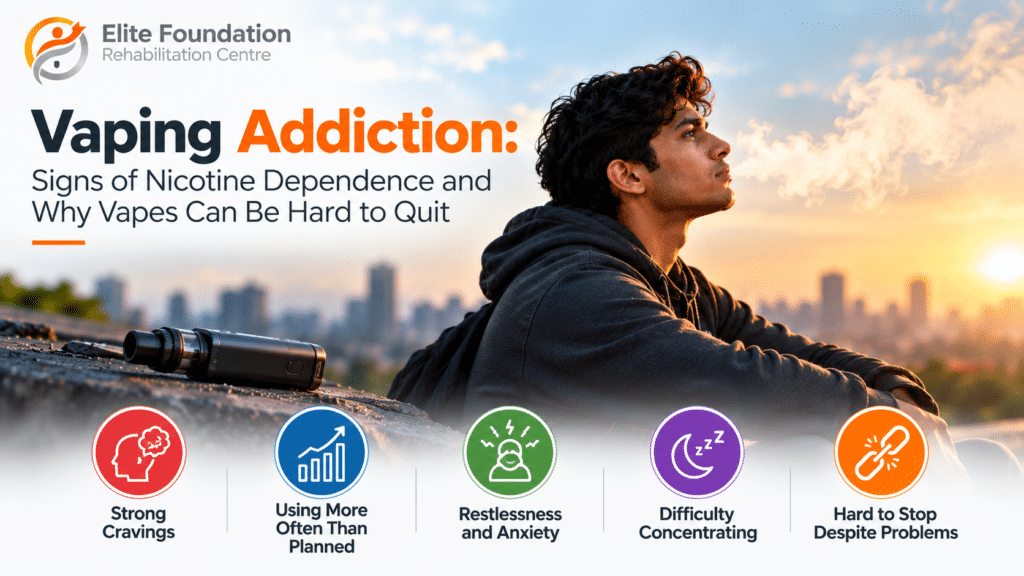
Vaping addiction can be easy to miss because using an e-cigarette may look like an ordinary part of the day. A person may take a few puffs before leaving for work, reach for the device while studying or become restless when they cannot use it. Strong nicotine cravings, difficulty cutting down and returning to vaping after deciding to stop are more meaningful warning signs than the appearance of the device itself. For families looking for a vyasan mukti kendra in the Mumbai metropolitan region, Elite Care Rehabilitation Centre is located in Titwala, Thane and serves people from Mumbai and nearby areas.
Families searching for vaping addiction treatment often want to understand whether the behaviour is a habit, nicotine dependence or a problem requiring professional help. Elite Care’s service page explains its approach to vaping-related concerns. The appropriate level of care should be determined through individual assessment: many people can receive suitable cessation support through outpatient healthcare, counselling and appropriate medication rather than residential admission. This article explains the signs, health concerns and treatment evidence so that families can make informed decisions without mistaking every instance of vaping for severe addiction.
The signs may emerge quietly. Someone commuting between Thane and Mumbai might begin reaching for a vape whenever their journey starts. A college student may use it during late-night study sessions and struggle to concentrate without it. At home, family members might notice irritability when a device is misplaced or frequent attempts to conceal how often it is used. These experiences warrant a conversation, but no single behaviour establishes a nicotine-use disorder.
Vaping addiction in Mumbai and Thane: when is support worth considering?
The question is not simply how many puffs a person takes. A more useful starting point is whether vaping has become difficult to control. Do they use more nicotine than they intended? Have they tried to stop and found themselves returning to the device? Are cravings interrupting sleep, work, studies or family life? Has the person continued vaping despite problems they recognise?
For someone in Titwala, Thane, Mumbai or the surrounding region, the right first step may be a discussion with a qualified healthcare professional who understands nicotine dependence. If anxiety, depression or another substance-use problem is also present, that assessment can consider these concerns together. Nicotine withdrawal alone generally does not require admission to a rehabilitation centre.
India’s rules also matter. The Prohibition of Electronic Cigarettes Act, 2019 restricts specified activities involving qualifying vaping devices, including manufacture, import, sale and distribution. This does not make a person who has used a vape undeserving of healthcare or make unregulated products medically safe. Families should seek lawful, clinically appropriate support rather than attempting to treat dependence through unknown products obtained from prohibited supply channels.
Early signs that vaping may be more than an occasional habit
It is worth paying attention when several changes occur together: reaching for nicotine soon after waking, increasing the frequency of vaping, feeling uncomfortable during periods without the device or repeatedly failing to follow through on a decision to stop. Secretive use or unexpected spending may add to family concerns, but those behaviours can have other explanations. They need to be understood in context, not turned into a diagnosis.
A private, non-judgemental conversation can establish what is being used, how often and what happens when nicotine is unavailable. If cravings or withdrawal are significant, evidence-based support is available. This guide goes on to explain why vaping can become difficult to stop, what clinical trials actually show and when more specialised assessment may be needed.
If the person is a teenager, the conversation should be appropriate to their age and focused on safety rather than blame. With adults, treatment decisions should respect their preferences and consent. Severe breathing difficulty, chest pain or other serious physical symptoms need prompt medical attention; these should not be dismissed as ordinary nicotine withdrawal.
What is vaping addiction?
Vaping addiction is a commonly used term for a pattern of e-cigarette use that becomes difficult to control. When the product contains nicotine, repeated exposure can lead to physical dependence, cravings and withdrawal symptoms when nicotine intake decreases.
Clinical assessment considers more than the presence of a device or the number of puffs taken. Relevant factors include impaired control, repeated unsuccessful attempts to stop, continued use despite harm, cravings and the extent to which vaping affects everyday functioning.
Nicotine dependence can develop alongside behavioural habits. A person may become accustomed to holding the device, inhaling aerosol or reaching for it during particular activities. That familiar action can remain appealing even when physical withdrawal becomes less intense.
Understanding these components helps distinguish nicotine dependence from habitual behaviour. It also helps clinicians choose support that addresses the problems the individual is actually experiencing.
What are the signs of vaping addiction?
The clearest warning signs involve difficulty controlling vaping, cravings and continued nicotine use despite wanting to reduce or stop. Symptoms can develop gradually, and diagnosis depends on the wider pattern rather than one isolated behaviour.
- Using a vape soon after waking: feeling an urge for nicotine before beginning normal morning activities.
- Vaping more frequently than intended: repeatedly taking additional puffs despite deciding to cut down.
- Feeling uncomfortable without the device: experiencing restlessness, irritability or strong cravings when vaping is unavailable.
- Repeated unsuccessful attempts to quit: deciding to stop but returning to nicotine-containing vaping products.
- Planning activities around vaping: worrying about access to the device, charging it or obtaining supplies.
- Continuing despite problems: vaping despite recognising health, financial, family or work-related consequences.
- Concealing the extent of use: hiding devices or minimising consumption because of embarrassment or anticipated conflict.
- Increasing nicotine exposure: using the device more frequently or changing products in ways that increase nicotine intake.
These indicators are most useful when considered together. Daily vaping, for example, tells us something about frequency, but cravings, control, withdrawal and consequences provide additional information about dependence.
Why can vaping become addictive?
Nicotine is the main addictive substance in nicotine-containing e-cigarettes. After inhalation, nicotine can be absorbed into the bloodstream and reach the brain, where it acts on nicotinic acetylcholine receptors and influences signalling systems involved in reward and reinforcement.
Repeated exposure can lead to physiological adaptation. When nicotine levels fall, cravings, restlessness or difficulty concentrating may develop. Taking another puff can temporarily relieve some of that discomfort.
Gradually, nicotine may be used not only for its immediate effects but also to avoid the unpleasant feelings associated with going without it.
The wider neuroscience of dependence is discussed in Elite Foundation’s guide to nicotine addiction and why cravings become strong. With vaping, an additional concern is how easily repeated nicotine exposure can become part of daily routines.
Why vapes can be used more frequently than cigarettes
A cigarette has a clear beginning and end. The person lights it, smokes it and eventually finishes it. Vaping often lacks that obvious stopping point.
A device may be kept in a pocket, on a desk or beside the bed. A few puffs can be taken without leaving the room or interrupting an activity for very long.
This convenience makes frequent use easier to overlook. It does not mean that every person who vapes will become dependent.
A student might take several puffs while watching a lecture. An office worker may use a vape between emails. During a film, someone may repeatedly reach for the device without consciously deciding to begin another vaping session.
When the behaviour becomes frequent, total nicotine exposure may be greater than expected. The amount absorbed depends on the device, liquid, nicotine concentration, inhalation pattern and frequency of use.
Nicotine salts and vaping dependence
Some e-cigarette liquids use nicotine salts rather than freebase nicotine. Nicotine-salt formulations can allow relatively high nicotine concentrations to be inhaled with less harshness in certain devices and formulations.
This matters because the sensation in the throat is not a reliable measure of how much nicotine enters the body.
A product that feels smoother than cigarette smoke may still deliver substantial nicotine. Conversely, a harsh sensation does not necessarily mean the product contains more nicotine.
Dependence risk is influenced by nicotine concentration, formulation, device power, puffing behaviour and frequency of use rather than one ingredient label alone.
Different nicotine-salt products can deliver different amounts of nicotine. The label or the sensation experienced while vaping cannot independently establish the severity of dependence.
Can disposable vapes make nicotine use harder to monitor?
Disposable vaping devices may be compact, convenient and easy to carry. Their design can allow repeated use without preparing the product before every session.
People sometimes pay attention to the advertised puff count rather than the amount of nicotine they may be receiving. However, puff counts are marketing estimates and do not establish an individual’s nicotine exposure.
Actual exposure depends on how the device is used. Two people using the same product may take different numbers and lengths of puffs and absorb different amounts of nicotine.
This uncertainty becomes relevant when somebody reports relatively little vaping but experiences strong cravings whenever the device is unavailable.
A more informative assessment explores frequency, time since waking, cravings, attempts to stop and effects on everyday life.
Why vaping may stop feeling like a conscious decision
Repeated behaviour can become closely associated with particular situations. Reaching for a vape during a work break may eventually feel as familiar as reaching for a phone.
Initially, the person may deliberately decide when to vape. After months of repetition, the device may already be in their hand before they have consciously considered using it.
This does not mean vaping occurs entirely outside conscious control. Familiar environments and repeated actions can make certain behaviours increasingly automatic.
During a quit attempt, these associations may remain noticeable. The person may reach towards an empty pocket where the vape was normally kept, even without a particularly strong physical craving.
Can someone become dependent without vaping all day?
Yes. Dependence cannot be determined solely by the number of hours spent vaping.
A person might vape only during certain periods but experience powerful cravings during those times. Another may use nicotine frequently yet report relatively little distress when access is interrupted.
The amount and frequency of nicotine exposure matter, but control, withdrawal, previous attempts to stop and consequences are equally relevant to assessment.
Using a vape soon after waking can be one useful indicator of dependence, although it is not a complete diagnostic measure.
Early warning signs people may overlook
Dependence is not always noticed when vaping becomes more frequent. Small changes can seem ordinary at first.
Someone stops leaving home without the device. They become irritated when it needs charging. They begin using it in situations where they previously went without nicotine. A vape originally purchased for occasional use remains within reach throughout the day.
A revealing change may occur in the way the person talks about vaping. Initially, they describe enjoying it. Later, they begin saying they need it to concentrate, calm down or feel comfortable.
That perceived need may partly reflect the cycle of nicotine withdrawal and temporary relief.
Why nicotine vaping can feel relaxing
Vaping is often described as a way of coping with stress.
The immediate experience may feel calming, especially when nicotine use relieves discomfort that has developed since the previous session.
Nicotine withdrawal itself can contribute to irritability, anxiety and restlessness. Taking nicotine again may briefly reduce those feelings, leading the person to associate vaping with emotional relief.
External stress can exist alongside dependence. An argument, difficult examination, work pressure or an existing anxiety condition may also be contributing.
The clinical question is whether vaping provides sustainable stress management or repeatedly relieves discomfort linked with nicotine dependence.
Vaping addiction and anxiety can become difficult to separate
Someone who experiences anxiety may begin vaping because they believe nicotine helps them feel calmer. As dependence develops, periods without nicotine may themselves become associated with nervousness and restlessness.
The experiences can overlap. Anxiety may precede vaping, contribute to nicotine use or become more noticeable during withdrawal.
Persistent anxiety, panic symptoms, depression or significant problems with daily functioning deserve appropriate mental-health assessment. Treating nicotine dependence may be useful, but an existing anxiety disorder may require separate care.
What happens when someone addicted to vaping tries to stop?
When nicotine dependence has developed, stopping or substantially reducing vaping may cause withdrawal symptoms.
These can include cravings, irritability, anxiety, restlessness, disturbed sleep, increased appetite, low mood and difficulty concentrating.
Symptoms may begin within hours, particularly when nicotine was being used repeatedly throughout the day. The early days are often uncomfortable, although the course differs between individuals.
Physical withdrawal is only part of the experience. The person may also miss the familiar device, hand-to-mouth action or routine of taking puffs while studying, working or travelling.
For a detailed explanation of withdrawal symptoms and their typical course, see the guide to nicotine withdrawal symptoms after smoking or vaping.
Why vaping cravings may continue after physical withdrawal improves
After several weeks without nicotine, a person may still experience an urge when returning to an activity previously associated with vaping.
For example, they might no longer feel constantly restless but begin thinking about a vape whenever they start playing a particular game or work late at night.
The return of that urge does not necessarily mean acute physical withdrawal has started again.
Learned cues can remain influential after the most uncomfortable withdrawal symptoms have eased. Changing a routine or recognising the trigger may therefore be more useful than assuming nicotine is still medically necessary.
Does using a nicotine-free vape mean someone has overcome addiction?
Not necessarily, although the distinction is important.
If a product genuinely contains no nicotine, it would not be expected to maintain physical nicotine dependence through nicotine exposure. Someone may nevertheless continue vaping because of habit, sensory experience or emotional associations.
That behaviour is not automatically equivalent to a nicotine addiction diagnosis.
There is also uncertainty when products come from unregulated sources or when labelling is unreliable. A device described as nicotine-free may not always contain what the label claims.
The complete pattern of use is more informative than the product description alone.
Vaping addiction is not always visible to family members
Cigarette smoking often leaves a recognisable smell. Vaping can be less noticeable, depending on the device, liquid and circumstances.
Parents or partners may therefore find it difficult to recognise how frequently nicotine is being used.
Possible concerns include hiding a device, becoming unusually distressed when it is unavailable, spending unexpected amounts on vaping-related products or withdrawing from activities because vaping access is restricted.
Secrecy can also arise from fear of punishment or conflict, while mood and spending changes may have other explanations.
A calm conversation about the behaviour, cravings and difficulty stopping is more useful than attempting to diagnose addiction after finding one device.
Vaping addiction among teenagers and young adults
Nicotine exposure is particularly concerning during adolescence because the brain is still developing, and nicotine can affect processes involved in attention, learning and dependence.
Young people may encounter vaping through social groups, online content or curiosity about devices and flavours.
A teenager who repeatedly uses a nicotine-containing vape may experience withdrawal during an attempt to stop. Irritability, poor concentration and restlessness may then become confused with ordinary examination pressure or school-related stress.
Discovering a device does not, by itself, establish the severity of dependence or explain every behavioural change.
Age-appropriate assessment is essential. Adult tobacco-cessation medication recommendations cannot simply be applied to adolescents without considering the evidence, medical circumstances and relevant prescribing rules.
The wider subject of teenage vaping, parental warning signs, school concerns and safeguarding deserves its own detailed article.
Can vaping affect concentration and everyday performance?
Nicotine can have short-term effects on attention, but dependence can also create periods of reduced concentration when nicotine levels fall.
A student may believe that vaping is necessary for studying because they feel distracted whenever they attempt to work without it.
In that situation, the apparent improvement after vaping may partly reflect relief from nicotine withdrawal rather than an improvement beyond their usual ability to concentrate.
Sleep disturbance, anxiety and repeated interruptions to vape can also affect performance.
Persistent concentration difficulties warrant assessment of other relevant factors, including sleep problems, stress and mental-health conditions.
What are the health risks of vaping?
Vaping products do not burn tobacco in the same way as conventional cigarettes, but their aerosols are not simply harmless water vapour.
Depending on the product and conditions of use, vaping aerosols may contain nicotine, particles, flavouring-related compounds, carbonyl compounds, metals and other potentially harmful substances.
Exposure differs between devices and liquids. Product quality, temperature, formulation and frequency of use all matter.
Nicotine can produce dependence and has physiological effects, including effects on heart rate and blood pressure. Exposure during pregnancy and adolescence raises additional concerns.
The long-term health consequences of vaping are still being studied. The absence of conventional cigarette combustion does not make vaping harmless.
At the same time, the chemical exposures produced by cigarettes and e-cigarettes differ. The relative health risks should be examined through evidence rather than assuming the products are identical.
Can vaping cause coughing, breathlessness or chest discomfort?
People who vape may report throat irritation, coughing or respiratory discomfort. Possible causes include airway irritation, respiratory infection, asthma and other lung conditions.
Symptoms cannot be diagnosed from vaping history alone.
A persistent cough, worsening breathlessness, chest pain, fever or other significant respiratory symptoms should be evaluated by a qualified healthcare professional.
Severe breathing difficulty, severe chest pain or another immediate medical emergency requires urgent care.
Stopping vaping is not a substitute for medical assessment when serious respiratory symptoms are present.
Is vaping addiction the same as cigarette addiction?
Both can involve dependence on nicotine, but the products and behavioural patterns differ.
Cigarettes deliver nicotine through tobacco smoke. E-cigarettes deliver aerosol produced by heating a liquid or other material, depending on the device.
A smoker may associate nicotine with recognisable cigarette breaks, while someone using a vape may take repeated puffs throughout the day.
The health exposures also differ. Smoking produces combustion-related toxicants that contribute substantially to tobacco-related disease. Vaping produces another mixture of substances, with its own health risks and uncertainties.
Assessment should reflect the products actually used and the person’s pattern of dependence rather than treating every form of nicotine use as identical.
What if someone both smokes cigarettes and vapes?
Using cigarettes and vaping products together is often described as dual use.
A person may vape at work and smoke cigarettes in the evening. Another might vape when smoking is inconvenient while continuing their usual cigarette consumption.
Dual use can make nicotine exposure difficult to estimate because nicotine is being received from more than one product.
It should not automatically be described as successful harm reduction. Continued cigarette smoking maintains exposure to harmful combustion products.
When discussing cessation, healthcare professionals should assess both products and help the person establish an appropriate goal rather than concentrating on only one form of nicotine use.
Can nicotine e-cigarettes help people stop smoking?
Yes. International evidence has become more informative about the effectiveness of nicotine-containing e-cigarettes for smoking cessation among adults.
An updated Cochrane review published on 26 August 2026, with evidence searched through 1 January 2026, found high-certainty evidence that nicotine e-cigarettes improved smoking-cessation rates compared with nicotine replacement therapy in the randomised trials examined.
In the comparison between nicotine e-cigarettes and nicotine replacement therapy, the estimated difference was approximately four additional people successfully stopping smoking for every hundred using nicotine e-cigarettes rather than NRT.
This is meaningful evidence about smoking cessation in adults. It should be recognised accurately rather than dismissed because e-cigarettes also deliver addictive nicotine.
However, the findings should not be generalised to unknown devices, unregulated liquids or products containing other active substances. Longer-term health outcomes remain incompletely understood.
There is also an important distinction between helping an adult cigarette smoker stop smoking and recommending vaping to someone who has never smoked. Evidence supporting the former does not establish a health benefit for the latter.
What does Indian law say about vaping?
India’s legal environment differs from countries where regulated nicotine-containing e-cigarettes are commercially available.
The Prohibition of Electronic Cigarettes Act, 2019 prohibits specified activities involving qualifying e-cigarettes, including production, manufacture, import, export, transport, sale, distribution and advertising. It also regulates storage of e-cigarette stock.
The statutory definition includes qualifying devices that produce an aerosol for inhalation from a substance with or without nicotine. Consequently, the legislation is not limited to devices that deliver nicotine.
The Act does not list the mere act of personal vaping as a standalone prohibited activity. This distinction should not be confused with permission to manufacture, import, sell or distribute prohibited devices, or with the requirements of other applicable laws.
International findings about regulated vaping products for adult smoking cessation must therefore be considered separately from what is lawful, accessible and clinically appropriate for somebody seeking treatment in India.
How can someone stop vaping?
A useful starting point is understanding how nicotine exposure and daily routines are contributing to continued vaping.
The evidence for treating cigarette smoking is more extensive than the research on treatments specifically designed for vaping cessation. However, newer clinical trials are beginning to identify approaches that may help.
Quitting may involve assessment of nicotine use, recognition of withdrawal symptoms, behavioural support and an agreed plan for situations in which vaping normally occurs.
- Understand nicotine exposure. Identify the products used, their stated nicotine concentration, how frequently vaping occurs and whether cigarettes or smokeless tobacco are also being used.
- Recognise dependence signs. Notice cravings, morning use, discomfort without the device and previous unsuccessful attempts to stop.
- Change familiar routines. Identify activities associated with vaping, such as studying, travelling, gaming or watching videos.
- Consider appropriate treatment. Discuss behavioural support and potential medication with a qualified healthcare professional when dependence or withdrawal is significant.
- Plan follow-up. Review progress and seek additional support when symptoms or repeated return to vaping make quitting difficult.
These steps help organise a treatment plan. The next decision depends on the person’s age, nicotine exposure, medical history, motivation and response to previous attempts.
What does research say about varenicline for vaping cessation?
Varenicline is a prescription medicine already used for smoking cessation in appropriately selected adults. Researchers have also investigated whether it can help people stop nicotine vaping.
A randomised clinical trial published in JAMA in April 2025 studied 261 participants aged 16–25 who vaped nicotine daily or nearly daily and did not regularly smoke cigarettes. Participants receiving varenicline together with brief behavioural counselling and text-message support achieved higher biochemically verified vaping-abstinence rates than those receiving placebo with comparable behavioural support.
During the final four weeks of treatment, continuous abstinence was 51% in the varenicline group compared with 14% in the placebo group. For the extended assessment through 24 weeks, the corresponding figures were 28% and 7%. These findings are encouraging, but they come from selected participants in a US trial rather than a broadly representative Indian treatment population.
A systematic review and meta-analysis published in 2026 combined three randomised trials involving 355 participants. The results were promising for several abstinence outcomes, but the estimate for abstinence at the longest follow-up was imprecise and did not establish a clear benefit on that pooled measure. The small number of trials means the evidence remains preliminary. Varenicline can also cause adverse effects such as nausea, insomnia and vivid dreams.
These results support further clinical consideration and research; they are not instructions to start varenicline independently. Age, pregnancy status, medical history, adverse effects, approval status and availability in India must be considered by an appropriately qualified clinician. The inclusion of 16- and 17-year-olds in a research trial does not automatically establish routine prescribing suitability for all adolescents.
Is nicotine replacement therapy useful for someone who vapes?
Medicinal nicotine replacement therapy, including patches, gum and lozenges, has an established evidence base for helping eligible adults stop cigarette smoking.
For somebody who exclusively vapes, treatment selection requires more individual consideration. The evidence and approved indications cannot simply be assumed to match every vaping-cessation situation.
Nicotine exposure from vaping may also be difficult to estimate because the delivered amount varies according to the device, formulation and pattern of use.
A clinician can consider dependence, age, medical history, pregnancy status, other nicotine products and previous treatment attempts before recommending an appropriate approach.
Self-prescribing high doses or combining nicotine products without following product guidance or clinical advice can create unnecessary risks.
Can counselling help with vaping addiction?
Behavioural counselling can help identify the reasons vaping continues and the situations that make stopping difficult.
A counsellor may explore how the device became associated with concentration, what happens during stressful situations, why repeated quit attempts have ended and whether particular social environments encourage vaping.
Motivational approaches may help somebody who feels uncertain about quitting. Other behavioural strategies can address triggers, routines, coping responses and the management of setbacks.
There is also direct trial evidence for some vaping-specific behavioural programmes. A 2024 randomised clinical trial involving 1,503 adolescents aged 13–17 evaluated a tailored, interactive text-message programme providing coping-skills training and social support. At seven months, self-reported 30-day vaping abstinence was 37.8% in the intervention group compared with 28.0% in the assessment-only control group.
These findings support the potential value of structured digital behavioural support, but they should be interpreted carefully. Abstinence was self-reported, follow-up was incomplete, and the study involved US adolescents recruited through social media. The results do not prove that every text-message programme will work equally well or that the same outcomes can be expected from Indian services.
Where anxiety, depression or another substance-use problem is present, coordinated clinical care may be needed alongside vaping-cessation support.
Why simply taking away a vape may not solve the problem
A parent or partner who discovers frequent vaping may feel tempted to confiscate the device and assume the behaviour will stop.
Reducing access can be relevant, particularly where a young person’s safety is involved. However, removing a device does not resolve nicotine withdrawal or the situations that have become connected with vaping.
If physical dependence has developed, cravings and irritability may appear when access ends. Without an explanation or suitable support, this can create conflict or encourage secretive attempts to obtain another device.
A more constructive response considers the person’s age, safety, nicotine exposure and need for professional help.
How should families respond to suspected vaping addiction?
Beginning with accusations often makes an already uncomfortable conversation harder.
It may help to ask how often vaping occurs, whether cravings are present, what happens during attempts to stop and whether the product contains nicotine.
Questions about spending, sleep, anxiety and school or work performance may reveal additional concerns.
Families can maintain reasonable boundaries around nicotine use and aerosol exposure, particularly where children are present. Support does not mean ignoring unsafe behaviour.
At the same time, shaming somebody for cravings or treating every return to vaping as deliberate defiance does little to address dependence.
Where communication has become difficult, a qualified counsellor or healthcare professional may help the family understand the problem and decide what support is appropriate.
When vaping addiction affects a student’s daily life
A student who vapes may struggle with concentration during lectures because they have become accustomed to nicotine throughout the day. Restlessness may develop when a class or examination prevents them from using the device.
At home, vaping may become closely associated with studying, leading the student to believe nicotine is essential for completing academic work.
Those experiences can be linked to dependence, but other factors also deserve attention, including sleep, anxiety, learning difficulties and general stress.
For adolescents, clinical treatment and family involvement must be age-appropriate. Evidence from adult cessation programmes cannot simply be transferred to teenagers without additional consideration.
Can someone quit vaping and then start again?
Yes. Returning to vaping after a period without it can happen when nicotine cravings or familiar cues remain influential.
The person may stop using the device but later experience an urge while meeting friends, working late or returning to an activity strongly associated with nicotine.
A return to vaping deserves attention, but it does not erase every earlier period without nicotine.
Reviewing what happened before use resumed can help identify whether withdrawal, social situations, stress or another trigger contributed. The treatment plan can then be adjusted where necessary.
Does vaping addiction require residential rehabilitation?
Usually not for nicotine dependence alone.
Many people can receive appropriate care through outpatient healthcare, behavioural counselling, tobacco-cessation services and suitable treatment for nicotine dependence.
Daily vaping, strong cravings or several unsuccessful attempts to stop do not independently establish a need for residential admission.
Residential care may have a role in managing broader addiction-related or co-occurring psychiatric needs when an individual clinical assessment supports that level of care. The decision should reflect mental health, other substance use, safety, functional difficulties and the person’s overall treatment requirements.
Residential care should not be presented as the routine first-line treatment for vaping-related nicotine withdrawal.
When vaping-related symptoms need medical attention
Cravings and irritability may be part of nicotine withdrawal, but not every symptom experienced by someone who vapes is caused by nicotine.
Persistent coughing, chest discomfort, worsening breathlessness, unexplained vomiting or other significant symptoms require appropriate medical assessment.
Severe chest pain, severe breathing difficulty, collapse or another immediate medical emergency requires urgent care.
Significant depression, suicidal thoughts or marked deterioration in mental health should also be taken seriously. Suicidal thoughts require prompt professional assessment, while immediate danger requires emergency intervention.
In India, call 112 or attend the nearest emergency department when immediate safety is at risk.
Frequently asked questions about vaping addiction
What are the main signs of vaping addiction?
Common warning signs include strong cravings, frequent nicotine vaping, difficulty reducing use, discomfort when the device is unavailable, repeated unsuccessful attempts to quit and continued use despite problems. Clinical assessment considers the wider pattern rather than one isolated sign.
How do you know if you are addicted to vaping?
Consider whether vaping feels difficult to control, whether withdrawal develops when nicotine use stops and whether you continue despite wanting to quit. A healthcare professional can assess the pattern and identify dependence or other relevant concerns.
Can you become addicted to vaping?
Yes. Nicotine-containing vaping products can lead to physical dependence and addiction. The risk is influenced by nicotine exposure, product characteristics, frequency of use and individual susceptibility.
Why are vapes so addictive?
Nicotine acts on brain systems involved in reward and reinforcement. Repeated exposure can produce physical dependence, while convenient devices and familiar routines may encourage frequent use. Dependence risk differs across products and users.
Can nicotine salts cause addiction?
Yes. Nicotine-salt formulations contain nicotine, which can cause dependence. Some formulations allow relatively high concentrations to be inhaled with less harshness, although the actual exposure depends on the device and usage pattern.
Is vaping every day a sign of addiction?
Daily vaping raises questions about dependence, but frequency alone does not establish a diagnosis. Cravings, withdrawal, difficulty controlling use and consequences provide further information.
Can occasional vaping cause addiction?
Dependence can develop through repeated nicotine exposure, but there is no reliable number of vaping sessions that predicts addiction for everybody. Occasional use should not automatically be regarded as harmless.
Can you become addicted to a nicotine-free vape?
A genuinely nicotine-free product would not create physical nicotine dependence through nicotine exposure. A behavioural habit may still develop, and actual contents can be uncertain when product labelling is unreliable.
What are the symptoms of vaping withdrawal?
Stopping nicotine vaping can produce cravings, irritability, anxiety, restlessness, poor concentration, sleep disturbance, appetite changes and temporary low mood.
How long does vaping withdrawal last?
Nicotine withdrawal may begin within hours, often becomes more troublesome during the first few days and generally eases over subsequent weeks. The course varies, and learned cravings may continue beyond acute withdrawal.
Can vaping addiction cause anxiety?
Nicotine dependence and withdrawal can contribute to anxiety or restlessness. Anxiety may also exist independently or precede vaping. Persistent symptoms deserve appropriate assessment.
Why do I feel stressed when I cannot vape?
Nicotine withdrawal may cause irritability, anxiety or restlessness when nicotine levels fall. Another puff may temporarily relieve those feelings, reinforcing the impression that vaping is necessary for managing stress.
Can vaping affect sleep?
Nicotine use and withdrawal may influence sleep. Difficulty sleeping can also have other behavioural, medical or psychological causes.
Is vaping as harmful as smoking cigarettes?
The exposures differ. Cigarettes produce harmful combustion products, while vaping aerosols contain another mixture of substances that may also cause harm. The relative risks depend on products and usage patterns. Vaping is not harmless.
Can vaping help adults quit cigarettes?
Yes. An updated 2026 Cochrane review found high-certainty evidence that nicotine e-cigarettes achieved higher smoking-cessation rates than nicotine replacement therapy in the trials studied. Longer-term safety remains incompletely understood, and India’s legal restrictions must be considered separately.
Is vaping illegal in India?
India’s 2019 e-cigarette legislation prohibits specified activities involving qualifying devices, including manufacture, import, sale, distribution and advertising. The Act does not list personal vaping alone as a standalone prohibited activity. Its definition also covers qualifying devices that produce aerosol without nicotine.
Can varenicline help someone quit vaping?
Research is promising. A 2025 randomised trial involving 261 participants aged 16–25 found higher vaping-abstinence rates with varenicline plus behavioural support than with placebo plus similar support. A 2026 meta-analysis of three trials also found favourable results on some outcomes, but the evidence remains preliminary. Prescribing suitability, adverse effects, age and local approval requirements need clinical assessment.
Can nicotine replacement therapy help someone stop vaping?
Nicotine replacement is well established for helping eligible adults stop cigarettes. For exclusive vaping cessation, the treatment evidence and individual circumstances need consideration rather than assuming every smoking-cessation regimen applies unchanged.
Can counselling help with vaping addiction?
Behavioural support can help address triggers, motivation and habitual nicotine use. A 2024 US trial found that an interactive text-message programme improved self-reported vaping abstinence among adolescents compared with assessment alone. The findings are encouraging, although the evidence does not establish equal effectiveness for every programme or population.
Can text messages help teenagers stop vaping?
They may help when delivered as part of a structured, evidence-based intervention. In a US trial involving 1,503 adolescents aged 13–17, self-reported vaping abstinence at seven months was 37.8% with the programme compared with 28.0% in the control group. These results should not be generalised automatically to all adolescents or services.
How can parents tell if a teenager is addicted to vaping?
Repeated use, cravings, difficulty stopping, restlessness without nicotine and continued use despite consequences may raise concern. Finding a device or noticing irritability alone does not prove dependence. Age-appropriate professional assessment may be useful.
Can someone stop vaping without rehabilitation?
Yes. Many people can manage nicotine dependence through outpatient healthcare and appropriate cessation support. Residential rehabilitation is not routinely required for nicotine withdrawal alone.
What if someone returns to vaping after quitting?
The episode can be reviewed to understand whether cravings, social situations, stress or another trigger contributed. Reconnecting with suitable support and reviewing the plan may help. Returning to vaping does not erase all previous progress.
Recognising vaping dependence before it becomes harder to manage
Vaping addiction may develop quietly through repeated nicotine exposure, convenient device access and everyday routines that increasingly involve the next puff.
The difference between enjoying vaping and feeling uncomfortable without it often becomes clearer during an attempt to cut down. Someone may discover how frequently they reach for the device, how strongly cravings affect concentration or how difficult it is to change routines associated with nicotine.
Understanding the warning signs matters, but dependence is best considered through the whole picture: products used, nicotine exposure, control, withdrawal, consequences and effects on physical and mental health.
Newer research has also improved the evidence base for vaping cessation. Trials involving varenicline and structured text-message support suggest that targeted treatment can help selected groups, although the evidence is still developing and clinical decisions must account for age, safety, prescribing requirements and local circumstances.
There is a separate distinction between evidence supporting regulated nicotine e-cigarettes as a smoking-cessation intervention for adults and the risks of dependence among people who vape. Effectiveness for cigarette cessation does not establish harmlessness or justify starting vaping among non-smokers.
For people who have developed dependence, support may involve assessment of nicotine exposure, behavioural counselling, help with withdrawal and carefully selected medical treatment where appropriate. Most do not routinely require residential admission.
Recognising the problem creates an opportunity to understand what maintains the behaviour and choose an approach that suits the person’s actual needs.
Medical and safety disclaimer: This article provides general educational information and does not replace individual medical assessment, diagnosis or treatment. Vaping products differ in nicotine content, formulation, device characteristics and chemical exposure. Dependence, withdrawal symptoms and treatment needs vary between individuals. Research findings involving varenicline, text-message programmes or other interventions should not be interpreted as personal prescribing advice or guaranteed treatment outcomes. Medicines should be used only with appropriate professional guidance, considering age, pregnancy status, medical history, potential adverse effects, approval status and availability in India. The discussion of India’s e-cigarette legislation is general information, not legal advice. Significant respiratory symptoms, serious medical concerns, severe psychological distress or worsening psychiatric illness require appropriate assessment. Suicidal thoughts require prompt professional attention, while immediate danger requires urgent emergency care. No treatment approach can guarantee that nicotine cravings or vaping-related urges will never return.
