
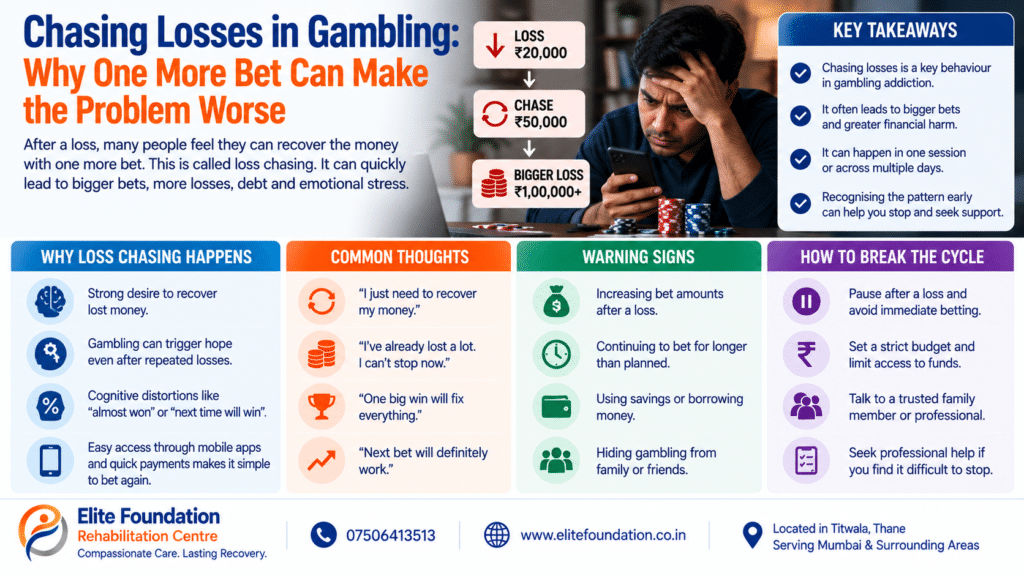
Chasing losses in gambling can begin with a thought that sounds practical: “I only need to recover yesterday’s ₹20,000.” For some families in Thane and Titwala, that thinking can quickly lead to larger bets, borrowing, hidden debt and repeated attempts to recover money already lost. At Elite Foundation, a nasha mukti kendra in Thane, families may seek help when gambling starts affecting finances, trust and daily life. Our gambling rehab in India approach focuses on stopping further losses, understanding loss chasing, managing debt and building a safer recovery plan.
That belief can change very quickly.
At ₹20,000 lost:
“I just need to recover ₹20,000.”
After more gambling, the total becomes ₹50,000.
Now the thought becomes:
“I’ve already lost ₹50,000. I can’t stop here.”
More money is risked.
The loss reaches ₹1 lakh.
Savings may no longer be enough.
Borrowing begins.
And the next thought may be:
“If I stop now, the ₹1 lakh is gone. I need one big win.”
That is the trap.
The amount already lost starts being used as the reason to risk even more.
This is called loss chasing, and it is one of the most important behaviours in understanding Gambling Disorder.
What does chasing losses mean in gambling?
Chasing losses means continuing or intensifying gambling after losing money in an attempt to recover those previous losses.
A 2023 systematic scoping review of loss-chasing research described it as the tendency to continue and/or intensify gambling following losses.
The review identified loss chasing as a key clinical symptom in Gambling Disorder and an important feature among people experiencing gambling-related problems.
The simplest definition is:
money has already been lost, and the person gambles again because they want that money back.
That sounds straightforward.
Psychologically, however, several things can happen at once.
The person is no longer thinking only about whether the next gamble is worth taking.
They are thinking about:
- The money already lost
- How to explain the loss
- How to repay debt
- How to restore savings
- How to avoid telling family members
- How quickly everything could supposedly be repaired by one win
The next wager therefore begins to feel different.
It feels less like a new financial risk and more like an attempt to reverse an old one.
Loss chasing can happen within one gambling session or across several sessions
The 2023 review highlighted an important distinction.
Loss chasing does not always look the same.
It can occur within the same gambling session or between separate gambling sessions.
Within-session loss chasing
This happens when somebody loses money and immediately continues or intensifies gambling.
That might involve:
- Continuing for longer than planned
- Increasing the amount risked
- Taking greater risks
- Making gambling decisions more rapidly
The pattern can look like:
₹5,000 loss → another ₹5,000 → another ₹10,000 → increasing urgency.
Between-session loss chasing
This occurs when the person stops temporarily but returns later because the previous loss is still psychologically unfinished.
For example:
“I lost ₹30,000 yesterday. Today I need to recover it.”
The person may return sooner than they otherwise would have, or begin the next session with larger amounts because they believe they now have a deficit to repair.
This distinction matters because someone may say:
“I stopped yesterday, so I was in control.”
But if the entire reason for gambling again today is to recover yesterday’s loss, the chasing process may still be continuing.
Why does one loss start feeling like a problem that gambling must solve?
The important psychological shift is:
the loss becomes unfinished business.
Suppose somebody begins with ₹20,000.
They lose it.
Logically, there are now two separate facts:
Fact 1: ₹20,000 has already been lost.
Fact 2: the person must decide whether to put additional money at risk.
Loss chasing combines these two decisions.
The person begins thinking:
“Because I lost ₹20,000, I now need to gamble again.”
The previous loss does not make another wager financially necessary.
It may make the loss emotionally difficult to accept and may also create very real financial pressure, particularly when savings, household money or borrowed funds have been lost.
But neither emotional pressure nor genuine debt turns another uncertain wager into a reliable or necessary way of repairing the loss.
Stopping can start to feel like accepting defeat
This is one of the strongest traps in chasing losses.
If the person stops after losing ₹20,000, the loss feels final.
If they keep gambling, there is still hope that the number could return to zero.
So psychologically:
stopping = accepting the loss
while:
continuing = keeping open the possibility of reversing it.
This can make stopping feel emotionally worse in the short term, even though further gambling creates additional financial risk.
The person is not necessarily thinking:
“I want to gamble more.”
They may be thinking:
“I cannot afford to stop now.”
That distinction is crucial.
₹20,000 can become ₹50,000 because the target keeps moving
Imagine the original loss is ₹20,000.
The goal becomes:
recover ₹20,000.
Another ₹10,000 is lost.
The target is now:
recover ₹30,000.
Another ₹20,000 is lost.
Now:
recover ₹50,000.
The problem is that every failed recovery attempt increases the amount that supposedly needs recovering.
The psychological target moves further away.
This can produce an escalating cycle:
loss → recovery attempt → larger loss → larger recovery target → greater financial pressure → another recovery attempt.
Why stakes may increase while chasing losses
As the deficit becomes larger, smaller wins can begin to feel irrelevant.
Suppose someone is ₹1 lakh down.
Winning ₹2,000 no longer feels meaningful.
They may begin thinking:
“I need something big enough to actually make a difference.”
This can encourage larger bets or greater risk-taking.
But increasing the amount at risk also increases how much can be lost.
The attempt to close the financial gap can therefore widen it.
Why gamblers keep gambling after losing money
There is no single explanation that applies to every person.
Several processes can operate together.
A person may be trying to:
- Return to their previous financial position
- Avoid admitting the loss
- Repay money that was borrowed
- Replace household money that was used
- Avoid telling a spouse or parent
- Restore confidence after feeling foolish
- Prove that their gambling judgement was not wrong
- Escape the anxiety caused by the loss itself
This is why telling somebody:
“You lost. Just accept it.”
may be logically correct but psychologically incomplete.
The loss may now be connected to debt, shame, secrecy, identity and fear.
The money already lost is gone from the current decision
This is one of the hardest ideas to accept emotionally.
Suppose someone has already lost ₹50,000.
The next ₹20,000 should be evaluated as a new ₹20,000 decision.
Instead, the person may evaluate it as:
“₹20,000 that could get my ₹50,000 back.”
That reframing makes the new money feel less like money being risked and more like money being invested in repairing the old loss.
But the ₹50,000 already lost does not become safer because another ₹20,000 is added.
The new money is simply another amount exposed to an uncertain outcome.
“I’ve already lost so much, stopping now makes no sense” is part of the trap
Once losses become substantial, the person may think:
“If I stop now, all the previous money was wasted.”
This can create a powerful reason to continue.
But stopping does not create the previous loss.
The previous gambling already created it.
Stopping prevents that previous loss from automatically becoming the reason for another one.
That is a very different way to frame the decision.
The need to break even can become more important than the original reason for gambling
Someone may initially gamble for:
- Entertainment
- Excitement
- Social reasons
- The hope of making money
After a substantial loss, those motivations can disappear.
The new objective becomes:
“I just want to get back to zero.”
The person may no longer even enjoy gambling.
They may feel anxious throughout the session.
Yet they continue because reaching the previous financial position has become the goal.
This helps explain why compulsive gambling can continue even when it no longer feels pleasurable.
Debt changes the psychology of loss chasing
Loss chasing can become especially dangerous once gambling is no longer being funded only from disposable money.
The person may begin using:
- Savings
- Credit cards
- Personal loans
- Salary advances
- Money borrowed from relatives
- Money borrowed from friends or colleagues
Now another pressure appears:
the money has to be repaid.
The person may think:
“My salary will take months to clear this. Gambling is the only way I can fix it quickly.”
That belief can make another wager seem necessary.
But gambling has now become the proposed solution to debt created by gambling.
Borrowing can turn loss chasing into a much larger financial problem
The progression may look like:
₹50,000 loss → ₹50,000 borrowed → further loss → ₹1 lakh total problem.
Then:
another loan → another recovery attempt → still greater debt.
At this point, the person is no longer simply trying to recover gambling losses.
They may also be trying to:
- Repay lenders
- Avoid missed EMIs
- Replace family savings
- Prevent relatives from discovering the debt
Every additional consequence increases the pressure for a rapid solution.
And that pressure can push the person back towards the same behaviour that created the problem.
Secrecy can make chasing losses even harder to interrupt
Imagine that nobody knows about the original loss.
The person may tell themselves:
“If I recover it before anyone notices, there is no problem.”
Now stopping gambling means more than accepting a financial loss.
It may also mean:
having to disclose what happened.
Another gamble seems to preserve the possibility that the entire problem can disappear privately.
This is one reason hidden gambling can escalate before families understand how large the losses have become.
The wider guide on gambling addiction symptoms and warning signs explains how secret transactions, borrowing, unexplained debt, missed payments and repeated attempts to recover money may become visible to families.
Loss chasing does not always mean someone believes a win is “due”
The gambler’s fallacy is relevant to some gambling behaviour, but loss chasing should not be reduced to one cognitive error.
A person may believe:
“I have lost repeatedly, so I must be due a win.”
But another person may fully understand that the next outcome is uncertain and still continue because:
“I need the money back.”
These are different psychological routes.
One involves an inaccurate belief about probability.
The other may involve desperation, debt, emotional difficulty accepting the loss or the perceived need to repair financial damage quickly.
Previous losses do not make a future win responsible for repaying them
The fact that somebody urgently needs ₹1 lakh does not change an uncertain gambling outcome into a reliable way of obtaining ₹1 lakh.
The next game, match or gambling event does not know:
- How much the person previously lost
- How much they owe
- How urgently repayment is needed
- How many times they have already tried
The emotional pressure is real.
The certainty of the next outcome does not increase simply because the financial need has increased.
Near misses can make stopping psychologically difficult
A near miss can sometimes create a powerful thought:
“I was almost right.”
Experimental gambling research, particularly involving slot machines and other chance-based gambling tasks, has found that near-miss outcomes can increase motivation to continue playing in some circumstances.
However, the effects are not identical across all studies or all forms of gambling, and much of the experimental evidence should not automatically be generalised to sports betting or every real-world gambling situation.
Psychologically, a person may nevertheless interpret an almost-successful outcome as:
“My approach was close to working.”
That interpretation can become:
“I don’t need to stop. I need one more attempt.”
The important issue is therefore not that every near miss predicts continued gambling, but whether the person repeatedly uses “almost winning” as justification for risking more money.
A previous win can make chasing losses feel reasonable
A person who once recovered a loss through further gambling may remember that event strongly.
For example:
“Last time I was ₹30,000 down and recovered everything.”
That memory can become justification for trying again.
But the fact that a previous recovery happened does not guarantee that the same sequence can be reproduced.
What worked once may encourage repeated attempts under increasingly dangerous financial conditions.
Cognitive distortions can help maintain gambling problems
Gambling psychology research has repeatedly examined beliefs that can influence gambling decisions.
These can include:
- Overestimating personal control
- Believing previous outcomes alter what must happen next
- Remembering wins more strongly than losses
- Interpreting near misses as evidence of future success
- Believing persistence will eventually be rewarded
Not every person who chases losses will hold all of these beliefs.
And not every gambling decision should be described as irrational.
The clinically important question is whether particular thoughts repeatedly encourage gambling despite mounting evidence of harm.
Why gamblers sometimes cannot stop even when they know they are losing
Knowing that gambling is harmful is not the same as being able to stop the behaviour.
Someone may simultaneously think:
“I know I should stop.”
and:
“I cannot stop while I am this far down.”
Both thoughts can exist together.
This helps explain why family members sometimes become frustrated:
“If you know you’re losing money, why are you still doing it?”
The answer may be that the losses themselves have become part of what is driving continued gambling.
Loss chasing is not proof of Gambling Disorder by itself
Loss chasing is clinically important.
But one attempt to recover a loss does not independently diagnose Gambling Disorder.
The WHO describes Gambling Disorder through the broader pattern of impaired control, increasing priority given to gambling and continuation despite negative consequences.
Assessment therefore needs to consider:
- How often loss chasing occurs
- Whether the person can stop
- Whether stakes are escalating
- Whether borrowing has begun
- Whether essential money is being used
- Whether gambling is being hidden
- Whether work, sleep or relationships are affected
The pattern matters more than one isolated decision.
Online gambling can compress loss chasing into minutes
Loss chasing existed long before smartphones.
Digital access does not cause Gambling Disorder.
But online access can reduce the delay between:
losing money
and:
risking more money.
A person may be able to move rapidly from:
result → frustration → payment → another wager.
This matters because time itself can create an opportunity for emotional intensity to reduce.
When that pause disappears, a decision made in frustration can quickly become another financial transaction.
Loss chasing can continue after the phone is switched off
The gambling session may end.
The chasing process may not.
The person goes to bed thinking:
“How do I recover ₹50,000 tomorrow?”
They wake up thinking about the same number.
They may spend the day:
- Looking for money
- Thinking about another gambling opportunity
- Calculating how large a win would be required
- Planning what to tell the family
This is between-session chasing.
Physically stopping gambling for several hours does not necessarily mean the psychological cycle has ended.
Why paying off someone’s gambling debt may not automatically stop the cycle
Families understandably want to protect someone from debt.
But removing the financial consequence without addressing the gambling pattern can leave the underlying mechanism untouched.
The person may think:
“The debt is cleared. Now I can start again carefully.”
If loss chasing returns, another debt can appear.
This does not mean families should ignore serious financial problems.
It means debt management and gambling treatment need to happen together.
The article on family support in addiction recovery explains why helping somebody can involve both compassion and clear boundaries around money and addictive behaviour.
A family should not fund another “recovery attempt”
A person who is chasing losses may be very persuasive.
They may say:
“I don’t need money for gambling. I need money to fix what happened.”
But if the proposed method of fixing the loss is another gamble, the household is still being asked to finance gambling.
Another uncertain event cannot be made safe by calling it a recovery plan.
How to stop chasing losses: separate recovery from gambling
The most important change is conceptual.
The person has to stop asking:
“How do I win the money back?”
and begin asking:
“How do I prevent another loss and deal with the money already gone?”
Those are completely different recovery strategies.
The first depends on another uncertain gambling outcome.
The second can involve:
- Stopping further gambling
- Protecting essential household money
- Documenting all debts accurately
- Reducing access to unrestricted credit
- Blocking gambling access where appropriate
- Identifying triggers for loss chasing
- Disclosing the problem to a trustworthy person where safe
- Seeking appropriate psychological or psychiatric assessment
Write down the total loss instead of keeping a moving number in your head
During active loss chasing, the amount can become confusing.
The person may remember:
the amount they hope to recover
rather than:
the complete amount deposited, borrowed and lost.
A realistic financial assessment needs to separate:
- Total gambling losses
- Bank debt
- Credit-card debt
- Money owed informally
- Household payments that are now outstanding
The purpose is not shame.
It is replacing a constantly changing mental estimate with an accurate financial position.
Protecting money can interrupt the chase
When a person is in an intense loss-chasing state, immediate access to additional money can make acting on the urge easier.
Depending on individual circumstances, safeguards may include:
- Blocking further gambling transactions where available
- Reducing access to credit
- Separating money required for essential expenses
- Using agreed temporary financial safeguards with a trusted person
These measures do not treat the whole psychological problem.
They can reduce the chance that a powerful urge immediately becomes another financial loss.
Financial safeguards must still be safe for the family
Where gambling occurs alongside intimidation, violence, economic abuse or coercive control, family members should not put themselves at risk by confronting the person or attempting to seize control of finances.
Personal and household safety comes first.
In such situations, confidential professional, safeguarding, domestic-abuse, financial or legal support may be necessary.
Likewise, safeguards should not become coercive control in the opposite direction.
Financial arrangements should be proportionate, lawful and agreed where this can be done safely.
CBT can address the thoughts that keep the chase going
Cognitive behavioural therapy does not simply tell somebody:
“Stop gambling.”
It can examine the beliefs and decisions that repeatedly return the person to gambling.
Examples include:
“If I stop now, I’ve wasted everything.”
“One win can fix all of this.”
“I was almost right last time.”
“I have already lost too much to stop.”
“Nobody needs to know if I recover it first.”
NICE guidance on gambling-related harms recommends gambling-specific CBT for reducing gambling severity and frequency and states that treatment should include relapse prevention.
The broader Elite Foundation guide on addiction treatment and longer-term recovery explains why assessment, behaviour change and relapse planning need to work together rather than relying on willpower alone.
A relapse can immediately restart loss chasing
Someone may stop gambling for weeks or months.
Then one gambling episode occurs.
They lose ₹10,000.
The most dangerous response may be:
“I’ve already relapsed. I might as well recover today’s ₹10,000 before I stop again.”
That turns one lapse into a chasing episode.
NICE advises that relapse planning should include understanding triggers, using practical coping strategies and helping the person recover quickly rather than allowing shame to prolong the episode.
A relapse therefore needs a different response:
stop the new loss from becoming another recovery target.
Loss chasing can become dangerous when hope turns into desperation
As debt grows, gambling may begin to feel like the only available way out.
The person may be facing:
- Creditors
- Family discovery
- Missed payments
- Relationship breakdown
- Shame
- Fear
Severe gambling-related financial distress can be associated with serious mental-health risk.
Statements such as:
“I have destroyed everything.”
“There is no way out.”
“My family would be better without me.”
must be taken seriously.
Suicide risk should never be treated as simply a financial issue.
If someone has suicidal intent, a suicide plan, has recently attempted suicide, cannot remain safe or presents another immediate danger, urgent emergency mental-health care takes priority over discussions about debt.
In India, Tele-MANAS can be reached on 14416 or 1800-89-14416 for mental-health support.
Loss chasing may occur alongside depression, anxiety or other mental-health problems
Gambling-related debt itself can produce severe anxiety.
At the same time, somebody may already have been gambling as a way of escaping:
- Stress
- Low mood
- Loneliness
- Anxiety
- Other emotional difficulties
A complete assessment should therefore look beyond the money.
Where significant psychiatric symptoms are present, a broader mental-health assessment may need to address both the gambling behaviour and the co-occurring condition.
How do you know when chasing losses has become part of a gambling problem?
Questions worth asking include:
- Do I gamble again mainly because I want previous money back?
- Do I increase the amount after losing?
- Do I return sooner than planned after a loss?
- Have I borrowed specifically to recover gambling losses?
- Do I feel unable to stop while I am financially behind?
- Do I hide losses because I expect to recover them first?
- Have previous recovery attempts created larger losses?
- Do I keep thinking about the amount I need to “get back to zero”?
- Have I used household money while chasing losses?
- Have I repeatedly promised to stop only after I recover the money?
Several “yes” answers do not independently diagnose Gambling Disorder.
They indicate that loss chasing may be an important part of the person’s gambling pattern and deserves closer assessment.
Frequently asked questions
What does chasing losses mean?
Chasing losses means continuing or increasing gambling after losing money because the person wants to recover previous losses.
Is chasing losses a sign of gambling addiction?
Loss chasing is an important clinical feature associated with Gambling Disorder, but one episode does not establish a diagnosis. The wider pattern of control, priority, persistence and harm needs to be assessed.
Why do gamblers keep gambling after losing?
A person may begin seeing another gamble as a way to repair the previous loss. Debt, shame, secrecy, previous wins, gambling-related beliefs and fear of accepting the loss can all contribute.
Why can’t gamblers just stop after losing?
For somebody actively chasing losses, stopping can feel like making the loss permanent, while continuing preserves hope that the money can still be recovered. That emotional logic can keep gambling going even when the person understands the financial risk.
Why does a gambler say “I just need to get back to zero”?
The previous financial position can become a psychological reference point. Instead of evaluating the next wager as a new risk, the person evaluates it according to whether it might restore the money already lost.
Can a ₹20,000 gambling loss really become ₹1 lakh?
Yes. Repeated attempts to recover an initial loss can increase the total amount at risk. If each recovery attempt also loses, the financial target becomes progressively larger.
Why do people increase their bets after losing?
As the amount to be recovered grows, smaller potential wins may feel insufficient. Some people therefore take greater risks or increase stakes, which can expose them to larger additional losses.
Is chasing losses the same as the gambler’s fallacy?
No. They can overlap, but they are not identical. The gambler’s fallacy involves inaccurate beliefs about how previous outcomes affect future probabilities. Someone can chase losses even while understanding that the next outcome remains uncertain.
What is between-session loss chasing?
Between-session chasing means returning to gamble at another time or day because the person wants to recover a previous loss. It can also involve returning sooner or gambling more heavily during the next session.
What is within-session loss chasing?
Within-session chasing means continuing or intensifying gambling during the same session after losing, such as increasing stakes, taking greater risks or gambling more rapidly.
Does borrowing money make loss chasing worse?
It can. Borrowing adds repayment pressure to the original gambling loss. The person may then feel an even stronger need for a rapid win, which can create another round of gambling and greater debt.
Why do gamblers hide losses from their families?
Shame, fear of conflict and the belief that the money can be recovered before anyone finds out can contribute to secrecy. Hidden gambling can allow debt to become substantially larger before the family understands what is happening.
Can one big win stop loss chasing?
A win can temporarily reduce a deficit, but it can also reinforce the belief that continued gambling is an effective way to recover losses. Some people subsequently return to gambling and begin another chasing cycle.
Why can a near miss make someone gamble again?
A near miss may sometimes be interpreted as evidence that the person was close to succeeding. Experimental evidence for near-miss effects comes particularly from electronic gaming-machine and other chance-based gambling research, so the effect should not automatically be assumed to work identically in every type of gambling or sports betting.
How do I stop chasing gambling losses?
The first step is to stop treating another wager as the method for repairing the previous loss. Prevent further gambling, protect essential money, document the real debt, reduce access to additional credit or gambling where appropriate and seek assessment if repeated attempts to stop have failed.
Should I try to win back my gambling losses before stopping?
Another gambling outcome cannot reliably restore previous losses. Continuing creates another opportunity to lose additional money and can turn a manageable loss into a much larger financial problem.
Should family members lend money so the gambler can recover losses?
Providing money specifically for another recovery bet exposes more household money to gambling risk. Financial problems may need practical advice and repayment planning rather than another uncertain wager.
Can paying off gambling debt cure the addiction?
No. Clearing debt may reduce immediate financial pressure, but it does not automatically change the thoughts, urges, triggers and loss-chasing behaviour that produced the debt.
Can CBT help with chasing losses?
Yes. Gambling-specific CBT can examine beliefs and behaviours that maintain harmful gambling, including thoughts about recovering losses, control, probability and relapse. Treatment should be tailored to the individual.
What should I do if I relapse and lose money again?
Stop the episode rather than trying to recover the new loss. Re-establish financial and gambling-access safeguards, identify the trigger and reconnect with treatment or support. One lapse does not need to become a prolonged chasing episode.
When should professional help be considered?
Professional assessment becomes particularly important when chasing losses repeatedly leads to larger bets, borrowing, debt, hidden gambling, use of essential household money, failed attempts to stop or significant mental-health, work or relationship problems.
What if gambling losses cause suicidal thoughts?
Suicidal thoughts require prompt professional assessment. If there is suicidal intent, a suicide plan, a recent attempt, inability to remain safe or another immediate danger, urgent emergency mental-health care is required. In India, Tele-MANAS can be reached on 14416 or 1800-89-14416 for mental-health support.
The hardest loss to accept may be the one that has already happened
Loss chasing can make gambling feel backwards.
The person is no longer gambling mainly because they expect a new reward.
They are gambling because they want to erase an old loss.
₹20,000 becomes ₹50,000.
₹50,000 becomes ₹1 lakh.
Then borrowing begins.
The increasing loss creates increasing pressure.
And increasing pressure creates a stronger argument for another attempt.
That is why the thought:
“I’ve already lost too much to stop now”
is so dangerous.
The money already lost cannot be made safer by putting additional money at risk.
The recovery direction has to change.
From:
“How do I get back to zero through gambling?”
to:
“How do I stop this number becoming even larger?”
That means separating two problems that chasing losses combines:
the gambling behaviour
and:
the financial consequences already created by it.
The gambling needs to stop creating new losses.
The debt needs its own realistic plan.
The secrecy may need honest and safe disclosure.
The beliefs driving repeated recovery attempts may need psychological treatment.
And if severe anxiety, depression, hopelessness or another mental-health problem has developed, that needs assessment in its own right.
Another bet cannot reliably do all of those jobs.
Medical disclaimer: This article provides general educational information and does not replace individual psychological, psychiatric, medical, financial or legal assessment. Loss chasing is an important gambling-related behaviour but does not by itself establish Gambling Disorder. Significant gambling debt, secrecy and repeated borrowing may require both clinical and financial support. Where gambling occurs alongside violence, threats, coercive control or economic abuse, family safety takes priority over confrontation or financial investigation. Gambling-related distress can also be associated with self-harm or suicide risk. Suicidal thoughts require prompt professional assessment; suicidal intent, a suicide plan, a recent attempt, inability to remain safe or another immediate danger requires urgent emergency care.
