
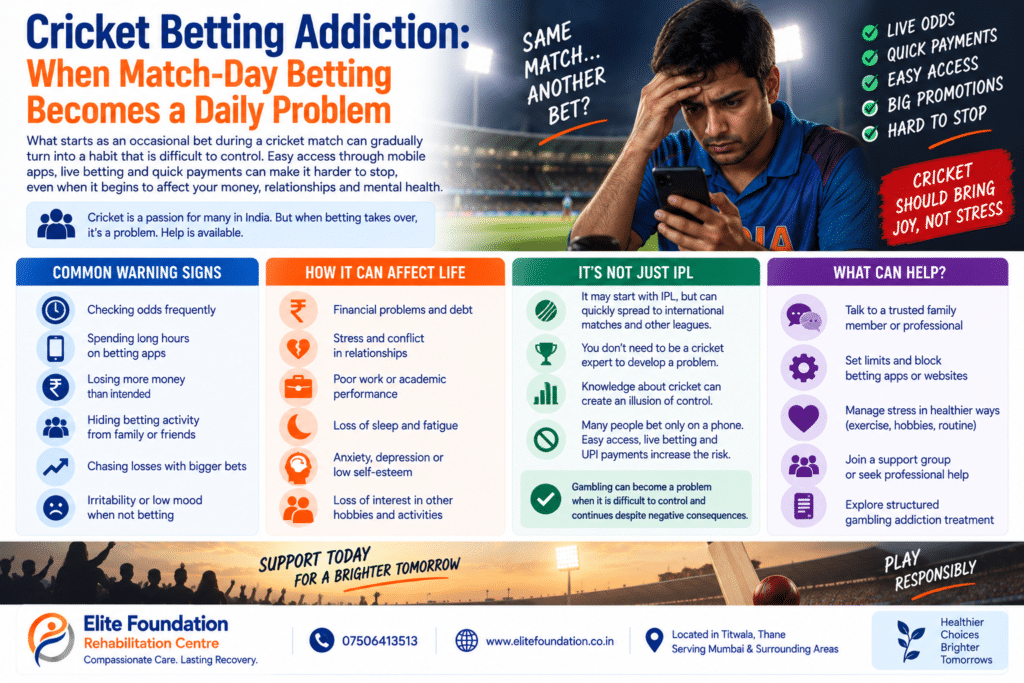
Cricket betting addiction can begin around IPL, T20 and international cricket, but for some families in Thane and Mumbai, match-day betting gradually becomes a daily financial and behavioural problem. A person may start with one IPL match, then move to live scores, repeated in-match bets, borrowing, chasing losses and hiding transactions. Families seeking gambling addiction treatment at Elite Foundation, a rehab centre in Mumbai, may notice debt and secrecy before the person admits betting has become difficult to control. Cricket knowledge can create false confidence because knowing teams and players does not remove uncertainty.
A person may follow the IPL closely.
They know the teams.
They know which batter is in form.
They remember how a bowler performed at a particular ground.
They discuss the pitch, weather, playing XI and previous matches with friends.
Then a wager is added.
At first, the betting may happen only during an important match.
Later, it happens during more matches.
Then during international cricket.
Then T20 leagues.
Then matches the person would never previously have watched.
Eventually, the day is no longer organised only around cricket.
It is organised around:
the next opportunity to bet.
That is an important transition.
Cricket itself is not the problem.
Knowing cricket is not the problem.
Watching every match is not automatically Gambling Disorder.
The concern begins when betting becomes difficult to control, repeatedly takes priority over other areas of life and continues despite debt, secrecy, stress or relationship harm.
Where cricket betting has become persistently difficult to control, gambling addiction treatment in India needs to look beyond the final amount lost. It should examine the person’s betting pattern, cricket-related triggers, loss chasing, beliefs about sports knowledge, access to money, debt, secrecy and repeated attempts to stop.
What is cricket betting addiction?
“Cricket betting addiction” is a useful public search term.
It is not a separate psychiatric diagnosis.
The recognised clinical condition is Gambling Disorder.
The World Health Organization describes Gambling Disorder around three central features:
- Impaired control over gambling
- Increasing priority given to gambling over other activities and responsibilities
- Continuation or escalation despite negative consequences
A cricket bettor therefore does not have Gambling Disorder simply because they:
- Watch the IPL
- Know a great deal about cricket
- Have placed a bet
- Have lost money once
The clinical concern is the wider pattern.
The important shift is from watching cricket to needing a betting opportunity
Someone may initially say:
“I only bet during IPL.”
That may be true.
Later, however, the boundaries can gradually widen.
IPL becomes:
IPL + international matches.
Then:
international matches + other T20 competitions.
Then:
almost any cricket match that creates another opportunity to gamble.
A person who once watched cricket because they loved the sport may begin watching unfamiliar teams because money is now attached to the result.
That change can be clinically meaningful.
Cricket is no longer only entertainment.
It has become a repeated gambling cue.
How match-day betting can become an everyday problem
The actual match may last only a few hours.
But betting-related thinking can spread much further across the day.
The cycle may look like this:
| Stage | What may happen |
|---|---|
| Before the match | Repeated checking of team news, players, conditions and predictions |
| Match begins | Initial gambling decision is made |
| During the match | Repeated attention to live events creates additional gambling decisions |
| Loss | The person feels pressure to recover money |
| After the match | The loss is reviewed repeatedly and another match becomes the hoped-for recovery opportunity |
| Following day | Attention shifts to the next match rather than accepting the previous loss |
This is how somebody who says:
“I only gamble during cricket”
can nevertheless spend a large part of every day thinking about gambling.
Cricket knowledge can create a powerful illusion of control
This is one of the most important psychological differences between sports betting and many other forms of gambling.
A person betting on cricket may genuinely know a lot.
They may understand:
- Team strength
- Player form
- Batting order
- Bowling combinations
- Pitch conditions
- Ground history
- Previous head-to-head results
- Weather conditions
That knowledge is real.
The mistake occurs when:
knowledge about cricket
becomes:
belief that the financial outcome of betting can therefore be reliably controlled.
The person may think:
“I understand this team better than most people.”
Therefore:
“I should be able to make money from this.”
Those are not the same statement.
Being better at predicting sport does not guarantee better financial results
A small but particularly relevant experiment examined experienced sports bettors.
In the study of expert hockey bettors, experienced participants were more accurate than random selection when predicting game outcomes.
But they did not achieve significantly better monetary outcomes than the random selections.
The researchers argued that sports information and near-misses could reinforce bettors’ perception of expertise even when that apparent expertise did not translate into superior financial results.
This study involved hockey rather than cricket and had only 30 participants.
It should not be presented as proof that knowledge can never influence any sports prediction.
Its more useful lesson is narrower:
correctly understanding aspects of a sport is not the same as possessing reliable control over gambling returns.
Modern research still finds illusion-of-control beliefs relevant to sports betting
A 2026 study involving 1,311 adult gamblers aged 40 to 75 examined different dimensions of illusion of control.
These included beliefs involving:
- Skill
- Strategy
- Luck
- Rituals or superstitious behaviour
Higher illusion-of-control scores, particularly beliefs involving skill and strategy, were associated with greater gambling severity and engagement in strategic forms of betting such as sports betting and horse racing.
The study was observational, involved adults aged 40 to 75 and did not specifically study Indian cricket bettors. Its findings therefore should not automatically be generalised to younger bettors or to every cricket-betting population.
But it supports a clinically important point:
beliefs about personal skill and control can become part of the gambling problem.
“I know cricket” and “I can predict cricket” are still different statements
Suppose someone knows:
- A batter’s recent average
- Which bowlers perform well in particular conditions
- How teams have historically performed at a ground
- Which players have recently returned from injury
That information can improve understanding of the sport.
It cannot remove uncertainty from what happens next.
A cricket match still contains events that cannot be controlled by the person watching it:
- A dropped catch
- An unexpected injury
- A run-out
- A tactical change
- A player’s unusually good or poor performance
- Weather changes
- An umpiring decision
- A sudden collapse or partnership
The bettor may understand cricket extremely well.
They still do not control the match.
Prediction accuracy can actually reinforce overconfidence
This point is easy to miss.
Suppose a person predicts correctly:
“This batter is going to perform well today.”
The batter does.
The prediction becomes evidence in the person’s memory:
“See? I understand cricket.”
They may then feel more confident about the next gambling decision.
But the mind may pay less attention to:
- Incorrect predictions
- Losses that occurred during the same week
- Money lost on other decisions
- Times when the match changed unexpectedly
The problem is not remembering cricket correctly.
The problem is using selected memories as evidence of reliable financial control.
A memorable win can become more powerful than many ordinary losses
Someone may say:
“I won ₹40,000 during an IPL match last year.”
That memory may remain vivid for months.
But when asked:
“How much have you deposited and withdrawn across the entire year?”
they may not know.
A single dramatic win can become part of the person’s identity:
“I am good at this.”
Meanwhile, many smaller losses are mentally treated as temporary mistakes.
Near misses can feel like proof that the prediction was almost right
Sports provide endless explanations for why an expected result nearly happened.
A bettor may say:
“If that catch had been taken, I would have been right.”
“If he had stayed for one more over, everything would have worked.”
“I read the match perfectly; one unusual event changed it.”
Sometimes that description may be factually reasonable.
Sport is uncertain.
The problem begins when every loss is interpreted as:
evidence that the underlying method was still correct.
If wins prove expertise and losses are dismissed as bad luck, the belief becomes very difficult to challenge.
IPL and T20 cricket can create repeated gambling cues
IPL and T20 cricket do not cause gambling addiction.
Millions of people enjoy these matches without gambling at all.
But for someone already struggling with betting, a dense tournament schedule can create frequent triggers.
A cue may begin with something ordinary:
- A match notification
- Team news
- A highlights programme
- A discussion with friends
- A live score
- A player announcement
For most fans, these are simply part of enjoying cricket.
For a person with an established betting problem, they can trigger:
“Maybe I should place something on today’s match.”
Live scores can become gambling triggers rather than simple sports information
A cricket fan may check a live score because they want to know how the match is progressing.
Someone with a betting problem may experience the same score differently.
A wicket, boundary or partnership can immediately create thoughts about:
another gambling decision.
The score stops being only information.
It becomes a cue.
This distinction matters during recovery because somebody may delete gambling access but continue repeatedly checking the same sporting cues that previously triggered betting.
Multiple gambling decisions within one match can increase exposure
One cricket match can contain many changing events.
That means someone vulnerable to compulsive betting may not experience one gambling decision per match.
They may experience repeated decisions throughout the game.
The pattern can become:
decision → result → emotion → another decision.
If the first outcome is positive:
“I’m reading the match well.”
If the first outcome is negative:
“I can recover it before the match ends.”
Different emotional routes can therefore lead to the same destination:
another bet.
Live betting can make it harder to emotionally leave a loss behind
A loss may occur while the sporting event itself is still continuing.
The person therefore does not have to wait until tomorrow to consider gambling again.
Another event may follow moments later.
That can compress the cycle:
loss → frustration → new opportunity → another wager.
The issue is not that live cricket is harmful.
The concern is repeated gambling during a period of heightened emotion.
Loss chasing can turn the next cricket match into a financial rescue plan
Suppose someone loses ₹25,000 during one IPL match.
The next morning they feel:
- Shame
- Fear
- Anger
- Financial pressure
Then they see that another match is scheduled that evening.
Instead of viewing it as entertainment, they think:
“Tonight I can get the ₹25,000 back.”
The next match has now been given a job it cannot reliably perform:
repairing the previous financial damage.
The problem can continue even on days when there is no bet
A person may insist:
“I don’t gamble every day.”
That may be true.
But gambling-related preoccupation may still occupy the day.
They may spend hours:
- Thinking about the previous loss
- Waiting for the next match
- Checking player information
- Thinking about obtaining money
- Planning how to repay debt after a hoped-for win
Gambling problems are not measured only by the minutes during which a wager is physically active.
When does enthusiasm for cricket become something different?
| Cricket enthusiasm | Possible gambling problem |
|---|---|
| Enjoys watching matches | Feels a match is incomplete without gambling |
| Checks scores for interest | Repeatedly checks scores because money depends on events |
| Discusses team performance | Uses cricket knowledge to justify repeated gambling after losses |
| Disappointed when a team loses | Severe distress because the result created financial loss |
| Looks forward to the next match | Needs the next match to recover money |
| Can miss a match when necessary | Work, sleep or family responsibilities are repeatedly displaced by betting |
The distinction is not how passionate somebody is about cricket.
It is what gambling has begun doing to the rest of their life.
Signs someone may be addicted to cricket betting
Possible warning signs include:
- Betting on more matches than originally intended
- Gambling on teams or competitions that previously held little interest
- Repeated betting during the same match
- Constant checking of live scores because of wagers
- Chasing losses during or after matches
- Borrowing money before major cricket events
- Using salary or household funds for betting
- Hiding betting transactions
- Repeatedly claiming the next match will recover previous losses
- Staying awake for matches mainly because money is involved
- Marked irritability after losses
- Unusually strong confidence after wins
- Repeated promises to stop after the tournament ends
- Returning to betting when the next series begins
The wider guide on gambling addiction symptoms and warning signs explains the broader financial, behavioural and family warning signs that may appear alongside cricket betting.
“I’ll stop after IPL” can become a repeating promise
A person may recognise that the betting has become excessive but delay stopping.
They say:
“I’ll stop once IPL finishes.”
Then international cricket begins.
Later another tournament appears.
Then another series.
The calendar becomes an endless reason to postpone change.
The important question is not:
“When is the next gap in cricket?”
It is:
“Why does stopping always need to wait for the next event?”
Cricket betting can change the experience of watching sport
Before gambling becomes central, someone may enjoy:
- A close contest
- A great innings
- A bowler’s spell
- A comeback
- Watching with family or friends
Once substantial money is involved, the experience can become narrower.
The person may stop appreciating the match itself.
Instead, every event is judged according to:
“What does this mean for my money?”
A match can be objectively excellent and still leave the bettor angry because the financial result went against them.
Cricket discussion groups can become triggers too
Friends discussing:
- Teams
- Players
- Predictions
- Past wins
may be completely harmless for most people.
For somebody trying to stop gambling, however, a particular conversation may activate old beliefs:
“I know this match.”
“This one is different.”
“I should not miss the opportunity.”
Recovery planning therefore sometimes needs to consider social triggers, not only the betting device.
Phone access can shorten the distance between cricket interest and betting
Cricket, scores, banking, payments and communication may all sit on the same phone.
That can make the sequence from:
seeing a cricket cue → thinking about gambling → acting on the urge
very short.
This does not mean the phone causes Gambling Disorder.
The separate Elite Foundation guide on reducing compulsive phone use explains why the specific digital behaviour matters more than simply counting total screen time.
For cricket betting, the treatment target is the gambling behaviour.
The phone is one route through which that behaviour may be accessed.
Debt can make cricket knowledge feel even more important
Once the person owes money, psychological pressure changes.
They may think:
“I cannot repay this through salary quickly enough.”
Then:
“But I know cricket. I can recover this.”
Knowledge that once justified recreational gambling now becomes the proposed solution to debt.
This is especially dangerous because financial desperation can increase confidence in a strategy precisely when the consequences of another loss are greatest.
The next match cannot be assigned responsibility for the previous loss
If someone lost ₹1 lakh during previous betting, that ₹1 lakh is already part of the financial position.
The next cricket match does not know:
- How much the person owes
- How urgently they need money
- How many times they have already lost
- How confident they feel
The previous loss does not make the next outcome responsible for correcting it.
Recovery requires separating:
existing debt
from:
the decision whether to gamble again.
What families may notice during cricket season
A family may see a sudden increase in:
- Phone secrecy
- Late-night matches
- Repeated payment activity
- Requests to borrow money
- Mood changes around cricket results
- Arguments when the person is interrupted
- Promises about money that will arrive “after the next match”
The family should not diagnose Gambling Disorder from cricket watching alone.
But repeated betting-related financial and behavioural changes deserve attention.
The guide on family support in addiction recovery explains why families may need both emotional support and practical boundaries when addictive behaviour starts affecting the household.
Families should not finance another attempt to recover cricket betting losses
A person may sound highly convincing.
They may explain:
why the previous prediction failed.
Then they explain:
why the next one is different.
Because they know cricket well, the explanation may sound technically sophisticated.
But the family still faces the same basic question:
Is more household money being put at risk in an attempt to recover previous gambling losses?
If yes, another detailed cricket explanation does not remove that risk.
Can someone stop betting and still enjoy cricket?
For some people, yes.
Others may find that watching cricket initially triggers such strong gambling urges that a temporary change in viewing habits is helpful.
There is no universal rule requiring someone recovering from Gambling Disorder to permanently stop watching cricket.
The practical question is:
Can the person watch without repeatedly moving towards gambling?
If watching:
score → prediction → urge → bet
continues to happen, more distance from the trigger may temporarily be useful.
IPL season can become a relapse period for somebody who has stopped betting
A person may avoid gambling for several months.
Then IPL begins.
Old routines return:
- Daily cricket conversations
- Match notifications
- Memories of previous wins
- Friends discussing predictions
- Repeated live scores
The person tells themselves:
“I am under control now. One match will not matter.”
For someone with a previous Gambling Disorder pattern, this deserves careful thought.
A relapse-prevention plan should identify high-risk sporting periods before they begin rather than waiting until after another loss.
A cricket-specific relapse plan can be practical
Before a tournament or major series begins, someone in recovery can identify:
- Which matches are strongest triggers
- Which people or conversations increase urges
- Whether live-score notifications are a problem
- How easy access to money will be managed
- Who they will contact when the urge to gamble returns
- Whether temporarily reducing cricket exposure is necessary
The goal is not to declare cricket dangerous.
The goal is to recognise the person’s own learned connection between cricket and gambling.
Treatment needs to challenge gambling beliefs without attacking cricket knowledge
Telling a knowledgeable cricket fan:
“You know nothing about cricket.”
is unnecessary and probably unhelpful.
They may know a great deal.
A more useful treatment question is:
“Does that knowledge give you reliable control over uncertain financial outcomes?”
Cognitive behavioural approaches can examine beliefs such as:
- “I understand this team, so this bet is safe.”
- “I was nearly right last time, so my method works.”
- “I have lost several times, so a win must be coming.”
- “I can recover my debt because cricket is my area of expertise.”
The objective is not to remove somebody’s interest in sport.
It is to separate:
sports expertise
from:
the belief that expertise guarantees gambling control.
Treatment should also examine what cricket betting is doing emotionally
Some people gamble mainly for excitement.
Others use it to escape:
- Stress
- Loneliness
- Low mood
- Boredom
- Financial anxiety
A proper assessment therefore should not stop at:
“How much did you lose during IPL?”
It should also ask:
“What happens emotionally before you start betting?”
If significant depression, anxiety, mood change or another psychiatric problem is present, the broader mental-health assessment may need to address that condition alongside the gambling behaviour.
How can someone start stopping cricket betting?
The first objective is not recovering the losses.
It is preventing further losses.
Depending on the person’s circumstances, that may involve:
- Stopping further gambling transactions
- Removing or blocking gambling access
- Reducing unrestricted access to credit
- Protecting household and essential money
- Documenting all gambling-related debt
- Identifying cricket-specific triggers
- Reducing exposure to triggers that repeatedly lead directly to gambling
- Disclosing the problem to an appropriate trustworthy person
- Seeking professional assessment where repeated attempts to stop have failed
The wider guide on addiction treatment and longer-term recovery explains why assessment, behavioural change and relapse prevention need to work together rather than relying on one promise to stop.
Cricket betting addiction does not automatically require residential rehabilitation
Not everyone with a gambling problem needs residential care.
Some people can be treated through outpatient psychological or psychiatric support combined with strong financial safeguards and changes to gambling access.
More structured treatment may be considered when there is:
- Severe repeated loss of control
- Substantial debt
- Repeated relapse despite previous treatment
- Serious depression, anxiety or another psychiatric condition
- Alcohol or drug problems occurring alongside gambling
- An unsafe or highly destabilising home situation
The level of treatment should match the person’s needs rather than being determined only by the amount lost.
A practical cricket betting self-check
Ask yourself:
- Do I feel that watching cricket is incomplete unless I gamble?
- Do I bet on matches I would otherwise have little interest in?
- Do I make several gambling decisions during one match?
- Do I keep gambling after losing because I want to recover the money?
- Do I believe my cricket knowledge makes recovering losses realistic?
- Have I borrowed money to bet?
- Have I hidden cricket betting transactions?
- Does my mood depend heavily on financial outcomes from matches?
- Have I promised to stop after a tournament and then continued?
- Do I plan my finances around hoped-for cricket betting wins?
- Has cricket betting affected sleep, work, family life or household expenses?
Several “yes” answers do not independently diagnose Gambling Disorder.
They indicate that the pattern deserves closer assessment.
Frequently asked questions
What is cricket betting addiction?
Cricket betting addiction is a common term for difficult-to-control gambling involving cricket that continues despite financial, psychological, relationship or other significant harm. The recognised clinical diagnosis is Gambling Disorder.
What are the signs of cricket betting addiction?
Possible signs include repeatedly betting more than intended, multiple gambling decisions during matches, chasing losses, borrowing, hidden transactions, missed household payments, repeated failed attempts to stop and continuing despite serious consequences.
Can someone be addicted to cricket betting without gambling every day?
Yes. A person may lose control mainly during IPL, major international series, T20 tournaments or particular matches. Daily gambling is not required for the behaviour to produce serious harm.
Why does cricket betting feel more predictable than other gambling?
Sports contain genuine information about teams and players, so bettors may feel their knowledge gives them control over the financial outcome. The danger is confusing better knowledge of cricket with reliable control over an uncertain future event.
Does knowing cricket well make betting safe?
No. Sports knowledge can improve understanding of teams, players and conditions, but it does not remove uncertainty or guarantee a profitable gambling outcome.
What is illusion of control in cricket betting?
Illusion of control refers to overestimating how much personal knowledge, skill or action can control an uncertain gambling outcome. In cricket betting, this may appear as the belief that detailed knowledge of teams or players makes future betting results reliably controllable.
Is all confidence about cricket an illusion of control?
No. Someone can make an informed sports prediction. The concern is the additional belief that being knowledgeable or occasionally correct means future financial gambling outcomes can be reliably controlled.
Why can a correct prediction make gambling harder to stop?
A correct prediction may strengthen confidence in personal expertise. The bettor may remember successful predictions more strongly than losses and begin treating those successes as evidence that future gambling can be controlled.
Can one big IPL win contribute to a gambling problem?
A win does not by itself cause Gambling Disorder. However, a memorable win can reinforce confidence and encourage further gambling, particularly if the person begins believing the same result can be repeatedly reproduced.
Why do cricket bettors chase losses?
After losing money, another cricket match may begin to look like an opportunity to repair the previous loss. This is loss chasing. Further betting can instead increase the financial damage.
Why do some people bet several times during one cricket match?
A live sporting event contains repeated changes and outcomes. For somebody struggling with control, each new event can create another decision point, particularly after a win or loss has increased emotional involvement.
Can live scores trigger gambling?
They can for some people who have learned to associate cricket updates with betting. For most fans, live scores are ordinary sporting information. During gambling recovery, however, repeated score checking may trigger urges in somebody whose previous gambling routine was closely connected to live cricket.
Is watching IPL harmful for someone recovering from betting addiction?
Not necessarily. Some people can return to watching cricket without gambling. Others may need temporary distance from particular tournaments or live-score triggers if watching repeatedly produces strong urges to bet.
Can someone enjoy cricket again after stopping gambling?
Yes, for many people. Recovery may involve relearning how to watch the sport without attaching money to every result. The pace and approach should depend on the individual’s triggers and relapse history.
Why does someone keep saying they will stop after the tournament?
Postponing change until a tournament ends can allow the gambling pattern to continue. When another series or competition begins, the stopping point may simply move again.
Can cricket betting cause debt?
Yes. Repeated losses, chasing losses, borrowing and using money intended for essential expenses can produce serious financial harm.
Should family members lend money for one final cricket bet?
No wager can reliably recover previous losses. Giving unrestricted money specifically for another attempt to win back gambling losses can expose the household to additional financial harm.
Is cricket betting addiction the same as sports betting addiction?
Cricket betting is one form of sports betting. Gambling Disorder can develop around cricket or other sports when gambling becomes difficult to control and continues despite significant harm.
Is cricket betting legal in India?
The legal position depends on the type of betting activity and the current regulatory framework. India’s rules governing online money games changed substantially in 2025–2026. Because gambling and online-gaming laws can change and individual services may operate differently, legal questions should be checked against current official sources or qualified legal advice.
Can cricket betting addiction be treated?
Yes. Treatment can address impaired control, loss chasing, beliefs about sporting expertise, access to money, debt, emotional triggers and relapse prevention. Co-occurring mental-health or substance-use problems should also be assessed where relevant.
Does cricket betting addiction require rehab?
Not automatically. Outpatient treatment may be appropriate for some people. More structured or residential care may be considered when gambling is severe, previous treatment attempts have failed, debt is substantial or serious psychiatric, substance-use or safety problems are also present.
What should someone do after a cricket betting relapse?
The priority is to stop the episode rather than trying to recover the new loss. Restore financial and access safeguards, identify the cricket-related trigger and reconnect with treatment or support rather than turning the next match into another recovery opportunity.
When should professional help be considered?
Professional assessment becomes increasingly important when attempts to stop repeatedly fail, loss chasing continues, borrowing or debt increases, gambling is being hidden, household money is affected or cricket betting is disrupting work, sleep, mental health or relationships.
What if gambling debt leads to hopelessness or suicidal thoughts?
Severe gambling-related financial distress can become a mental-health emergency. Suicidal thoughts require prompt professional assessment. Suicidal intent, a suicide plan, a recent attempt, inability to remain safe or another immediate danger requires urgent emergency care. In India, Tele-MANAS can be reached on 14416 or 1800-89-14416 for mental-health support.
Cricket knowledge is valuable — but it is not control over the future
A knowledgeable cricket fan may understand the sport far better than the average viewer.
That knowledge is real.
The person may accurately recognise:
- A strong team
- A player’s form
- A difficult pitch
- A tactical weakness
None of that requires pretending cricket is completely random.
But neither does it make future events controllable.
That distinction becomes essential when money is involved.
Someone struggling with cricket betting addiction may stop asking:
“What could happen in this match?”
and begin thinking:
“I know what will happen, therefore I can recover my money.”
The first statement recognises uncertainty.
The second can turn sports knowledge into justification for another wager.
Recovery does not require somebody to stop loving cricket.
It requires separating:
enjoying the sport
from:
needing the sport to solve a financial problem.
Medical and legal disclaimer: This article provides general educational information and does not replace individual psychological, psychiatric, medical, financial or legal assessment. Watching cricket, following live scores or having extensive sports knowledge does not establish Gambling Disorder. Gambling-related debt and severe psychological distress can create serious safety risks. Sudden major mood or behavioural changes may require assessment for other psychiatric or medication-related causes. Gambling and online-gaming laws can change, so specific legal questions should be checked against current official sources or qualified legal advice. Suicidal thoughts require prompt professional assessment; suicidal intent, a suicide plan, a recent attempt, inability to remain safe or another immediate danger requires urgent emergency care.
