
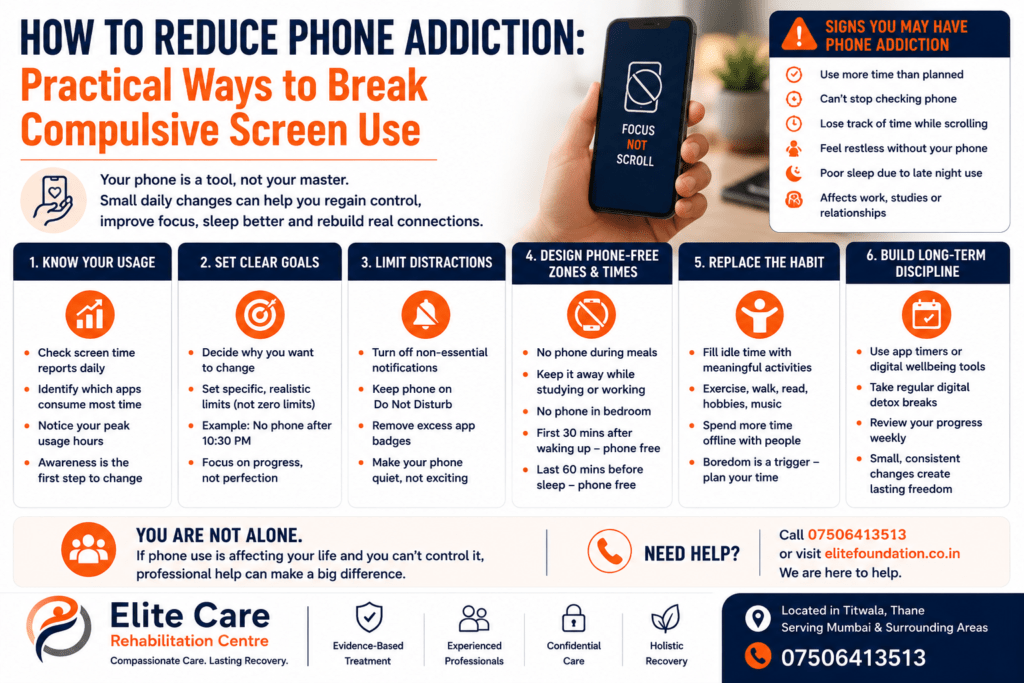
How to reduce phone addiction becomes a practical question when you are no longer simply using your phone a lot—you keep reaching for it after deciding to stop, lose time to scrolling or allow it to interfere with sleep, work, study or relationships. Families approaching a nasha mukti kendra in Thane may sometimes be seeking help for this kind of behavioural problem. Where self-directed changes repeatedly fail, mobile phone addiction treatment can focus on the specific digital behaviour, its triggers, daily consequences, sleep and any mental-health difficulty occurring alongside it.
For many people, however, the first step does not need to be giving up the smartphone. It is learning to make phone use intentional again.
That difference matters. Your phone may be necessary for work, UPI payments, navigation, family communication and everyday tasks. Trying to remove it completely can therefore be unrealistic. A better plan is to identify the parts of phone use that are automatic, unnecessary or repeatedly causing problems, and then make those behaviours harder to perform without thinking.
This guide is deliberately practical. It explains how to stop checking your phone automatically, reduce unnecessary screen time, deal with notifications, control late-night scrolling, make distracting apps less accessible, rebuild offline habits and decide whether your plan is actually working.
For most people, do not start by trying to stop using your phone completely
When people decide they have a phone problem, the first reaction is often extreme:
- “From tomorrow I will use it only for one hour.”
- “I am deleting everything.”
- “I will never use social media again.”
That may work briefly for some people, but an all-or-nothing rule is difficult to maintain when the same device is also required for ordinary life.
Instead, separate phone use into three broad categories.
| Type of use | Examples | What to do |
|---|---|---|
| Necessary | Work calls, UPI, maps, banking, essential messages | Usually keep it |
| Intentional recreation | A film, planned social-media time, reading or gaming | Keep within chosen boundaries if it is not causing problems |
| Automatic or unwanted use | Repeated checking, endless scrolling, opening apps without intending to | This is usually the first target for change |
You are not trying to make the smartphone disappear. You are trying to reduce the gap between what you intended to do and what you actually did.
Step 1: Find out where your phone time is actually going
Do not begin with memory alone.
Open your phone’s built-in screen-time or digital-wellbeing report and look at recent ordinary days.
Check:
- Total screen time
- Time spent in individual apps
- Number of phone pickups or unlocks, if available
- Notification volume
- When phone use begins in the morning
- Which apps dominate late at night
Then look for surprises.
You may think WhatsApp is the problem and discover that short-form videos consume far more time. You may believe you use the phone mainly for work but notice that dozens of brief recreational checks are scattered through the working day.
The goal is not to become obsessed with the number. It is to discover where your attention is actually going.
If you are unsure whether the underlying pattern is problematic in the first place, the previous guide on mobile phone addiction signs, sleep, focus and relationships explains how loss of control differs from simply having high screen time.
Step 2: Choose one phone behaviour to change first
Trying to change everything at once makes it difficult to know what is working.
Instead of saying:
“I need to use my phone less.”
choose something observable.
For example:
- No recreational scrolling once I get into bed
- Do not check Instagram while working
- Keep the phone away during dinner
- Stop opening short-form videos during study breaks
- Do not check messages immediately after waking unless something urgent is expected
A specific behaviour is easier to monitor than a vague promise to “control phone addiction”.
Step 3: Identify what happens immediately before you check
Compulsive phone checking is often connected with a cue.
The cue may be external:
- A notification
- A vibration
- Seeing the phone on the desk
- A message preview
- An application icon
Or it may come from inside:
- Boredom
- Anxiety
- Loneliness
- Stress
- A difficult work task
- The desire to avoid an uncomfortable conversation
Ask yourself:
“What normally happens just before I unlock the phone?”
This question can be more useful than asking why you have no willpower.
Step 4: Turn off notifications that do not deserve immediate attention
Every notification creates another opportunity to interrupt what you are doing.
Most people do not need an immediate alert every time:
- A social-media post receives a reaction
- A shopping app announces an offer
- A news app publishes a story
- A game offers a reward
- A video platform recommends new content
Keep notifications that genuinely need immediate attention.
For the rest, consider disabling:
- Sound
- Vibration
- Lock-screen previews
- Badges
- Promotional alerts
A randomised study of behavioural strategies for problematic smartphone use included measures such as disabling non-essential notifications and changing how the phone environment was presented. The combined intervention reduced problematic smartphone use and screen time compared with screen-time monitoring alone.
This does not mean that turning off notifications will solve every case. It does show why reducing unnecessary cues is a reasonable part of a broader plan.
Step 5: Stop keeping your most distracting apps one tap away
Convenience works in both directions.
If an app is:
- On the first home screen
- Already logged in
- Sending notifications
- Placed exactly where your thumb expects it
opening it requires almost no decision.
You can introduce a small amount of friction by:
- Removing the app from the main home screen
- Placing it inside a folder
- Logging out after use where practical
- Removing saved shortcuts
- Using the browser instead of the app for a particularly compulsive platform
- Temporarily uninstalling an app that is repeatedly causing problems
The purpose is not punishment.
It is to create one extra moment in which you can ask:
“Did I actually mean to open this?”
Step 6: Consider making the display less attention-grabbing
Some people find that changing the display to greyscale makes recreational checking less visually appealing.
In a preregistered field experiment comparing commonly available screen-time strategies, greyscale produced an immediate reduction in objectively measured screen time, while a self-set time-limit strategy produced a smaller and more gradual reduction.
That does not make greyscale a treatment for smartphone addiction, and it will not work equally well for everyone.
It is better understood as another form of friction: the device still works, but some of its visual pull may be reduced.
Step 7: Keep the phone physically farther away during important tasks
Sometimes changing the settings is less effective than changing the distance.
If you are studying, writing or doing work that needs sustained attention, consider placing the phone:
- Inside a drawer
- In a bag
- On a shelf behind you
- In another room when practical
This changes the sequence from:
urge → unlock
to:
urge → stand up → walk to the phone → decide whether checking is actually necessary
That small delay can make an automatic behaviour more deliberate.
Step 8: Create phone-free activities rather than a phone-free life
For many adults, a completely phone-free day is unrealistic.
Phone-free activities are usually more practical.
You might protect:
- Meals
- Exercise
- A family conversation
- A work meeting
- Study periods
- Reading
- The first part of the morning
- The period immediately before sleep
The aim is to practise doing some ordinary activities without automatically adding digital stimulation at the same time.
Step 9: Give your phone a parking place at home
One reason people check constantly is simple: the device travels everywhere with them.
Consider choosing a regular place where the phone stays when it is not actively needed.
This might be:
- A side table
- A charging station
- A shelf near the entrance
- A desk away from the sofa
If the phone is always in your pocket, it is available during every second of boredom.
If you need to deliberately walk towards it, unnecessary checking becomes easier to notice.
Step 10: Do not take every phone break with your phone
A common work pattern is:
- Work for some time.
- Feel mentally tired.
- Take a break.
- Open social media.
- Spend the entire break consuming more information.
- Return to work without feeling mentally rested.
Try making some breaks genuinely different from the task you were doing.
Options include:
- Standing up
- Walking
- Stretching
- Drinking water
- Looking outside
- Talking briefly with someone nearby
The important point is not that these activities are magical. It is that a break does not automatically have to mean another screen.
How to stop checking your phone automatically
When checking feels automatic, use a short interruption before acting.
When the urge appears, ask:
- Why am I picking up the phone?
- Which app am I planning to open?
- What am I planning to do there?
If you cannot answer, the checking may be habitual rather than purposeful.
You do not need to win every urge.
The first goal is simply to notice that an urge occurred.
Replace the checking habit instead of leaving an empty gap
Removing a behaviour leaves a moment behind.
If your normal sequence is:
boredom → phone → video
and you remove the phone without replacing the next step, boredom remains.
A replacement might be:
- Walking for a few minutes
- Reading
- Music without accompanying scrolling
- Stretching
- Making tea
- Speaking with another person
- Continuing an offline hobby
The replacement should be realistic.
If the unwanted habit happens during a two-minute wait, replacing it with a 45-minute gym session makes no sense.
How to reduce phone addiction caused by boredom
Boredom can be a common trigger for automatic phone checking.
Notice what happens when:
- You wait for a lift
- You stand in a queue
- An advertisement begins
- A meeting has not started
- Your food is still being prepared
If every empty moment immediately becomes phone time, start allowing some short pauses to remain empty.
You are not trying to become comfortable with hours of boredom.
You are rebuilding the ability to experience ordinary pauses without automatically searching for digital stimulation.
How to use your phone less when anxiety is the trigger
Some checking is not driven by entertainment.
It is driven by uncertainty.
You may repeatedly check:
- Whether someone replied
- Whether a client responded
- Whether a message was read
- Whether something happened in a group
- Whether there is new news
Checking briefly reduces uncertainty.
But if that reassurance lasts only a short time, you may need to check again and again.
In this situation, reducing screen time alone may not address the full problem. The anxiety linked with uncertainty may need attention as well.
How to stop scrolling when you are stressed
Scrolling can become an escape from tasks that feel uncomfortable.
A typical pattern is:
Difficult work → discomfort → “I’ll check my phone for a minute” → scrolling → delayed work → greater pressure.
The phone temporarily reduces discomfort while making the original problem larger.
When this pattern appears, the useful question is:
“What am I avoiding right now?”
Sometimes the answer is more important than the app itself.
How to stop scrolling at night
Night-time phone use deserves its own plan because tiredness can make deliberate decisions harder.
If you regularly intend to sleep and instead continue scrolling, do not wait until you are already in bed to decide what to do.
Change the environment earlier.
Possible strategies include:
- Charge the phone away from the bed
- Use a separate alarm clock if the phone alarm keeps the device beside you
- Remove the most problematic applications from the home screen before evening
- Disable unnecessary night-time notifications
- Choose a point after which recreational scrolling stops
- Replace scrolling with a lower-stimulation bedtime routine
If you still need the phone for emergencies, it does not need to be switched off entirely. Essential calls can remain available while recreational alerts are limited.
Do not use bedtime as your final opportunity to catch up online
Some people reduce phone use during the day and then compensate at night.
They think:
“I haven’t checked anything all evening. I’ll just see what I missed.”
That can turn bedtime into a backlog-clearing session.
If social media or messages genuinely need reviewing, doing it deliberately before the bedtime routine may be easier to control than beginning once you are already lying in bed.
Morning phone use can set the pattern for the day
Many people open the phone almost immediately after waking.
That first check may involve one message but quickly expand into:
- News
- YouTube
You do not necessarily need a rigid no-phone morning.
But if your morning routinely disappears into recreational scrolling, consider completing one or two ordinary activities first:
- Getting out of bed
- Washing
- Eating breakfast
- Preparing for work
The principle is simple: avoid allowing an automatic app sequence to become the first decision of the day.
How to reduce screen time without missing important messages
People sometimes resist reducing phone use because they genuinely need to remain reachable.
You can separate:
- Calls from important contacts
- Work communication
- Family messages
from:
- Promotional alerts
- Social reactions
- Shopping notifications
- Game reminders
- Breaking-news alerts
Reducing interruptions does not have to mean becoming unreachable.
Use app limits as a boundary, not as magic
Built-in timers and app limits can be useful because they make invisible use visible.
However, a timer only helps if you treat the alert as meaningful.
If you repeatedly press “ignore for today”, the timer may simply become another notification.
Use it together with a plan:
- What will you do when the limit appears?
- What activity will replace the app?
- Are there situations in which extra use is genuinely necessary?
The boundary should support a decision rather than pretend the software itself is treatment.
Should you use a screen-time reduction app?
It can help some people, particularly when the tool makes behaviour visible or creates a deliberate pause before a distracting application opens.
But adding another application does not automatically solve compulsive smartphone use.
If you choose one, focus on whether it helps you:
- Notice usage
- Set meaningful boundaries
- Interrupt automatic opening
- Review progress
A tool that you bypass every day is probably not changing the behaviour that matters.
Should you delete social media?
Not everyone needs to.
Ask whether social media is:
- The primary source of uncontrolled phone use
- Needed for business or work
- Your main way of communicating with certain people
- Easy or difficult to use within boundaries
Possible approaches range from:
- Disabling notifications
- Removing the app from the home screen
- Scheduled use
- Using only the web version
- Temporarily uninstalling it
Deleting every account is not automatically more effective than learning to use the platform intentionally.
Do you need a digital detox?
A temporary break from selected digital activities can help some people recognise how frequently they check automatically.
But “digital detox” should not be confused with medical detoxification from alcohol or drugs.
You also do not need to assume that a weekend away from the phone has somehow “reset your dopamine”.
A short break may reduce exposure to cues. The more important question is what happens after the phone returns.
If the same:
- Notifications
- Bedtime routine
- Apps
- Stress
- Boredom
- Automatic habits
are still present, the previous pattern can return.
Why extreme screen-time targets may backfire
A target should fit your life.
Someone whose job depends on a smartphone cannot reasonably follow the same screen-time target as someone who uses the device mainly for entertainment.
A 2025 randomised controlled trial asked healthy university students to reduce smartphone screen time to no more than two hours a day for three weeks. The intervention group showed improvements in several mental-health and sleep measures during the study, but screen time increased rapidly after the intervention and was approaching earlier levels at follow-up.
The 2025 smartphone screen-time reduction trial is useful evidence that reducing use can be achievable in a controlled setting, but its specific two-hour target should not be treated as a universal clinical rule for every age, occupation or individual.
The longer-term challenge is creating a level of use that can survive ordinary life.
Reduce the behaviour that causes harm, not every useful screen
If the main problem is:
Instagram from midnight to 2 a.m.
reducing daytime Google Maps use is irrelevant.
If the problem is:
checking WhatsApp every few minutes while studying
cutting a planned weekend film may not help.
The more precisely you define the unwanted behaviour, the easier it becomes to build a useful intervention around it.
Do not turn screen-time tracking into another compulsion
Screen-time reports are measurement tools.
You do not need to check them every hour.
Look for broader patterns:
- Is unwanted app use falling?
- Are you checking less automatically?
- Is bedtime improving?
- Can you work or study for longer without reaching for the phone?
The aim is better control, not a perfect graph.
How to reduce phone addiction while working from your phone
This is especially relevant for people who run a business, work in sales, communicate through WhatsApp or handle customer enquiries throughout the day.
Do not classify every minute of work communication as problematic screen time.
Instead, separate work use from recreational drift.
For example:
| Necessary task | Common distraction |
|---|---|
| Reply to customer message | Open social media afterwards |
| Check work email | Read unrelated news |
| Use UPI | Open another app automatically |
| Take a business call | Continue scrolling after the call ends |
The task itself may be necessary. The extra 15 minutes that follows it may be the behaviour you want to change.
How to control phone use while studying
Studying often involves moments of frustration.
The easiest chapter is rarely the one that triggers the phone. The difficult one does.
Try:
- Keeping the phone out of immediate reach
- Disabling recreational notifications
- Deciding in advance when messages will be checked
- Using a computer rather than the phone when study material allows
- Writing down something you want to check later instead of interrupting the task immediately
If concentration remains very difficult even when the phone is removed, consider whether poor sleep, anxiety, ADHD, depression or another issue may also be contributing.
What if your friends expect immediate replies?
Social expectations can maintain constant checking.
You may worry that a delayed reply looks:
- Rude
- Uninterested
- Unprofessional
- Unfriendly
But every message does not require an immediate answer.
If a group expects constant availability, you may need to change the expectation rather than continuously changing your attention.
For work, decide which communication actually needs urgent response and which can wait for a planned checking period.
How to reduce phone use in a relationship
A phone-free rule is easier to maintain when both people understand why it exists.
Possible boundaries include:
- No recreational phones during meals
- No scrolling while discussing something important
- Phones placed away during selected shared activities
- Agreeing when work interruptions are genuinely necessary
A relationship boundary should not become surveillance.
Partners do not need to check one another’s screen-time report every night unless both people have deliberately agreed to that arrangement.
How families can support someone trying to use their phone less
Family support is more useful when it focuses on observable behaviour rather than repeated accusations.
Instead of:
“You are addicted to that phone.”
try discussing the actual consequence:
“You have been staying awake until 2 a.m. most nights and are finding it difficult to wake for college.”
The broader principles in Elite Care’s article on the role of family support in recovery are also relevant here: boundaries work better when they are clear, consistent and focused on behaviour rather than shame.
Do not ask family members to become phone police
A plan that depends on another person constantly:
- Checking your phone
- Counting your hours
- Taking the device away
- Arguing whenever you cross a limit
can create resentment without building self-control.
External structure can help, particularly for younger people, but the longer-term aim is for the person to recognise their own triggers and make deliberate choices.
What if you keep breaking your own screen-time rules?
Do not respond only by making the rule stricter.
Ask what happened.
For example:
Rule: No Instagram after 11 p.m.
What happened: Had an argument at 10:45 p.m., felt upset and began scrolling.
The important information is not simply that the rule failed.
You discovered that emotional distress is a trigger.
The next version of the plan needs to address that trigger rather than merely moving the cutoff to 10:30 p.m.
A setback does not mean the entire plan failed
Behaviour change is rarely perfectly linear.
You may have several controlled days followed by one evening of prolonged scrolling.
Avoid:
“I ruined the whole week, so there is no point trying anymore.”
Instead review:
- What happened immediately before the uncontrolled use?
- Was the phone unusually accessible?
- Was sleep already poor?
- Was there stress or conflict?
- Did a notification restart the pattern?
The setback can provide information for the next adjustment.
How quickly should phone addiction improve?
There is no universal timeline.
Some environmental changes can affect behaviour immediately. Turning off a notification means that particular alert stops immediately.
Other habits may take longer because they are linked with:
- Stress
- Loneliness
- Sleep
- Anxiety
- Work habits
- Social expectations
The useful question is not whether you have reached zero unnecessary use.
Look for a trend towards greater voluntary control.
How to tell whether your phone-reduction plan is working
Progress can include:
- Fewer automatic unlocks
- Less time on the specific apps you targeted
- Going to bed closer to the intended time
- Longer periods of uninterrupted work or study
- Being able to finish a meal without checking
- Leaving the phone in another room without immediately retrieving it
- More time for exercise or offline activities
- Less relationship conflict about phone use
- Feeling that you choose when to check rather than reacting automatically
That final point is particularly important.
When self-help may not be enough
Practical phone-reduction strategies can help many people, but there is no single self-help method that works for every pattern of problematic smartphone use.
A 2026 systematic review and meta-analysis of 125 treatment studies found improvement in problematic smartphone-use outcomes with structured psychological interventions. However, results varied considerably between studies, and the wider evidence base does not support one universal programme for every person.
Professional assessment may be useful when:
- Repeated serious attempts to reduce phone use keep failing
- Sleep is substantially disrupted
- Work or education is deteriorating
- Relationships are being repeatedly damaged
- Most offline activities have disappeared
- Severe anxiety or low mood is driving the behaviour
- ADHD or another attention problem may be present
- Phone use is mainly a gateway to uncontrolled gaming, gambling, pornography or another specific behaviour
The broader article on digital addiction in India explains why these different behaviours should be assessed separately rather than treated as one identical condition.
Reducing phone use does not require treating technology as the enemy
Smartphones are useful.
They can:
- Connect families
- Support work
- Provide education
- Help with navigation
- Enable financial transactions
- Provide entertainment
The goal is not to create fear around the device.
The concern is when use becomes less voluntary and begins repeatedly displacing things you value more.
A practical phone-reduction plan
If you want a simple starting structure, use these questions:
- Which app or behaviour causes the biggest problem?
- When does it usually happen?
- What normally triggers it?
- Which notifications can be removed?
- Can the app be moved, logged out or temporarily removed?
- Where can the phone physically stay during important activities?
- Which part of the day should be protected from recreational use?
- What offline behaviour will replace some of the checking?
- How will you measure whether control is improving?
This turns “I need to stop phone addiction” into several smaller behaviours that can actually be changed.
Frequently asked questions
How can I reduce phone addiction?
Start by identifying the specific phone behaviour that is difficult to control. Review your screen-time report, remove unnecessary notifications, make distracting apps less accessible, keep the phone away during important activities, protect bedtime and replace automatic checking with another realistic activity.
How do I stop phone addiction completely?
Complete smartphone avoidance is unnecessary and unrealistic for many people. A more practical goal is reducing uncontrolled recreational use while preserving necessary work, communication, navigation, banking and other useful functions.
How do I control phone addiction?
Control improves when the behaviour becomes less automatic. Identify triggers, reduce digital cues, increase friction before opening high-risk apps, decide where and when recreational phone use will occur and monitor whether the behaviour is becoming more voluntary.
How can I use my phone less?
Do not target every form of use equally. Identify unnecessary scrolling, repeated checking or other unwanted behaviours first. Reducing those periods may be more useful than trying to lower every minute of screen time.
How do I stop checking my phone constantly?
Turn off non-essential notifications, keep the phone out of immediate reach and pause before unlocking it to identify what you actually intend to check. If no clear purpose comes to mind, the urge may be habitual.
Why do I keep checking my phone even when there are no notifications?
Checking can become associated with cues such as boredom, anxiety, waiting or difficult work. With repeated pairing, the response can begin to feel increasingly automatic even without an external alert.
How can I stop scrolling?
Identify when scrolling usually starts, make the app less immediately accessible and decide what will happen when you reach the intended stopping point. Simply telling yourself to stop is often less effective than changing the environment that keeps restarting the behaviour.
How can I stop scrolling at night?
Move the phone away from the bed when practical, reduce evening notifications, make high-risk apps less accessible and decide before bedtime when recreational phone use will end. If you need the phone for emergencies, essential calls can remain available.
Should I use app limits?
App limits can make use more visible and create a useful stopping cue. They work best as part of a broader plan rather than as a standalone solution, particularly if you routinely override the limit.
Does greyscale reduce phone addiction?
Research has found that greyscale can reduce screen time in some participants, but it should be viewed as a behavioural friction tool rather than a treatment by itself.
Should I turn off all notifications?
Not necessarily. Keep alerts that genuinely need immediate attention and consider disabling promotional, entertainment and other non-essential notifications that repeatedly interrupt you.
Should I delete Instagram or other social media?
Some people benefit from temporarily removing a particularly difficult app. Others can regain control by disabling notifications, moving the app, scheduling use or accessing it less conveniently. The best approach depends on the behaviour.
Does digital detox cure phone addiction?
No temporary break can be assumed to cure a persistent problematic pattern. A break may help identify habits and triggers, but sustainable change usually depends on what happens when normal phone access resumes.
Does reducing phone use reset dopamine?
Claims that a short period away from a phone literally “resets dopamine” oversimplify how the brain works. Reducing cues and repetitive behaviour can still be useful without relying on that explanation.
How much should I reduce my screen time?
There is no universal adult screen-time target that defines recovery from problematic smartphone use. Your goal should account for necessary work and practical use while specifically reducing the behaviour that is causing impairment or loss of control.
Can I reduce phone addiction without deleting social media?
Yes. Depending on the pattern, you may be able to reduce notifications, limit access, move apps away from the home screen, schedule recreational use and stop using the platform during high-risk periods such as bedtime or work.
How do I reduce phone addiction while working from my phone?
Separate necessary work tasks from recreational drift. The aim may be to stop opening unrelated apps after completing a legitimate work task rather than trying to reduce essential work communication.
Why do I fail every time I try to reduce phone use?
A failed attempt may mean the plan did not address the trigger. Review whether uncontrolled use followed boredom, stress, anxiety, poor sleep, notifications or easy app access, then adjust the environment and coping strategy around that pattern.
Can therapy help phone addiction?
Structured psychological interventions have shown benefit for problematic smartphone use in research, although results vary and there is no single universal treatment programme. Therapy can also help when anxiety, depression, ADHD, sleep difficulties or another problem is maintaining the behaviour.
When should I seek professional help for phone addiction?
Consider professional assessment when repeated attempts to regain control fail and phone use is substantially affecting sleep, education, employment, relationships, mental health or ordinary daily functioning.
Reducing phone addiction is about regaining choice
Learning how to reduce phone addiction does not require throwing away a smartphone or removing every enjoyable digital activity.
The more useful goal is to make phone use intentional again.
Start with the behaviour that causes the greatest problem. Look at when it happens. Identify what triggers it. Reduce the notifications and visual cues that repeatedly start the checking cycle. Create a little friction around distracting applications. Move the phone away during activities that deserve your full attention. Protect sleep. Replace some automatic scrolling with something realistic offline.
Then review what actually changed.
If screen time falls but sleep remains poor, the phone may not be the only problem. If an app is deleted but another immediately takes its place, the wider checking habit may need attention. If every attempt to reduce use collapses during anxiety or stress, those emotions may need to be addressed directly.
The aim is not a perfect screen-time number. It is being able to use the phone when you choose to use it—and put it down when you intend to stop.
Medical disclaimer: This article provides general educational information and does not replace individual psychological, psychiatric or medical assessment. Problematic smartphone use can occur alongside anxiety, depression, ADHD, sleep disorders and other conditions that may require separate assessment. Seek urgent professional assistance if digital-use concerns occur alongside suicidal intent, self-harm, psychosis, dangerous aggression, severe depression or another mental-health or medical emergency.
