
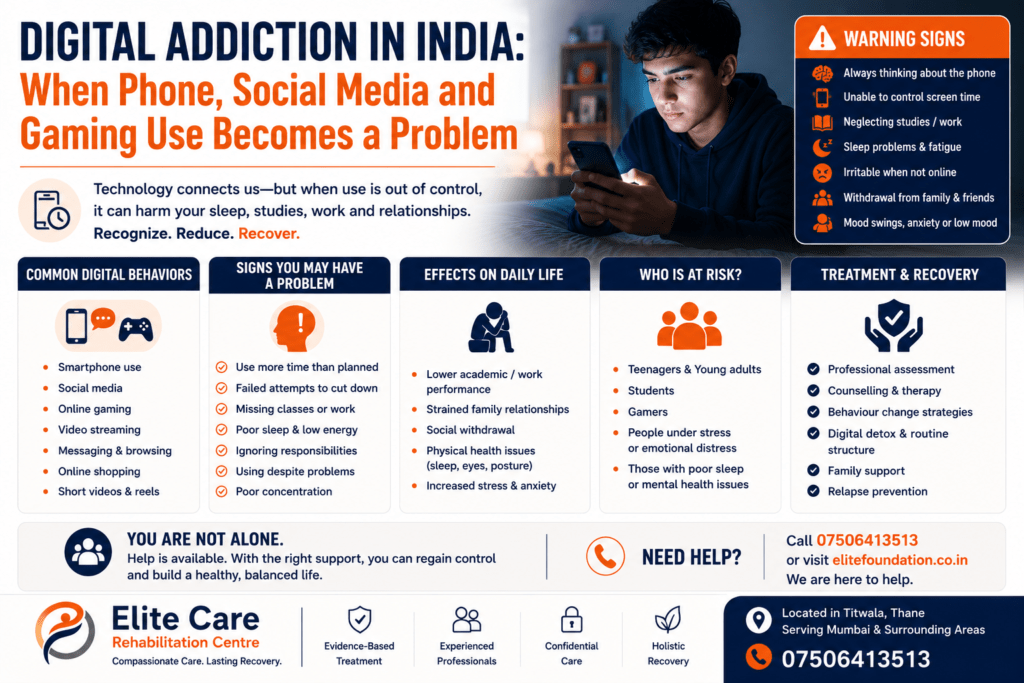
Digital addiction is a broad term used when phone, social media, gaming or other online activities become increasingly difficult to control and begin interfering with sleep, education, work, relationships or everyday functioning. Families approaching a nasha mukti kendra in Thane may sometimes be seeking help for a behavioural rather than substance-related problem. In such cases, mobile phone addiction treatment should begin by identifying the specific digital behaviour, its consequences, sleep pattern, mental health and whether a formally recognised disorder such as gaming disorder may be present.
Using a smartphone for many hours does not automatically mean that someone has an addiction. A student may spend most of the day online for classes, a professional may work through a phone, and a family member living abroad may depend heavily on messaging and video calls. The more important questions are whether the person can control the behaviour, whether repeated attempts to reduce it fail and whether digital use continues despite meaningful harm.
Phone use, social media, gaming and general internet use also should not be treated as one identical condition. The motivations, risks and treatment needs can differ substantially. Someone who scrolls social media late at night may need a different assessment from someone who spends most waking hours gaming, repeatedly spends money inside games or becomes unable to attend college because gaming has taken priority over ordinary life.
This guide explains digital addiction symptoms, excessive phone use, compulsive social media use, gaming addiction, sleep disruption, family warning signs, assessment and digital addiction treatment while separating commonly searched terms from formally recognised clinical diagnoses.
What is digital addiction?
Digital addiction is a broad, commonly used term rather than one single diagnosis covering every form of technology use.
People may use it to describe difficulty controlling:
- Smartphone use
- Social media
- Online gaming
- Video streaming
- Short-form videos
- Messaging
- Internet browsing
- Online shopping
- Compulsive checking of notifications
- Other repetitive online activities
These behaviours can overlap, but they should not automatically be assumed to share one diagnosis or one treatment plan.
A useful assessment asks what the person is doing online rather than simply asking how many hours they spend on a device.
Is digital addiction a recognised medical diagnosis?
Not as one universal condition called “digital addiction”.
Digital environments can provide connection, education, entertainment, access to information and useful services. At the same time, particular patterns of gaming, gambling, social-media use and other online behaviours can become harmful for some people. This is why assessment should focus on the specific activity, level of control and effect on daily functioning rather than treating technology itself as the problem.
This balanced approach matters. A phone is not inherently harmful, just as every person who enjoys social media or gaming does not have a behavioural addiction.
Among digital behaviours, gaming has a more specific formal framework.
The World Health Organization definition of gaming disorder describes a pattern involving impaired control over gaming, increasing priority given to gaming over other activities and continuation or escalation despite negative consequences. The behaviour must cause significant impairment in important areas of functioning and would normally have been evident for at least 12 months.
WHO also emphasises that gaming disorder affects only a small proportion of people who play digital or video games.
Digital addiction in India
Digital technology is deeply integrated into Indian life. Smartphones are used for banking, UPI payments, education, work, entertainment, shopping, travel, healthcare and family communication.
Telecom Regulatory Authority of India data reported approximately 1,092.79 million internet subscriptions as of March 2026.
This number represents subscriptions, not necessarily 1,092.79 million unique people. One person can have more than one connection, and the figure says nothing about how many users have problematic digital behaviour or addiction.
It does, however, show why discussions about digital habits are increasingly relevant. The same device can move within seconds between:
- Work email
- Social media
- Gaming
- UPI transactions
- Video streaming
- Online shopping
- Study material
- Family conversations
This makes complete avoidance unrealistic for many people. Treatment usually needs to focus on restoring control and function rather than simply declaring all screen use harmful.
India also has specialist clinical services focused specifically on problematic technology use. NIMHANS in Bengaluru operates the Service for Healthy Use of Technology (SHUT), reflecting the need to assess technology-related behavioural problems within a mental-health framework rather than treating every period of heavy screen use as addiction.
Heavy digital use is not automatically digital addiction
The number of hours on a screen is useful information, but it does not diagnose addiction by itself.
Consider two people who each use a phone for eight hours a day.
One may:
- Work for six hours through the device
- Use navigation during travel
- Speak with family
- Put the phone away at bedtime
- Reduce recreational use when necessary
Another may:
- Check the phone every few minutes despite trying not to
- Continue scrolling until early morning
- Miss classes or work
- Repeatedly argue with family about use
- Lose interest in offline activities
- Return to the same behaviour after repeated attempts to stop
The second pattern raises much greater concern even if total screen time is similar.
Digital addiction symptoms
Possible digital addiction symptoms are usually behavioural and functional rather than simply numerical.
Warning patterns can include:
- Repeated difficulty controlling digital use
- Using for much longer than intended
- Repeated unsuccessful attempts to reduce use
- Constant preoccupation with checking a device, platform or game
- Digital activity becoming more important than sleep, study, work or relationships
- Continuing despite recognised consequences
- Losing interest in previously valued offline activities
- Using digital activity repeatedly to escape distress
- Becoming highly irritable when access is interrupted
- Hiding or minimising the true amount of use
- Returning rapidly to uncontrolled use after attempts to change
- Staying online despite exhaustion
No single item proves a behavioural addiction.
The pattern, persistence, level of impaired control and effect on daily life matter more.
Signs of digital addiction families may notice first
Families often notice consequences before they understand what is happening on the device.
Possible signs of digital addiction include:
- Sleeping later and waking with difficulty
- Taking the phone into the bathroom repeatedly
- Using the device throughout meals
- Keeping the phone under the pillow or beside the face overnight
- Becoming defensive when asked about screen use
- Rapidly changing screens when someone enters the room
- Declining school or college attendance
- Reduced work productivity
- Stopping exercise or outdoor activities
- Increasing isolation from family
- Repeatedly postponing responsibilities
- Loss of interest in face-to-face social contact
These observations need context. A teenager may suddenly spend more time online because of examinations, a new friend group or schoolwork. A professional may be handling a temporary work crisis.
Concern increases when several changes persist and the person repeatedly struggles to restore balance.
Mobile phone addiction
Mobile phone addiction is one of the most common phrases people use when a smartphone feels increasingly difficult to put down.
In clinical and research discussions, terms such as problematic smartphone use may sometimes be more precise because not every compulsive-looking phone habit meets criteria for a recognised addictive disorder.
Possible mobile phone addiction symptoms include:
- Automatic checking without a clear purpose
- Feeling unable to leave the phone in another room
- Repeatedly interrupting conversations to check notifications
- Scrolling far longer than intended
- Checking immediately after waking
- Using the phone until sleep is delayed
- Repeated use while studying or working despite reduced concentration
- Using during situations where attention should remain elsewhere
- Failed attempts to impose screen limits
The problem often lies not in one application but in rapid switching between messaging, short videos, news, shopping, games and social media.
Why compulsive phone use can feel automatic
Many digital behaviours become strongly linked with everyday cues.
The person may reach for the phone:
- Immediately after waking
- During a pause in conversation
- When waiting for a lift
- When feeling anxious
- After receiving a notification
- During a difficult work task
- Before falling asleep
- Whenever boredom appears
Over time, the action can become habitual enough that the phone is unlocked before the person has consciously decided what they want to do.
This is one reason advice such as “just use willpower” can be insufficient. Treatment and behaviour change often need to address the trigger, the automatic action and the short-term reward that keeps the pattern going.
Smartphone addiction versus everyday smartphone reliance
Modern life can create strong practical reliance on smartphones without necessarily creating a problematic or addictive pattern.
| Area | High but controlled use | Possible problematic pattern |
|---|---|---|
| Work | Device is used heavily because work requires it | Unrelated checking repeatedly disrupts work |
| Sleep | Phone is put away at an intended time | Scrolling repeatedly delays sleep despite attempts to stop |
| Control | Use can be reduced when circumstances require | Attempts to reduce use repeatedly fail |
| Relationships | Phone use does not consistently replace face-to-face interaction | Use continues despite repeated relationship conflict |
| Priorities | Offline responsibilities remain intact | Digital use repeatedly displaces study, work, exercise or family life |
Social media addiction
Social media addiction is another widely searched phrase, although it is not one universal WHO diagnosis.
Problematic social media use may involve repeated difficulty controlling scrolling, posting, checking messages, monitoring reactions or moving between platforms despite recognised consequences.
Possible social media addiction symptoms include:
- Opening social platforms automatically
- Checking reactions immediately after posting
- Repeatedly refreshing feeds
- Losing substantial periods of time to short-form videos
- Continuing late into the night
- Feeling compelled to respond immediately
- Persistent comparison with other people
- Using social media to avoid loneliness, stress or difficult emotions
- Returning to scrolling immediately after deciding to stop
- Relationships or responsibilities being repeatedly disrupted
The underlying function matters. One person may use social media mainly to escape boredom, another for reassurance, another for social connection and another to avoid distress.
Why endless scrolling can become difficult to interrupt
Many digital feeds do not have a natural stopping point.
A newspaper eventually ends. A television episode finishes. A social-media feed can continue indefinitely.
The user also does not know exactly what the next swipe will reveal. It may be:
- A message
- A funny video
- News
- A social update
- A personally relevant post
- Something emotionally upsetting
This uncertainty can keep attention engaged for longer than originally planned.
The goal of treatment is not to claim that one app has permanently damaged the brain. It is to understand how the individual’s behaviour is being reinforced and what practical changes can restore control.
Gaming addiction and gaming disorder are not identical phrases
Gaming addiction is commonly searched online, while gaming disorder has a specific clinical definition in ICD-11.
Gaming disorder focuses on three core features:
- Impaired control over gaming
- Gaming taking increasing priority over other activities
- Continuation or escalation despite negative consequences
The pattern also needs to cause significant impairment in personal, family, social, educational, occupational or another important area of functioning.
Playing for several hours on a weekend does not automatically establish gaming disorder.
Some people play intensively while:
- Maintaining work or study
- Sleeping adequately
- Keeping relationships intact
- Exercising
- Reducing play when necessary
Others become increasingly unable to control gaming even when important parts of life are deteriorating.
Possible gaming addiction symptoms
Warning signs may include:
- Gaming for substantially longer than intended
- Repeated failed attempts to reduce gaming
- Gaming becoming the dominant daily activity
- Missing school, college or work
- Remaining awake through the night to play
- Ignoring meals or hygiene
- Increasing conflict with family
- Losing interest in previous hobbies
- Continuing despite academic or occupational decline
- Returning immediately to the same pattern after promises to stop
Irritability when gaming is interrupted can occur, but irritability by itself does not prove gaming disorder.
Gaming can also have normal and positive roles
Gaming can provide entertainment, competition, problem-solving, social connection and shared experiences with friends.
The question is therefore not simply:
“Does this person play games?”
A more useful question is:
“Can this person control gaming without important parts of life repeatedly being displaced?”
This distinction reduces the risk of labelling enthusiastic but controlled gaming as illness.
Internet addiction is also an umbrella term
Internet addiction can describe many different online behaviours.
A person may not be attached to “the internet” itself. The main difficulty may involve:
- Social media
- Gaming
- Streaming
- Shopping
- Sexual content
- Constant news checking
- Messaging
- Online communities
Assessment should identify the activity that is actually difficult to control.
Two people who both report internet addiction may therefore need very different treatment plans.
Screen addiction is not simply a screen-time number
The phrase screen addiction is especially common among parents.
However, screens are used for very different activities.
Three hours spent:
- Attending an online course
- Playing a competitive game
- Scrolling social media
- Editing a work presentation
should not automatically be treated as equivalent exposures.
The content, purpose, time of day, degree of control and effect on functioning all matter.
Phone addiction and sleep
Sleep is often one of the first areas where compulsive digital behaviour becomes visible.
A person may intend to sleep at 11 p.m. but continue:
- Watching one more video
- Answering one more message
- Playing another game
- Checking one more notification
The result can be progressively delayed sleep.
Morning consequences may include:
- Difficulty waking
- Daytime sleepiness
- Reduced concentration
- Irritability
- Reduced motivation
- Missing morning classes or meetings
Sleep loss can then make self-control, mood and concentration harder the following day, creating a cycle in which tiredness contributes to more passive scrolling and further delayed sleep.
Is feeling irritated without a phone withdrawal?
People with problematic digital habits sometimes describe restlessness, irritability, boredom or anxiety when access is interrupted.
These experiences should not automatically be equated with medically dangerous withdrawal from substances such as alcohol or benzodiazepines.
There is no standard digital withdrawal syndrome that should be managed using a substance-detox model.
Instead, a clinician may explore:
- What behaviour has been interrupted
- How strongly the person expects relief or stimulation from it
- Whether anxiety or loneliness is becoming more noticeable
- Whether sleep deprivation is contributing
- Whether another mental-health condition is present
Digital detox does not mean medical detoxification
The term digital detox usually describes voluntarily reducing or temporarily stopping selected digital activities.
It is not equivalent to medical detoxification from alcohol, opioids or sedatives.
A period of reduced access can sometimes help a person notice:
- How automatically they reach for a device
- Which situations trigger checking
- How much bedtime use has become habitual
- Which offline activities have disappeared
However, temporarily surrendering a phone does not by itself treat the reasons compulsive use developed.
If anxiety, loneliness, depression, family conflict, academic stress or another problem is driving the behaviour, those issues may remain when the device is returned.
Why digital behaviour becomes difficult to control
There is rarely one explanation.
A problematic pattern may be maintained by several factors at the same time.
Boredom
The phone provides immediate stimulation during almost any pause.
Stress
Scrolling, gaming or videos may temporarily distract from difficult thoughts.
Loneliness
Online communication can become the person’s main source of social connection.
Anxiety
Repeated checking may temporarily reduce uncertainty about messages, work or social reactions.
Low mood
Passive digital activity may require less effort than exercise, study or meeting people.
Habit
Hundreds of repeated checking episodes can make device use increasingly automatic.
Sleep disruption
Being awake late creates additional hours in which digital activity can continue, while poor sleep may reduce attention and self-regulation the next day.
Digital addiction and mental health
Problematic digital behaviour can occur alongside:
- Anxiety
- Depression
- Attention difficulties
- Loneliness
- Social anxiety
- Stress
- Trauma-related symptoms
- Sleep disorders
- Family conflict
The relationship is not always simple.
For example, heavy social-media use may occur because a person is already lonely or depressed. Poor sleep caused by late-night use may then worsen mood and concentration.
A good assessment therefore avoids assuming that digital behaviour caused every psychological symptom.
Digital addiction in teenagers
Teenagers deserve particularly careful assessment because digital technology is also part of education, friendships and recreation.
Parents may become concerned when they see:
- Constant phone use
- Late-night gaming
- Reduced conversation
- Difficulty waking for school
- Falling marks
- Anger when Wi-Fi or devices are restricted
These observations can be important, but they should not automatically lead to a diagnosis.
Assessment should also consider:
- Bullying
- Academic pressure
- ADHD
- Anxiety
- Depression
- Peer relationships
- Family conflict
- Sleep
- Whether the young person has meaningful offline activities
Suddenly removing every device without understanding why it is being used may turn the discussion into a power struggle while leaving the underlying problem untouched.
Work-from-phone use can be mistaken for phone addiction
Adults increasingly handle work communication, payments, customer enquiries, calendars and documents through their phones.
Heavy phone exposure caused by work should be separated from recreational compulsive use.
A useful assessment may divide daily use into:
- Work
- Study
- Navigation and practical tasks
- Communication
- Social media
- Gaming
- Streaming
- Other entertainment
This often provides a clearer picture than the phone’s total daily screen-time figure.
When digital use begins affecting relationships
Relationship problems may develop gradually.
A partner may feel that:
- Every conversation competes with a screen
- Meals no longer involve conversation
- The phone is the first activity in the morning and last at night
- Attempts to discuss the problem lead to defensiveness
- Shared activities have disappeared
Parents may become trapped in repeated cycles of confiscating and returning devices.
Children may feel constantly monitored, while parents feel they are the only people trying to maintain limits.
The wider principles of communication, boundaries and accountability are discussed in Elite Care’s article on the role of family support in addiction recovery. Behavioural-addiction plans need to adapt those principles to digital access rather than treating the family as full-time device police.
How digital addiction is assessed
Assessment should begin with the actual behaviour.
A clinician may ask:
- Which applications, games or online activities are most difficult to control?
- How much time is spent on them?
- At what times of day?
- What usually happens immediately before use begins?
- What makes the person continue?
- What happens when they try to stop?
- Have previous attempts to reduce use failed?
- Is sleep being delayed?
- Are work, education or relationships affected?
- Has exercise or offline social activity reduced?
- Is money being spent through games or platforms?
- Is another mental-health problem present?
- Are alcohol or drugs also being used?
The general principle of beginning with proper assessment rather than jumping directly to a treatment label is also explained in Elite Care’s guide to understanding addiction treatment from assessment through continuing recovery.
Screen-time reports can help, but they do not diagnose addiction
Phone and application usage reports can provide useful information about:
- Total device time
- Application-specific time
- Number of pickups
- Notification frequency
- Late-night usage
These records can help identify patterns that are difficult to estimate from memory.
However, a screen-time report cannot independently establish:
- Digital addiction
- Gaming disorder
- The reason someone is using a phone
- The severity of impairment
- Whether residential treatment is required
Numbers need clinical and practical context.
Digital addiction treatment
There is no single treatment protocol for every behaviour described as digital addiction. Treatment should be matched to the specific problem, such as problematic smartphone use, compulsive social-media use or gaming disorder, as well as the person’s level of impairment and any co-occurring mental-health condition.
A 2026 systematic review and meta-analysis of 125 studies on problematic digital-technology use found benefits from structured psychological and behavioural interventions across several areas, but the strength and amount of evidence differed substantially between behaviours. Evidence was more developed for problematic internet use, smartphone use and gaming, while substantially fewer studies were available for areas such as problematic social-media use.
Treatment should therefore be individualised rather than presented as one standard digital-addiction programme.
Possible components include:
- Detailed behavioural assessment
- Sleep assessment
- Psychiatric or psychological assessment when indicated
- Identifying high-risk situations and triggers
- Cognitive behavioural strategies
- Reducing unnecessary notifications and prompts
- Structured periods without recreational device use
- Rebuilding offline activities
- Family counselling
- Work or study routine planning
- Treatment of co-occurring mental-health conditions
- Follow-up and relapse-prevention planning
The aim should not automatically be permanent abstinence from all technology.
For many people, the practical goal is controlled, purposeful use.
Why treatment needs to identify the trigger
Simply blocking an application may reduce immediate access without changing the reason the person repeatedly wants to use it.
For example:
| Trigger | Digital response | Treatment question |
|---|---|---|
| Boredom | Short-form video scrolling | What realistic offline activity can fill short unstructured periods? |
| Anxiety | Repeated messaging or checking | What fear or uncertainty is the checking temporarily reducing? |
| Loneliness | Social media or online communities | How can real connection increase without removing useful online support? |
| Academic stress | Gaming or streaming | Is digital activity functioning as avoidance of difficult tasks? |
| Difficulty sleeping | Phone use in bed | Did insomnia lead to phone use, or is phone use delaying sleep? |
Cognitive behavioural strategies
Cognitive behavioural work can help identify the sequence between:
- A trigger
- An automatic thought
- The urge to use
- The digital behaviour
- The short-term reward
- The longer-term consequence
For example:
Trigger: difficult work assignment.
Thought: “I’ll check Instagram for two minutes first.”
Behaviour: scrolling.
Short-term result: relief from effort or anxiety.
Longer-term result: 45 minutes lost and greater work pressure.
Recognising this sequence can make intervention more specific than simply telling someone to reduce screen time.
Changing the digital environment
Behaviour is easier to change when the environment does not repeatedly trigger the old response.
Practical changes may include:
- Removing non-essential notifications
- Moving high-risk applications away from the home screen
- Keeping the phone outside the bedroom when practical
- Using a separate alarm clock
- Scheduling recreational rather than unlimited use
- Creating device-free meals
- Protecting study or work periods
- Reducing automatic login where useful
- Planning what will replace scrolling or gaming
These are behavioural tools, not proof that an individual has an addiction.
Offline routine matters
Reducing digital use leaves time behind.
If that time remains empty, boredom can become a powerful trigger for returning to the old pattern.
A recovery plan may therefore rebuild:
- Exercise
- Outdoor activity
- Reading
- Face-to-face social contact
- Household responsibilities
- Creative activity
- Work or study structure
- Regular sleep and waking times
Elite Care’s blog on how nature and environment can support mental healing discusses how surroundings, daylight, outdoor activity and routine can form part of a more supportive recovery environment.
Does someone need to delete every social media account?
Not necessarily.
Some individuals may benefit from temporarily removing a particular application. Others may need social media for business, education or important relationships.
Options can include:
- Removing only the most problematic platform
- Using scheduled access
- Turning off non-essential notifications
- Separating business and recreational use
- Removing the application while retaining web access for necessary tasks
The intervention should fit the behaviour rather than follow a universal rule.
Does every person with digital addiction need rehabilitation?
No.
Many people with problematic phone or social-media use can work on the behaviour through outpatient psychological support, family changes, sleep correction and structured habit modification.
More intensive treatment may be considered when:
- Daily functioning has substantially deteriorated
- The person repeatedly fails to maintain basic routines
- Severe gaming disorder is suspected
- There is serious depression, anxiety or another psychiatric condition
- The home environment cannot support change
- Repeated outpatient attempts have not been sufficient
- Several behavioural or substance-related problems occur together
The treatment setting should depend on individual assessment rather than on a screen-time number alone.
How families can respond without creating constant conflict
Family concern can easily turn into repeated surveillance.
Common cycles include:
- The family complains about phone use.
- The person becomes defensive.
- The device is confiscated.
- An argument follows.
- The device is eventually returned.
- The earlier pattern resumes.
A more useful approach is to discuss specific consequences.
Instead of:
“You are always addicted to your phone.”
the conversation can focus on:
- “You have missed college three times this week because you were gaming until morning.”
- “We have noticed you are sleeping at 3 a.m. most nights.”
- “You have tried several times to reduce Instagram use but are finding it difficult.”
Specific observations are usually more useful than labels.
What families should avoid
Families should avoid:
- Calling every teenager who enjoys gaming an addict
- Using humiliation
- Publicly exposing browsing or social-media behaviour
- Making threats that cannot realistically be maintained
- Destroying devices during arguments
- Assuming poor marks are caused only by a phone
- Ignoring depression, anxiety or bullying
- Expecting permanent change after a short digital break
The aim is to understand the behaviour and restore function, not to turn the device into the centre of every family interaction.
When digital behaviour needs urgent mental-health assessment
Digital overuse itself is not usually a medical emergency.
Urgent assessment is needed when the wider situation includes:
- Suicidal thoughts or intent
- A recent self-harm attempt
- Severe depression
- Psychotic symptoms
- Violence that cannot be managed safely
- Several nights with almost no sleep accompanied by markedly abnormal behaviour
- Severe neglect of food, fluids or basic self-care
- Another medical or psychiatric emergency
In such situations, the priority is the acute mental or physical health problem rather than the screen-time label.
Frequently asked questions
What is digital addiction?
Digital addiction is a broad term used for patterns in which activities such as phone use, social media or gaming become difficult to control and interfere with important areas of life. It is not one single universal medical diagnosis.
Is digital addiction officially recognised by WHO?
WHO does not classify one general condition called digital addiction covering every form of phone, internet and social-media use. Gaming disorder, however, is formally recognised in ICD-11.
What are common digital addiction symptoms?
Possible signs include repeated loss of control, using much longer than intended, failed attempts to reduce use, digital activity taking priority over sleep or responsibilities and continued use despite clear consequences.
How many hours of phone use means addiction?
There is no universal number. Screen time needs context because the same device may be used for work, study, communication and entertainment. Control and functional impairment are more informative than hours alone.
Is mobile phone addiction real?
People can develop genuinely problematic and compulsive patterns of smartphone use. However, mobile phone addiction is not one standalone WHO diagnosis, so assessment should focus on the specific behaviour and its impact.
What are smartphone addiction symptoms?
Possible signs include automatic checking, difficulty putting the phone away, repeated failed attempts to reduce use, delayed sleep and continued use despite disruption to work, study or relationships.
Is social media addiction a medical diagnosis?
Social media addiction is a commonly used and researched term, but it should not be presented as one universally established WHO diagnosis. Problematic use can still cause significant distress and impairment and may warrant clinical assessment.
What are social media addiction symptoms?
Possible signs include repeated uncontrolled scrolling, persistent checking, difficulty stopping, significant sleep disruption, neglect of responsibilities and continuing despite recognised relationship or mental-health consequences.
Is gaming addiction the same as gaming disorder?
Not exactly. Gaming addiction is a common search term. Gaming disorder is the specific ICD-11 diagnosis characterised by impaired control, increasing priority given to gaming and continued or escalating gaming despite negative consequences, together with significant functional impairment.
Does every gamer risk gaming disorder?
No. WHO states that gaming disorder affects only a small proportion of people who engage in gaming.
What is internet addiction?
Internet addiction is an umbrella term that may refer to different behaviours such as gaming, social media, streaming, shopping or other online activities. Assessment should identify which activity is actually difficult to control.
Is screen addiction the same as digital addiction?
The phrases overlap in everyday searches, but neither should be diagnosed from screen hours alone. The type of activity, control, purpose and impact on functioning matter.
Can phone addiction affect sleep?
Yes. Repeated late-night use can delay bedtime and shorten sleep. Poor sleep can then worsen concentration, mood and the ability to regulate behaviour the following day.
Is irritability without a phone withdrawal?
Irritability and restlessness can occur when a strongly habitual digital behaviour is interrupted. This should not automatically be equated with medically dangerous withdrawal from alcohol, benzodiazepines or other substances.
Does digital detox cure digital addiction?
No single digital detox can be assumed to cure a persistent compulsive pattern. A break may help reveal triggers and habits, but lasting change may also require work on sleep, stress, relationships, mental health and the situations linked with use.
Can digital addiction affect teenagers?
Teenagers can develop problematic digital-use patterns, but heavy use should not automatically be labelled addiction. School demands, friendships, anxiety, ADHD, depression, bullying, sleep and family circumstances should also be assessed.
How is digital addiction treated?
There is no single treatment programme for all problematic digital behaviours. Depending on the pattern, treatment may include behavioural assessment, cognitive behavioural strategies, changes to digital cues, sleep and routine work, family counselling, rebuilding offline activities and treatment of co-occurring mental-health conditions.
Should someone with phone addiction stop using a smartphone completely?
Not necessarily. Phones are essential for work, study, banking and communication for many people. Treatment often aims to restore controlled, purposeful use rather than eliminate all technology.
Does everyone with digital addiction need residential treatment?
No. Many people can be treated through outpatient support and structured changes at home. More intensive care may be considered where functioning has severely deteriorated, serious psychiatric problems are present or previous treatment has not been sufficient.
When should parents seek professional help?
Assessment becomes particularly useful when a young person repeatedly cannot control use, sleep or schooling is substantially affected, relationships are deteriorating or there are concerns about depression, self-harm, severe anxiety or another mental-health condition.
Digital technology is not the enemy; loss of control is the concern
Digital addiction in India should not be reduced to the idea that smartphones, social media or gaming are inherently harmful.
These technologies are part of modern education, work, banking, communication and recreation.
The concern begins when a digital behaviour becomes increasingly difficult to control, repeatedly displaces important parts of life and continues despite consequences the person genuinely wants to avoid.
Mobile phone addiction, social media addiction and internet addiction are useful search terms for experiences many people recognise, but they should not automatically be treated as formal diagnoses. Gaming disorder has a specific recognised diagnostic framework and should be assessed according to that framework rather than simply from the number of hours played.
A useful treatment plan therefore identifies the behaviour, its triggers, its function, the damage it is causing and the mental-health or family circumstances surrounding it. The aim is not punishment or fear of technology. It is to restore sleep, attention, relationships, study, work, offline activity and voluntary control over how digital tools are used.
Medical disclaimer: This article provides general educational information and does not replace individual psychiatric, psychological or medical assessment. Heavy screen use alone does not establish a diagnosis. Seek urgent professional assistance where digital-use concerns occur alongside suicidal intent, self-harm, psychosis, severe depression, dangerous aggression, prolonged inability to sleep with markedly abnormal behaviour or another medical or psychiatric emergency.
