
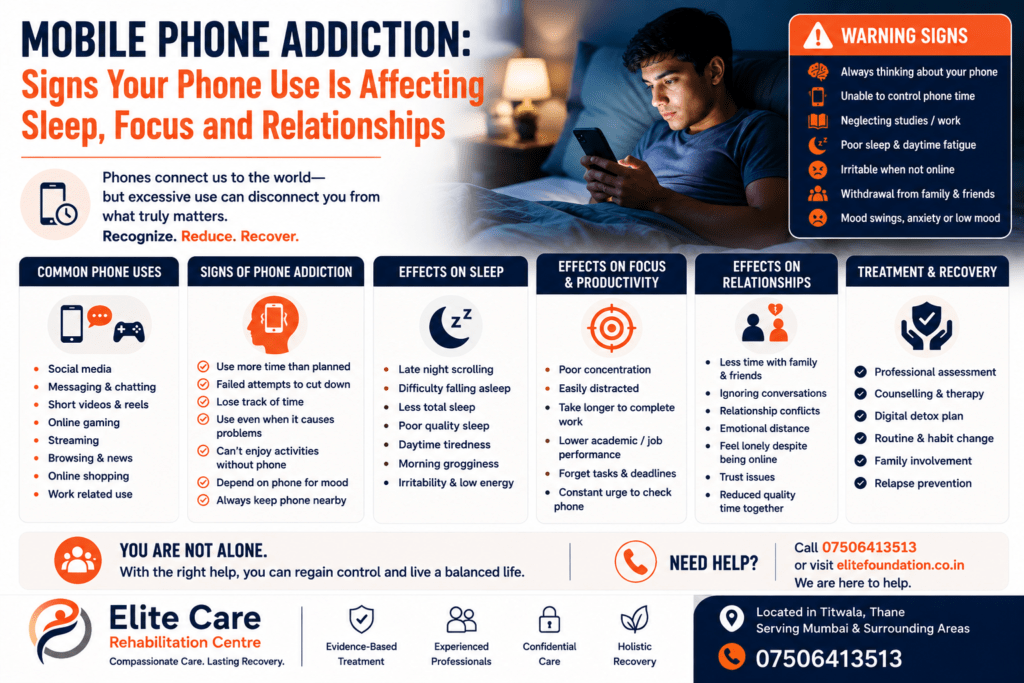
Mobile phone addiction is a common term for phone use that feels increasingly difficult to control and begins affecting sleep, attention, work, study or relationships. Families approaching a nasha mukti kendra in Thane may sometimes be looking for help with a behavioural rather than substance-related problem. In that situation, mobile phone addiction treatment should focus on the specific apps and habits involved, the person’s ability to cut back, sleep timing, daily functioning, mental health and whether phone use is displacing important parts of life.
Using a smartphone frequently does not automatically mean that someone has an addiction. Phones now handle work, payments, navigation, communication, education, photography and entertainment. A person who spends many hours on a phone for work but can put it aside when necessary may have a very different pattern from someone who repeatedly tries to stop scrolling at midnight and finds themselves still awake two hours later.
Am I addicted to my phone? The more useful questions are not simply how many hours you use it, but whether you repeatedly lose control over that use, continue longer than intended, struggle to cut back and keep using the phone despite consequences you genuinely want to avoid.
This guide explains phone addiction symptoms, excessive and compulsive phone use, effects on sleep, focus and relationships, how screen-time reports should be interpreted, when a phone habit becomes concerning and when professional assessment may be useful.
What is mobile phone addiction?
Mobile phone addiction is a widely used public and search term for persistent, difficult-to-control smartphone behaviour that causes distress or interferes with everyday functioning.
In research, the term problematic smartphone use is often more precise.
This distinction matters because there is no single universally accepted diagnostic cut-off at which someone can be declared “addicted to their phone” simply from:
- Daily screen time
- Number of phone pickups
- Number of notifications
- One questionnaire score
- Using a particular social-media platform
The phone itself is also rarely the whole problem. A person may mainly struggle with:
- Instagram or other social media
- Short-form videos
- WhatsApp or messaging
- Online gaming
- News checking
- Shopping applications
- Video streaming
- Work communication
- Dating applications
- Constant switching between several activities
This is why assessment should ask what the person is doing on the phone, not simply whether the phone is being used.
The broader guide to digital addiction in India explains how smartphone use, social media, internet use and gaming overlap while remaining clinically different behaviours.
Is smartphone addiction an official medical diagnosis?
The phrase smartphone addiction is commonly used by the public and appears widely in research, but problematic smartphone use does not have one universally accepted diagnostic framework equivalent to recognised disorders such as substance use disorder or gaming disorder.
This does not mean that compulsive phone use cannot become serious.
A person can experience:
- Repeated loss of control
- Major sleep disruption
- Reduced study or work performance
- Relationship conflict
- Persistent distraction
- Loss of offline activities
- Significant distress about their own inability to reduce use
Those problems deserve assessment even when the behaviour does not fit one formal diagnosis called “smartphone addiction”.
Heavy phone use versus problematic phone use
The difference between heavy use and problematic use is crucial.
| Area | High but controlled use | Possible problematic phone use |
|---|---|---|
| Purpose | Much of the use has a clear work, study or practical purpose | The phone is repeatedly opened without a clear intention |
| Control | The person can reduce use when necessary | Repeated attempts to cut down fail |
| Sleep | The phone can be put away at bedtime | Scrolling or checking repeatedly delays sleep |
| Attention | Phone use can wait during important work | Checking repeatedly interrupts study, work or conversations |
| Relationships | Phone use generally fits around relationships | The phone repeatedly competes with face-to-face interaction |
| Consequences | No continuing pattern of meaningful harm | Use continues despite recognised problems |
A busy professional may record nine hours of screen time because the phone is a work tool. Another person may record four hours but spend most of that time in uncontrolled late-night scrolling that damages sleep and relationships.
Total hours alone cannot distinguish those situations.
Phone addiction symptoms
Possible phone addiction symptoms usually involve a pattern of impaired control and consequences rather than one isolated behaviour.
Signs may include:
- Picking up the phone automatically without deciding to
- Checking it repeatedly despite no new notification
- Using the phone substantially longer than intended
- Repeatedly deciding to reduce use but failing to maintain the change
- Feeling unable to leave the phone in another room
- Interrupting work or study repeatedly to check it
- Continuing to scroll despite being exhausted
- Delaying bedtime night after night
- Using the phone throughout meals or conversations
- Feeling preoccupied with what might be happening online
- Losing interest in previous offline activities
- Hiding or minimising the true amount of use
- Continuing despite repeated arguments about phone use
- Returning quickly to the same pattern after attempts to change
No individual symptom proves smartphone addiction.
A person who checks their phone frequently because a close relative is in hospital, for example, has a very different context from someone who has developed a persistent uncontrolled checking pattern over many months.
Signs of phone addiction that are easy to miss
Some of the strongest signs are ordinary enough that they gradually become normal.
Checking immediately after waking
The person reaches for the phone before getting out of bed, drinking water or speaking to anyone nearby.
Carrying it from room to room
Even a short period without the phone feels uncomfortable or unnecessary.
Automatic unlocking
The phone is opened before the person has consciously decided what they want to check.
Using during every small pause
A queue, lift ride, advertisement break or moment of boredom immediately triggers phone use.
Checking in the middle of another activity
Reading, studying, watching a film or talking with another person is repeatedly interrupted by checking.
Losing track of time
A planned five-minute check becomes 30 or 60 minutes of scrolling.
Taking the phone to bed
Bedtime becomes the beginning of another session rather than the end of the day.
Am I addicted to my phone?
A useful self-check is to look at control and consequences.
Ask yourself:
- Do I regularly use my phone longer than I intended?
- Have I tried to reduce my use more than once and returned to the same pattern?
- Do I check my phone automatically when I feel bored, anxious or uncomfortable?
- Does my phone repeatedly delay my sleep?
- Do I struggle to concentrate because I keep checking it?
- Do people close to me regularly complain that I am not present because of my phone?
- Have I stopped or reduced activities I previously enjoyed?
- Do I feel uncomfortable leaving the phone somewhere I cannot immediately reach it?
- Do I continue using it even when I know it is interfering with work, study or relationships?
- Do I hide how much time I spend online?
Several “yes” answers do not provide a medical diagnosis. They do suggest that looking more closely at the pattern may be worthwhile.
How much phone use is too much?
There is no universal daily screen-time number that diagnoses mobile phone addiction in adults.
Context matters.
Four hours of recreational scrolling is different from four hours spent:
- Working
- Studying
- Using maps while travelling
- Speaking with distant family
- Managing a business
A more useful assessment separates:
- Necessary use
- Purposeful recreational use
- Automatic checking
- Unplanned scrolling
- Late-night use
- Use that repeatedly interferes with another activity
The question is not only “How long?”
It is also:
“What is the phone replacing, and can the person stop when they intend to?”
Phone addiction and sleep
Sleep is one of the clearest areas in which problematic smartphone use may become visible.
A common pattern looks like this:
- The person gets into bed intending to sleep.
- They check one message or video.
- Another item appears.
- Scrolling continues.
- Bedtime moves later.
- The person sleeps fewer hours.
- They wake tired.
- Low energy makes passive phone use more attractive the next evening.
Over time, the cycle can become routine.
What research says about smartphones and sleep
A 2024 systematic review and meta-analysis of electronic-media use and sleep included 55 papers covering more than 41,000 participants. Both general electronic-media use and problematic use were associated with poorer sleep outcomes, although effect sizes differed by type of use and population.
The association does not prove that smartphones alone caused every sleep problem. Much of the evidence is observational, and the relationship can work in more than one direction.
Someone with insomnia may reach for the phone because they are already awake.
At the same time, repeated late-night checking can further postpone sleep.
Late-night phone use can affect more than bedtime
A person who regularly loses one or two hours of sleep to the phone may notice consequences the next day.
These can include:
- Difficulty waking
- Morning irritability
- Daytime sleepiness
- Reduced concentration
- Slower work
- Difficulty remembering information
- Reduced motivation
- Greater reliance on caffeine
- Falling asleep during passive activities
These symptoms should not automatically be blamed on the phone. Sleep disorders, depression, anxiety, thyroid problems, medicines, shift work and other medical conditions can produce similar difficulties.
Why “one more video” can turn into an hour
Many phone activities have no natural stopping point.
A printed chapter ends.
A social-media feed does not.
The next swipe may reveal:
- A funny video
- A message
- News
- A comment
- A social update
- Something surprising
Because the next item is unknown, it can be difficult to identify a natural moment to stop.
This is more useful to understand than simply saying that a person “lacks discipline”.
Phone addiction and focus
Compulsive phone use can interfere with sustained attention when checking repeatedly breaks up a task.
Consider someone studying for 45 minutes.
If they check the phone every five minutes, the study session may technically last 45 minutes while containing only short fragments of uninterrupted attention.
The same can happen during:
- Office work
- Reading
- Meetings
- Driving-related pauses
- Household tasks
- Conversations
People sometimes describe this as being unable to focus without realising how often their attention is being voluntarily or automatically redirected.
Concentration problems are not always caused by phone use
Difficulty concentrating can also lead to more phone use.
For example, someone with:
- ADHD
- Anxiety
- Depression
- Sleep deprivation
- Academic burnout
- A highly stressful job
may already find sustained attention difficult.
The phone then provides an immediate alternative whenever the main task becomes uncomfortable.
In that situation, removing the phone may reduce one source of distraction without fully treating the original attention problem.
Does problematic smartphone use affect academic performance?
A 2024 systematic review and meta-analysis of problematic smartphone use and academic achievement analysed 29 studies involving 48,490 participants.
The researchers found a negative association between problematic smartphone use and academic achievement, but the overall relationship was small.
Importantly, the available studies were cross-sectional. That means the findings cannot establish that problematic smartphone use directly caused lower academic performance.
The relationship could also reflect factors such as:
- Poor sleep
- Existing concentration problems
- Stress
- Academic burnout
- Low motivation
- Other mental-health difficulties
This is why falling marks should not automatically lead parents to conclude that the phone is the sole cause.
Phone addiction and work
Adults may experience a similar pattern at work.
Common examples include:
- Opening WhatsApp while writing a report
- Checking Instagram between every email
- Watching short videos during tasks that require sustained attention
- Responding immediately to non-urgent notifications
- Repeatedly switching between work and recreational applications
Each interruption may appear small.
The larger problem is that a full workday can become fragmented into many attention shifts.
Work-from-phone use should not be mistaken for addiction
Modern work complicates screen-time numbers.
A salesperson may handle:
- Calls
- WhatsApp enquiries
- Payments
- Maps
- Customer support
through one smartphone.
Eight hours of phone use in that context should not automatically be labelled addiction.
The more useful question is whether unrelated checking repeatedly interrupts necessary work or whether the person is unable to stop recreational use even when responsibilities require attention.
Phone addiction and relationships
Relationships can be affected even before total screen time becomes extreme.
The issue may be repeated interruption rather than total duration.
A partner may notice that:
- The phone stays on the table throughout dinner.
- Messages interrupt serious conversations.
- The other person looks at the screen while being spoken to.
- Bedtime is spent on separate phones.
- Shared activities are interrupted by repeated checking.
- The phone receives more immediate attention than the person in the room.
Over time, this can create the feeling of being physically together but repeatedly competing with a device.
What is phubbing?
“Phubbing” is a research term used for ignoring or neglecting another person in a social interaction in favour of a phone.
A 2025 meta-analysis of partner phubbing combined 52 studies involving 19,698 participants. Partner phubbing was associated with poorer relationship outcomes including lower relationship satisfaction, intimacy, responsiveness and emotional closeness.
These findings describe associations across studies. They do not prove that checking a phone during one conversation causes a relationship to fail.
The concern is the repeated pattern.
Phone use can become part of a relationship conflict cycle
A common pattern is:
- One person checks the phone repeatedly.
- The partner complains.
- The user feels criticised or controlled.
- An argument begins.
- The person turns back to the phone to avoid the argument.
- The partner feels even more ignored.
The phone is then both the original source of conflict and a way of escaping the conflict.
Effective change may therefore require more than installing an app timer.
When family members keep saying “put the phone down”
Repeated criticism rarely explains what actually needs to change.
Compare:
“You are always on that phone.”
with:
“During dinner yesterday, you checked your phone several times while we were trying to discuss something important.”
The second statement describes observable behaviour.
The broader principles of communication, boundaries and support are discussed in Elite Care’s article on the role of family support in addiction recovery. With problematic smartphone use, those principles should be adapted without turning family members into constant device monitors.
Effects of mobile addiction on everyday life
The effects of mobile addiction differ between people and should not be presented as though every heavy phone user experiences the same problems.
Possible areas of difficulty include:
Sleep
Late-night scrolling may delay bedtime and shorten sleep.
Attention
Repeated checking can fragment tasks that require sustained focus.
Relationships
Phone use may repeatedly interrupt conversations and shared activities.
Work or study
Unplanned recreational use can displace time intended for responsibilities.
Physical activity
Long periods of passive phone use may replace walking, sport or other movement.
Offline recreation
Activities that require more effort may gradually lose out to immediate digital entertainment.
Mood
Problematic use may coexist with anxiety, loneliness, depression or stress, although the direction of these relationships can vary.
Physical effects associated with long periods of phone use
Long periods spent looking at or holding a phone can also be associated with physical discomfort.
People may report:
- Neck discomfort
- Shoulder discomfort
- Hand or wrist discomfort
- Eye strain
- Headache
- Reduced movement during the day
These symptoms are not specific to phone addiction and may have many other causes.
Persistent pain, vision changes or neurological symptoms should be medically assessed rather than assumed to come from screen time.
Why compulsive phone use becomes automatic
A phone can become attached to many everyday triggers.
For example:
| Situation | Automatic response |
|---|---|
| Waking up | Check messages immediately |
| Boredom | Open short-form videos |
| Difficult work | Check social media for a break |
| Notification sound | Reach for the phone instantly |
| Anxiety | Check messages or updates repeatedly |
| Bedtime | Begin scrolling |
With repeated pairing between everyday cues and phone checking, the behaviour can begin to feel increasingly automatic.
Understanding this pattern helps explain why sincere intentions such as “I will use my phone less tomorrow” may not be enough on their own.
Boredom can be a common trigger for phone checking
Before smartphones, many small periods of the day simply involved waiting.
Now a phone can remove almost every moment of boredom.
This means a person may gradually stop experiencing:
- Quiet waiting
- Unstructured thinking
- Short periods without stimulation
Eventually, even a brief period without activity may trigger automatic checking.
This does not mean boredom is harmful. The treatment question is whether the person has lost the ability to tolerate ordinary unstimulated moments without immediately reaching for the device.
Stress and phone use
Phones can also become a coping tool.
After:
- An argument
- A stressful meeting
- A difficult assignment
- Feeling lonely
- Receiving bad news
scrolling or watching videos may provide temporary distraction.
That relief can reinforce the habit.
The issue is not that distraction is always unhealthy. Concern increases when the phone becomes the person’s main or only way of dealing with difficult emotions.
Fear of missing out and repeated checking
Some people repeatedly check because they are worried about what they might miss.
This can involve:
- Group conversations
- Work messages
- Social events
- News
- Comments or reactions
- Relationship communication
The phone provides immediate reassurance that nothing important has happened.
The reassurance may last only briefly, which encourages another check later.
Is irritability without a phone a withdrawal symptom?
People with compulsive phone habits may feel:
- Restless
- Irritable
- Bored
- Anxious
- Uncomfortable
when access is interrupted.
These experiences are sometimes described online as phone withdrawal symptoms.
They should not be equated with medically dangerous withdrawal from alcohol, benzodiazepines or other dependence-forming substances.
Instead, the discomfort may reflect interruption of a strong habit, loss of a familiar coping strategy, fear of missing information or the return of anxiety or boredom that the phone usually suppresses.
Phone addiction test: can an online test diagnose it?
No online phone addiction test should be treated as a standalone diagnosis.
Questionnaires may help identify patterns such as:
- Loss of control
- Preoccupation
- Functional disruption
- Repeated failed attempts to reduce use
However, a score cannot by itself determine:
- Why the phone is being used
- Whether the use is required for work
- Whether another mental-health condition is present
- The severity of impairment
- Whether professional treatment is needed
The context remains essential.
Your phone’s screen-time report can still be useful
Objective usage records can provide information that memory misses.
Look at:
- Total daily screen time
- Time spent in individual applications
- Number of pickups
- First use after waking
- Late-night use
- Notification volume
Then ask:
Which of these hours were intentional?
A report showing four hours of necessary work use and two hours of deliberate entertainment tells a different story from six hours of repeated unplanned scrolling.
Mobile phone addiction in adults
Phone addiction in adults can be particularly difficult to recognise because the device is integrated into legitimate responsibilities.
Adults may use the same phone for:
- Banking
- Business
- Parenting groups
- Work
- Medical appointments
- Shopping
- Communication
The phone therefore cannot simply be removed from daily life.
For many adults, the goal is not zero smartphone use. It is separating purposeful use from compulsive checking.
Phone use and mental health can influence each other
Problematic smartphone use often occurs alongside:
- Anxiety
- Depression
- Loneliness
- ADHD
- Social anxiety
- Stress
- Insomnia
It is important not to assume that the phone caused every symptom.
Someone with social anxiety may rely heavily on online communication because face-to-face interaction feels difficult.
Someone who is depressed may spend long periods scrolling because other activities require more energy.
Someone with ADHD may reach for immediate digital stimulation during tasks that demand sustained attention.
The phone may worsen parts of the problem while also functioning as a response to an existing problem.
When phone use replaces offline life
One of the more important warning signs is displacement.
Ask what has reduced as phone use has increased.
Has the person stopped:
- Exercising?
- Reading?
- Meeting friends?
- Going outdoors?
- Completing household responsibilities?
- Sleeping on time?
- Participating in hobbies?
A healthier routine is not built simply by subtracting screen time. The empty time usually needs somewhere meaningful to go.
Elite Care’s article on how nature and environment can support mental healing discusses the value of routine, outdoor activity and supportive surroundings as part of wider mental wellbeing.
How mobile phone addiction is assessed
An assessment should be more detailed than asking for the daily screen-time number.
Useful questions include:
- Which apps take most of the time?
- Which activity is hardest to stop?
- When does uncontrolled use usually begin?
- What emotion or situation commonly comes before it?
- How often does bedtime get delayed?
- How is work or study affected?
- Are relationships being interrupted?
- Have attempts to reduce use repeatedly failed?
- What happens when the phone is unavailable?
- Has exercise or offline recreation reduced?
- Is the person using the phone mainly to escape distress?
- Are anxiety, depression, ADHD or sleep problems present?
- Is online gaming, gambling or pornography also involved?
The aim is to understand what role the phone has developed in the person’s life.
Mobile phone addiction treatment
There is no single universally established treatment protocol for every pattern described as mobile phone addiction or smartphone addiction.
A 2026 systematic review and meta-analysis of 125 studies examining treatment for problematic digital-technology use found that structured psychological interventions improved problematic smartphone-use outcomes. However, results varied considerably between studies, so the evidence does not support one universal treatment programme for every person with compulsive smartphone use.
Treatment should be matched to:
- The specific digital behaviour
- Degree of impaired control
- Sleep disruption
- Work or educational consequences
- Relationship problems
- Mental-health conditions
- Previous attempts to change
Possible components may include:
- Behavioural assessment
- Identifying triggers
- Cognitive behavioural strategies
- Changing notification and application cues
- Creating protected work or study periods
- Changing bedtime phone routines
- Rebuilding offline activities
- Family or couples work where appropriate
- Treatment of anxiety, depression, ADHD or sleep disorders when present
- Follow-up to review whether control is improving
The practical goal for most people is not permanent abstinence from smartphones.
It is the ability to decide when and why the phone is being used rather than feeling that every cue automatically produces another checking session.
Does treatment mean giving up the phone?
Usually, complete permanent avoidance is unrealistic.
A smartphone may be necessary for:
- Work
- UPI and banking
- Navigation
- Family communication
- Medical appointments
- Education
Some people may temporarily reduce access to particular applications or recreational activities, but the longer-term aim is usually controlled use.
Why deleting one application may not solve the problem
A person may delete one social-media application and immediately shift to:
- YouTube
- Another social platform
- News
- Shopping
- Games
This suggests that the underlying problem may involve the broader checking habit rather than one application.
Treatment therefore needs to understand what the behaviour is providing.
How to stop phone addiction
There is no single trick that works for everyone, and the next article in this series will examine practical reduction strategies in detail.
At a basic level, change usually requires more than deciding to “use the phone less”.
A useful plan identifies:
- The apps or activities creating the biggest problem.
- The times of day when control is weakest.
- The triggers that lead to automatic checking.
- The responsibilities being displaced.
- The offline activity that will replace some of the phone use.
- The sleep or mental-health problem that may be contributing.
A clear target such as “no recreational scrolling after 11 p.m.” is more measurable than “I will reduce my phone addiction”.
Does everyone with smartphone addiction need rehabilitation?
No.
Many people with problematic smartphone use can make progress through structured behavioural changes, psychological support and treatment of underlying sleep or mental-health difficulties.
More intensive care may be considered when:
- Daily functioning has substantially deteriorated
- Education or employment is repeatedly failing
- The person cannot maintain basic sleep or daily routines
- Several problematic digital behaviours occur together
- Severe psychiatric difficulties are also present
- Previous outpatient treatment has not been sufficient
The appropriate level of care depends on the whole clinical and functional picture rather than on phone hours alone.
How families can respond
Families often see the phone as the visible problem and want immediate removal.
Before doing that, it is useful to understand:
- What the person is doing online
- Why the behaviour is appealing
- What happens emotionally when it is interrupted
- What offline problems may be contributing
Families should avoid:
- Public humiliation
- Reading private conversations without a genuine safety reason
- Calling the person lazy
- Destroying devices during arguments
- Using unrealistic threats
- Assuming every emotional problem is caused by the phone
- Expecting a three-day phone break to permanently solve the problem
When should someone seek professional help?
Professional assessment becomes more useful when phone use:
- Repeatedly feels impossible to control
- Continues despite several serious attempts to reduce it
- Regularly disrupts sleep
- Contributes to repeated absence from work or education
- Causes significant relationship conflict
- Replaces most offline interests
- Is closely linked with severe anxiety or depression
- Is part of a wider pattern involving gaming, gambling or another compulsive online behaviour
When the phone is not the urgent problem
Problematic smartphone use itself is usually not a medical emergency.
Urgent assessment is needed when the wider situation includes:
- Suicidal thoughts or intent
- Self-harm
- Psychosis
- Severe depression
- Dangerous aggression
- Several nights with almost no sleep together with markedly abnormal behaviour
- Severe neglect of food, fluids or personal safety
In these situations, the acute mental or physical health problem takes priority over the phone-use label.
Frequently asked questions
What is mobile phone addiction?
Mobile phone addiction is a commonly used term for persistent smartphone use that becomes difficult to control and causes meaningful problems with areas such as sleep, concentration, work, study or relationships. Research often uses the term problematic smartphone use.
What are the main phone addiction symptoms?
Possible symptoms include repeated loss of control, using the phone much longer than intended, failed attempts to reduce use, automatic checking, delayed sleep and continuing despite recognised problems.
What are signs of smartphone addiction?
Signs can include checking without a reason, being unable to leave the phone elsewhere, repeatedly interrupting tasks to check it, scrolling late at night and continuing despite relationship or work problems.
Am I addicted to my phone if I use it all day?
Not necessarily. A high-use day may involve work, study, navigation and communication. The more important questions concern impaired control, recreational use, repeated failed attempts to reduce use and consequences.
How many hours of phone use is addiction?
There is no universally accepted number of hours that diagnoses phone addiction. Purpose, timing, control and effect on daily functioning are more informative than total hours alone.
Can phone addiction affect sleep?
Yes. Problematic and late-night smartphone use are associated with poorer sleep outcomes. However, the relationship can be bidirectional because people with existing insomnia may also use their phones more while awake.
Why do I keep using my phone when I am already tired?
The phone may have become linked with bedtime, boredom or relaxation. Endless feeds and repeated cues can make stopping less obvious, particularly when the behaviour has become strongly habitual.
Can smartphone addiction affect concentration?
Repeated phone checking can fragment periods of sustained attention. However, concentration problems can also arise from ADHD, anxiety, depression, poor sleep and other conditions that may themselves increase phone use.
Does smartphone use reduce academic performance?
Research has found a small negative association between problematic smartphone use and academic achievement. Much of the evidence is cross-sectional, so it cannot establish that smartphones directly caused lower academic performance.
Can phone addiction affect relationships?
Yes. Repeated phone checking during shared time can create conflict and reduce the sense that another person is receiving full attention. Research on partner phubbing has found associations with lower relationship satisfaction and intimacy.
What is phubbing?
Phubbing means ignoring or giving reduced attention to someone during an interaction because attention is directed towards a phone.
Why do I check my phone without notifications?
Checking may become linked with boredom, anxiety, habit or anticipation of new information. With repeated pairing between these cues and checking, the behaviour can become increasingly automatic.
Is feeling anxious without my phone withdrawal?
People can experience anxiety, irritability or restlessness when a strong phone habit is interrupted. This should not be equated with medically dangerous withdrawal from substances such as alcohol or benzodiazepines.
Does a phone addiction test diagnose smartphone addiction?
No. Questionnaires can help identify problematic patterns, but there is no single online test or screen-time score that independently establishes a diagnosis.
Can anxiety cause excessive phone use?
Yes. Some people repeatedly check messages, social media or news to reduce uncertainty or temporarily distract themselves from anxiety. The relationship between mental health and smartphone use can work in both directions.
Can depression cause excessive phone use?
It can contribute. Someone with low motivation or reduced pleasure in other activities may find passive scrolling easier than activities requiring more energy. Depression should be assessed separately rather than assumed to be caused by the phone.
Should I delete all social media to stop phone addiction?
Not necessarily. Some people benefit from reducing access to particular platforms, but the correct strategy depends on which behaviour is difficult to control and whether the platform is also needed for work or communication.
Should I stop using my smartphone completely?
Usually not. Smartphones are necessary for many aspects of modern life. Treatment commonly aims for purposeful, controlled use rather than permanent avoidance of the device.
What is mobile phone addiction treatment?
There is no universal treatment programme for every person with problematic smartphone use. Depending on the individual pattern, treatment may include behavioural assessment, cognitive behavioural strategies, changes to digital cues and routines, sleep work, rebuilding offline activities and treatment of co-occurring mental-health conditions.
When should I get help for phone addiction?
Professional assessment may be useful when repeated attempts to control use fail and the pattern is significantly affecting sleep, education, employment, relationships or mental health.
The most important sign is not screen time — it is loss of control
Mobile phone addiction cannot be understood from screen time alone.
A smartphone may be essential for work, payments, travel, education and communication. High use can therefore exist without a compulsive pattern.
Concern increases when the phone repeatedly overrides intentions. The person plans to stop but continues. Bedtime keeps moving later. Work is interrupted. Conversations compete with the screen. Several attempts to cut back produce only temporary change.
The effects of mobile addiction should also be interpreted carefully. Poor sleep, attention problems, anxiety and relationship conflict can be connected with problematic smartphone use, but they may also contribute to increased phone use themselves.
A useful assessment therefore asks not only “How much are you using your phone?” but “What are you using it for, what happens when you try to stop, and what parts of your life are being displaced?”
Medical disclaimer: This article provides general educational information and does not replace individual psychiatric, psychological or medical assessment. Heavy smartphone use alone does not establish a diagnosis. Seek urgent professional assistance if concerns about phone use occur alongside suicidal intent, self-harm, psychosis, severe depression, dangerous aggression, prolonged inability to sleep with markedly abnormal behaviour or another medical or psychiatric emergency.
