
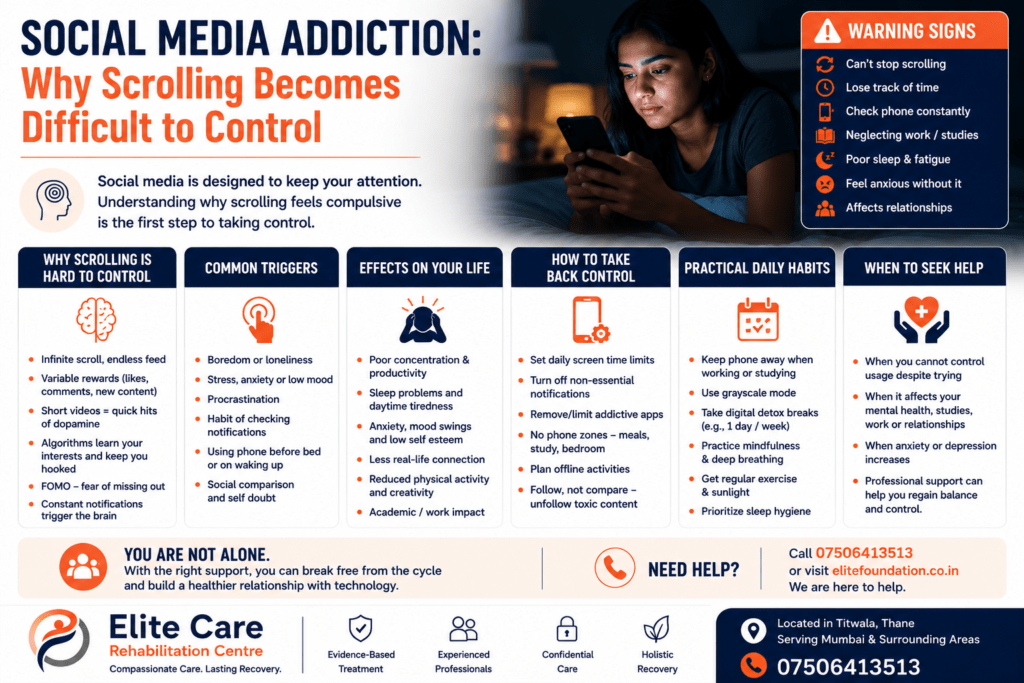
Social media addiction is a common term for social-media use that becomes increasingly difficult to control and begins interfering with sleep, attention, work, study or relationships. Families approaching a nasha mukti kendra in Mumbai may sometimes be seeking help for a behavioural rather than substance-related problem. Where scrolling, Reels or repeated checking has become difficult to control, social media addiction treatment should focus on the specific behaviour, its triggers, consequences, sleep pattern and any mental-health problem occurring alongside it.
Social media itself is not automatically harmful. Instagram, YouTube and other platforms can provide entertainment, information, professional opportunities, creativity and genuine social connection. Spending a lot of time online also does not by itself establish an addiction.
The concern is the pattern: opening an app without intending to, scrolling much longer than planned, checking repeatedly, continuing despite exhaustion or responsibilities, and finding that attempts to cut back repeatedly fail.
This guide looks specifically at Instagram and Reels, YouTube Shorts, endless scrolling, notifications, checking behaviour, social comparison, sleep disruption, fragmented attention and the associations between problematic social-media use, anxiety and depression.
What is social media addiction?
Social media addiction is a widely used public term, but it is important to use it carefully.
Social media addiction is not currently recognised as a standalone diagnosis in the DSM-5-TR. Research commonly uses terms such as problematic social media use to describe patterns involving difficulty controlling use together with distress, impairment or repeated negative consequences. No number of hours on Instagram, YouTube or another platform can diagnose the problem by itself.
Possible problems may involve:
- Instagram Reels
- YouTube Shorts
- Snapchat
- X or other continuously updating feeds
- Short-form video platforms
- Repeated messaging or notification checking
The broader article on digital addiction in India explains why problematic social-media use, smartphone use and gaming should not automatically be treated as one identical condition.
Social media addiction is not the same as simply enjoying social media
A person can enjoy Reels every evening and still remain in control of the behaviour.
Another person may use social media for fewer total hours but repeatedly:
- Stay awake later than intended
- Interrupt work every few minutes
- Open apps without consciously deciding to
- Check reactions repeatedly after posting
- Ignore conversations to keep scrolling
- Return immediately after deciding to stop
The second pattern may be more concerning even if the total daily number is lower.
| Area | High but controlled use | Possible problematic pattern |
|---|---|---|
| Control | The person can stop when necessary | Repeated attempts to stop or reduce use fail |
| Sleep | Social media can be put away at bedtime | Scrolling repeatedly postpones sleep |
| Work or study | Use fits around responsibilities | Checking repeatedly interrupts important tasks |
| Relationships | Online activity does not consistently replace shared time | Use continues despite repeated relationship conflict |
| Intent | The person generally knows why they opened the app | Apps are opened automatically without a clear purpose |
Social media addiction symptoms
Possible social media addiction symptoms usually involve a pattern rather than one isolated habit.
Signs can include:
- Using social media much longer than intended
- Repeated failed attempts to reduce use
- Opening social-media apps automatically
- Checking even when no notification has arrived
- Feeling preoccupied with what is happening online
- Repeatedly refreshing a feed or checking reactions
- Continuing to scroll despite being tired
- Delaying sleep because of social media
- Interrupting work or study repeatedly
- Using social media throughout meals or conversations
- Becoming increasingly distressed about missing updates
- Hiding or minimising the amount of time spent online
- Losing interest in some offline activities
- Continuing despite recognised consequences
No single sign proves that someone has an addiction.
The important questions are whether control is being lost and whether the behaviour is repeatedly interfering with everyday functioning.
Why scrolling can become difficult to stop
Scrolling is unusually easy to continue because many feeds have no natural endpoint.
A newspaper has a final page.
A television programme ends.
A social-media feed can continue producing new material for as long as the person continues swiping.
The next item may be:
- A funny Reel
- A friend’s update
- A breaking-news story
- A celebrity post
- A comment
- A useful tutorial
- A disturbing video
- Something completely unexpected
This makes the stopping point less obvious.
The person may initially intend to spend five minutes online without ever making a conscious decision to spend the next 45 minutes there.
Endless scrolling removes natural stopping points
A useful way to understand endless scrolling is to compare it with older forms of media.
When reading a magazine, you might stop when:
- An article ends
- A page ends
- The magazine is finished
With a continuously refreshed feed, the platform can immediately present another item.
This does not mean everyone exposed to infinite scrolling will develop problematic use. It means that a person who already finds stopping difficult may encounter fewer natural cues telling them that the activity has finished.
Instagram addiction and Reels addiction
Instagram addiction and Reels addiction are common public terms for patterns in which Instagram use becomes difficult to control.
The main problem may not involve every part of Instagram.
For example, someone may use direct messages normally but repeatedly lose time to Reels.
Another person may rarely watch Reels but constantly check:
- Likes
- Comments
- Story views
- Follower changes
- Direct messages
These are different behavioural patterns even though both occur inside the same app.
Instagram Reels addiction: why short videos can become a long session
A Reel may last only seconds.
That does not mean a Reels session is short.
The sequence can become:
One video → swipe → another video → swipe → another video → 30 minutes have passed.
The short duration of each individual video may actually make it harder to recognise the total amount of time being spent.
Instead of deciding to watch a 40-minute programme, the person repeatedly makes a much smaller decision:
“Just one more.”
YouTube Shorts addiction
YouTube Shorts addiction and Shorts addiction are also public search terms rather than standalone medical diagnoses.
The relevant question is whether short-form video consumption has become difficult to control.
Warning patterns may include:
- Opening YouTube for one purpose and moving automatically into Shorts
- Watching far longer than intended
- Returning repeatedly throughout the day
- Using Shorts whenever boredom appears
- Continuing late at night despite needing sleep
- Interrupting study or work for short-video sessions
Again, it is the pattern and consequence rather than the platform name that matters most.
Short-form video addiction is not a separate diagnosis
The phrase short form video addiction is useful because it describes what many people experience.
However, it should not be presented as though every person who enjoys Reels or Shorts has a clinically recognised addictive disorder.
Assessment should focus on:
- Control
- Frequency
- Duration
- Sleep
- Attention
- Work or study
- Relationships
- Repeated unsuccessful efforts to change
What is scrolling addiction?
Scrolling addiction is another common public phrase rather than a formal standalone diagnosis.
It usually describes scrolling that:
- Feels automatic
- Continues longer than intended
- Is repeatedly difficult to stop
- Occurs whenever there is a spare moment
- Continues despite negative consequences
The content may be entertaining, social, educational or distressing.
This is different from doomscrolling, which has a more specific meaning.
Doomscrolling is not the same as all endless scrolling
The term doomscrolling is often used loosely, but it usually refers specifically to repeatedly consuming upsetting, threatening or negative news and content online.
A person might move from one story about:
- War
- Crime
- Political conflict
- Economic uncertainty
- Disasters
- Health scares
to another while feeling increasingly anxious yet still finding it difficult to stop checking.
Watching comedy Reels for two hours is endless or compulsive scrolling, but it is not necessarily doomscrolling.
Keeping these terms separate makes the article more clinically and linguistically precise.
Why do people doomscroll?
Doomscrolling may partly involve an attempt to reduce uncertainty.
When something frightening or important is happening, the person may think:
“Maybe the next update will tell me what is really happening.”
Checking can provide new information, but each new update can also create another question.
The cycle may become:
uncertainty → check → upsetting information → more uncertainty → check again.
In that situation, the person may not even be enjoying the content.
Notifications can turn social media into repeated checking
Not all social-media overuse happens through long scrolling sessions.
Some people interact with social media in dozens of very short bursts throughout the day.
A notification may indicate:
- A new message
- A like
- A comment
- A follow request
- A mention
- A new post
- A recommended video
Each alert provides another reason to open the platform.
Once inside, the person may complete the original task and then continue into the feed.
For example:
Notification → check comment → open profile → view Reel → scroll through several more Reels.
The original notification may take seconds to deal with, while the resulting session lasts much longer.
Why people check even without notifications
After repeated use, checking can become associated with ordinary situations.
Common cues include:
- Waiting
- Boredom
- Anxiety
- Taking a break from work
- Getting into bed
- Waking up
- Finishing a meal
- Feeling uncomfortable in a social situation
The phone may eventually be unlocked before the person has clearly decided what they want to see.
This is why turning off notifications can help some people but may not completely stop checking.
Checking likes, comments and views
Posting can create another form of repeated social-media checking.
Someone uploads:
- A photograph
- A Reel
- A Story
- A professional post
and then repeatedly returns to see what happened.
The person may check:
- Who viewed it?
- Who liked it?
- Who did not like it?
- Did somebody comment?
- How many views did it receive?
For some people this is casual curiosity.
For others, reactions become tied closely to reassurance, social approval or self-worth, making disengagement more difficult.
Social comparison on social media
Social media provides an unusually large number of opportunities to compare yourself with other people.
You may see someone’s:
- Holiday
- Career success
- Relationship
- Fitness progress
- Home
- Business
- Appearance
- Social life
without seeing most of the ordinary, difficult or private parts of that person’s life.
The comparison can therefore become:
your full everyday life versus someone else’s selected moments.
That does not mean social comparison always causes psychological harm. Different people respond differently, and some social-media content can motivate, educate or support users.
Concern increases when repeated comparison consistently leaves someone distressed, inadequate or preoccupied with how they appear to others.
Why the same social media affects different people differently
There is no single effect of social media that applies to everybody.
The experience depends on:
- What content is viewed
- Why the person is using the platform
- Whether use is active or passive
- Who they interact with
- Whether cyberbullying is involved
- Age
- Existing mental health
- Sleep
- Offline relationships
Someone using Instagram to communicate with close friends may have a very different experience from someone spending hours comparing their appearance with influencers.
Social media addiction and mental health
Problematic social-media use is associated in research with several mental-health outcomes, but association should not be confused with simple one-way causation.
A 2024 systematic review and meta-analysis of social media use, mental health and sleep in adolescents and young adults included 182 studies involving more than 1.1 million participants in the systematic review, with 98 studies contributing to the meta-analyses. The meta-analyses found small associations between general social-media use and depression and anxiety. Problematic social-media use was associated with depression, anxiety, sleep problems and lower wellbeing.
The authors also reported considerable variation across the studies.
This matters because the research cannot be simplified to:
“Social media causes depression.”
The relationship can be more complicated.
Social media and anxiety
Anxiety may contribute to problematic social-media use in several ways.
Someone may repeatedly check:
- Whether another person replied
- Whether a post received reactions
- Whether friends are doing something without them
- Whether new information has appeared
Checking may temporarily reduce uncertainty.
But social media can also expose the person to new comparison, conflict, upsetting news or social uncertainty.
For some people the relationship therefore works in both directions.
Social media and depression
Depression may also interact with social-media behaviour rather than having one simple causal relationship.
Someone experiencing low mood may:
- Have less energy for offline activities
- Spend more time passively scrolling
- Withdraw from face-to-face interaction
- Use social media as distraction
At the same time, certain online experiences may worsen feelings of inadequacy, loneliness or distress.
A clinical assessment should therefore ask what came first, what is maintaining the pattern and whether depression itself needs treatment.
Social media addiction and sleep
Sleep is one of the most practical places to look for consequences.
The problem may begin with:
“I’ll check Instagram for five minutes before sleeping.”
Then:
- A Reel appears.
- Another looks interesting.
- A message arrives.
- The person checks a profile.
- More content appears.
- Bedtime moves later.
Repeated late-night use can shorten available sleep when the person’s morning responsibilities remain fixed.
The same 2024 systematic review found that problematic social-media use was associated with sleep problems. However, the relationship can also be bidirectional: people who already have difficulty sleeping may spend more time on social media because they are awake.
Why checking the time can become another scrolling session
A person wakes during the night and picks up the phone simply to see the time.
Then they notice:
- A message
- A notification
- A news alert
The intended two-second check becomes another period of social-media use.
This is an example of how easy access can turn a practical phone action into an unplanned social-media session.
Social media and attention
Social media does not need to occupy several continuous hours to interfere with concentration.
Repeated brief checks can fragment an activity.
Consider someone studying for an hour who:
- Checks one message
- Returns to study
- Checks a Reel
- Returns
- Checks a notification
- Returns again
The total social-media time may not appear extreme, but the study period has been repeatedly interrupted.
Attention fragmentation is different from permanently damaging your attention span
This distinction is important.
If social media interrupts a task every few minutes, attention is being fragmented during that task.
That does not automatically prove that the person’s brain or attention span has been permanently damaged.
Popular statements such as “Reels have destroyed everyone’s attention span” go beyond what an individual person’s screen behaviour can establish.
A more useful question is whether repeated checking is preventing sustained attention when sustained attention is actually required.
Social media in India’s Economic Survey 2025–26
Digital overuse has also moved beyond a private family concern and into Indian public-health and policy discussion.
A Ministry of Finance summary of the Economic Survey 2025–26 specifically highlighted measures aimed at addressing digital addiction among children and referred to the Service for Healthy Use of Technology at NIMHANS as part of the mental-health response.
This is significant because it places unhealthy technology use within a wider health, education and family context rather than treating it simply as a failure of personal discipline.
At the same time, an Economic Survey discussion should not be interpreted as evidence that every Indian who uses Instagram, YouTube or another digital platform has an addiction.
Social media addiction in teenagers
Teenagers require particularly careful language.
Social media can be part of:
- Friendship
- School communication
- Creativity
- Entertainment
- Identity exploration
- Learning
Heavy use alone should therefore not automatically be labelled addiction.
Concern increases when social-media behaviour consistently interferes with:
- Sleep
- School attendance
- Academic responsibilities
- Offline friendships
- Family interaction
- Physical activity
- Emotional wellbeing
Young people may be affected by more than screen time
For teenagers, the content and social experience can be as important as the number of hours.
Assessment may need to consider:
- Cyberbullying
- Body-image content
- Social exclusion
- Sexual content
- Harassment
- Comparison
- Pressure to respond
- Exposure to self-harm or other harmful content
The American Psychological Association’s health advisory on adolescent social-media use recommends that social-media use and platform features be considered in relation to young people’s developmental capabilities. The advisory specifically discusses features such as recommended content, likes, alerts and endless scrolling.
Parents should not diagnose addiction from screen time alone
A teenager spending several hours online may be:
- Talking with friends
- Watching entertainment
- Doing schoolwork
- Creating content
- Gaming
Parents should first identify what the young person is actually doing.
A better conversation begins with:
“What seems hardest for you to stop?”
rather than:
“You are addicted to everything on your phone.”
Fear of missing out can maintain repeated checking
Some people check social media because not checking feels socially risky.
They may worry:
- Friends will make plans without them
- A message will go unanswered
- They will miss an important trend
- Someone will notice that they did not respond
- Something important will happen while they are offline
Repeated checking can provide reassurance that nothing important has been missed.
If that reassurance is short-lived, another check soon follows.
Social media can become a way of avoiding uncomfortable emotions
Scrolling is not always driven by entertainment.
A person may reach for social media when feeling:
- Lonely
- Anxious
- Bored
- Stressed
- Angry
- Embarrassed
For a while, the feed redirects attention elsewhere.
The problem is not occasional distraction. Everyone distracts themselves sometimes.
Concern increases when scrolling becomes the main response to every uncomfortable emotion.
Why “just have more self-control” may not be enough
If the behaviour is repeatedly connected with notifications, bedtime, boredom, anxiety or stress, the person is encountering the same cues every day.
A useful plan therefore looks at:
- When scrolling starts
- Which application is involved
- What happened immediately beforehand
- How long the session lasts
- What the person is avoiding or seeking
This turns a vague complaint about “social media addiction” into a behaviour that can actually be examined.
Social media detox: does deleting the apps solve the problem?
A temporary social-media break can be useful for some people.
It may help reveal:
- How often they reach for an app automatically
- Which situations trigger checking
- How much bedtime use had become habitual
- What activities had been displaced
But removing Instagram for a week does not necessarily address:
- Anxiety
- Loneliness
- Sleep problems
- Stress
- Need for reassurance
- The wider habit of checking the phone
Some people also delete one platform only to move immediately to another.
How to reduce social media use
If social-media use has become difficult to control, begin with the specific behaviour rather than trying to remove every digital activity.
For example:
- Turn off non-essential social notifications
- Move high-risk apps away from the first home screen
- Keep social media out of selected work or study periods
- Avoid beginning recreational scrolling once already in bed
- Identify the times of day when use is least controlled
- Decide what offline activity will replace some of that time
The detailed guide on how to reduce phone addiction and compulsive screen use provides a fuller step-by-step plan for notifications, screen-time reports, app friction, bedtime use and automatic checking.
How to stop scrolling
Do not rely only on deciding:
“I will scroll less today.”
Ask:
- Which feed causes the biggest problem?
- At what time does uncontrolled scrolling usually begin?
- What triggers it?
- What makes stopping difficult?
- What could create a natural stopping point?
If the main problem is Instagram Reels from midnight onwards, that is a much clearer target than “social media”.
When social media is not the only problem
Sometimes reducing access reveals another difficulty underneath.
For example:
Social media removed → anxiety becomes more obvious.
Or:
Reels removed → person moves immediately to YouTube Shorts.
Or:
Phone placed away at night → person still cannot sleep.
These observations are useful.
They suggest that the original behaviour may be part of a wider problem rather than the only problem.
Mobile phone addiction and social media addiction often overlap
The same device contains messaging, social media, videos, news, shopping and work.
Someone may think Instagram is the problem but discover that after deleting it they begin spending more time on another application.
The guide to mobile phone addiction signs explains how to distinguish a wider compulsive checking pattern from difficulty with one particular platform.
When professional assessment may help
Professional assessment may be useful when social-media use:
- Repeatedly feels impossible to control
- Continues despite several serious attempts to reduce it
- Regularly prevents adequate sleep
- Contributes to absence from college, school or work
- Causes substantial relationship conflict
- Has replaced most previous offline activities
- Is closely linked with severe anxiety or depression
- Is occurring alongside another problematic digital behaviour
The assessment should consider both the behaviour and the reason it has become so important.
What families should avoid
Families should avoid:
- Calling every frequent Instagram user an addict
- Humiliating the person about their online activity
- Assuming every mental-health problem was caused by social media
- Destroying devices during arguments
- Reading private messages without a genuine safety reason
- Making restrictions that cannot realistically be maintained
- Expecting permanent change from one weekend without a phone
The aim is to understand the pattern and restore control rather than make technology the centre of every family conflict.
When social-media concerns become an urgent mental-health issue
Problematic social-media use itself is usually not a medical emergency.
Urgent professional assessment is needed when the wider situation involves:
- Suicidal thoughts or intent
- Self-harm
- Severe depression
- Psychosis
- Dangerous aggression
- Severe neglect of food, fluids or personal safety
- Several nights with almost no sleep together with markedly abnormal behaviour
In these circumstances, the immediate mental-health or medical problem takes priority over deciding whether the person’s social-media behaviour should be called addiction.
Frequently asked questions
What is social media addiction?
Social media addiction is a commonly used term for persistent social-media behaviour that becomes difficult to control and begins causing meaningful problems with sleep, work, study, relationships or everyday functioning. Research often uses the term problematic social media use.
Is social media addiction an official diagnosis?
Social media addiction is not currently recognised as a standalone diagnosis in the DSM-5-TR. Problematic social-media use can still cause significant distress or functional impairment and may warrant professional assessment.
What are the main social media addiction symptoms?
Possible signs include using much longer than intended, repeated failed attempts to cut back, automatic checking, preoccupation with updates or reactions, delayed sleep and continuing despite recognised consequences.
How many hours of social media means addiction?
There is no universal number of hours that diagnoses social media addiction. The type of use, degree of control and effect on everyday functioning matter more than screen time alone.
Is Instagram addiction real?
People can develop genuinely problematic patterns of Instagram use, including difficulty controlling Reels, checking or social feedback. However, Instagram addiction is not one universally established standalone medical diagnosis.
What is Reels addiction?
Reels addiction is a public term used when Instagram Reels use becomes compulsive or difficult to control. The more precise assessment focuses on loss of control, repeated unsuccessful attempts to reduce use and consequences rather than the label itself.
Can YouTube Shorts be addictive?
Some people develop problematic patterns around YouTube Shorts and other short-form video feeds. “YouTube Shorts addiction” is a common descriptive phrase rather than a standalone medical diagnosis.
Why are Reels so difficult to stop watching?
Short videos can be consumed rapidly and the feed has no obvious endpoint. Each swipe produces another piece of content, so a session can continue without the person making one clear decision to spend a long period watching.
What is scrolling addiction?
Scrolling addiction is an informal term for persistent, difficult-to-control scrolling that repeatedly continues longer than intended or interferes with everyday life.
What is doomscrolling?
Doomscrolling usually refers to repeatedly consuming negative, worrying or threatening news and online content even when doing so is increasing distress. It is more specific than general endless scrolling.
Is all endless scrolling doomscrolling?
No. Spending an hour watching entertaining Reels can be endless or compulsive scrolling without being doomscrolling. Doomscrolling usually involves repeated consumption of distressing or negative information.
Why do I keep checking Instagram when there are no notifications?
Checking can become associated with boredom, anxiety, waiting, bedtime and other everyday cues. With repeated pairing, opening the app can begin to feel increasingly automatic.
Why do I keep checking likes and views?
For some people, reactions provide social information or reassurance. Concern increases when repeated checking becomes difficult to control or strongly influences mood or self-worth.
Can social media cause anxiety?
Research finds associations between social-media use, problematic social-media use and anxiety, particularly in studies of adolescents and young adults, but that does not establish a simple one-way cause. Existing anxiety can also contribute to repeated checking and social-media use.
Can social media cause depression?
Social-media use and problematic social-media use are associated with depressive symptoms in research, but causation is complex. Depression itself may also lead some people to spend more time passively online.
Can social media affect sleep?
Yes. Problematic social-media use is associated with sleep problems, and late-night scrolling can delay bedtime. However, people who already struggle to sleep may also spend more time online because they are awake.
Does social media destroy attention span?
That statement is too broad. Repeated social-media checking can fragment attention during work, study or conversations, but this does not by itself prove permanent damage to a person’s attention span.
Does social comparison on Instagram affect mental health?
Social comparison can be distressing for some people, particularly when they repeatedly compare their full everyday lives with highly selected presentations of other people’s appearance, success or relationships. The effect varies substantially between individuals.
How can I stop scrolling?
Identify the specific feed, time and trigger involved. Reduce unnecessary notifications, make the app less immediately accessible, protect high-risk periods such as bedtime and create another activity to replace some automatic scrolling.
Should I delete Instagram to stop social media addiction?
Not necessarily. Temporary removal can help some people, while others may regain control through notification changes, scheduled use or reducing access during specific high-risk periods. The right strategy depends on the individual behaviour.
Does a social media detox cure social media addiction?
No temporary break should be assumed to cure a persistent compulsive pattern. A break may reveal triggers and habits, but the longer-term question is whether control is maintained after normal access returns.
When should I get professional help for social media addiction?
Consider professional assessment when repeated attempts to regain control fail and social-media use is substantially affecting sleep, education, employment, relationships or mental health.
Social media is useful; the problem begins when scrolling stops feeling voluntary
Social media addiction should not be reduced to the claim that Instagram, Reels, YouTube Shorts or social media itself is inherently harmful.
Millions of people use these platforms for communication, information, entertainment, creativity and work without developing a serious behavioural problem.
The concern is when use repeatedly overrides intention.
You open Instagram for one message and emerge 45 minutes later. You intend to sleep but keep scrolling. You check reactions despite deciding not to. Work is repeatedly interrupted. Another Reel keeps appearing and there is never an obvious final one.
Those patterns are more informative than screen time alone.
Anxiety, depression, loneliness and sleep difficulties also need to be handled carefully. They can occur alongside problematic social-media use without proving that the platform itself caused them.
The useful questions are therefore:
What are you doing on social media? When does it become difficult to stop? What triggers the checking? What parts of life are being displaced? And can you regain control when you genuinely decide to use it less?
Medical disclaimer: This article provides general educational information and does not replace individual psychological, psychiatric or medical assessment. Heavy social-media use alone does not establish a diagnosis. Seek urgent professional assistance if concerns around digital use occur alongside suicidal intent, self-harm, psychosis, severe depression, dangerous aggression or another mental-health or medical emergency.
“`