
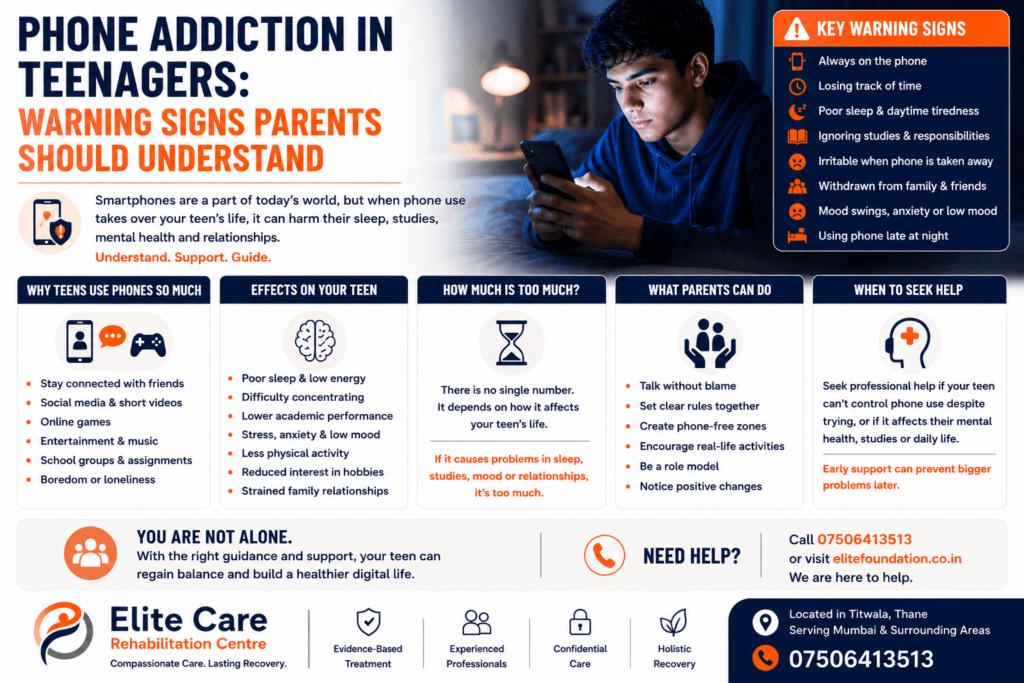
Phone addiction in teenagers is a phrase many parents use when a mobile begins taking over sleep, study, family time or other parts of everyday life. Parents approaching a nasha mukti kendra in India may sometimes be worried about a behavioural rather than substance-related problem. Where a teenager repeatedly struggles to control scrolling, social media or other phone use, mobile phone addiction treatment should look beyond screen hours to the behaviour involved, its consequences, sleep, school functioning, family circumstances and any mental-health problem occurring alongside it.
For parents, this can be difficult to judge. A teenager may genuinely need a phone for school groups, transport, payments, friendships and family communication. At the same time, the same device can provide social media, short videos, gaming and entertainment almost continuously.
That is why “my teenager is always on the phone” is not enough on its own to establish an addiction.
The more useful questions are: Can they put it down when something important needs their attention? Is sleep repeatedly being sacrificed? Are school, friendships, exercise or family life being displaced? Have they tried to cut back and found that they repeatedly cannot?
This article is written for parents trying to tell the difference between ordinary teenage phone use, heavy but controlled use and a pattern that deserves closer attention.
Is phone addiction in teenagers a real diagnosis?
“Phone addiction”, “mobile addiction” and “smartphone addiction” are widely used terms, but there is not one standalone DSM-5-TR diagnosis called smartphone addiction.
Research often uses terms such as problematic smartphone use when phone behaviour becomes difficult to control and is associated with distress or functional problems.
This distinction is important for parents.
A teenager should not be diagnosed from:
- A screen-time number
- Being upset when asked to stop
- Using social media every day
- Gaming regularly
- Taking the phone everywhere
Those behaviours may contribute to a wider picture, but they need context.
Why teenagers use their phones so much
For many teenagers, a smartphone is not simply an entertainment device.
It can be where they:
- Talk with friends
- Receive school notices
- Join class groups
- Watch educational videos
- Listen to music
- Play games
- Use social media
- Follow sport or entertainment
- Arrange transport
- Take photographs
- Research assignments
Parents therefore need to know what the teenager is doing on the phone before deciding that the number of hours is the problem.
Teenager always on phone: when should a parent actually worry?
Concern increases when the phone repeatedly interferes with parts of life that the teenager needs or values.
For example:
- Sleeping at 2 or 3 a.m. because scrolling continues
- Missing school because they cannot wake in the morning
- Repeatedly failing to complete assignments
- Stopping sport or previous hobbies
- Avoiding family meals to remain online
- Checking the phone throughout conversations
- Repeatedly trying to reduce use but returning to the same pattern
- Continuing despite recognising that the behaviour is causing problems
One difficult evening is different from a persistent pattern over time.
Warning signs of phone addiction in teenagers
Parents usually notice several changes rather than one defining symptom.
Possible warning signs include:
- Using the phone substantially longer than intended
- Repeated unsuccessful attempts to reduce use
- Checking automatically throughout the day
- Immediately reaching for the phone after waking
- Continuing to scroll despite being exhausted
- Regularly delaying sleep
- Repeated phone use during homework or studying
- Increasing conflict about device use
- Losing interest in hobbies that were previously important
- Reduced face-to-face interaction
- Using the phone during almost every meal
- Feeling unable to leave the device elsewhere
- Hiding or minimising the amount of recreational use
- School or college functioning beginning to deteriorate
No single item proves that a teenager has an addiction.
The strength of the concern comes from the combination of impaired control and meaningful consequences.
A teenager getting angry when you take the phone away does not automatically prove addiction
This is one of the most important distinctions for parents.
A teenager may become angry because:
- They were in the middle of a conversation
- A game was interrupted
- They feel a rule is unfair
- They believe their privacy is being invaded
- The phone is their main connection with friends
- They were given no warning that screen time was ending
Irritability can also occur when a strongly established digital habit is interrupted.
The reaction therefore needs context.
More concern is warranted when arguments about the phone occur repeatedly alongside sleep loss, school problems, withdrawal from other activities and persistent inability to control use.
My child is addicted to the phone: first identify what is actually happening on it
Parents often describe the problem as “the mobile”.
But the difficult behaviour may actually be:
- Instagram Reels
- YouTube Shorts
- Gaming
- Streaming
- Online gambling
- Shopping
- Pornography
- Constant checking across several applications
This matters because these problems do not all have the same triggers, risks or treatment needs.
The detailed guide on social media addiction, Reels, Shorts and compulsive scrolling explains how social-media-specific patterns differ from broader smartphone use.
Phone addiction in teenagers and sleep
Bedtime is often where a manageable phone habit becomes a serious family problem.
A teenager may intend to sleep at 11 p.m. but:
- Reply to a message.
- Check one Reel.
- Move into another feed.
- Receive another notification.
- Continue scrolling.
- Realise that an hour or more has passed.
The phone does not need to be the only reason sleep is poor. Anxiety, depression, academic pressure, insomnia and irregular routines can also contribute.
But when recreational phone use repeatedly pushes bedtime later, it becomes a practical target for change.
Look at the morning, not only the night
Parents sometimes argue about how late a teenager was online without looking at what happens the next morning.
Warning signs can include:
- Repeated difficulty waking for school
- Sleeping through alarms
- Morning irritability
- Falling asleep during the day
- Missing breakfast because of late waking
- Reduced concentration in early classes
- Trying to catch up on sleep throughout the weekend
If bedtime phone use is repeatedly producing daytime consequences, the problem is more meaningful than the screen-time number alone.
Mobile addiction in students
The phrase mobile addiction in students often reflects a parent’s concern that phone use is damaging studies.
That can happen, but the relationship is not always as simple as:
phone use → poor marks.
A teenager may already be struggling with:
- ADHD
- Anxiety
- Depression
- Academic pressure
- Bullying
- Learning difficulties
- Sleep deprivation
- Low motivation
The phone can then become an easy escape from a task that already feels difficult.
Removing the phone may reduce one source of distraction while leaving the original difficulty untreated.
Mobile addiction effects on students: what parents may notice
Potential problems associated with uncontrolled phone use can include:
Fragmented study time
A teenager may technically sit with a textbook for an hour while checking messages or videos every few minutes.
Delayed assignments
A short planned break becomes prolonged scrolling.
Reduced sleep
Late-night phone use leaves less time for sleep before school.
Morning absence or lateness
The teenager struggles to wake after staying online late.
Conflict around homework
Parents repeatedly try to remove the phone while the teenager feels monitored or criticised.
These observations are useful, but parents should avoid assuming that every academic problem is caused by a device.
Phone addiction and studies: distraction can be more important than total time
Imagine two students who each spend three hours recreationally on their phones.
One finishes schoolwork first and uses the phone afterwards.
The other checks it throughout every study session.
The total recreational screen time may be similar, but the second pattern creates repeated interruptions during tasks requiring sustained attention.
For parents, when a teenager uses the phone may therefore matter as much as how long they use it.
Attention fragmentation does not mean the teenager’s brain has been permanently damaged
Claims that smartphones or Reels have permanently “destroyed” a teenager’s attention span are much stronger than the evidence allows.
What parents can observe more directly is interruption.
If a teenager switches between homework, WhatsApp, Reels and gaming every few minutes, sustained attention to the assignment is being fragmented.
That is different from claiming permanent neurological damage.
Phone addiction in teenagers and social media
For many teenagers, what parents call phone addiction is mainly social-media use.
The teenager may repeatedly check:
- Messages
- Likes
- Story views
- Comments
- Reels
- Short-form videos
- Friends’ locations or updates
This can be driven by entertainment, boredom, friendship, social reassurance, fear of missing out or a mixture of these.
It is useful to ask:
“What do you feel you might miss if you don’t check?”
That can lead to a more productive conversation than simply asking why the teenager cannot put the phone down.
Social comparison can matter during adolescence
Teenagers may compare their appearance, popularity, friendships, lifestyle or achievements with highly selected content from other people.
For some, this causes little difficulty.
For others, repeated comparison can contribute to:
- Feeling left out
- Appearance concerns
- Low confidence
- Pressure to look or behave a certain way
- Repeated checking for reassurance
The effect differs considerably between young people, which is why the content being consumed matters alongside the amount of time online.
Is your teenager using the phone to cope with something else?
Sometimes the phone is the most visible problem but not the original problem.
A teenager may spend increasing amounts of time online because they feel:
- Lonely
- Anxious
- Bullied
- Left out
- Overwhelmed by school
- Uncomfortable socially
- Depressed
- Bored at home
Scrolling, gaming or messaging can temporarily distract from those feelings.
If the phone is removed without understanding what it was helping the teenager avoid or manage, the underlying distress may remain.
Teenagers need privacy, but parents still have a safety role
Privacy becomes increasingly important during adolescence.
Constantly reading every message or checking every conversation can damage trust and may discourage a teenager from telling parents when something genuinely unsafe happens online.
At the same time, privacy is not absolute when there is a serious safety concern.
Parents may need to intervene more directly if there are concerns about:
- Self-harm content
- Suicidal communication
- Sexual exploitation
- Sextortion
- Threats
- Cyberbullying
- Dangerous challenges
- Unknown adults contacting the teenager
- Uncontrolled financial spending
The aim is proportionate safety, not routine surveillance of every ordinary teenage conversation.
India’s concern about digital addiction among children is now part of national policy discussion
Concerns about unhealthy digital use are no longer limited to individual families.
The Government of India’s summary of the Economic Survey 2025–26 specifically highlighted initiatives addressing digital addiction among children and referred to NIMHANS’s Service for Healthy Use of Technology as part of the mental-health response.
The wider Economic Survey discussion also placed excessive digital use in the context of attention, sleep, education, social connection and mental health.
This does not mean every Indian teenager who spends several hours online has an addiction. It does show that healthier technology use among children and young people has become an active public-health and education concern.
What Indian parents are reporting
Parental concern is also visible in survey data.
A December 2025 LocalCircles survey received more than 57,000 responses from urban Indian parents of school-age children. Among parents answering the time-use question, 49% said children aged 9–17 spent an average of three or more hours a day on social media, videos or OTT and online games.
In another question, a majority of respondents described their children as “addicted” to at least one of videos or OTT, social media or online gaming.
That wording needs an important qualification: these are parental perceptions, not clinical diagnoses or a measured national prevalence of addiction.
The value of the survey is that it shows how widespread parental concern has become.
There is no single screen-time number that diagnoses a teenager
Parents often want a simple answer:
“How many hours are too many?”
For teenagers, one number cannot answer that question.
Screen use can include:
- Homework
- School research
- Online tuition
- Music
- Communication
- Gaming
- Social media
- Streaming
A more useful question is whether recreational media is crowding out:
- Adequate sleep
- Physical activity
- School responsibilities
- Family relationships
- Offline friendships
- Other interests
Use screen time as information, not as a diagnosis
Phone reports can still be helpful.
Look at:
- Total use
- Which apps dominate
- Late-night use
- How often the phone is picked up
- Whether use is concentrated during homework
Then discuss the pattern with the teenager.
A report saying “six hours” tells you far less than knowing that four hours were educational and two were recreational, or that most recreational use happened after midnight.
Do not turn every screen-time discussion into an argument
If the only conversation about phones is criticism, teenagers may begin hiding rather than discussing their online behaviour.
Instead of:
“You are always on that stupid phone.”
try something observable:
“You’ve slept after 2 a.m. four nights this week and are struggling to wake for school. Let’s look at what is happening at night.”
The second statement focuses on a real consequence rather than attacking the teenager’s character.
Ask what they like about the phone before asking them to use it less
This may sound simple, but it changes the conversation.
Ask:
- Which app do you enjoy most?
- Who do you usually talk to?
- What do you watch?
- What do your friends use?
- What part would be hardest to reduce?
A teenager who feels that a parent genuinely understands the role of technology in their life may be more willing to discuss the parts that are causing problems.
How to reduce mobile addiction in children and teenagers
The solution should usually begin with the behaviour causing the problem rather than confiscating every digital device indefinitely.
Parents can start by agreeing on a few clear priorities.
For example:
- Sleep should not be repeatedly sacrificed for recreational phone use.
- Phones can be put away during selected study periods.
- Meals can be protected from recreational scrolling.
- Non-essential notifications can be reduced.
- The most distracting applications can be kept away from bedtime.
- Offline activity should have a regular place in the week.
The separate practical guide on how to reduce phone addiction and compulsive screen use goes deeper into app friction, notification control, bedtime changes, screen-time tracking and automatic checking.
Make rules with teenagers, not only for teenagers
As children move through adolescence, rules are more likely to teach self-management when the teenager understands their purpose and has some involvement in creating them.
The American Academy of Pediatrics Family Media Plan recommends creating family-specific rules, protecting screen-free areas or periods such as meals and bedtime, reducing unnecessary notifications and making sure the plan applies to adults as well as children.
This is particularly useful with teenagers because the long-term goal is not simply parental control.
It is helping them build their own ability to decide when technology should and should not have their attention.
Parents’ phone habits matter too
A teenager is unlikely to take a “no phones at dinner” rule seriously if every adult at the table checks messages continuously.
Parents do not need perfect digital habits.
They do need rules that make sense across the household.
If a parent genuinely has an urgent work message, say so.
If not, putting the device away alongside the teenager demonstrates that the rule is about protected family time rather than punishment.
Should parents take the phone away?
Sometimes temporary restriction is reasonable.
But taking the phone away should have a clear purpose.
Ask:
- What behaviour are we trying to change?
- For how long?
- What necessary phone functions does the teenager still need?
- What happens when the phone is returned?
If a teenager stays awake on Reels every night, simply removing the device for one weekend may stop the immediate behaviour without creating a sustainable bedtime routine.
The return plan matters.
Do not use sudden confiscation as the only strategy
A cycle can develop:
- Teenager uses phone excessively.
- Parent gets angry.
- Phone is confiscated.
- Major argument follows.
- Phone is eventually returned.
- The previous routine resumes.
If this happens repeatedly, the family is managing the device rather than changing the behaviour.
Clear expectations established before the next conflict are usually more useful.
What if your teenager needs the phone for school?
Many school-age teenagers genuinely need digital access.
Separate necessary education use from recreational use.
For example:
| Original task | What can happen next |
|---|---|
| Check school WhatsApp group | Move into unrelated chats and social media |
| Watch an educational video | Move into recommended entertainment |
| Search for homework information | Open another distracting app |
| Upload an assignment | Remain online scrolling afterwards |
The school task may be necessary. The extra unplanned session may be the part that needs changing.
Phone-free bedrooms can help some families, but one rule does not fit everyone
Keeping the phone outside the bedroom can be useful when night-time use is a repeated problem.
However, some families depend on the phone for:
- Emergency contact
- Alarms
- Health-related monitoring
If removing the phone entirely is impractical, alternatives include:
- Charging it away from the bed
- Using a separate alarm clock
- Restricting non-essential night notifications
- Making recreational apps unavailable during the agreed sleep period
The rule should solve the actual problem rather than simply look strict.
Do not remove the phone and leave nothing in its place
If a teenager spends four hours every evening online and that use is suddenly reduced, the family has created several hours of empty time.
Something needs to compete with the screen.
That might include:
- Sport
- Gym or exercise
- Music
- Art
- Reading
- Going outside
- Meeting friends face to face
- Cooking
- Family activity
The alternative should reflect the teenager’s interests rather than simply what adults think teenagers ought to enjoy.
Physical activity should not be presented as punishment for screen use
“You used your phone too much, so now go exercise” can turn a healthy activity into a penalty.
It is usually better to make offline activity part of the normal routine.
The aim is to build a life in which screens do not have to fill every available period.
NIMHANS also frames healthy technology use around balance
NIMHANS guidance on healthy gadget, social-media and internet use for children and adolescents recommends balancing screen use with offline activities, involving families and schools, setting boundaries and paying attention when online behaviour begins interfering with schoolwork, sleep or real-world activities. Its practical guidance also suggests limiting screen time for adolescents, but such recommendations should not be confused with a diagnostic threshold: crossing a particular number of hours does not by itself establish phone addiction or problematic smartphone use.
This is a useful model for parents because the goal is not to label every teenager who likes technology as addicted.
It is to notice when digital activity is beginning to control parts of daily life.
When limits keep failing, look for the trigger
If the same rule is broken every evening, ask why.
For example:
Rule: Phone away at 11 p.m.
What actually happens: Teenager starts talking to friends at 10:45 p.m. and does not want to leave the conversation.
Or:
Rule: No social media during study.
What actually happens: A difficult chapter creates anxiety, and checking the phone provides an immediate escape.
The failure tells you something about the behaviour.
A better plan addresses that trigger rather than simply adding another punishment.
Could ADHD be contributing?
Some teenagers with ADHD may find:
- Long assignments difficult to sustain
- Immediate digital stimulation unusually appealing
- Transitions away from enjoyable activities difficult
This does not mean phone overuse proves ADHD.
It means persistent concentration and organisation difficulties should not automatically be blamed on the phone.
Could anxiety be contributing?
An anxious teenager may repeatedly check:
- Whether friends replied
- Whether someone is upset with them
- Whether they were excluded
- School-group messages
The checking may briefly reduce uncertainty.
If anxiety is maintaining the behaviour, app limits alone may not be enough.
Could depression be contributing?
A teenager experiencing depression may have less energy for:
- Sport
- Studying
- Going out
- Meeting people
Passive scrolling may feel easier.
Parents should therefore avoid concluding that the phone caused the depression simply because phone use increased at the same time.
The depression may need assessment in its own right.
Could bullying or loneliness be hidden behind the phone use?
A teenager who suddenly stops going out but spends much more time online may be maintaining friendships digitally because something has changed offline.
Ask about:
- Friendships
- School
- Bullying
- Relationship problems
- Feeling excluded
Do not assume that reducing phone access automatically solves social withdrawal.
What parents should avoid
Try to avoid:
- Calling your teenager an addict during arguments
- Humiliating them about screen use in front of relatives or friends
- Assuming every low mark is caused by the phone
- Destroying the device in anger
- Making threats that you will not maintain
- Secretly reading ordinary private conversations without a genuine safety concern
- Ignoring your own phone behaviour
- Using the phone as both a constant reward and a constant punishment
- Expecting one weekend without technology to permanently change a long-established pattern
What parents can say instead
Try beginning with what you can actually observe.
Instead of:
“You’re addicted to your phone.”
try:
“You’ve been sleeping after 1:30 a.m. most school nights, and you told us yourself that you want to change that.”
Instead of:
“Social media is ruining your life.”
try:
“You seem much more upset after checking this group. Is something happening there?”
These conversations give a teenager room to explain rather than immediately defend themselves.
When should parents consider professional assessment?
Professional assessment may be useful when phone behaviour:
- Repeatedly feels impossible for the teenager to control
- Continues despite serious attempts to reduce it
- Regularly prevents adequate sleep
- Contributes to repeated school absence
- Is associated with marked academic deterioration
- Has displaced most offline interests
- Causes persistent family conflict
- Occurs alongside significant anxiety or depression
- Appears to be linked with ADHD or another difficulty requiring assessment
- Is mainly a gateway to uncontrolled gaming, gambling, pornography or another specific online behaviour
The goal of assessment is not simply to calculate screen time.
It is to understand the teenager, the behaviour and the circumstances around it.
Does a teenager with phone addiction need rehabilitation?
Not automatically.
Many teenagers with problematic smartphone use can be supported through:
- Changes at home
- Improved sleep routines
- Family media rules
- Psychological support
- School involvement where needed
- Treatment of anxiety, depression, ADHD or other co-occurring problems
More intensive treatment may be considered when functioning has severely deteriorated or when significant psychiatric, behavioural or other addictive problems occur alongside the digital behaviour.
When the phone is not the urgent problem
Phone overuse itself is usually not a medical emergency.
The situation becomes urgent when a teenager has:
- Suicidal thoughts with intent or a plan
- A recent self-harm attempt
- Severe depression with immediate safety concerns
- Psychotic symptoms
- Dangerous aggression that cannot be safely managed
- Several nights with almost no sleep together with markedly abnormal behaviour
- Severe neglect of food, fluids or personal safety
In India, call 112 or seek the nearest emergency department when there is an immediate risk to life or safety.
In these situations, do not leave a teenager at immediate suicide risk alone while waiting for professional assistance.
Frequently asked questions
What are the signs of phone addiction in teenagers?
Possible signs include repeated loss of control, failed attempts to reduce use, late-night scrolling, interference with schoolwork, withdrawal from previous activities and continued use despite recognised problems. No single symptom establishes a diagnosis.
Why is my teenager always on the phone?
The phone may be used for friends, school, social media, gaming, videos or several activities at once. Start by finding out what is actually happening on the device before assuming that the teenager is addicted.
My child is addicted to the phone. What should I do first?
Begin by identifying the specific behaviour causing problems. Look at sleep, school, relationships, the applications involved and whether the teenager has tried unsuccessfully to reduce use. Avoid beginning with a label alone.
How many hours of phone use is too much for a teenager?
Healthy-use guidance can include recommended limits for adolescent screen time, but these should not be treated as diagnostic cut-offs. The purpose of the screen use, timing, degree of control and whether important activities are being displaced remain essential when judging whether phone use has become problematic.
Is mobile addiction in students a medical diagnosis?
“Mobile addiction in students” is a common public phrase. Problematic smartphone use can be clinically important, but smartphone addiction is not one standalone DSM-5-TR diagnosis determined from screen time alone.
What are the effects of mobile addiction on students?
Uncontrolled phone use may be associated with disrupted sleep, fragmented study time, school lateness, unfinished work and family conflict. These problems can also have other causes, so the phone should not automatically be blamed for every academic difficulty.
Can phone addiction affect a teenager’s studies?
Repeated checking can interrupt homework and sustained concentration, while late-night use may reduce sleep before school. However, academic problems may also reflect ADHD, anxiety, depression, learning difficulties or other factors.
Can phone addiction affect sleep in teenagers?
Yes. When recreational phone use repeatedly postpones bedtime, available sleep can be reduced. Existing insomnia, anxiety or other problems can also cause teenagers to use their phones more because they are already awake.
Does getting angry when a phone is taken away mean addiction?
No. Anger may reflect interruption, disagreement about rules, social concerns or loss of privacy. It becomes more concerning when repeated intense conflict occurs together with impaired control and substantial problems with sleep, school or everyday functioning.
Should I take my teenager’s phone away?
Temporary restrictions may sometimes be useful, but they should have a clear purpose and return plan. Indefinite confiscation does not by itself address the triggers or routines maintaining problematic use.
Should teenagers have phones in their bedrooms?
There is no rule that fits every family. If night-time use is causing persistent sleep problems, keeping the device outside the bedroom or away from the bed may help. Essential communication or health needs should also be considered.
How can I reduce phone use in my teenager?
Start with the specific behaviour causing harm, agree on a few clear boundaries, protect sleep and study periods, reduce unnecessary notifications, make room for offline activities and review the plan with the teenager rather than relying only on punishment.
How can I reduce mobile addiction in children?
Use age-appropriate family rules, identify the applications or behaviours causing the problem, keep screens from consistently displacing sleep and other activities, model the same rules as a parent and seek help when repeated attempts to regain control fail.
How can I reduce mobile addiction in students?
Separate educational use from recreational interruption. Protected study periods, fewer unnecessary alerts and keeping the phone out of immediate reach during concentrated work can help reduce repeated checking.
Can social media be the real reason behind phone addiction?
Sometimes. A teenager may use the phone normally for most activities but struggle specifically with Reels, Shorts, messaging or checking reactions. Identifying the exact behaviour makes the problem easier to address.
Can gaming cause a teenager to stay on the phone all day?
Gaming may be the main difficult behaviour for some teenagers. Heavy gaming alone does not establish gaming disorder, but impaired control, increasing priority given to gaming and continued play despite significant consequences deserve assessment.
Can anxiety make teenagers use phones more?
Yes. Some teenagers repeatedly check messages or social media to reduce uncertainty or gain reassurance. Anxiety may therefore contribute to phone use rather than being only a consequence of it.
Can depression make teenagers stay on their phones?
It can contribute. A teenager with low energy or reduced interest in offline activities may spend more time passively scrolling. Depression should be assessed separately rather than automatically blamed on the device.
Could ADHD look like phone addiction?
ADHD can make sustained attention and transitions difficult and may contribute to repeated digital distraction. Phone overuse does not diagnose ADHD, and persistent attention problems should be assessed in their wider context.
Should parents check a teenager’s phone?
Routine total surveillance can damage trust. Parents should balance age-appropriate privacy with safety. More direct checking may be justified when there is a genuine concern about self-harm, exploitation, bullying, threats or another significant risk.
Should parents also reduce their own screen time?
It can help. Family rules are easier to accept when adults also follow agreed device-free periods such as meals, conversations or selected family activities.
When should a teenager get professional help for phone addiction?
Consider professional assessment when repeated attempts to reduce use fail and phone behaviour is substantially affecting sleep, school, relationships, mental health or normal daily functioning.
The goal is not to win a battle over the phone
Parents often arrive at this problem after months of arguments.
The phone has become the subject of dinner-table fights, bedtime fights, homework fights and weekend fights.
It is easy for the family to reach a point where every difficulty is blamed on the device.
But a teenager always being on the phone does not tell you why they are there.
Maybe they are talking with friends. Maybe they are scrolling because they cannot sleep. Maybe a difficult school task is being avoided. Maybe social anxiety makes online interaction feel easier. Maybe Reels or gaming really have become difficult to control.
The useful work begins when the family identifies which of those situations is actually happening.
Look for loss of control, not only hours. Look at what is being displaced. Protect sleep. Pay attention to school and relationships. Ask what happens online. Allow age-appropriate privacy while staying alert to genuine safety risks. Make rules that adults can follow too.
Most importantly, avoid reducing the teenager to the label “phone addict”. The aim is to help a young person build the ability to use technology deliberately while preserving sleep, education, relationships, physical activity and ordinary offline life.
Medical disclaimer: This article provides general educational information and does not replace individual paediatric, psychological, psychiatric or medical assessment. Heavy smartphone use alone does not establish a diagnosis. Seek urgent professional assistance if concerns about digital use occur alongside suicidal intent, self-harm, psychosis, dangerous aggression, severe depression, prolonged inability to sleep with markedly abnormal behaviour or another medical or psychiatric emergency.
