
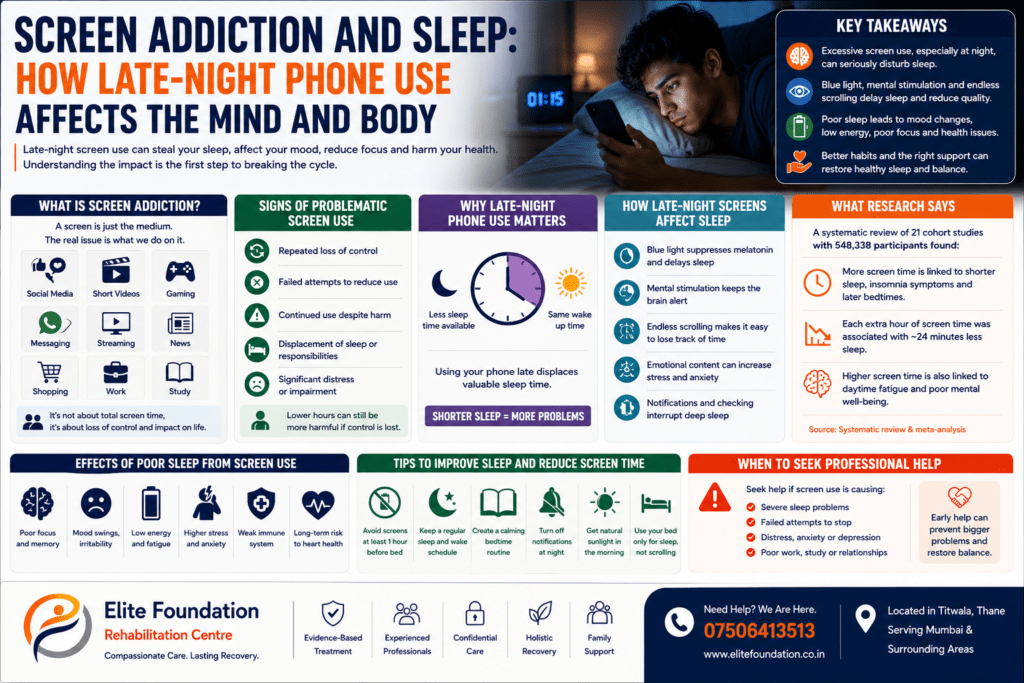
Screen addiction is a common phrase people use when phones, social media, videos, gaming or other digital activities become difficult to control and begin interfering with everyday life. Someone approaching a nasha mukti kendra may sometimes be worried about a behavioural rather than substance-related problem. When late-night scrolling or repeated phone checking is regularly interfering with sleep, mobile phone addiction treatment should look at the specific digital behaviour, the person’s ability to control it, sleep timing, daytime functioning and any other sleep or mental-health problem occurring alongside it.
Sleep is often where problematic screen use becomes easiest to notice.
A person may intend to check one message before bed and still be scrolling 45 minutes later.
Someone else may wake during the night, pick up the phone to check the time and then move into messages, news, Reels or Shorts.
Another person may put the phone away on time but still be unable to sleep because anxiety, insomnia or another health problem is present.
That is why the relationship between screens and sleep needs more care than the simple statement:
“Phones cause insomnia.”
Late-night screen use can interfere with sleep in several ways, but not every person who uses a phone before bed has a sleep disorder, and not every sleep problem is caused by screen time.
What does screen addiction actually mean?
“Screen addiction” is a widely used public term rather than one standalone medical diagnosis.
A screen is simply the medium.
What a person is actually doing might involve:
- Social media
- Short-form videos
- Gaming
- Messaging
- Streaming
- News
- Shopping
- Work
- Study
These activities do not all have the same psychological meaning or clinical status.
A useful assessment therefore asks what happens on the screen rather than diagnosing someone from total screen hours alone.
Screen time alone does not diagnose an addiction
Someone may spend many hours using screens because their job involves a computer.
A student may spend several hours online for classes and assignments.
Another person may use a phone for fewer total hours but repeatedly find that recreational scrolling continues past bedtime despite serious attempts to stop.
The third pattern may be more clinically relevant even though the total screen-time number is lower.
Concern increases when there is:
- Repeated loss of control
- Failed attempts to reduce use
- Continued use despite recognised harm
- Displacement of sleep or responsibilities
- Significant distress or impairment
Why late-night phone use matters
Night-time phone use occurs at a particularly important point in the day.
There are only so many hours available before the person needs to wake again.
If someone must wake at 6:30 a.m. but recreational screen use moves bedtime from 11 p.m. to 1 a.m., the morning obligation usually does not move two hours later to compensate.
The available sleep period has simply become shorter.
This is one of the most straightforward ways in which a phone can interfere with sleep: it can displace time that would otherwise have been available for sleeping.
What does research say about screen time and sleep?
A systematic review and meta-analysis of 21 cohort studies involving 548,338 participants examined screen time and several sleep outcomes.
Across the included studies, greater screen time was associated with shorter total sleep duration, a higher likelihood of short sleep, later bedtimes, insomnia symptoms and difficulty initiating sleep.
For studies reporting sleep duration continuously, each additional hour of daily screen time was associated on average with approximately three to five fewer minutes of sleep. The analysis also estimated a later bedtime with increasing screen time.
These findings should still be interpreted as associations rather than proof that every additional hour of screen exposure directly causes the same amount of sleep loss in every person.
The included studies differed in populations, screen behaviours, measurements and sleep outcomes.
Phone before bed effects are not explained by one mechanism
When people search for the effects of using a phone before bed, the answer is often reduced to blue light.
That is incomplete.
Several mechanisms can matter:
- Time displacement
- Psychological arousal
- Notifications
- Repeated checking
- Engaging or distressing content
- Light exposure
- Established bedtime habits
The relative importance of each factor can differ between people.
1. The phone can simply keep you awake longer
This is sometimes called time displacement.
You planned to sleep.
Instead, you spend that time:
- Watching Reels
- Replying to messages
- Gaming
- Watching one more episode
- Reading news
Nothing complicated needs to happen neurologically for sleep to be reduced.
If the phone occupies 45 minutes that had been available for sleep, bedtime has been delayed by 45 minutes unless something else in the schedule changes.
2. Some content can make it harder to mentally settle
Not all screen activity is equally calming.
Imagine the difference between:
- Reading a neutral article
- Arguing with someone online
- Watching a tense sporting event
- Doomscrolling through frightening news
- Playing a highly competitive game
All involve a screen.
But the emotional and cognitive arousal can be very different.
This is one reason why “screen time” alone can be a crude measure.
3. Notifications can interrupt the attempt to sleep
A phone beside the bed can:
- Vibrate
- Light up
- Make a sound
- Display a preview
Even when the person does not intend to use the device, an alert can create another decision:
“Should I check that?”
Once the phone is unlocked, the original notification may lead into another activity.
For example:
message → reply → check Instagram → open Reel → continue scrolling.
4. The habit can continue even without notifications
Some people automatically reach for the phone whenever they:
- Get into bed
- Wake during the night
- Cannot fall asleep immediately
- Feel bored
At that point, the bed itself may have become associated with checking the phone.
Turning off notifications can help, but it may not completely change a habit that is already strongly linked with bedtime.
5. Screen light may contribute, but “blue light is the whole problem” is too simple
Light is an important signal for the body’s circadian system, and short-wavelength light can influence melatonin and circadian timing under certain conditions.
However, the real-world sleep effect of screen light should not be reduced to a universal claim that any blue light from a phone will automatically cause insomnia.
A National Sleep Foundation expert consensus review of screen use and sleep concluded that screen use generally impairs sleep health among children and adolescents. For adults, the expert panel did not reach the same general consensus.
Importantly, the panel also did not reach consensus that the light from pre-sleep screen use independently impairs sleep across children, adolescents or adults.
This does not mean screen light can never matter.
It means the evidence does not support blaming every screen-related sleep problem on blue light alone.
Night mode does not make unlimited bedtime scrolling harmless
Reducing screen brightness or using a warmer night display may reduce some light exposure.
But night mode does not:
- Give back the time spent scrolling
- Stop notifications
- Make upsetting content calming
- Prevent “one more video” from becoming another hour
If the main problem is bedtime displacement, changing the colour of the screen cannot solve the whole problem.
Phone addiction and sleep can reinforce each other
The direction of the relationship may work both ways.
Someone may sleep poorly because they continue using their phone late at night.
But someone who already has insomnia may also spend more time on the phone because they are awake.
The cycle can become:
cannot sleep → pick up phone → become more engaged → stay awake longer → use phone again.
This is why a person with persistent insomnia should not automatically assume that eliminating the phone will solve every sleep problem.
Late-night scrolling can turn five minutes into an hour
Short-form feeds are particularly good at removing natural stopping points.
One Reel ends and another begins.
One Short is followed immediately by another.
The person does not make one clear decision:
“I am going to stay awake for the next hour.”
They make dozens of much smaller decisions:
“One more.”
The article on mobile phone addiction, sleep, focus and relationships explains how repeated checking can become problematic even when the phone is necessary for ordinary daily life.
Night scrolling and bedtime procrastination
Bedtime procrastination describes delaying going to bed without an external reason that makes the delay unavoidable.
A person may know they need sleep and still continue:
- Scrolling
- Streaming
- Gaming
- Messaging
This does not automatically mean addiction.
Sometimes people postpone bedtime because late evening feels like the only period they control after a demanding day.
Other times, the digital activity itself becomes difficult to stop.
Understanding which pattern is occurring matters more than simply telling the person to “use less screen time”.
What is sleep debt?
Sleep debt is a useful way of describing accumulated sleep loss when someone repeatedly gets less sleep than their body requires.
Imagine someone who repeatedly loses an hour of available sleep because they stay on their phone late at night.
That lost sleep does not necessarily disappear from its effects simply because the person becomes accustomed to feeling tired.
Over several days they may notice:
- Sleepiness
- Difficulty waking
- Reduced alertness
- More dependence on weekend catch-up sleep
However, individual sleep needs vary, so sleep debt should not be calculated from one universal number that applies identically to everybody.
India’s Economic Survey specifically discusses “sleep debt” and digital overuse
The Economic Survey 2025–26 discussion of digital addiction explicitly links digital overuse with concerns around distraction, “sleep debt”, reduced focus, academic performance and workplace productivity.
The Survey also discusses government measures relating to healthier technology use among children, including school guidance, screen-time guidance and specialised services such as NIMHANS’s Service for Healthy Use of Technology.
This is important because the problem is being considered not only as a matter of entertainment time but also in relation to sleep, learning and everyday functioning.
At the same time, a public-policy discussion of digital addiction should not be interpreted as a clinical diagnosis for every person who stays on their phone late at night.
How sleep loss can affect the mind the next day
When someone repeatedly sleeps less than they need, they may notice:
- Daytime sleepiness
- Difficulty sustaining attention
- Slower thinking
- Irritability
- Reduced motivation
- Difficulty concentrating on study or work
These effects are consequences of inadequate or disturbed sleep generally.
If late-night phone use is the reason sleep is being shortened, reducing that behaviour may help protect the available sleep period.
But these symptoms can also have many other causes and should not automatically be attributed to screen time.
Screen time and concentration: separate sleep loss from direct screen effects
This distinction improves the discussion considerably.
Suppose someone stays awake scrolling until 2 a.m. and must wake at 6:30 a.m.
The next day they cannot concentrate.
Part of that problem may be the resulting sleep restriction.
It would be too simplistic to say:
“The screen permanently damaged their attention span.”
A more immediate explanation may be that they are tired.
Phone use can also fragment attention before bedtime
The problem is not always continuous screen time.
A person trying to read or prepare for sleep may repeatedly:
- Check a message
- Return to what they were doing
- Check another alert
- Open social media
- Return again
This creates repeated switching between activities.
The detailed article on how to reduce phone addiction covers notification control, app friction, physical distance from the phone and other ways to reduce automatic checking.
How late-night phone use can affect the body
The most direct bodily consequence for many people is not mysterious neurological damage.
It is insufficient or poorly timed sleep.
A person who repeatedly loses sleep may experience:
- Fatigue
- Daytime sleepiness
- Difficulty waking
- Reduced physical energy
- Changes in appetite or routine
Chronic sleep deficiency is also associated with wider health risks, but an individual article about phone use should not imply that a device alone directly caused a particular disease.
Morning consequences may reveal the real problem
Instead of asking only:
“How late were you on your phone?”
look at what happens the next day.
Repeated signs can include:
- Sleeping through alarms
- Missing breakfast
- Arriving late
- Falling asleep during the day
- Difficulty concentrating
- Needing long weekend lie-ins
If the same late-night phone pattern repeatedly produces morning impairment, it is more clinically meaningful than one unusual night.
Late-night phone use in teenagers
Teenagers deserve particular attention because sleep, school schedules, friendships and digital communication often interact.
A teenager may stay awake because:
- Friends are still online
- A group chat is active
- Gaming continues
- Reels or Shorts have no obvious endpoint
- They are anxious about missing messages
The issue should not automatically be framed as disobedience or addiction.
The parent-focused article on phone addiction in teenagers explains why parents should look at control, sleep, school functioning and wider behaviour rather than relying on screen hours alone.
Children and adolescents appear particularly relevant in the sleep evidence
The National Sleep Foundation expert panel reached consensus that, in general, screen use impairs sleep health in children and adolescents.
The same level of consensus was not reached for adults.
This distinction matters because findings from adolescent populations should not automatically be rewritten as universal effects applying identically across all ages.
Adults can still have very real bedtime phone problems
Lack of universal consensus does not mean adults are immune to problematic night-time use.
An adult may repeatedly:
- Reply to work messages in bed
- Scroll after intending to sleep
- Wake and check notifications
- Doomscroll news
- Watch videos until the early morning
The relevant question is whether that behaviour is shortening or disrupting sleep in that individual.
Work messages can create a different sleep problem from entertainment
Not all bedtime phone use is recreational.
Someone may be checking:
- Work chats
- Client messages
- International team communication
The problem may therefore involve work boundaries rather than screen addiction.
If a person genuinely cannot disengage because their role requires night-time availability, the solution will be different from someone who is automatically scrolling entertainment feeds.
Doomscrolling at night
Doomscrolling refers more specifically to repeatedly consuming worrying, threatening or negative information.
At night, this can combine two problems:
- It postpones sleep.
- The content itself may increase worry or mental arousal.
The person may continue because they hope the next update will reduce uncertainty.
Instead, the next update may create another reason to keep checking.
Social media and sleep
Social media can interfere with sleep through several routes:
- Endless scrolling
- Short-form video
- Messages
- Social comparison
- Fear of missing out
- Notifications
But social media use and poor sleep can also influence each other.
Someone who cannot sleep may spend more time online simply because they are awake.
That bidirectional possibility should be remembered whenever research shows an association.
Gaming and sleep
A gaming session can also continue beyond bedtime because:
- A match is still in progress
- Friends want another round
- The player wants to recover rank
- An online event is running
The relevant question is whether the person can stop when sleep or another responsibility requires it.
Heavy gaming on one holiday night is very different from persistent inability to control gaming with significant impairment.
Streaming and “one more episode”
Streaming services create another version of bedtime displacement.
The behaviour may not involve repeated phone checking at all.
The person intends to watch one episode, but automatic continuation makes the next episode immediately available.
This is another reason “screen addiction” can be too broad as a diagnostic label.
The behaviour itself needs to be identified.
Does keeping the phone beside the bed matter?
For someone who repeatedly checks during the night, proximity matters practically.
A phone within arm’s reach requires almost no effort to access.
Moving it further away can create a small pause between:
urge → check.
That pause is not a medical treatment, but it can be useful behaviourally.
What if the phone is your alarm?
This is a common and reasonable objection.
Options include:
- Keeping the phone across the room
- Using a separate alarm clock
- Using sleep or focus settings that allow emergency contacts
The aim is not to create a rigid rule.
It is to make unplanned recreational use less automatic when that use is causing a problem.
Should you stop all screen use before bed?
There is no single universal rule that fits everybody.
A person whose phone use has no meaningful effect on sleep may not need the same intervention as someone who repeatedly loses two hours to scrolling.
If late-night screen use is clearly causing problems, a practical experiment is to protect a period before sleep from the specific activity that is difficult to control.
For example:
- No Reels once in bed
- No gaming after an agreed stopping time
- Work email closed after a set hour where feasible
- Phone charged away from the bed
How to stop using your phone late at night
1. Identify exactly what keeps you awake
“My phone” is too broad.
Is it:
- Instagram?
- YouTube?
- WhatsApp?
- Gaming?
- Work messages?
- News?
The more specific the behaviour, the easier it is to change.
2. Measure bedtime rather than only daily screen time
A daily screen-time report may show five hours.
For sleep, the more important detail may be that 90 minutes occurred after the person intended to go to bed.
Track:
- Intended bedtime
- Actual time the phone was put away
- Actual sleep period where known
- How you felt the next morning
3. Create a stopping cue
Endless feeds do not provide one naturally.
You may need to create your own:
- An alarm reminding you to finish
- A scheduled app limit
- A charging location outside immediate reach
- A fixed last gaming match
4. Reduce non-essential notifications
You do not need every:
- Like
- Recommended video
- Shopping alert
- News alert
to be able to wake the phone at night.
Keep emergency and genuinely necessary communication available according to your circumstances.
5. Do not begin the highest-risk activity once you are in bed
If Reels are the behaviour you repeatedly fail to stop, opening Reels after getting into bed creates the situation in which control usually fails.
Changing the starting point can be easier than trying to stop 45 minutes later.
6. Replace the final part of the evening
If scrolling normally occupies the last 30 minutes before sleep, simply removing it can create an empty period.
A replacement might include:
- Preparing for the next day
- Reading
- A quiet conversation
- Another low-arousal routine
The replacement does not need to be perfect or fashionable.
It needs to be something you can realistically repeat.
What if you put the phone away and still cannot sleep?
This is important.
If the phone is removed but significant sleep problems continue, the phone may not be the entire problem.
Other possibilities include:
- Insomnia
- Anxiety
- Depression
- Irregular sleep timing
- Substance use
- Medication effects
- Sleep-related medical conditions
Persistent sleep difficulty deserves appropriate assessment rather than repeatedly imposing stricter screen rules while ignoring another cause.
Do not use sleeping tablets simply to cancel out late-night phone use
Do not take borrowed medication, unprescribed sedatives or extra doses of prescribed medicines simply because recreational phone use is keeping you awake.
If a medicine is prescribed for sleep or another health condition, use it only as directed by the treating clinician.
The underlying behaviour still needs to be addressed.
Is screen addiction causing your sleep problem? A practical self-check
Ask:
- Do I repeatedly stay on my phone longer than I intend at night?
- Is my bedtime regularly delayed because of recreational screen use?
- Have I tried to reduce night-time use and repeatedly failed?
- Do I pick up the phone automatically when I wake?
- Does night-time use leave me tired the next day?
- Does the behaviour continue despite recognising the sleep consequences?
- Do I sleep better when this specific digital activity is reduced?
These questions do not diagnose an addiction or sleep disorder.
They help identify whether late-night digital behaviour may be contributing to the problem.
When should you consider professional help?
Professional assessment may be useful when:
- Repeated attempts to control late-night screen use fail
- Sleep is persistently inadequate
- School or work is being affected
- The person regularly misses important responsibilities
- Phone, social-media or gaming behaviour is difficult to control throughout the day as well
- Anxiety, depression or ADHD symptoms are present
- Significant insomnia continues even when screen use is reduced
The aim is to determine whether the main issue is problematic digital behaviour, a sleep disorder, another mental-health condition or a combination.
Screen addiction itself usually does not require medical detox
Stopping recreational phone, gaming or social-media use is not equivalent to stopping alcohol or certain sedative drugs.
Someone reducing a strong digital habit may feel:
- Bored
- Restless
- Irritable
- Strong urges to check
These experiences should not be confused with medically dangerous substance withdrawal.
When the sleep problem is part of something more urgent
Late-night screen use itself is usually not a medical emergency.
Urgent assessment is required when severe sleep loss occurs alongside:
- Suicidal intent or a suicide plan
- Serious self-harm
- Psychosis
- Dangerous aggression
- Several nights with almost no sleep together with markedly abnormal behaviour
- Another immediate psychiatric or medical danger
In these situations, the immediate safety problem takes priority over deciding whether the person’s phone use should be called screen addiction.
Frequently asked questions
What is screen addiction?
Screen addiction is a common public term for digital behaviour that becomes persistently difficult to control and causes meaningful problems. It is not one standalone diagnosis determined simply by the number of hours spent looking at screens.
Can screen time affect sleep?
Research consistently finds associations between greater or problematic screen use and poorer sleep outcomes. Late-night use can also directly displace time that would otherwise be available for sleep. However, the size and cause of the relationship vary across people and types of screen use.
What are the effects of using a phone before bed?
Phone use before bed can postpone bedtime, expose a person to notifications, encourage repeated checking and involve stimulating or distressing content. Screen light may also contribute under some circumstances, but blue light should not be treated as the only mechanism.
Does using a phone before bed cause insomnia?
Bedtime phone use is associated with poorer sleep in research, but an individual case of insomnia should not automatically be attributed to the phone. Insomnia can have several causes, and people who already cannot sleep may also use their phones more.
Does blue light from a phone stop you sleeping?
Short-wavelength light can affect circadian and melatonin-related processes under certain conditions, but the real-world relationship between phone use and sleep involves more than blue light. Time displacement, content, arousal and notifications can also matter.
Does night mode prevent sleep problems?
Night mode may alter the light emitted by the display, but it does not prevent a person from spending another hour scrolling or receiving engaging content. It therefore cannot solve every form of screen-related sleep disruption.
What is sleep debt?
Sleep debt is a term used to describe accumulated sleep loss when someone repeatedly gets less sleep than they need. Individual sleep needs vary, so it should not be treated as one universal number for everybody.
Can late-night phone use cause sleep debt?
It can contribute when phone use repeatedly delays bedtime while the required waking time stays unchanged. Other causes of insufficient sleep are also possible.
Why do I keep scrolling even though I am tired?
Endless feeds provide few natural stopping points, and checking may also be tied to boredom, habit, stress or fear of missing out. The person can therefore continue through many small “one more” decisions despite intending to sleep.
Why do I check my phone when I wake at night?
The phone may be immediately accessible, and checking can become associated with waking, boredom or difficulty falling back asleep. Moving the device away from the bed can create more friction if this is a repeated problem.
Can phone addiction cause daytime tiredness?
If difficult-to-control phone use repeatedly reduces or disrupts sleep, daytime tiredness may follow. Fatigue also has many medical and psychological causes, so persistent symptoms should not automatically be blamed on the device.
Does screen time reduce concentration?
Repeated digital interruptions can fragment attention, and inadequate sleep can also impair concentration the following day. This does not automatically mean screens have permanently damaged a person’s attention span.
Can social media affect sleep?
Problematic or late-night social-media use can be associated with delayed bedtime and poorer sleep. The relationship may also be bidirectional because people who cannot sleep may spend more time online.
Can gaming affect sleep?
Gaming can reduce available sleep when sessions repeatedly continue beyond the intended bedtime. Heavy gaming on its own does not establish Gaming Disorder.
Is watching Netflix before bed screen addiction?
No. Watching streaming content before bed does not automatically indicate addiction. Concern increases when the person repeatedly cannot stop as intended and the behaviour is causing meaningful consequences.
How much screen time before bed is too much?
There is no universal number of minutes that diagnoses a problem. A useful question is whether screen use is regularly delaying sleep, causing next-day impairment or continuing despite repeated attempts to reduce it.
Should I stop using my phone one hour before bed?
A screen-free period before sleep can be a useful behavioural experiment for someone whose bedtime use is causing problems, but there is no single rule that must be applied identically to everyone. Target the behaviour that is actually disrupting sleep.
How can I stop using my phone at night?
Identify the app or behaviour causing the problem, create a stopping time, reduce non-essential notifications, keep the phone away from immediate reach and avoid starting the highest-risk activity once you are in bed.
Should I leave my phone outside the bedroom?
It can help some people who repeatedly check at night. Others may need the device for emergency contact or another legitimate reason. Keeping it across the room or restricting non-essential notifications may be a practical alternative.
Can reducing screen time improve sleep?
It may help when screen use is genuinely delaying or interrupting sleep. If significant sleep problems continue after screen use is reduced, other causes should be considered.
Is screen addiction the same as phone addiction?
No. Screen addiction is a broad public term, while problematic phone use refers specifically to smartphone behaviour. A person’s difficult screen activity may instead involve gaming, social media, streaming or another specific behaviour.
Does late-night phone use affect teenagers more?
Children and adolescents are particularly prominent in the evidence base, and expert consensus supports a negative effect of screen use on sleep health in these age groups. Findings should still be interpreted in relation to the specific teenager, behaviour and sleep pattern.
When should I see a professional about phone use and sleep?
Consider assessment when repeated attempts to reduce late-night use fail, sleep deprivation is persistent, daily functioning is deteriorating or significant insomnia continues even after screen habits change.
The problem is often not the screen itself, but what happens when the screen takes over the time meant for sleep
A phone beside the bed is not automatically harmful.
A person using a laptop in the evening does not automatically have screen addiction.
And one late night on social media does not establish a disorder.
The more useful pattern is much easier to recognise.
You intend to sleep, but keep scrolling.
You wake during the night and automatically check the phone.
You repeatedly lose sleep even though you know how tired you will be the next morning.
You promise to stop earlier and find yourself in exactly the same situation again.
At that point, screen time has stopped being merely a number.
It is interfering with an important biological need.
The solution is also usually more precise than “never use screens”.
Identify what actually keeps you awake. Protect the intended sleep period. Reduce unnecessary cues. Create a stopping point where the app provides none. Move the phone if proximity drives automatic checking. Address anxiety, insomnia or another condition when that is part of the picture.
Most importantly, do not reduce the entire problem to blue light or dopamine.
Late-night digital behaviour affects sleep through a mixture of time, habit, content, arousal, access and, in some circumstances, light exposure.
The most useful question is therefore:
“When I intend to sleep, can I actually stop—and if I cannot, what keeps the screen in my hand?”
Medical disclaimer: This article provides general educational information and does not replace individual medical, sleep, psychological or psychiatric assessment. Screen time alone does not establish an addiction or sleep disorder. Persistent insomnia, excessive daytime sleepiness or other ongoing sleep problems deserve appropriate assessment. Seek urgent professional care when severe sleep disturbance occurs alongside suicidal intent, serious self-harm, psychosis, dangerous behaviour or another immediate medical or psychiatric emergency.
