
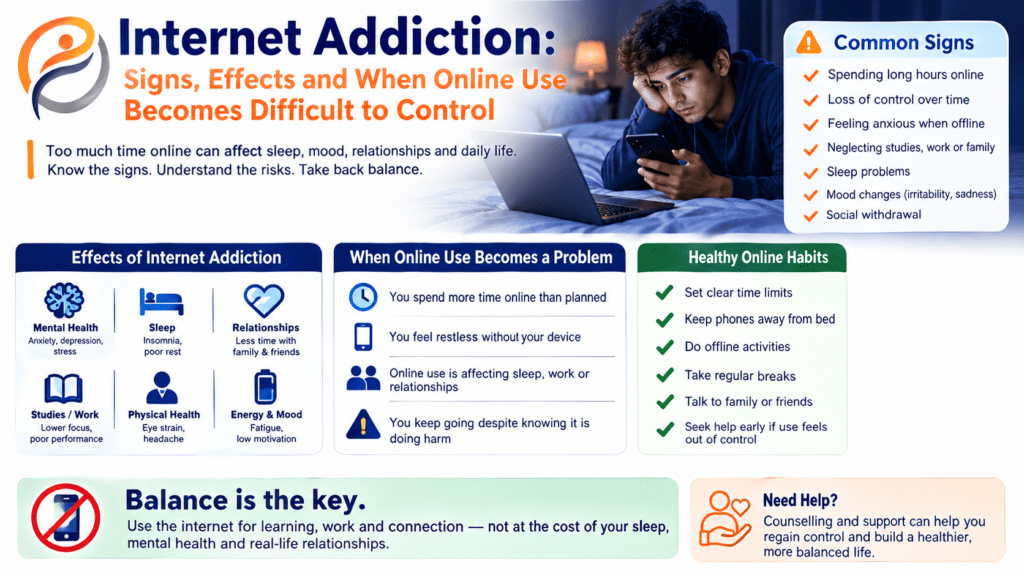
Internet addiction is a common term people use when being online becomes increasingly difficult to control and starts interfering with sleep, studies, work, relationships or everyday responsibilities. Someone approaching a rehabilitation centre in India may sometimes be concerned about a behavioural rather than substance-related problem. Where compulsive internet use mainly involves phones, social media or repeated online checking, mobile phone and social media addiction treatment should look beyond total screen hours to the behaviour involved, its triggers, consequences and any mental-health difficulty occurring alongside it.
That distinction matters because the internet is now part of ordinary life.
People use it for:
- Work
- Education
- Banking
- Communication
- Shopping
- Entertainment
- News
- Gaming
- Social media
Spending many hours online therefore does not automatically mean someone has an addiction.
The more important questions are whether the person can control their use, whether they repeatedly stay online longer than intended, what online behaviour is causing the difficulty and whether important parts of life are being displaced.
What is internet addiction?
Internet addiction is a widely used public and research term for internet use that becomes excessive, compulsive or difficult to regulate and begins producing meaningful problems.
Researchers also commonly use the term problematic internet use.
The problem may involve one dominant activity, such as social media or gaming.
But for some people the pattern is broader.
They may repeatedly move between:
- Social media
- Videos
- News
- Messaging
- Forums
- Shopping
- Gaming
- General browsing
When one activity becomes boring, another immediately replaces it.
The difficulty is no longer simply one particular application. Much of the person’s free time has become organised around being online.
Is internet addiction an official medical diagnosis?
This is where terminology needs to be precise.
General internet addiction is not currently a standalone disorder in the DSM-5-TR.
The American Psychiatric Association’s information on technology addiction notes that technology addictions are not currently included among the disorders identified in the DSM-5-TR.
Internet Gaming Disorder appears separately as a condition requiring further study, and its proposed criteria relate specifically to gaming rather than general internet use, social media or smartphones.
This means a person should not be told:
“You spend eight hours online, therefore you have Internet Addiction Disorder.”
No single number of hours can establish that diagnosis.
Problematic internet use is still clinically important
The absence of one standalone DSM-5-TR diagnosis does not mean that difficult-to-control internet use cannot cause genuine problems.
Someone may repeatedly:
- Fail to stop when intended
- Stay awake much later than planned
- Miss work or college
- Neglect assignments
- Withdraw from offline activities
- Experience relationship conflict
- Continue despite recognising these consequences
Those problems deserve assessment even when the terminology remains scientifically debated.
Internet addiction and digital addiction are not exactly the same phrase
The terms overlap substantially, but they can be useful in slightly different ways.
Digital addiction is an even broader public term that may include problematic use of phones, gaming, social media and other technologies.
Internet addiction focuses more specifically on online behaviour.
The existing guide to digital addiction in India explains the wider distinction between problematic smartphone use, social-media use and Gaming Disorder.
This article focuses on the person whose difficulty is spread across the online environment itself.
Heavy internet use versus problematic internet use
| Area | Heavy but controlled use | Potentially problematic use |
|---|---|---|
| Reason for being online | Work, study, communication or chosen recreation | Use increasingly feels automatic or difficult to resist |
| Stopping | Can stop when responsibilities require it | Repeatedly remains online much longer than intended |
| Sleep | Internet use can be put aside at bedtime | Online activity repeatedly delays sleep |
| Work or study | Online activity fits around responsibilities | Browsing or checking repeatedly interrupts important tasks |
| Offline life | Relationships and activities remain broadly intact | Important offline activities are increasingly displaced |
| Attempts to reduce use | Can usually change behaviour when needed | Serious attempts repeatedly fail |
Internet addiction symptoms
Possible internet addiction symptoms or signs of problematic internet use usually involve a pattern rather than one isolated behaviour.
Possible signs include:
- Repeatedly staying online longer than intended
- Difficulty stopping even when something important needs attention
- Repeated unsuccessful attempts to reduce recreational internet use
- Going online automatically whenever there is a spare moment
- Thinking frequently about what is happening online
- Moving constantly between websites or apps without a clear purpose
- Continuing to browse despite being exhausted
- Regularly delaying sleep
- Repeatedly interrupting work or study
- Using the internet throughout meals or face-to-face conversations
- Neglecting hobbies or offline activities
- Hiding or minimising the amount of recreational use
- Continuing despite recognised consequences
No single symptom establishes an addiction.
The combination of impaired control, persistence and functional consequences is more important.
Symptoms of excessive internet use are not the same as a diagnosis
Someone may occasionally:
- Stay online too late
- Spend an entire weekend watching videos
- Use social media more during a holiday
That does not automatically establish a persistent disorder.
The concern becomes stronger when the behaviour repeatedly overrides the person’s own intentions and begins interfering with important areas of life.
Why the internet can become difficult to leave
The internet does not have one natural endpoint.
One activity can immediately lead to another.
For example:
message → social media → video → news article → comments → another video.
The person may originally have intended to complete one small task.
Forty-five minutes later, they are still online but no longer doing what they originally picked up the device to do.
The internet provides almost unlimited next options
Traditional activities often contain stopping points.
A newspaper ends.
A television programme finishes.
A shop closes.
Online, however:
- A feed keeps refreshing
- Another video appears
- Another notification arrives
- Another article is recommended
- Another message becomes available
This does not mean the internet itself automatically causes addiction.
It means someone who already struggles with stopping can encounter very few natural reasons to stop.
Compulsive internet use can involve switching rather than one activity
This is an important difference from an article about one specific platform.
A person may delete Instagram and immediately begin spending more time on YouTube.
They may stop gaming but begin:
- Watching streams
- Reading online forums
- Checking news
- Shopping
The pattern suggests that the problem may involve a broader relationship with online stimulation, boredom or avoidance rather than one application alone.
Why people go online automatically
Internet use can become associated with ordinary situations.
Common cues include:
- Boredom
- Waiting
- Stress
- Anxiety
- Procrastination
- Bedtime
- Waking up
- A difficult task
- Feeling socially uncomfortable
With repetition, the behaviour can begin to feel increasingly automatic.
The person may unlock the phone or open the browser before consciously deciding what they want to do.
Boredom is not dangerous, but constant escape from boredom can become a habit
Modern internet access makes it possible to remove almost every empty moment.
A queue can become social media.
A lift journey can become messages.
A five-minute work break can become videos.
Bedtime can become browsing.
There is nothing inherently unhealthy about using the internet during spare time.
The issue arises when a person feels unable to tolerate even brief periods without going online and repeatedly returns despite wanting to do something else.
Internet use can become an escape from difficult tasks
A student opens a textbook.
The first chapter feels difficult.
They check one notification.
Twenty minutes later, they are browsing videos.
The internet did not necessarily create the original difficulty.
The difficult task may already have been:
- Boring
- Anxiety-provoking
- Confusing
- Overwhelming
Online activity simply provided an immediate alternative.
Procrastination and internet addiction can reinforce each other
The cycle can become:
difficult task → go online → temporary relief → task remains unfinished → more stress → return online again.
This is why simply blocking one website may not completely solve the problem.
If the original task or emotion is still difficult to manage, another online distraction may replace it.
Internet addiction and sleep
Late-night internet use is one of the most practical warning signs because sleep has a fixed place in the day.
A person may plan to sleep at 11:30 p.m.
Instead, they:
- Check a message.
- Open social media.
- Watch a video.
- Read comments.
- Open another website.
- Notice that it is now 1 a.m.
If they still need to wake at the same time, available sleep has been reduced.
Poor sleep can also lead to more internet use
The relationship can work in both directions.
A person with insomnia may use the internet more because they are already awake.
Someone who is anxious may stay online because being alone with their thoughts feels uncomfortable.
The cycle can become:
cannot sleep → browse → become more engaged → remain awake → browse again.
This is why persistent sleep problems should not automatically be blamed entirely on the internet.
Internet addiction and studies
Students are particularly likely to describe the problem as:
“I sit down to study but somehow end up online.”
Internet use may interfere with study in two main ways.
Time displacement
Two hours intended for revision become two hours of recreational browsing.
Attention fragmentation
The student remains at the desk but repeatedly:
- Checks messages
- Watches a short video
- Reads a notification
- Searches something unrelated
- Returns to the assignment
The study session exists on the clock but contains relatively little uninterrupted work.
Internet addiction effects on students
When online use becomes persistently difficult to control, students may experience:
- Assignments being delayed
- Reduced uninterrupted study time
- Late-night use and insufficient sleep
- Difficulty waking for classes
- Repeated academic procrastination
- Conflict with parents
- Reduced participation in other activities
However, poor academic performance should not automatically be attributed to internet use.
Other possible contributors include:
- ADHD
- Anxiety
- Depression
- Learning difficulties
- Bullying
- Poor sleep
- Academic pressure
Internet addiction in teenagers
Teenagers require particular care because a large part of education, friendship and entertainment now occurs online.
A teenager can genuinely need the internet for:
- Homework
- School groups
- Research
- Communication with friends
- Entertainment
Parents should therefore avoid diagnosing internet addiction simply from a router report or daily screen-time figure.
The more useful questions are:
- Can the teenager stop when needed?
- Is sleep repeatedly being sacrificed?
- Are school responsibilities being neglected?
- Have offline interests disappeared?
- Have serious attempts to reduce recreational use repeatedly failed?
The parent-focused guide on phone addiction in teenagers explains these warning signs in greater detail.
A teenager being online all day does not tell you what they are doing
One hour may involve:
- Homework
- Talking with a close friend
- Gaming
- Watching videos
- Scrolling social media
Those activities have different purposes and risks.
Before parents decide that “the internet” is the problem, they should identify the specific online activity that is consuming the teenager’s attention.
Internet addiction in adults
Adults can develop problematic internet-use patterns too.
The behaviour may look different from teenage use.
An adult may repeatedly:
- Browse during work
- Stay up late reading news
- Switch constantly between work and social media
- Spend long periods shopping online
- Use the internet whenever stressed
- Remain online during family time
Because adults often need the internet professionally, the line between necessary and recreational use can be especially difficult to see.
Work use and compulsive use can overlap
An employee may genuinely need to be online for eight hours.
The relevant question is what happens inside those eight hours.
For example:
necessary email → unrelated news → social media → video → back to work.
Repeated switching may create a different problem from simply having a screen-based occupation.
Internet addiction and relationships
Relationship problems can develop when online behaviour repeatedly displaces shared attention.
A partner may feel ignored because the other person:
- Checks the phone throughout meals
- Browses during conversations
- Stays online after going to bed
- Repeatedly says “one minute” and remains online much longer
Again, one incident does not establish addiction.
The concern is the persistent pattern.
Being physically present is not always the same as being available
Two people may be sitting beside each other while one repeatedly moves between online activities.
The issue is not necessarily the total number of internet hours.
It may be that online attention repeatedly interrupts moments that are meant to be shared.
Internet addiction and mental health
Problematic internet use frequently occurs alongside mental-health difficulties.
A 2025 meta-analysis examining internet addiction and adolescent mental health included 33 studies with 303,243 participants and an average participant age of approximately 14.6 years.
The review found associations between internet addiction or problematic internet use and several outcomes, including depression, anxiety, suicidal behaviour, lower psychological wellbeing and lower self-esteem.
Importantly, most of the included evidence was cross-sectional.
That means the results should not be simplified to:
“The internet causes depression.”
The direction of the relationship can be more complicated.
Internet addiction and depression
A person experiencing depression may:
- Have less motivation for offline activities
- Spend more time passively browsing
- Use the internet for distraction
- Withdraw from face-to-face interaction
At the same time, severe uncontrolled internet use can contribute to problems such as:
- Sleep disruption
- Social conflict
- Academic difficulties
- Reduced activity
Those consequences may add further distress.
Depression and problematic internet use therefore need to be assessed separately rather than assuming one simple cause.
Internet addiction and anxiety
Anxiety can also increase internet use.
Someone may repeatedly search online for reassurance about:
- Health
- Work
- Relationships
- News
- Messages
Checking may briefly reduce uncertainty.
But the relief may not last.
The person checks again.
If anxiety is maintaining the online behaviour, reducing internet access alone may not address the underlying problem.
Internet use can be a coping strategy
People may go online when they feel:
- Bored
- Lonely
- Anxious
- Depressed
- Stressed
- Overwhelmed
There is nothing abnormal about occasional distraction.
Concern increases when the internet becomes the person’s main response to almost every uncomfortable feeling.
Different online behaviours may need different assessment
Someone saying:
“I am addicted to the internet.”
may actually be describing:
- Gaming Disorder
- Problematic social-media use
- Problematic pornography use
- Online gambling
- Compulsive shopping
- Generalised browsing and checking
Those patterns should not automatically be treated as one identical condition.
Gaming deserves its own diagnostic distinction
Gaming Disorder is formally recognised in ICD-11.
General problematic internet use is not the same diagnosis.
Someone who spends almost all their problematic online time gaming may therefore need assessment focused specifically on gaming rather than being given the vague label “internet addiction”.
Online gambling is not simply excessive internet use
Likewise, someone who repeatedly risks money online may have a gambling problem.
The important clinical issue is not merely that gambling occurs through the internet.
It is the gambling behaviour itself, including impaired control, financial harm and chasing losses.
Problematic pornography use also requires separate assessment
Someone may spend relatively little total time online but have a specific compulsive pornography-use pattern.
That is different from a person who moves constantly between news, social media, video and general browsing throughout the day.
Again, the activity matters.
Online shopping can become difficult to control
Some people use online shopping repeatedly when:
- Bored
- Stressed
- Sad
- Seeking excitement
If spending becomes uncontrolled and produces debt or significant consequences, the financial behaviour deserves assessment in its own right.
The fact that it occurs online does not mean every problem should be placed under one internet-addiction label.
Internet addiction test: can an online test diagnose you?
Questionnaires can help people reflect on behaviours such as:
- Loss of control
- Preoccupation
- Functional consequences
- Failed attempts to reduce use
But no online internet addiction test should be treated as a standalone medical diagnosis.
Research uses different scales, definitions and thresholds.
A score cannot independently tell you:
- Why the person is online
- Whether another mental-health condition is driving the behaviour
- Which online activity is actually problematic
- Whether a formal disorder such as Gaming Disorder is present
A practical internet-use self-check
Ask yourself:
- Do I repeatedly stay online much longer than I intend?
- Have I seriously tried to reduce recreational internet use and repeatedly failed?
- Does being online regularly interfere with sleep?
- Does it repeatedly interrupt work or study?
- Have I lost interest in offline activities I previously valued?
- Do people close to me repeatedly complain that I am unavailable because I am online?
- Do I automatically go online whenever I feel bored, anxious or stressed?
- When I stop one app, do I immediately replace it with another online activity?
- Do I continue despite recognising meaningful consequences?
Several “yes” answers do not establish a diagnosis.
They suggest that the behaviour deserves closer examination.
Does irritability without internet mean addiction?
Not by itself.
Someone may become irritated because:
- An enjoyable activity was interrupted
- They were communicating with someone
- They need internet access for work
- An established habit has been disrupted
Restlessness or irritability can occur when highly habitual internet use is reduced.
These experiences should not be confused with medically dangerous withdrawal from alcohol or certain sedative drugs.
Internet addiction does not require medical detox
General problematic internet use does not involve a medical detoxification process comparable with alcohol, benzodiazepine or other medically significant substance withdrawal.
A person reducing a strong internet habit may experience:
- Boredom
- Restlessness
- Urges to check
- Irritability
The solution is usually behavioural and psychological rather than a substance-style detox.
What causes internet addiction?
There is no single cause.
A difficult pattern may involve a combination of:
- Easy access
- Habit learning
- Notifications
- Boredom
- Stress
- Social needs
- Anxiety
- Depression
- ADHD
- Sleep difficulties
- Offline problems the person wants to avoid
Different people can therefore arrive at similar patterns of excessive internet use for very different reasons.
ADHD and problematic internet use
People with ADHD may find highly stimulating online activities easier to remain engaged with than tasks requiring prolonged effort.
They may also experience difficulties with:
- Task initiation
- Sustained attention
- Time management
- Transitions between activities
This does not mean excessive internet use diagnoses ADHD.
It means persistent attention and organisation problems should not automatically be blamed on the internet.
Loneliness can also increase online time
For someone who feels socially isolated, the internet may provide:
- Friendship
- Community
- Conversation
- Shared interests
This can be genuinely valuable.
Reducing online time without considering where social connection will come from may make the person’s situation worse rather than better.
Online relationships are still relationships
A person should not automatically be described as socially isolated simply because some friendships exist online.
The more useful questions are:
- Are the relationships supportive?
- Is the person able to maintain other necessary parts of life?
- Has internet use displaced almost every offline activity?
Clinical assessment should distinguish online social connection from complete social withdrawal.
How to stop internet addiction
If internet use feels out of control, avoid beginning with the impossible instruction:
“I will stop using the internet.”
For most people, the internet is necessary.
Instead identify the specific behaviour you want to change.
For example:
“I repeatedly browse social media and videos from midnight until 2 a.m.”
Or:
“Every difficult work task turns into 30 minutes of unrelated browsing.”
Those descriptions provide a real target.
1. Separate necessary internet use from unwanted use
Create three categories:
- Necessary: work, study, banking, communication
- Intentional recreation: deliberately chosen entertainment
- Automatic unwanted use: browsing or checking you repeatedly wish you had not started
The third category is usually the most useful place to begin.
2. Identify the main trigger
Ask what usually happens immediately before uncontrolled internet use.
Common triggers include:
- Boredom
- Stress
- A difficult task
- Bedtime
- Loneliness
- Anxiety
- Notifications
The trigger tells you what the internet may be doing for you psychologically.
3. Protect one high-risk period
Do not try to redesign the entire day at once.
If the main problem occurs:
11:30 p.m. to 1:30 a.m.
start there.
If the main problem is during study:
protect one study period.
A specific boundary is easier to test than the vague goal “use the internet less”.
4. Reduce unnecessary cues
Possible changes include:
- Turning off non-essential notifications
- Logging out of distracting websites
- Removing shortcuts
- Keeping high-risk apps away from the first home screen
- Using website restrictions during selected periods
These steps create friction.
They do not cure an underlying problem by themselves.
5. Make the internet serve a purpose again
Before opening the browser or app, ask:
“What am I going online to do?”
Examples:
- Reply to one message
- Pay a bill
- Watch one chosen programme
- Research one topic
When that task ends, decide consciously whether you want to remain online.
6. Create natural stopping points
The internet often provides none.
You may need to create them.
For example:
- A fixed study block
- A selected number of videos
- A bedtime alarm
- A scheduled app limit
- A charging location away from the bed
7. Replace some of the online time
If four hours of recreational internet use are suddenly reduced, several hours become empty.
Without another activity, returning online is the easiest option.
Possible replacements might include:
- Exercise
- Reading
- Meeting someone
- Music
- Sport
- Cooking
- An offline hobby
- Sleep
The replacement should be something the person genuinely values.
8. Do not treat boredom as failure
If the internet has filled every spare moment, reducing use may initially create boredom.
That does not mean the plan is failing.
It may simply reveal how automatically the internet had been used whenever nothing else demanded attention.
9. Address anxiety, depression or another underlying problem
If uncontrolled internet use repeatedly follows:
- Anxiety
- Low mood
- Loneliness
- ADHD-related task difficulty
- Insomnia
the underlying condition may need treatment in its own right.
Should you take a complete internet detox?
A temporary break from selected online activities can sometimes be useful.
It may help reveal:
- Which situations trigger checking
- Which apps are hardest to leave
- How often use is automatic
- Whether another online activity immediately replaces the one removed
But avoiding the entire internet is unrealistic for many people.
A temporary break also does not prove that the brain has been “reset”.
The longer-term question is whether control improves after ordinary access returns.
Reducing internet use is more useful than trying to “detox dopamine”
Dopamine is a normal neurotransmitter involved in motivation and learning.
It is not a toxin that can be removed from the brain by staying offline for a weekend.
If a digital break helps, the benefit is better explained by:
- Fewer cues
- Fewer interruptions
- Changed routines
- More offline activity
- Greater awareness of automatic behaviour
What does current research say about treatment?
A 2026 systematic review and meta-analysis of 125 studies on problematic digital-technology use examined psychological therapies, digital programmes, exercise-based interventions, medication studies and several other approaches.
For problematic internet use, psychological treatments showed significant benefit in the pooled analysis, and digital interventions also showed improvement.
Across the broader review, structured psychological interventions showed the most consistent overall evidence.
However, the authors also reported substantial heterogeneity and evidence of small-study effects in several areas. Treatment findings should therefore not be interpreted as proof that one programme works reliably for every person or every type of problematic internet use.
What treatment may involve
Depending on the person, treatment may include:
- Detailed assessment of internet behaviour
- Identifying the specific online activities involved
- Cognitive behavioural strategies
- Managing cues and triggers
- Improving sleep routines
- Rebuilding offline activities
- Family involvement when appropriate
- Treatment of anxiety, depression, ADHD or another co-occurring problem
- Monitoring progress over time
Treatment should not focus only on reducing hours
Imagine that someone reduces internet use from eight hours to five.
That may sound like progress.
But if those five hours still:
- Prevent sleep
- Interrupt every study session
- Cause repeated relationship conflict
the underlying problem may remain.
A useful outcome is greater control and improved functioning, not simply a lower screen-time number.
What if reducing internet use keeps failing?
Repeated failure is useful information.
Ask:
- Which activity returns first?
- What triggers it?
- What time of day is hardest?
- What emotion appears immediately beforehand?
- Does one online activity simply replace another?
The answers can help identify whether the problem is one specific digital behaviour or a broader problematic internet-use pattern.
Family support should not become constant surveillance
Families may understandably become frustrated.
But constantly checking:
- Browsing history
- Screen reports
- Messages
- Every website visited
can turn the internet into the centre of every family conflict.
Clear boundaries may be necessary, particularly for younger people, but they should focus on observable problems such as sleep, school responsibilities and agreed limits.
What families should avoid
Try to avoid:
- Calling every heavy internet user an addict
- Humiliating the person about screen use
- Assuming every mental-health problem was caused by the internet
- Destroying devices during arguments
- Making restrictions that cannot realistically be maintained
- Expecting permanent change after one internet-free weekend
When professional assessment may help
Consider professional assessment when internet use:
- Repeatedly feels impossible to control
- Continues despite serious attempts to reduce it
- Regularly prevents adequate sleep
- Contributes to school, college or work absence
- Is associated with substantial academic or occupational decline
- Has displaced most previous offline activities
- Causes persistent relationship conflict
- Occurs alongside significant anxiety or depression
- Appears connected with ADHD or another condition requiring assessment
- Repeatedly shifts from one problematic online behaviour to another
Does internet addiction require residential rehabilitation?
Not automatically.
Many people with problematic internet use may be supported through:
- Outpatient psychological treatment
- Changes in routine
- Family support
- Improved sleep
- Treatment of co-occurring mental-health difficulties
More intensive treatment may be considered when overall functioning has severely deteriorated, several psychiatric or behavioural problems occur together, or less intensive treatment has not been sufficient.
When the internet is not the urgent problem
Problematic internet use itself is usually not a medical emergency.
Urgent assessment is needed when the wider situation includes:
- Suicidal intent or a suicide plan
- A recent serious self-harm attempt
- Psychosis
- Dangerous aggression
- Severe depression with immediate safety concerns
- Several nights with almost no sleep together with markedly abnormal behaviour
- Severe neglect of food, fluids or personal safety
In those situations, the immediate medical or mental-health problem takes priority over deciding whether internet use should be labelled an addiction.
Frequently asked questions
What is internet addiction?
Internet addiction is a common term for internet use that becomes persistently difficult to control and causes meaningful problems with sleep, studies, work, relationships or everyday functioning. Researchers also commonly use the term problematic internet use.
Is internet addiction a recognised medical diagnosis?
General internet addiction is not currently a standalone DSM-5-TR diagnosis. Internet Gaming Disorder is separately listed as a condition requiring further study, while problematic internet use remains an active area of research.
What are the signs of internet addiction?
Possible signs include repeatedly staying online longer than intended, failed attempts to reduce use, automatic checking, neglect of responsibilities, delayed sleep and continuing despite recognised consequences.
What are internet addiction symptoms?
Symptoms people commonly report include loss of control, preoccupation with online activity, repeated difficulty stopping, sleep disruption, work or study interference and reduced involvement in offline activities.
What is problematic internet use?
Problematic internet use is a research term describing internet behaviour that becomes difficult to regulate and is associated with significant distress, impairment or negative consequences.
How many hours online means internet addiction?
There is no universal number of hours that diagnoses internet addiction. Purpose, control, timing and effect on everyday functioning are more informative than total internet time alone.
Is using the internet all day an addiction?
Not automatically. Someone may need the internet throughout the day for work or study. Concern increases when recreational use becomes difficult to control and repeatedly causes meaningful problems.
Can internet addiction affect sleep?
Yes. Difficult-to-control late-night internet use can postpone bedtime and reduce available sleep. However, people who already have insomnia may also spend more time online because they are awake.
Can internet addiction affect studies?
Uncontrolled internet use may displace study time or repeatedly interrupt concentration. Academic difficulties can also have other causes such as ADHD, anxiety, depression or learning problems.
Can internet addiction cause depression?
Problematic internet use and depression are associated in research, but association does not establish simple one-way causation. Depression may also contribute to increased online use.
Can internet addiction cause anxiety?
Problematic internet use and anxiety can occur together. Some people repeatedly go online for reassurance or distraction because they are already anxious, so the relationship can work in more than one direction.
Can ADHD contribute to excessive internet use?
ADHD can contribute to difficulties with sustained attention, task initiation and transitions away from highly engaging activities. Excessive internet use does not diagnose ADHD.
What causes internet addiction?
There is no single cause. Problematic internet use can involve habit, easy access, notifications, boredom, stress, loneliness, anxiety, depression, ADHD, sleep problems and other individual circumstances.
Is internet addiction the same as phone addiction?
No. Problematic phone use relates specifically to smartphone behaviour, while internet addiction is a broader public term covering online activity across phones, computers and other devices.
Is internet addiction the same as gaming addiction?
No. Gaming Disorder has a specific diagnostic framework in ICD-11. Someone whose internet problems occur mainly through gaming should be assessed for the gaming behaviour rather than assuming all problematic internet use is identical.
Can social media cause internet addiction?
Social media may be the main difficult-to-control online activity for some people. Others move between social media, videos, messaging, news and other online activities. The specific behaviour should be identified.
Can an internet addiction test diagnose me?
No online test should be treated as a standalone medical diagnosis. Questionnaires can help identify possible warning signs, but assessment requires context, functioning and the specific online activity involved.
Do people experience withdrawal from internet addiction?
Some people report boredom, irritability, restlessness or strong urges to check when reducing a habitual internet-use pattern. These experiences are not equivalent to medically dangerous alcohol or sedative withdrawal.
Do I need detox for internet addiction?
No substance-style medical detoxification is required simply to reduce internet use. Psychological and behavioural approaches may be useful when control repeatedly fails.
How can I stop internet addiction?
Identify the specific unwanted online behaviour, understand its triggers, protect high-risk periods, reduce unnecessary cues, build offline alternatives and address mental-health or sleep problems that may be maintaining the pattern.
How can I reduce internet usage?
Separate necessary internet use from automatic recreational use, turn off unnecessary notifications, create selected internet-free periods, use stopping cues and plan alternative activities for high-risk times.
Should I completely stop using the internet?
For most people that is neither necessary nor practical. The more useful goal is usually to regain control over the specific online behaviour that is causing problems.
Can therapy help internet addiction?
Research suggests structured psychological treatments can help problematic internet use, but the evidence base is heterogeneous and treatment should be individualised rather than presented as one guaranteed programme.
When should I seek professional help?
Consider professional assessment when repeated attempts to control internet use fail and the behaviour is substantially affecting sleep, education, employment, relationships, mental health or ordinary daily functioning.
The real question is not how much internet you use, but whether you still control how you use it
The internet is now woven into ordinary life.
We work through it.
We study through it.
We communicate, pay bills, watch entertainment and maintain friendships through it.
That makes “just stop using the internet” an unrealistic response to most problems.
It also makes screen hours alone a poor way to decide whether someone has an addiction.
The more useful pattern is different.
You intend to be online for ten minutes and remain there for an hour.
You begin one task and repeatedly drift into unrelated browsing.
You stay online even though you know you need sleep.
You remove one application and immediately replace it with another.
You repeatedly promise yourself that tomorrow will be different, but the same pattern returns.
Those experiences point towards loss of control rather than simply high internet exposure.
Even then, the next question should be:
“What exactly am I doing online?”
Gaming, gambling, pornography, social media, shopping and general browsing can involve different psychological mechanisms and different clinical considerations.
Internet addiction is therefore most useful as the beginning of an assessment, not the end of one.
The aim is not to make the internet the enemy.
It is to restore a situation in which online activity serves the person’s life instead of repeatedly overriding sleep, responsibilities, relationships and their own intention to stop.
Medical disclaimer: This article provides general educational information and does not replace individual psychological, psychiatric or medical assessment. Heavy internet use alone does not establish an addiction or mental-health diagnosis. Seek urgent professional assessment when concerns about internet use occur alongside suicidal intent, serious self-harm, psychosis, dangerous aggression, severe depression, prolonged inability to sleep with markedly abnormal behaviour or another immediate psychiatric or medical danger.
