
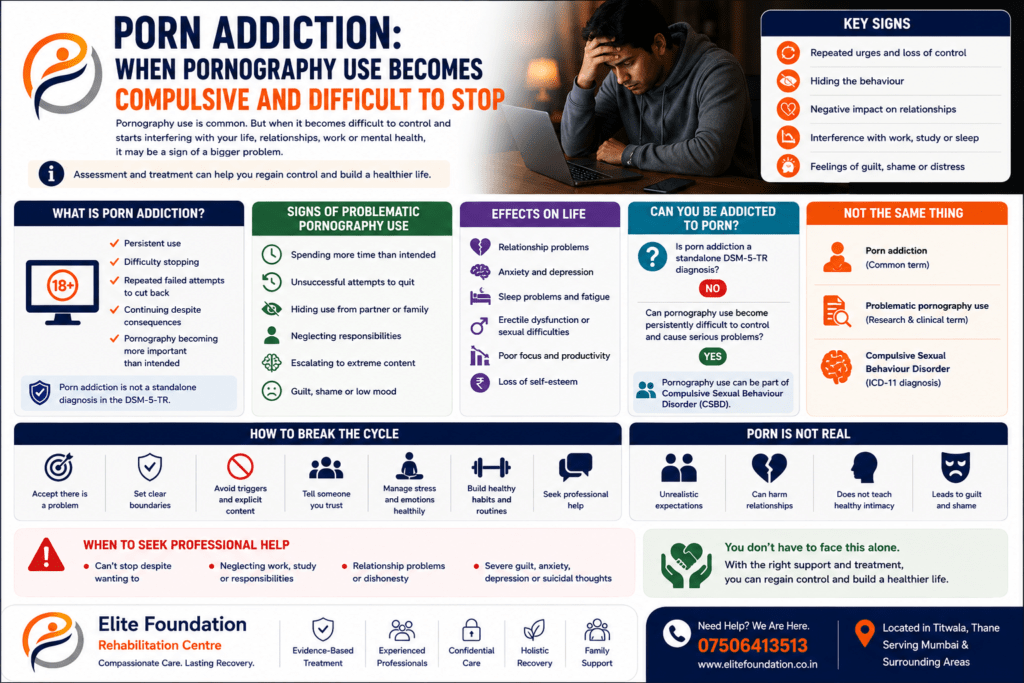
Porn addiction is a common term people use when pornography use becomes increasingly difficult to control and starts interfering with relationships, work, study, sleep or other parts of everyday life. Someone approaching a nasha mukti kendra in Thane may sometimes be worried about a behavioural rather than substance-related problem. Where pornography use is persistent, difficult to control and causing significant problems, porn addiction treatment in India should distinguish problematic pornography use from frequent but controlled use, moral distress and the broader diagnosis of Compulsive Sexual Behaviour Disorder.
This distinction matters because watching pornography frequently does not automatically mean someone has an addiction.
Two people may spend a similar amount of time viewing pornography while having very different experiences.
One may choose when to view it, stop when they intend to and experience no meaningful interference with everyday life.
Another may repeatedly decide to stop, return despite not wanting to, stay awake much later than intended, hide the behaviour from a partner or continue even when it is damaging important parts of life.
The second pattern deserves closer attention.
What is porn addiction?
“Porn addiction” and “pornography addiction” are widely used public terms.
They describe an experience many people recognise:
- Repeated urges to view pornography
- Difficulty stopping once viewing begins
- Repeated unsuccessful attempts to reduce use
- Continuing despite recognised consequences
- Feeling that pornography has become more important than intended
Clinically, however, the terminology is more complicated.
Porn addiction is not currently a standalone diagnosis in the DSM-5-TR.
Researchers and clinicians commonly use the term problematic pornography use, or PPU, when pornography use becomes dysregulated, difficult to control and associated with significant distress or impairment.
Pornography use may also occur as part of Compulsive Sexual Behaviour Disorder, a formally recognised diagnosis in the World Health Organization’s ICD-11.
Can you be addicted to porn?
The answer depends on what is meant by “addicted”.
If the question means:
“Is porn addiction a standalone DSM-5-TR diagnosis?”
No.
If the question means:
“Can pornography use become persistently difficult to control and cause serious problems in someone’s life?”
Yes.
Research describes clinically significant problematic pornography use, and pornography can be one behaviour involved in Compulsive Sexual Behaviour Disorder.
Whether all problematic pornography use should be conceptualised specifically as an addiction remains scientifically debated.
That is why it is better to assess the behaviour than to begin by forcing every person into the same label.
Porn addiction, problematic pornography use and CSBD are not identical terms
| Term | What it generally means |
|---|---|
| Porn addiction | A common public term for pornography use that feels compulsive or difficult to control |
| Problematic pornography use | A research and clinical term describing dysregulated pornography use associated with distress, impairment or repeated negative consequences |
| Compulsive Sexual Behaviour Disorder | An ICD-11 diagnosis involving persistent failure to control intense, repetitive sexual impulses or urges resulting in repetitive sexual behaviour and significant impairment |
A person can therefore report problematic pornography use without automatically meeting all requirements for CSBD.
Likewise, CSBD can involve sexual behaviours other than pornography.
What does ICD-11 say about Compulsive Sexual Behaviour Disorder?
The World Health Organization’s ICD-11 classification of Compulsive Sexual Behaviour Disorder describes a persistent pattern in which someone repeatedly fails to control intense sexual impulses or urges, resulting in repetitive sexual behaviour.
The pattern can involve:
- Repeated sexual behaviour becoming a central focus of life
- Neglect of health, personal care or other interests and responsibilities
- Repeated unsuccessful efforts to reduce the behaviour
- Continuing despite negative consequences
- Continuing despite deriving little or no satisfaction from the behaviour
The behaviour must cause marked distress or significant impairment in important areas of functioning.
The ICD-11 framework also expects a persistent pattern over an extended period rather than one isolated episode.
CSBD is classified as an impulse-control disorder, not an addictive disorder
This is an important technical distinction.
The WHO places Compulsive Sexual Behaviour Disorder within its group of impulse-control disorders.
That does not mean people cannot experience pornography use as addiction-like.
It means the official ICD-11 classification should not be rewritten simply because “porn addiction” is the phrase most people search online.
A 2026 interdisciplinary expert review of CSBD and problematic pornography use describes both constructs as important areas of clinical and scientific research while also highlighting continuing debate about conceptualisation, measurement and classification.
Frequent pornography use does not automatically mean addiction
Frequency is easy to count.
Control is harder to measure.
That is why people often ask:
“How many times a week is too much?”
There is no universal frequency that automatically diagnoses porn addiction, problematic pornography use or CSBD.
Instead, look at:
- Control
- Time spent
- Failed efforts to cut down
- Consequences
- Functional impairment
- Whether pornography repeatedly overrides the person’s own intentions
How much porn is too much?
There is no clinically valid answer such as:
“More than X minutes per day means addiction.”
The same amount of pornography use can have different meanings for different people.
A better question is:
“Is this behaviour under my control, and what is it doing to the rest of my life?”
Concern increases when pornography use repeatedly:
- Continues longer than intended
- Disrupts sleep
- Interferes with work or study
- Creates serious relationship conflict
- Replaces previously valued activities
- Continues despite repeated efforts to stop
Signs of porn addiction
Possible signs of porn addiction or problematic pornography use include:
- Repeatedly viewing pornography longer than intended
- Repeated failed attempts to reduce or stop
- Feeling unable to resist urges despite having decided not to view it
- Spending increasing amounts of time around the behaviour
- Regularly delaying sleep
- Viewing during work, study or other inappropriate times
- Neglecting responsibilities
- Hiding the extent of use
- Repeated relationship conflict connected with pornography
- Continuing despite recognising significant negative consequences
- Using pornography repeatedly as the main response to stress, loneliness, anxiety or boredom
- Returning rapidly to the same pattern after deciding to stop
No single sign establishes a diagnosis.
The overall pattern matters.
Porn addiction symptoms are about more than sexual desire
A strong sex drive is not the same thing as Compulsive Sexual Behaviour Disorder.
Someone may have frequent sexual thoughts or strong sexual interest while still remaining fully able to:
- Choose their behaviour
- Respect boundaries
- Meet responsibilities
- Stop when necessary
Clinical concern centres on persistent failure of control and significant consequences rather than the intensity of sexual interest alone.
Moral discomfort is not automatically Compulsive Sexual Behaviour Disorder
This is one of the most important safeguards in the ICD-11 framework.
Some people experience intense guilt about pornography because its use conflicts with:
- Religious beliefs
- Personal values
- Cultural expectations
- Relationship agreements
That distress can be genuine and important.
However, distress that comes entirely from moral judgement or disapproval of sexual thoughts, urges or behaviour is not sufficient by itself to diagnose CSBD.
Moral incongruence can feel like addiction even when the pattern is different
Moral incongruence means someone’s behaviour conflicts strongly with their personal values.
For example, one person may view pornography occasionally, remain able to stop whenever they choose and experience no functional impairment, but feel intense guilt afterwards.
Another may experience repeated loss of control, failed attempts to stop, work disruption and relationship harm.
Both people may say:
“I am addicted to porn.”
But their clinical needs may be different.
Assessment should therefore explore both behavioural dysregulation and the meaning the behaviour has for the person.
Problematic pornography use is not a moral diagnosis
Treatment should not be based on shaming a person for sexual thoughts or assuming that all pornography use represents illness.
The clinical questions are:
- Is there persistent loss of control?
- Are repeated attempts to reduce the behaviour failing?
- Is there significant distress that is not explained solely by moral disapproval?
- Is everyday functioning being affected?
Other conditions can sometimes resemble compulsive sexual behaviour
Loss of control over sexual behaviour should also be assessed in its wider medical and psychiatric context. A clinician may need to consider whether a sudden or unusual change in sexual behaviour is better explained by another mental-health condition, a medical condition, the effects of a prescribed medicine or substance use.
This is another reason why a diagnosis should not be made from pornography frequency, browser history or an online questionnaire alone.
Why can pornography use become difficult to stop?
There is rarely one explanation.
The behaviour may become connected with:
- Sexual arousal
- Boredom
- Stress
- Loneliness
- Anxiety
- Habit
- Procrastination
- Difficulty sleeping
- Avoidance of uncomfortable emotions
Repeated pairing between a situation and pornography use can make the behaviour increasingly automatic.
A person may eventually open a website or application before clearly deciding that this is what they want to do.
The compulsive pornography cycle
One possible pattern is:
trigger → urge → pornography use → short-term relief or absorption → regret or consequences → decision to stop → trigger appears again.
Not everybody follows this exact pattern.
But identifying the individual’s sequence can make the behaviour easier to understand.
Stress can become a trigger
Someone may initially use pornography occasionally for sexual interest.
Over time, they may also begin using it whenever they feel stressed.
For a short period, attention moves away from:
- Work pressure
- Financial worries
- Relationship conflict
- Anxiety
If the behaviour repeatedly becomes the default response to distress, reducing pornography use may require learning other ways to deal with the underlying emotion.
Boredom can become a powerful cue
A person may notice that they rarely intend to view pornography at the beginning of the day.
Instead, it begins when they are:
- Alone
- Waiting
- Unable to sleep
- Avoiding work
- Scrolling without a clear purpose
The behaviour can therefore be linked as much with an unstructured situation as with sexual desire.
Porn cravings do not necessarily mean substance-style addiction
People with problematic pornography use can report strong urges or cravings.
That experience is real.
But the presence of craving alone does not establish that pornography affects the body in the same way as alcohol, nicotine or another substance.
Behavioural patterns and substance dependence should not be treated as biologically identical simply because both can involve urges and loss of control.
Porn and dopamine: avoid the oversimplified explanation
Popular videos often explain pornography problems as:
“Porn creates too much dopamine and damages your brain.”
That explanation is too simplistic.
Dopamine is a normal neurotransmitter involved in motivation, learning and reward-related processes.
The presence of dopamine activity does not automatically make an activity addictive or harmful.
Problematic pornography use is better understood through the interaction of behaviour, learning, cues, emotions, individual vulnerabilities and social context rather than one simple “dopamine overload” explanation.
Do you need a dopamine detox to stop watching porn?
No medical procedure exists in which avoiding pornography removes excess dopamine from the brain.
Reducing pornography may still be useful if the behaviour has become difficult to control.
The benefit comes from changing routines and reducing cues, not from cleansing dopamine.
Effects of watching porn: frequency and problematic use should not be confused
Statements such as:
“Porn always destroys relationships.”
or:
“Watching porn always causes mental illness.”
are too broad.
Research outcomes vary according to the population, pattern of use, individual circumstances, relationship context and how problematic use is measured.
The clinically important question is whether pornography use is associated with actual distress, impaired control or meaningful problems in that person’s life.
Possible effects when pornography use becomes problematic
A difficult-to-control pattern may contribute to or occur alongside:
- Loss of time
- Delayed sleep
- Reduced concentration
- Work or study disruption
- Secrecy
- Relationship conflict
- Sexual concerns
- Guilt or shame
- Anxiety or low mood
- Withdrawal from other activities
These problems can also have other causes.
The presence of pornography use should not automatically be treated as proof that it caused every symptom.
Porn and relationships
Pornography can affect relationships differently.
For some couples, pornography is not a major source of conflict.
For others, difficulties may arise around:
- Secrecy
- Broken agreements
- Different expectations about pornography
- Time spent viewing it
- Reduced shared intimacy
- Repeated unsuccessful promises to stop
- Loss of trust
The relationship problem is therefore not always explained by the number of times pornography was viewed.
The context matters.
Secrecy can become more damaging than the person expects
A person may hide pornography use because they believe:
“If I can stop before my partner finds out, there is no reason to discuss it.”
But the cycle can become:
use → hide → promise privately to stop → use again → hide more.
When the behaviour is eventually discovered, the partner may be reacting not only to pornography but also to repeated secrecy.
Relationship boundaries are not identical for every couple
One couple may mutually agree that pornography use is acceptable.
Another may agree that it is not.
Clinical assessment should not impose one universal moral rule.
It should examine whether agreements were clear, whether behaviour was concealed and whether compulsive use is continuing despite meaningful consequences.
Pornography use and sexual health
People sometimes attribute every sexual difficulty to pornography.
Sexual functioning is more complicated than that.
Sexual concerns can be influenced by:
- Anxiety
- Relationship conflict
- Depression
- Medicines
- Physical health conditions
- Sleep
- Alcohol or drug use
- Sexual expectations
- Problematic pornography use
Persistent sexual difficulties deserve appropriate medical or psychological assessment rather than assuming pornography is automatically the sole cause.
Does porn cause erectile dysfunction?
It is not medically sound to assume that pornography automatically causes erectile dysfunction in every person who uses it.
Some people with problematic pornography use also report sexual-functioning concerns, but association does not prove a single cause.
Erectile dysfunction can have psychological, relationship, medication-related and physical causes.
Persistent symptoms should therefore be medically assessed rather than self-diagnosed as “porn-induced” without considering other possibilities.
Porn and mental health
Problematic pornography use can occur alongside:
- Anxiety
- Depression
- Loneliness
- ADHD
- Obsessive or compulsive symptoms
- Stress
Again, direction matters.
Someone may use pornography more because they are lonely or depressed.
The secrecy, sleep disruption or relationship conflict surrounding problematic use may then add further distress.
The relationship can therefore be bidirectional rather than simply:
pornography → mental illness.
Porn and anxiety
Anxiety may contribute to repeated pornography use when the behaviour provides temporary distraction or relief.
At the same time, someone who strongly regrets or hides their use may become increasingly anxious afterwards.
If anxiety is maintaining the behaviour, simply blocking websites may not address the whole problem.
Porn and depression
Depression can reduce motivation for work, exercise, relationships and other activities.
A highly accessible online behaviour may then become easier to engage with than more demanding activities.
Problematic pornography use and depression should therefore both be assessed rather than automatically deciding which one caused the other.
Porn and sleep
Sleep problems can develop when pornography use repeatedly continues beyond the intended bedtime.
The pattern might be:
“Just for a few minutes” → continued browsing → bedtime moves later → morning fatigue.
But sleep difficulties can also work in the opposite direction.
Someone who already cannot sleep may be more likely to reach for their phone or laptop.
Compulsive use can interfere with work or study without taking up the entire day
A person does not need to spend eight hours viewing pornography for it to interfere with productivity.
Repeated short sessions can interrupt:
- Study
- Remote work
- Assignments
- Sleep
- Concentration
Timing and loss of control may therefore matter as much as total duration.
Escalation is not a universal requirement
Some people report that their pornography use becomes more frequent, takes more time or involves repeatedly seeking novelty.
That experience should not be turned into a universal rule.
Someone does not need to show continuous escalation in order for pornography use to be problematic, and escalation alone does not diagnose CSBD.
Hiding browser history does not automatically prove addiction
People may keep sexual behaviour private for many reasons.
Privacy alone does not diagnose a disorder.
Concern increases when secrecy is part of a broader pattern involving:
- Repeated lying
- Broken relationship agreements
- Work or study interference
- Loss of control
- Repeated unsuccessful attempts to stop
Is porn addiction the same as sex addiction?
No single label should automatically replace the other.
Problematic pornography use may be the main behaviour causing difficulty for one person.
Another person may have a broader pattern of repetitive sexual behaviours consistent with CSBD.
A proper assessment identifies what the person is actually struggling to control rather than assuming every pornography problem represents the same condition.
Is porn addiction the same as digital addiction?
Not exactly.
Pornography is usually accessed digitally, but problematic pornography use has a sexual-behaviour component that distinguishes it from general smartphone checking or social-media use.
The broader guide on digital addiction in India explains how problematic phone, social-media and gaming behaviours differ from one another even when they occur on the same device.
Can you have problematic pornography use without watching every day?
Yes.
Daily frequency is not required for pornography use to create problems.
For example, someone might have intermittent episodes in which they repeatedly:
- Lose control of how long they spend
- Miss responsibilities
- Break important agreements
- Return despite having decided not to
The episodic pattern can still deserve assessment.
Can someone watch porn every day without being addicted?
Frequency alone cannot answer the question.
Daily use may be concerning in some contexts and not meet criteria for a disorder in others.
The clinically important questions remain control, impairment, consequences and persistence.
What is a porn addiction test?
Online questionnaires can sometimes help people reflect on:
- Loss of control
- Urges
- Time spent
- Consequences
- Attempts to cut down
But a score from an online porn addiction test should not be treated as a medical diagnosis by itself.
Different research tools use different definitions and thresholds.
Clinical assessment needs context.
A practical self-check
Ask yourself:
- Do I repeatedly use pornography longer than I intend?
- Have I made serious attempts to reduce use and repeatedly failed?
- Does pornography regularly interfere with sleep?
- Is it interfering with work or study?
- Am I concealing important aspects of the behaviour from my partner?
- Am I continuing even though I recognise meaningful harm?
- Has pornography displaced activities or relationships I value?
- Do I use it automatically whenever I feel stressed, bored or lonely?
Several “yes” answers do not independently establish a diagnosis.
They do suggest that the pattern deserves closer examination.
Are porn addiction withdrawal symptoms real?
People who stop a strongly established pornography habit may report experiences such as:
- Urges
- Restlessness
- Irritability
- Boredom
- Preoccupation
Research on withdrawal-like experiences in problematic pornography use is still developing.
These experiences should not be treated as equivalent to medically dangerous withdrawal from alcohol or certain sedative drugs.
Stopping pornography does not require a medical detoxification process comparable with alcohol or benzodiazepine withdrawal.
How to stop porn addiction
If pornography use feels difficult to control, begin with the specific behaviour rather than a vague promise.
Instead of:
“I will never watch porn again.”
first identify:
- When use usually occurs
- What device is involved
- What emotion or situation precedes it
- How long it usually lasts
- What consequence follows
A specific pattern is easier to change than an undefined label.
1. Identify the highest-risk situation
Examples might include:
- Late at night
- When home alone
- After relationship conflict
- During work breaks
- When anxious
- When unable to sleep
The aim is to understand where control is most likely to fail.
2. Reduce easy access during that period
Depending on the situation, this might include:
- Keeping a device away from the bed
- Using website restrictions
- Removing private browsing shortcuts
- Keeping work and recreational devices separate
- Avoiding unstructured screen time during the highest-risk period
Barriers can create a pause between the urge and the behaviour.
They are not a complete treatment by themselves.
3. Do not rely only on blocking software
If the underlying trigger is:
- Loneliness
- Anxiety
- Depression
- Relationship distress
- ADHD-related procrastination
a blocker may remove one route without addressing why the urge keeps appearing.
4. Plan what you will do when an urge appears
A useful plan is specific.
For example:
“If I feel the urge while working, I will leave the room for ten minutes and return to the task without taking my phone.”
This is more practical than relying on:
“I just need stronger willpower.”
5. Replace the time
If pornography use normally occupies an hour late at night, removing it creates an empty hour.
The replacement could be:
- Sleep
- Reading
- Exercise
- Conversation
- A hobby
- Structured work
The replacement should fit the trigger.
6. Track the pattern without obsessively counting
Useful information includes:
- Trigger
- Time
- Urge intensity
- Whether pornography was viewed
- What happened afterwards
The purpose is to understand behaviour, not create another source of shame.
7. Address the underlying mental-health problem when one is present
If pornography use repeatedly follows:
- Panic
- Depression
- Loneliness
- Trauma-related distress
- ADHD-related task avoidance
the co-occurring problem may need its own treatment.
Does quitting porn completely work better than moderation?
There is no single answer for everybody.
Some people may find a period of abstinence useful because controlled use repeatedly fails.
Others may work towards greater control and reduced problematic use.
The appropriate goal depends on:
- Severity
- Previous attempts to change
- Relationship agreements
- Personal values
- Triggers
- Whether controlled use is realistically sustainable
Do not make recovery a punishment
A recovery plan should not become:
“I watched porn, therefore I deserve shame.”
Shame may actually make honest assessment more difficult.
The useful questions are:
- What triggered the behaviour?
- What boundary failed?
- What needs to change next time?
Does psychotherapy help problematic pornography use?
A 2025 meta-analysis of psychotherapy for problematic pornography use included 20 studies with 2,021 participants. Most interventions involved cognitive behavioural therapy or acceptance and commitment therapy approaches.
Participants receiving psychotherapy showed greater improvement than comparison groups in problematic pornography use, sexual compulsivity and frequency or duration of pornography use.
These findings are promising, but they should not be presented as proof that one treatment works reliably for everybody. The authors identified important methodological limitations, including a high risk of bias in the available evidence, and called for more rigorous randomised controlled trials and more diverse study populations.
Assessment therefore remains important because people who describe themselves as “porn addicted” may have different patterns, triggers, co-occurring conditions and treatment needs.
What professional assessment should look at
Assessment may include:
- The pornography behaviour itself
- Loss of control
- Duration of the pattern
- Consequences
- Relationship context
- Moral or religious conflict
- Sexual health
- Anxiety and depression
- ADHD or other co-occurring conditions
- Sleep
- Other compulsive sexual behaviours
The broader article on understanding addiction treatment explains why treatment planning should begin with assessment rather than applying the same programme to every person.
Family and partner support should not become surveillance
Partners understandably want reassurance after repeated secrecy.
But recovery can become unhealthy if it turns into constant:
- Phone checking
- Interrogation
- Location monitoring
- Humiliation
Boundaries and transparency may be important, particularly where trust has been damaged, but they should be agreed and proportionate rather than used primarily as punishment.
The principles discussed in family support during addiction recovery are also relevant when families are trying to combine accountability with respectful communication.
What partners should avoid
Try to avoid:
- Assuming every sexual thought is evidence of addiction
- Using humiliation as treatment
- Making a diagnosis from browser history alone
- Assuming all relationship problems were caused by pornography
- Secretly giving medicines or supplements
- Expecting one promise to permanently change a long-established compulsive pattern
What the person struggling should avoid
Try to avoid:
- Making repeated promises without changing the conditions that trigger use
- Hiding setbacks until they become much larger
- Using alcohol or drugs to manage urges
- Stopping prescribed medication because of internet advice
- Replacing pornography with another uncontrolled digital behaviour
- Assuming a temporary “dopamine detox” has cured the problem
When pornography is not the most urgent issue
Problematic pornography use itself is usually not a medical emergency.
The wider situation requires urgent assessment when there is:
- Suicidal intent or a suicide plan
- A recent serious self-harm attempt
- Psychosis
- Dangerous aggression
- Inability to remain safe
- A risk of acting sexually without another person’s consent
- Another immediate psychiatric or medical danger
In these situations, immediate safety takes priority over deciding which label best describes the pornography behaviour.
Frequently asked questions
What is porn addiction?
Porn addiction is a common public term for pornography use that becomes persistently difficult to control and causes significant problems. Clinicians may instead use terms such as problematic pornography use or assess whether a broader pattern meets criteria for Compulsive Sexual Behaviour Disorder.
Is porn addiction a real diagnosis?
Porn addiction is not currently a standalone DSM-5-TR diagnosis. Problematic pornography use is recognised in research, and pornography can be one behaviour involved in ICD-11 Compulsive Sexual Behaviour Disorder.
Can you be addicted to porn?
Some people develop clinically significant, difficult-to-control pornography use. Whether every such pattern is best conceptualised specifically as an addiction remains debated, which is why assessment of control, consequences and impairment is more useful than relying on the label alone.
What are the signs of porn addiction?
Possible signs include repeated loss of control, failed attempts to cut down, pornography interfering with sleep, work or relationships, hiding the extent of use and continuing despite significant negative consequences.
What is problematic pornography use?
Problematic pornography use is a research and clinical term for pornography use that is difficult to regulate and associated with distress, impairment or repeated negative consequences.
What is Compulsive Sexual Behaviour Disorder?
Compulsive Sexual Behaviour Disorder is an ICD-11 impulse-control disorder involving persistent failure to control intense repetitive sexual impulses or urges resulting in repetitive sexual behaviour and significant impairment.
Is watching porn every day an addiction?
Not automatically. Frequency alone does not diagnose problematic pornography use or CSBD. Control, persistence, consequences and functional impairment are more informative.
How much porn is too much?
There is no universal amount that independently diagnoses addiction. Pornography use becomes more concerning when it repeatedly overrides intention or interferes with sleep, work, study, relationships or other important areas of life.
Can porn addiction affect relationships?
Problematic pornography use can contribute to relationship difficulties, particularly where there is secrecy, broken agreements, loss of trust or persistent loss of control. Pornography does not affect every relationship in the same way.
Does porn cause erectile dysfunction?
It should not be assumed to be the sole cause. Erectile dysfunction has many possible physical and psychological causes. Persistent symptoms deserve appropriate medical assessment.
Can porn affect mental health?
Problematic pornography use can occur alongside anxiety, depression, loneliness and other mental-health concerns. These relationships can work in more than one direction, so causation should not be assumed from pornography use alone.
Can anxiety cause compulsive porn use?
Anxiety can become a trigger when pornography is repeatedly used for temporary distraction or relief. Treating the underlying anxiety may therefore be important for some people.
Can depression contribute to porn addiction?
Depression may contribute to greater use when other activities feel difficult or unrewarding. Problematic pornography use can also create additional distress, so both patterns may need assessment.
Does porn addiction cause withdrawal?
Some people report urges, irritability, restlessness or boredom when stopping habitual pornography use. Research on withdrawal-like experiences remains developing, and these symptoms are not equivalent to dangerous alcohol or sedative withdrawal.
Do I need detox for porn addiction?
No medical detoxification process comparable with alcohol or sedative withdrawal is required simply to stop pornography use. Psychological or behavioural treatment may be useful when control repeatedly fails.
Does dopamine detox cure porn addiction?
No. There is no established treatment in which avoiding pornography resets or detoxifies dopamine. Behavioural changes may still help by reducing triggers and interrupting established routines.
How do I stop porn addiction?
Identify when and why the behaviour occurs, reduce access during high-risk periods, plan alternatives for urges, address underlying emotional triggers and seek professional assessment when repeated self-directed efforts fail.
Should I block porn websites?
Blocking tools can create useful friction, but they do not address every trigger. They work best as one part of a wider behaviour-change plan rather than the entire treatment.
Should I quit porn completely?
There is no single rule for every person. The appropriate goal depends on severity, previous attempts to control use, personal values, relationship agreements and whether moderation is realistically sustainable.
Can therapy help porn addiction?
Psychotherapy, including CBT- and ACT-based approaches, has shown promising benefit in research on problematic pornography use. However, the current evidence has important methodological limitations and a high risk of bias, so treatment findings should not be interpreted as proof that one approach works reliably for everybody.
Does feeling guilty about porn mean I have CSBD?
No. Distress based solely on moral judgement or disapproval is not sufficient for the ICD-11 diagnosis of Compulsive Sexual Behaviour Disorder. Persistent loss of control and significant impairment are central considerations.
Can religious beliefs affect how someone experiences porn addiction?
Yes. A conflict between pornography use and personal or religious values can produce significant distress and can influence whether someone describes themselves as addicted. That distress deserves respectful assessment without automatically assuming a compulsive disorder.
Can another condition cause a sudden change in sexual behaviour?
Sometimes. A clinician may need to consider whether an unusual change in sexual behaviour is better explained by another psychiatric or medical condition, prescribed medication or substance use rather than assuming CSBD from the behaviour alone.
Is porn addiction the same as sex addiction?
Not necessarily. Problematic pornography use may be the main difficulty for one person, while another may have a broader pattern of repetitive sexual behaviours. Clinical assessment should identify the actual pattern rather than treating the labels as interchangeable.
When should I seek professional help for compulsive pornography use?
Professional assessment may be useful when repeated attempts to regain control fail and pornography use is significantly affecting relationships, work, study, sleep, sexual health or mental health.
The issue is not whether someone watches pornography; it is whether they can control the behaviour
Pornography is a difficult topic because moral beliefs, relationships, sexuality, technology and mental health can all become mixed together.
That makes simplistic labels tempting.
Someone watches frequently, so they are called addicted.
Someone feels guilty, so they conclude their brain has been damaged.
A relationship is struggling, so pornography is blamed for every difficulty.
None of those conclusions should be automatic.
The more useful questions are:
Can the person control the behaviour?
Have serious attempts to reduce it repeatedly failed?
Is pornography taking priority over sleep, work, relationships or other important activities?
Does use continue despite meaningful consequences?
Is the distress coming from behavioural loss of control, moral conflict, or both?
Those questions distinguish clinically meaningful problematic pornography use from frequency alone.
They also explain why the terminology matters.
“Porn addiction” is the phrase many people understandably use when they feel they have lost control.
Clinical assessment can then determine whether the better description is problematic pornography use, Compulsive Sexual Behaviour Disorder, another mental-health or medical difficulty, a medication or substance-related effect, or a conflict between behaviour and personal values.
The goal is not to minimise a genuinely compulsive problem.
It is to describe it accurately enough that the person receives the right kind of help rather than more shame, internet myths or an incorrect diagnosis.
Medical disclaimer: This article provides general educational information and does not replace individual psychiatric, psychological, sexual-health or medical assessment. Frequent pornography use alone does not establish an addiction or Compulsive Sexual Behaviour Disorder. Seek urgent professional assessment when concerns occur alongside suicidal intent, serious self-harm, psychosis, inability to remain safe, risk of non-consensual sexual behaviour or another immediate psychiatric or medical danger.
