
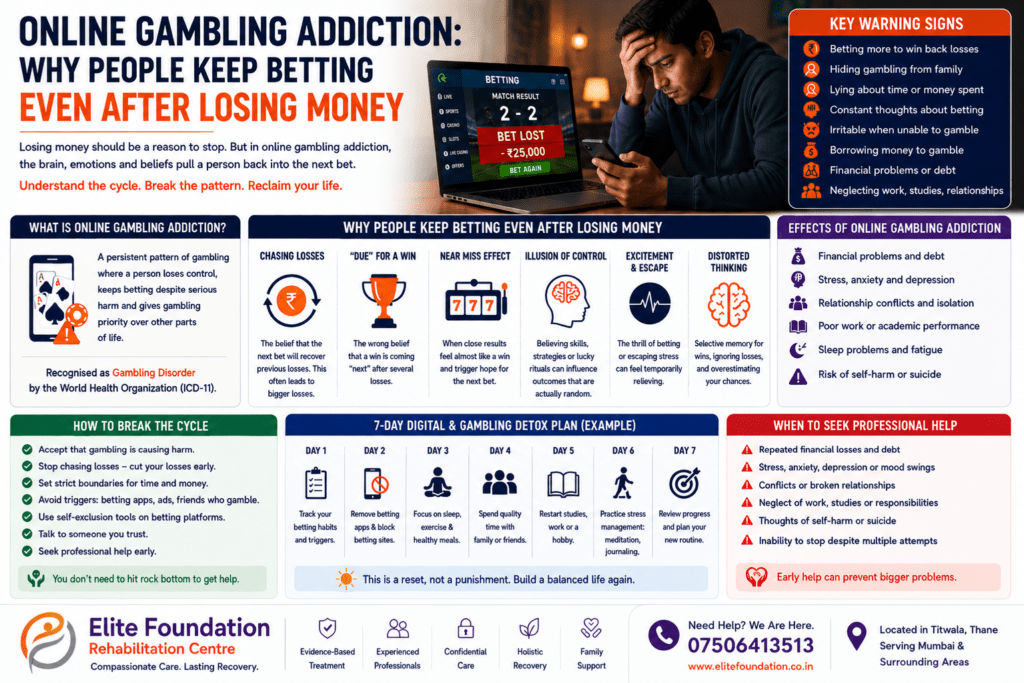
Online gambling addiction can begin with entertainment, curiosity or the hope of winning money, but the pattern can change when betting becomes difficult to control and losses create pressure to keep gambling rather than stop. Families approaching a nasha mukti kendra nearby may sometimes be dealing with a behavioural rather than substance-related addiction. Where repeated betting, hidden losses, borrowing or mounting debt are present, gambling addiction treatment in Mumbai should assess both the gambling behaviour and the financial, psychological and family consequences surrounding it.
One of the hardest things for families to understand is why someone who has already lost a large amount of money would gamble again.
From the outside, stopping can appear obvious.
From inside the gambling cycle, another bet may begin to feel like the only way to repair the previous loss.
This is known as chasing losses, and it is one of the most important psychological patterns to understand in gambling problems.
The person may stop thinking:
“Should I gamble?”
and start thinking:
“How do I win my money back?”
That change can turn gambling from recreation into an increasingly dangerous attempt to solve a financial problem created by gambling itself.
What is gambling addiction?
Gambling addiction is a common public term for persistent gambling that becomes difficult to control and continues despite serious negative consequences.
The clinically recognised term is gambling disorder.
The World Health Organization describes gambling disorder through three central features:
- Impaired control over gambling
- Increasing priority given to gambling over other interests and everyday activities
- Continuation of gambling despite negative consequences
This means gambling disorder is not diagnosed simply because someone placed a bet, lost money or occasionally gambled more than intended.
The pattern and its effect on everyday life matter.
Online gambling addiction can involve more than casinos
When people hear the word gambling, they may imagine a physical casino.
Online gambling-related behaviour can instead involve:
- Sports betting
- Cricket betting
- Casino-style games
- Slots
- Card-based money games
- Roulette-style games
- Live dealer-style games
- Other online activities involving financial stakes and expected monetary winnings
The exact legal classification of an online product is a separate question from whether someone has developed gambling-related harm.
Gaming addiction and gambling addiction are not the same
This distinction has become especially important because the words “gaming” and “gambling” are often mixed together.
A person playing a conventional video game for entertainment may develop problematic gaming behaviour without betting money on uncertain financial outcomes.
A person with gambling disorder may repeatedly stake money even if they have little interest in ordinary video games.
The guide to gaming addiction and Gaming Disorder explains the clinically recognised gaming pattern in more detail.
Why do gamblers keep gambling after losing?
This is one of the most searched and misunderstood questions around gambling addiction.
There is rarely one reason.
Several psychological processes can combine:
- Chasing losses
- Believing a win is “due”
- Near misses
- Illusion of control
- Selective memory for wins
- Urgency to repair debt
- Stress and emotional escape
- Secrecy and shame
These processes can make stopping feel psychologically harder precisely when stopping would be financially safer.
Chasing losses: when another bet feels like the solution
Imagine someone deposits ₹5,000 and loses it.
At that point they can accept a ₹5,000 loss.
Instead, they think:
“If I put in another ₹5,000 and win, I can get back to zero.”
The second deposit is therefore no longer experienced simply as another gamble.
Psychologically, it may feel like a recovery attempt.
If that money is also lost, the pressure grows:
“Now I need to recover ₹10,000.”
Another deposit follows.
The financial target keeps moving further away.
Why chasing losses can accelerate quickly
Suppose someone begins the evening wanting to win ₹2,000.
After several losses, their goal changes completely.
| Stage | Possible thought |
|---|---|
| Before gambling | “Maybe I can make some money.” |
| After first loss | “I can recover this.” |
| After further losses | “I can’t stop now because I’ll lock in the loss.” |
| After serious losses | “One big win is the only way out.” |
At the final stage, continued gambling may feel less like recreation and more like emergency financial repair.
But gambling remains an uncertain activity.
The previous loss does not create a guarantee that the next bet will recover it.
The previous loss does not make the next win more likely
A dangerous thought can be:
“I’ve lost so many times that I must be due a win.”
Past losses do not automatically create an obligation for a future random outcome to compensate the player.
This misunderstanding is often related to what is commonly called the gambler’s fallacy.
A losing sequence can feel as though it must eventually be “balanced”, even when the outcome of the next event is not determined by how much the player previously lost.
What is the near-miss effect?
A near miss occurs when an unsuccessful outcome feels unusually close to success.
Examples might include:
- A slot-style result appearing almost to complete a winning combination
- A team losing a bet by one late goal
- A cricket result missing a prediction by a very small margin
- Several parts of a multi-event bet succeeding while one fails
The person has still lost.
Psychologically, however, the outcome may feel different from a complete failure.
It can feel like:
“I nearly had it.”
Near misses can encourage continued play
A systematic review of 51 experimental studies examining near misses and related gambling-machine effects found that near misses can increase motivation to continue playing, while their effects on emotion and betting behaviour varied between studies. Much of this evidence comes from experimental and electronic gaming-machine settings, so it should not be assumed to apply identically to every form of sports betting.
This is important because a near miss does not mean the player’s underlying chance of success has necessarily improved.
The player can experience psychological closeness without actually having achieved a financially better result.
“Almost winning” is still losing
This sounds obvious when written down.
During gambling, it can feel very different.
Suppose a person bets on several outcomes and all except one are correct.
They may think:
“My strategy is working. I was only one result away.”
That interpretation can increase confidence.
But financially, the wager may still have produced a loss.
What is the illusion of control in gambling?
The illusion of control occurs when someone believes their personal skill, knowledge or actions influence an outcome more than they actually do.
This can be particularly complicated in sports betting because genuine knowledge does exist.
A cricket fan may know:
- Player form
- Pitch conditions
- Team selection
- Previous results
- Weather
That knowledge can affect how informed a prediction is.
But information cannot remove uncertainty.
A knowledgeable person can still lose.
Cricket knowledge is not the same as control over the match
A bettor may think:
“I understand cricket better than most people, so I can consistently beat this.”
But unexpected events still occur:
- An injury
- A dropped catch
- A sudden collapse
- Weather
- A surprising individual performance
- A tactical decision
Expertise may influence a prediction.
It does not give the bettor control over what happens on the field.
Why wins can be remembered differently from losses
A dramatic win is emotionally memorable.
A person may clearly remember:
“I won ₹40,000 that night.”
But the total deposits made over the previous weeks may receive much less attention.
This can produce a distorted personal story:
“I’m good at betting.”
when the more useful approach is to review the complete financial position rather than remembering individual winning sessions.
Gross wins and actual profit are not the same
Consider a simple example where no money remains in the gambling account:
- Total deposited over several months: ₹3,00,000
- Total withdrawn: ₹2,20,000
- Remaining gambling-account balance: ₹0
The person may vividly remember several large winning withdrawals.
But in this simplified example, they have a net cash loss of ₹80,000.
Where money remains in gambling accounts, bets are still unsettled or other transactions are involved, the full financial position needs to be reviewed rather than calculated from deposits and withdrawals alone.
Looking only at individual wins can hide the overall financial direction of the behaviour.
Repeated deposits are an important warning sign
A gambling session may not begin with one huge financial decision.
It can involve many smaller decisions:
₹1,000 → ₹2,000 → another ₹2,000 → another ₹5,000.
Each additional deposit may feel manageable in isolation.
By the end of the session, however, the total can be far larger than the person originally intended to risk.
Deposit size can increase while gambling
After losses, someone may increase the amount because a small win no longer feels sufficient.
For example:
Loss = ₹20,000
A possible ₹500 win now feels irrelevant.
The person begins looking for an outcome large enough to repair the entire deficit.
This can encourage riskier bets and larger stakes.
Why people borrow money to gamble
Borrowing may initially be rationalised as temporary.
The thought can be:
“I just need enough money for one chance to recover the loss. Then I’ll repay everything.”
Borrowing can come from:
- Friends
- Family
- Credit cards
- Personal loans
- Salary advances
- Other credit sources
The borrowed money then becomes another financial obligation.
If it is gambled and lost, the person is dealing with both the original gambling loss and a new debt.
Debt can make gambling feel more urgent rather than less attractive
This is one of the cruelest parts of the cycle.
Logically, greater debt should create a reason to stop risking money.
Psychologically, greater debt can create pressure to find money quickly.
The person may think:
“My salary cannot clear this. I need a big win.”
Gambling then becomes imagined as the escape route from gambling debt.
There is no safe “recovery bet”
A person who has already lost money may begin searching for:
- A safer match
- A sure bet
- A guaranteed strategy
- A high-confidence prediction
- A final recovery opportunity
No uncertain wager becomes guaranteed simply because the money is urgently needed.
Financial pressure can change the emotional meaning of the bet without removing its risk.
Why gamblers hide losses
Secrecy often develops gradually.
At first, the person may hide a single bad session because they expect to recover the money before anybody notices.
Then another loss occurs.
The person may hide:
- Bank statements
- Loan messages
- Credit-card balances
- Borrowing
- Salary use
- Repeated deposits
The lie is sometimes maintained because the person still believes:
“Once I win it back, I can tell them nothing happened.”
Shame can make the problem harder to disclose
Someone may recognise that the gambling has become serious but still avoid telling anybody because they fear:
- Anger
- Judgement
- Relationship breakdown
- Being seen as irresponsible
- Having financial control taken away
The secrecy can then isolate the person from exactly the support they need.
Hiding gambling losses is itself clinically useful information
A person does not need to meet every feature of Gambling Disorder before secrecy matters.
Repeatedly hiding:
- How much was lost
- How often gambling occurs
- Where money came from
- How much debt exists
is a strong reason for the family to look more closely at the behaviour.
Online betting addiction can become a 24-hour problem
Traditional gambling often required travelling somewhere.
Online access changes that environment.
Betting activity may potentially occur from:
- A bedroom
- A workplace
- A train
- A college campus
- A bathroom
- A family gathering
The physical distance between an urge and the opportunity to gamble can become very small.
Speed matters
The faster someone can:
lose → deposit → bet again
the less time there may be for the emotional intensity of the loss to settle.
A slower environment naturally creates pauses.
An online environment can make another financial decision available almost immediately.
Betting during stress
Not everyone gambles primarily because they expect to become rich.
For some people, gambling also changes how they feel for a while.
They may gamble when:
- Stressed
- Lonely
- Angry
- Bored
- Depressed
- Worried
- Trying not to think about another problem
The intensity of a match, casino-style game or wager temporarily occupies attention.
Gambling can become emotional escape
Imagine someone under serious work pressure.
When they start betting, their attention shifts completely towards:
- The score
- The odds
- The next event
- The potential payout
For that period, the work problem disappears from immediate attention.
Unfortunately, if money is lost, the person may finish gambling with both the original stress and a new financial problem.
The emotional cycle can look like this
Stress → betting → temporary absorption → loss → more stress → betting again.
That does not mean everybody who gambles during stress has Gambling Disorder.
It does mean that emotional triggers deserve attention when gambling repeatedly becomes the main coping strategy.
Cricket betting addiction
Cricket betting can become particularly emotionally engaging because the person may already care deeply about the sport.
A match provides repeated events:
- Toss
- Runs
- Wickets
- Overs
- Player performance
- Match result
This can create repeated opportunities for prediction and financial involvement.
The important distinction is between enjoying cricket and becoming unable to control betting around cricket.
Watching sport can become linked with the urge to bet
If someone repeatedly combines cricket with betting, the match itself can eventually become a cue.
They may find it difficult to watch without thinking about:
- Odds
- Possible bets
- Recovering earlier losses
- How much could be won
That association may persist even when the person originally intended simply to watch the game.
Sports knowledge can increase confidence without removing uncertainty
A person may perform extensive research before a sports bet.
Research can make the decision feel more controlled.
But no amount of analysis can guarantee an uncertain future event.
It is therefore important to distinguish:
being informed
from:
having control over the outcome.
Online casino addiction
Casino-style online gambling can create a different pattern from sports betting.
There may be:
- Rapid rounds
- Short gaps between outcomes
- Near misses
- Bright feedback
- Repeated opportunities to stake again
Someone can therefore cycle through a large number of gambling decisions in a relatively short period.
Why casino-style play can feel detached from real money
Depositing digital money can psychologically feel different from physically handing over cash each time.
The person may see:
balance: 8,500
rather than:
₹8,500 that could pay for food, rent, school fees or debt.
Reconnecting gambling balances with real-life financial needs can be an important part of understanding the harm.
Gambling addiction symptoms
Possible signs of gambling addiction include:
- Repeatedly gambling longer or with more money than intended
- Difficulty stopping
- Repeated unsuccessful attempts to cut down
- Chasing losses
- Increasing stakes
- Repeated deposits during one session
- Borrowing money for gambling
- Hiding gambling activity
- Lying about losses
- Using money intended for essential expenses
- Gambling during stress or emotional distress
- Continuing despite relationship conflict
- Accumulating debt
- Missing work or responsibilities
- Thinking constantly about the next opportunity to gamble
No individual item should be treated as an automatic diagnosis.
The overall pattern of impaired control and harm matters.
Financial harm can begin before Gambling Disorder is diagnosed
This is an important point.
WHO notes that gambling harm can occur below the clinical threshold for Gambling Disorder.
Someone does not need a formal diagnosis before:
- Rent money is lost
- School fees are affected
- Credit-card debt grows
- Family savings disappear
- Relationships deteriorate
Financial harm itself deserves attention.
Warning signs in bank and payment behaviour
Families may notice:
- Repeated transfers to gambling-related accounts
- Multiple deposits close together
- Cash withdrawals without explanation
- New loans
- Credit-card advances
- Requests to borrow money
- Unpaid household bills despite apparently adequate income
- Salary disappearing shortly after being received
These signs do not prove exactly what has happened, but they should not be ignored.
Why simply giving the gambler more money can make things worse
A family member may pay off debt to protect the household.
Sometimes immediate financial intervention is necessary.
But if new access to money is provided without addressing gambling behaviour, the cycle can restart.
The person may interpret the rescued situation as:
“I have another chance.”
rather than:
“The gambling pattern must change.”
Families need to separate financial rescue from gambling access
When significant debt exists, families may need professional financial and clinical advice.
Useful principles can include:
- Understand the full debt rather than one disclosed loan
- Avoid giving unrestricted cash intended to cover gambling losses
- Protect essential household expenses
- Look for additional hidden borrowing
- Combine financial boundaries with treatment
Financial safety and psychological treatment often need to happen together.
India’s online money gaming law
India’s legal environment changed substantially with the Promotion and Regulation of Online Gaming Act, 2025.
The Act provides for the promotion of e-sports and online social games while prohibiting online money games and online money gaming services.
It also prohibits advertising connected with online money games and the transfer of funds for such services.
The enforcement framework and Online Gaming Authority were subsequently established in 2026.
The law and Gambling Disorder answer different questions
This distinction matters.
The law asks whether an online product or service falls within prohibited or permitted legal categories.
A clinical assessment asks whether the person’s gambling behaviour shows impaired control, increasing priority and continuation despite harmful consequences.
A legal classification does not diagnose a person.
A psychiatric diagnosis does not determine whether a particular online service is legally permitted.
Why India acted against online money games
The Government’s 2026 regulatory explanation specifically referred to the financial, psychological and social distress associated with online money gaming and to concerns around addictive design and misleading promises of quick wealth.
That policy concern closely matches what families often see:
- Repeated deposits
- Debt
- Attempts to recover losses
- Secrecy
- Psychological distress
However, government concern about online money gaming should not be converted into a claim that every person who has ever placed a bet has Gambling Disorder.
Online gambling addiction and depression
Depression can occur alongside gambling problems.
The relationship can work in more than one direction.
A person experiencing depression may gamble to:
- Escape low mood
- Feel excitement
- Distract themselves
- Imagine a financial solution to wider problems
At the same time, escalating gambling losses can contribute to:
- Hopelessness
- Shame
- Relationship conflict
- Debt
- Fear about the future
Depression therefore needs assessment in its own right rather than being assumed to have one simple cause.
Gambling addiction and suicide risk
This requires especially careful treatment.
WHO identifies suicide as one of the serious harms associated with gambling and highlights financial distress, relationship breakdown and mental illness among the wider consequences of gambling harm.
Research also finds an association between gambling problems and suicidal thoughts and attempts.
That does not mean gambling alone causes every suicidal crisis.
Suicide is complex and can involve multiple interacting factors.
But suicidal thinking in someone facing major gambling debt, shame or relationship breakdown should never be dismissed as merely a reaction to losing money.
“I’ll kill myself if you don’t give me money” needs a safety response
Families sometimes face threats of self-harm during intense arguments about debt or access to money.
Do not try to decide during the argument whether the person is “serious” or “just manipulating”.
Statements about suicide require appropriate assessment.
If there is suicidal intent, a suicide plan, a recent attempt, inability to remain safe or another immediate danger, prioritise emergency mental-health care rather than negotiating over gambling money.
For mental-health support in India, Tele-MANAS is available through 14416. If there is immediate danger, contact emergency services or go to the nearest emergency department.
Debt should be addressed directly
Psychological treatment cannot make existing financial obligations disappear.
The financial situation needs to be understood clearly.
This may mean documenting:
- Bank loans
- Credit cards
- Personal borrowing
- Money owed to friends or relatives
- Unpaid household obligations
The goal is not to shame the person.
It is to replace vague fear with an accurate picture of what needs to be managed.
Do not gamble to clear gambling debt
This deserves to be stated plainly.
If ₹5 lakh has been lost, the financial problem is real.
Trying to create ₹5 lakh through another uncertain wager does not make the debt safer.
The recovery plan needs to move from:
“How can I win the money back?”
to:
“How do I stop further losses and manage the debt that already exists?”
Why telling someone to “just stop” often fails
A person may already have told themselves to stop dozens of times.
The difficulty can involve:
- Loss chasing
- Emotional triggers
- Easy access
- Borrowing
- Belief in a recovery win
- Habitual sports betting
- Shame and secrecy
A useful intervention identifies these mechanisms rather than relying only on willpower.
How to stop gambling addiction
There is no one self-help rule that fits every person, particularly when severe debt or Gambling Disorder is present.
Useful early steps can include:
- Stopping further deposits
- Removing easy access to gambling accounts where possible
- Reducing access to unrestricted credit
- Telling at least one trusted person what is happening
- Documenting the real financial position
- Identifying the situations that usually trigger gambling
- Seeking psychological or psychiatric assessment when control is repeatedly failing
Do not focus only on the final gambling session
A family may discover the problem after one catastrophic loss.
Assessment should look further back.
Ask:
- When did betting begin?
- When did stakes increase?
- When did chasing losses begin?
- When did borrowing begin?
- When did secrecy begin?
- What usually triggers gambling?
The last loss may be the event that exposed the problem rather than the day the problem began.
What treatment can address
WHO identifies psychological approaches including cognitive behavioural therapy and motivational interviewing among treatments used for Gambling Disorder.
Treatment may examine:
- Loss chasing
- Gambling-related beliefs
- Triggers
- Impulse control
- Access to money
- Stress
- Depression or anxiety
- Sleep
- Relationship conflict
- Relapse prevention
The broader guide on understanding addiction treatment and longer-term recovery explains why treatment usually involves more than simply stopping the behaviour for a few days.
Family support needs boundaries
Supporting someone does not mean repeatedly financing gambling losses.
Family members may need to:
- Protect essential household finances
- Stop giving unrestricted bailout money
- Ask for full disclosure of debt
- Encourage treatment
- Set clear financial boundaries
- Avoid humiliating or publicly shaming the person
The guide on the role of family support in addiction recovery discusses why support and boundaries need to work together.
What families should avoid
Try to avoid:
- Giving more gambling money to “win it back”
- Joining in a final recovery bet
- Calling the person stupid or morally weak
- Threatening consequences that cannot be maintained
- Ignoring hidden debt because gambling has temporarily stopped
- Secretly giving unprescribed medication
- Assuming suicidal statements are only manipulation
Stopping gambling does not instantly repair everything
Even after gambling stops, the person may still face:
- Debt
- Relationship damage
- Loss of trust
- Work problems
- Anxiety
- Depression
- Legal or financial consequences
Recovery therefore involves both stopping further gambling harm and dealing with what already happened.
Frequently asked questions
What is gambling addiction?
Gambling addiction is a commonly used term for persistent gambling that becomes difficult to control and continues despite significant harm. Gambling Disorder is the clinically recognised diagnosis.
What are gambling addiction symptoms?
Possible signs include impaired control, chasing losses, repeated deposits, borrowing, hiding losses, increasing priority given to gambling and continuing despite financial, relationship or occupational harm.
Why do gamblers keep gambling after losing money?
One reason is loss chasing. The person begins seeing another bet as a possible way to recover previous losses. Near misses, overconfidence, emotional distress and beliefs about future wins can also contribute.
What does chasing losses mean?
Chasing losses means continuing or increasing gambling in an attempt to win back money already lost. This can cause losses and debt to escalate.
Why do gamblers chase losses?
A loss can create a psychological need to return to the previous financial position. The person may begin believing that another gamble is the fastest way to repair the damage, even though the next outcome remains uncertain.
What is the near-miss effect in gambling?
A near miss is a losing outcome that feels close to winning. Experimental research, particularly in gambling-machine settings, suggests near misses can increase motivation to continue playing, although their effects vary and should not automatically be generalised to every type of sports betting.
What is the illusion of control in gambling?
The illusion of control occurs when someone overestimates how much their knowledge, actions or strategy influence an uncertain outcome.
Can cricket knowledge prevent betting losses?
No. Knowledge may inform a prediction, but it cannot control future match events or guarantee a winning wager.
What is cricket betting addiction?
Cricket betting addiction is a public term describing gambling around cricket that becomes difficult to control and causes meaningful financial or personal harm. The clinically recognised condition is Gambling Disorder when diagnostic requirements are met.
Is sports betting gambling?
Betting money on an uncertain sporting outcome for the possibility of financial return is a form of gambling.
Can online casino games cause gambling problems?
Some people develop harmful or disordered gambling patterns involving online casino-style products. Rapid opportunities to place repeated bets can be particularly relevant to loss chasing and financial harm.
Why does someone keep depositing money after losing?
Each additional deposit may be seen as another opportunity to recover the earlier loss. As the loss grows, the amount required to “get back to zero” can also grow.
Why do gamblers borrow money?
Some borrow because they believe one future win will allow them to repay both previous losses and the loan. If the borrowed money is also lost, debt increases further.
Why do gamblers lie about losses?
Fear, shame and the hope of winning the money back before anyone discovers the loss can contribute to secrecy and lying.
Can gambling addiction cause debt?
Yes. Repeated losses, borrowing and chasing losses can cause serious financial harm. Gambling-related harm can occur even before someone meets the full threshold for Gambling Disorder.
Can gambling addiction cause depression?
Gambling problems and depression can occur together. Financial stress, shame and relationship conflict may contribute to depression, while some people with existing depression may also gamble as a form of escape.
Is gambling addiction linked with suicide?
Research and WHO guidance identify an association between harmful gambling and suicide risk. Suicide is multifactorial, so this should not be simplified to a single-cause relationship. Suicidal thoughts, intent or behaviour require appropriate mental-health assessment.
How can I stop gambling?
Stop further financial exposure, reduce access to gambling and unrestricted credit, disclose the problem to someone trustworthy, document debts and seek professional help when repeated attempts to stop have failed.
Should I gamble one last time to recover my losses?
No wager can be assumed to recover previous losses. A “final recovery bet” can create further financial harm.
Should family members pay gambling debt?
The answer depends on the financial and family circumstances. Families should protect essential needs and avoid providing unrestricted money that can return to gambling. Significant debt may require professional financial advice alongside treatment.
Is online gambling banned in India?
India’s Promotion and Regulation of Online Gaming Act, 2025 prohibits online money games and related online money gaming services, advertising and fund transfers while providing separate frameworks for e-sports and online social games. Individual legal questions should be checked against current legislation and regulatory decisions.
Is Gambling Disorder the same as Gaming Disorder?
No. Gambling Disorder involves gambling money or something of value on uncertain outcomes. Gaming Disorder relates to impaired control over gaming and does not require financial betting.
When should someone seek professional help?
Professional assessment is appropriate when gambling repeatedly feels impossible to control, debt is increasing, borrowing or secrecy is occurring, family or work functioning is deteriorating, or repeated attempts to stop have failed.
The most dangerous thought may be “I can win it back”
A person who has lost money may believe stopping means accepting defeat.
Another bet feels like hope.
That is exactly why chasing losses can become so powerful.
The next wager is no longer being judged on its own risk.
It is carrying the emotional weight of every previous loss.
The person may be trying to recover savings, repay a loan, hide the problem from a spouse or erase a mistake before anybody discovers it.
Near misses can strengthen the feeling that a win is close. Sports knowledge can create an illusion of greater control. A previous large win can dominate memory. Debt can create urgency. Shame can make disclosure harder.
Eventually, gambling can become both the source of the financial crisis and the imagined solution to it.
Recovery begins when those two things are separated.
The loss that already happened needs a financial plan.
The gambling behaviour needs a behavioural and psychological plan.
Another bet is not a debt-management strategy.
Medical disclaimer: This article provides general educational information and does not replace individual psychological, psychiatric, medical, financial or legal assessment. Gambling-related debt and severe psychological distress can create serious safety risks. Suicidal thoughts require prompt professional assessment; suicidal intent, a suicide plan, a recent attempt, inability to remain safe or another immediate danger requires urgent emergency care.
