
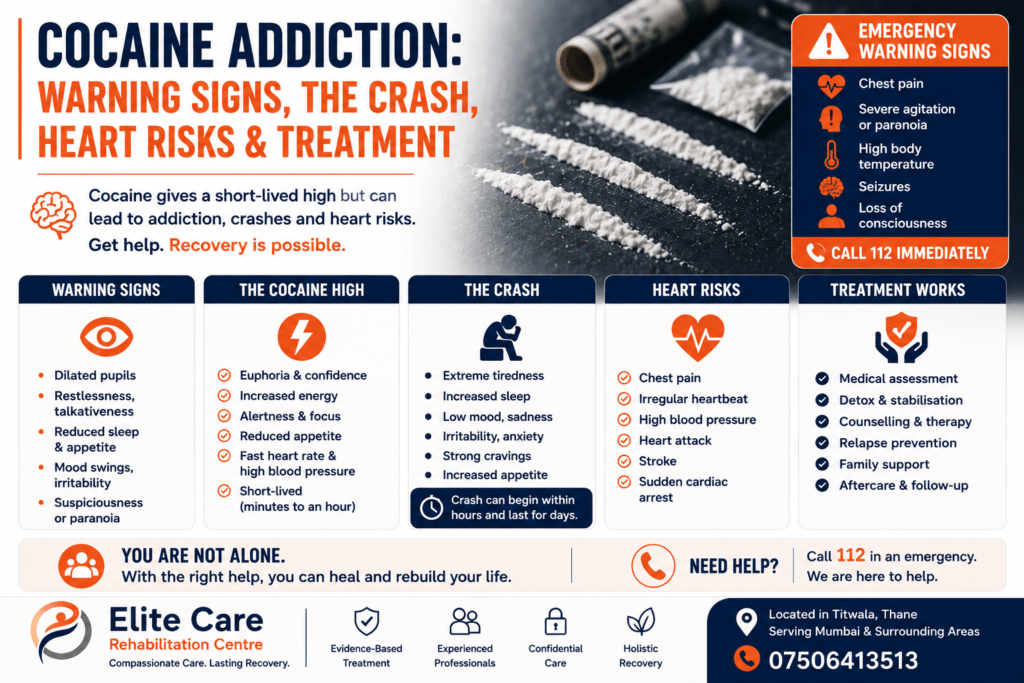
Cocaine addiction can develop through repeated use of a stimulant whose noticeable effects may be intense but short-lived. Families consulting a nasha mukti kendra in Mumbai should expect assessment of chest pain, heart rhythm, sleep loss, appetite, anxiety, suspiciousness, low mood, cravings and use of alcohol or other drugs—not simply a standard detox timetable. The cocaine crash differs between people and can involve exhaustion, disturbed sleep, depression or strong cravings.
Cocaine may initially produce energy, confidence, talkativeness and alertness. As its effects wear off, some people take repeated doses to maintain the stimulation or avoid the unpleasant rebound. This cycle can extend wakefulness, reduce food intake and increase the risks of panic, paranoia, heart problems, seizures and loss of control over use.
What is the cocaine crash? It is a commonly used term for the early period after cocaine effects wear off or a period of repeated use ends. Possible symptoms include severe tiredness, increased sleep, low mood, irritability, anxiety, increased appetite and cravings. Not every person experiences the same symptoms, severity or timeline.
This guide explains cocaine addiction symptoms, the crash, withdrawal, cardiovascular risks, use with alcohol or other drugs, assessment, emergency warning signs and evidence-based cocaine addiction treatment.
What is cocaine?
Cocaine is a powerful central nervous system stimulant. It increases activity in brain systems involved in reward, alertness, movement and motivation.
It may be:
- Snorted as a powder
- Smoked in a processed form
- Injected after being dissolved
- Used through another route
The route affects how quickly the effects appear, how intense they feel and how long they remain noticeable. Faster delivery to the brain may produce a more abrupt and reinforcing effect, but every route can result in addiction and serious medical harm.
A person cannot reliably judge the strength or contents of an illicit powder from its colour, texture, smell or price. A product sold as cocaine may contain additional substances, and those substances can change the expected symptoms and emergency risks.
How cocaine produces short-lived stimulation
Cocaine blocks the normal removal of dopamine and affects other chemical messenger systems in the brain. This can temporarily increase stimulation and reinforce repeated use.
Possible short-term effects include:
- Euphoria
- Increased energy
- Greater talkativeness
- Increased confidence
- Reduced tiredness
- Reduced appetite
- Greater alertness
- Increased sensitivity to sound, touch or surroundings
- Faster heart rate
- Higher blood pressure
- Increased body temperature
The SAMHSA clinical chapter on how stimulants affect the brain and behaviour explains that cocaine’s noticeable effects can include increased energy, alertness and stimulation. It also describes anxiety, irritability, paranoia and restlessness as use escalates.
The stimulating effect does not mean that thinking, judgement or work performance is genuinely improved. Confidence may increase while risk assessment, impulse control and decision-making become less reliable.
Why short-lived effects can lead to repeated dosing
Some people take another dose as soon as the earlier effect begins to fade. Repeated dosing may continue over several hours or through the night.
The person may be trying to:
- Maintain euphoria or confidence
- Avoid tiredness
- Continue socialising
- Complete work or another activity
- Prevent low mood
- Reduce the unpleasant feeling of the drug wearing off
As the period of use continues, the desired effects may become less prominent while anxiety, irritability, suspiciousness and physical strain increase.
A repeated-use cycle can lead to:
- Little or no sleep
- Missed meals
- Dehydration
- Increasing heart rate and blood pressure
- Chest pain
- Panic
- Paranoia
- Impulsive decisions
- Further dosing despite recognising the danger
Repeated dosing does not guarantee an identical response each time. A person who previously used cocaine without an obvious emergency can still develop severe toxicity during a later episode.
Cocaine use versus cocaine use disorder
Use of cocaine does not by itself establish cocaine addiction. Cocaine addiction is clinically assessed as cocaine use disorder, which involves a pattern of impaired control, cravings, risky use and continuing use despite harm.
| Area | Cocaine use without an established disorder | Possible cocaine use disorder |
|---|---|---|
| Control | No continuing pattern of failed attempts to control use has been established | The person repeatedly uses more or for longer than planned |
| Cravings | Urges do not repeatedly control behaviour | Strong cravings contribute to continued use or failed attempts to stop |
| Responsibilities | No persistent disruption has been identified | Work, education, finances or family duties are repeatedly affected |
| Risk | No continuing pattern of unsafe use has been established | Use continues despite chest pain, impaired driving, psychiatric symptoms or other danger |
| Consequences | No established pattern of continuing harm | Use continues despite physical, psychological, financial or relationship consequences |
The disorder may be mild, moderate or severe. A person does not need to experience every possible symptom before the problem deserves assessment.
Cocaine addiction symptoms
Cocaine addiction symptoms usually become clearer through a pattern over time rather than through one episode of stimulation or one positive drug test.
Possible signs of cocaine addiction include:
- Using more cocaine than intended
- Continuing for longer than planned
- Repeated unsuccessful attempts to reduce or stop
- Strong cocaine cravings
- Taking repeated doses during one session
- Spending substantial time obtaining, using or recovering from cocaine
- Missing work, education or family responsibilities
- Continuing despite chest pain, panic or paranoia
- Using in situations where impairment creates serious danger
- Giving up important activities
- Keeping use secret
- Unexplained borrowing, spending or debt
- Returning to cocaine despite recognising its consequences
- Needing more frequent or repeated use to seek the earlier effect
- Experiencing a crash or withdrawal symptoms after stopping
The broader guide to drug addiction symptoms explains why changes in mood, behaviour, health and finances should be examined together rather than used as proof of one particular drug.
Signs of recent cocaine use
Possible signs of cocaine use can include:
- Unusual energy or talkativeness
- Restlessness
- Reduced appetite
- Staying awake for unusually long periods
- Enlarged pupils
- Sweating
- Rapid speech
- Frequent movement or inability to sit still
- Irritability
- Anxiety
- Jaw tension
- Repeated visits to a private room
- Nose irritation or nosebleeds when cocaine is snorted
- Increasing suspiciousness
These signs cannot confirm cocaine use. Anxiety disorders, mania, stimulant medicines, thyroid conditions, sleep deprivation and other substances can produce similar changes.
A drug test may support evidence of recent exposure, but it does not independently prove addiction, impairment at a particular time, the amount used or the severity of the disorder.
Reduced sleep and appetite
Cocaine can temporarily reduce tiredness and appetite. During repeated use, a person may remain awake and eat very little for an extended period.
Possible consequences include:
- Physical exhaustion
- Dehydration
- Weight loss
- Nutritional problems
- Difficulty concentrating
- Greater emotional instability
- Worsening anxiety
- Reduced ability to assess risk
- Increased suspiciousness
Sleep deprivation can itself contribute to confusion, agitation, unusual beliefs and perceptual changes. Clinicians therefore need to assess both cocaine exposure and the amount of sleep the person has had.
When use ends, appetite and sleep may rebound. Some people sleep for long periods, while others remain unable to sleep properly despite feeling exhausted.
Cocaine anxiety, suspiciousness and paranoia
Cocaine can cause anxiety, irritability and heightened alertness. With heavier or repeated use, ordinary events may be interpreted as threatening.
Possible signs of cocaine paranoia include:
- Believing that others are watching or following the person
- Repeatedly checking doors, windows or phones
- Accusing relatives without clear evidence
- Misinterpreting ordinary conversations
- Becoming unusually guarded
- Refusing help because of suspicion
- Responding aggressively to perceived threats
Paranoia may occur during intoxication and may sometimes continue after the immediate stimulant effect has faded. Severe sleep loss, other stimulant use and an underlying psychiatric condition can complicate the presentation.
Hallucinations, fixed delusions, severe confusion or behaviour that becomes unsafe requires urgent clinical assessment. Families should not attempt to prove that a severely paranoid person is wrong through prolonged confrontation.
What is the cocaine crash?
The cocaine crash is the early rebound period that may occur when cocaine effects wear off or a period of repeated use ends.
Possible cocaine crash symptoms include:
- Severe tiredness
- Increased sleep
- Difficulty sleeping despite exhaustion
- Low mood
- Reduced pleasure or interest
- Irritability
- Anxiety
- Increased appetite
- Slow thinking or movement
- Poor concentration
- Strong cravings
- Suspiciousness or paranoia
The MedlinePlus overview of cocaine withdrawal describes fatigue, low mood, anxiety, irritability, sleepiness, reduced pleasure and cravings among symptoms that may occur when a period of cocaine use ends.
The word crash can sound like one predictable event, but experiences vary. One person may sleep for a prolonged period. Another may feel exhausted but restless. Someone else may have mainly low mood and cravings without an obvious period of increased sleep.
The cocaine crash and withdrawal are related but not identical terms
The crash commonly refers to the early rebound after stimulation ends. Cocaine withdrawal is a broader term covering emotional, behavioural, sleep and craving-related symptoms that may continue beyond the initial crash.
| Phase | Possible experience | Important caution |
|---|---|---|
| Early crash | Exhaustion, increased sleep, low mood, irritability, increased appetite and cravings may begin as stimulation wears off | Some people remain agitated, suspicious or unable to sleep |
| Early withdrawal | Depression, anxiety, poor concentration, disturbed sleep and strong cravings may continue | Suicidal thoughts or severe psychiatric symptoms require urgent assessment |
| Continuing recovery | Energy, sleep and mood may gradually improve while cue-triggered cravings continue | Persistent symptoms may reflect depression, trauma, another substance or a separate medical condition |
These are broad patterns rather than a fixed sequence. The stages can overlap, and not every person passes through each one in the same way.
Cocaine withdrawal symptoms
Cocaine withdrawal symptoms are often more psychological and behavioural than the vomiting, diarrhoea or tremor associated with some other withdrawal syndromes.
Possible symptoms include:
- Low mood
- Severe fatigue
- Anxiety
- Irritability
- Restlessness
- Increased sleep
- Insomnia or fragmented sleep
- Vivid or unpleasant dreams
- Increased appetite
- Difficulty concentrating
- Slowed thinking or movement
- Reduced ability to experience pleasure
- Strong cocaine cravings
- Suspiciousness
- Suicidal thoughts in some people
Uncomplicated cocaine withdrawal does not usually produce the seizure or delirium syndrome associated with withdrawal from alcohol or certain sedatives. However, seizures, severe confusion and medical emergencies can occur during cocaine intoxication or because another substance is involved.
A person may also use alcohol, sleeping tablets, opioids or cannabis in an attempt to manage the crash. This can create an overlapping intoxication or withdrawal pattern that is more difficult to recognise.
How long does cocaine withdrawal last?
There is no single cocaine withdrawal timeline. The onset, severity and duration depend on the amount used, route, frequency, length of the recent episode, sleep deprivation, physical health, mental health and use of other substances.
The crash may begin soon after cocaine effects wear off or a period of repeated dosing ends. Fatigue, altered sleep, low mood and cravings may continue for days, while mood disturbance or cue-triggered cravings can continue for longer in some people.
A precise number of days should not be promised because:
- The amount and purity may be uncertain.
- Different routes produce different patterns of effect.
- Some people have used cocaine continuously, while others use intermittently.
- Alcohol, opioids, sedatives or other stimulants may be involved.
- Depression, bipolar disorder, anxiety or trauma may affect recovery.
- Severe sleep deprivation can continue affecting mood and thinking.
The full article on drug withdrawal symptoms explains why stimulant withdrawal should not be placed on the same timetable as opioid, cannabis or sedative withdrawal.
Low mood, exhaustion and suicide risk
Low mood after cocaine use may range from temporary emotional flatness to severe depression. Some people describe being unable to enjoy ordinary activities, think clearly or begin basic tasks.
Concerning signs include:
- Statements that life is not worth living
- Talking about death or suicide
- Searching for methods of self-harm
- Giving away belongings
- Extreme hopelessness
- Sudden withdrawal from family contact
- A recent self-harm attempt
- Severe agitation combined with suicidal thoughts
A person with immediate suicide risk should not be left alone while emergency help is arranged. Call 112 in India or go to the nearest emergency department.
Families should not assume that every period of prolonged sleep is harmless. Check that the person can be woken normally and is breathing without difficulty, particularly when alcohol, opioids, sleeping pills or an unknown powder may also have been used.
Why cocaine cravings can remain strong
Cravings may be triggered by:
- Friends connected with cocaine use
- Parties or nightlife
- Alcohol
- Money or salary day
- Music and familiar locations
- Work pressure
- Conflict
- Loneliness
- Low mood
- Objects or routines associated with preparing and using cocaine
Cravings may appear even after the person feels physically rested. This is one reason that sleeping through the crash does not complete cocaine addiction treatment.
The treatment plan should identify both emotional triggers and practical access to the drug. A person may understand the risks clearly and still experience powerful urges when exposed to a familiar cue.
Cocaine side effects
Cocaine side effects can affect the heart, brain, mood, temperature, digestion, sleep and judgement.
Possible short-term side effects include:
- Rapid heart rate
- Higher blood pressure
- Sweating
- Raised body temperature
- Reduced appetite
- Nausea
- Tremor
- Dizziness
- Anxiety
- Panic
- Irritability
- Paranoia
- Chest pain
- Seizures
- Stroke
- Abnormal heart rhythm
Repeated use may contribute to:
- Weight loss and nutritional problems
- Persistent sleep disruption
- Depression
- Cognitive and concentration problems
- Continuing paranoia
- Relationship and financial harm
- Damage associated with the route of use
- Cocaine use disorder
Cocaine effects on the heart
Cocaine can place several forms of stress on the cardiovascular system at the same time. It can increase heart rate and blood pressure while narrowing blood vessels and increasing the heart’s demand for oxygen.
Possible cocaine effects on the heart include:
- Rapid heart rate
- High blood pressure
- Irregular heart rhythm
- Reduced blood flow to heart muscle
- Heart attack
- Inflammation or damage to heart muscle
- Sudden cardiac arrest
The CDC guidance on stimulant risks identifies cardiovascular complications such as heart attack and stroke among the serious consequences of stimulant toxicity.
Severe cardiovascular events can occur in people who do not know that they have underlying heart disease. Age or apparent physical fitness should not be used to dismiss cocaine-related chest symptoms.
Cocaine chest pain is an emergency warning sign
Cocaine chest pain may reflect anxiety or muscular discomfort, but it can also indicate reduced blood flow to the heart, an abnormal rhythm or another serious cardiovascular problem.
Call 112 or go to the nearest emergency department when chest pain:
- Occurs after known or suspected cocaine use
- Is severe or persistent
- Feels like pressure, tightness or heaviness
- Spreads to the arm, shoulder, jaw, back or upper abdomen
- Occurs with sweating, nausea or breathlessness
- Occurs with fainting or collapse
- Occurs with a fast or irregular heartbeat
Do not ask the person to exercise, walk it off, take more cocaine or drink alcohol. Do not provide another person’s heart or anxiety medicine.
The person should tell emergency clinicians about the cocaine and any other substances used. This information can affect assessment and treatment.
Cocaine overdose symptoms
A cocaine emergency may involve severe overstimulation rather than the slow breathing typically associated with an opioid overdose.
Possible cocaine overdose symptoms include:
- Severe chest pain
- Very fast or irregular heartbeat
- Very high blood pressure
- Severe agitation
- Panic that cannot be settled
- Extreme paranoia
- Hallucinations
- Very high body temperature
- Heavy sweating
- Severe headache
- Weakness or numbness on one side
- Difficulty speaking
- A seizure
- Collapse or loss of consciousness
There is no home method that can reliably determine whether symptoms are temporary anxiety or serious stimulant toxicity.
Unlike an opioid overdose, cocaine toxicity does not have a specific reversal medicine equivalent to naloxone. Emergency treatment focuses on stabilising the person and managing complications.
When someone is unconscious or breathing slowly after suspected cocaine use, an opioid or another depressant may also be involved. Call 112 immediately. If naloxone is available, it may be administered according to its product instructions for possible opioid exposure, but it does not reverse cocaine itself.
Cocaine and alcohol
Cocaine and alcohol are sometimes used together in social settings or because a person believes alcohol will reduce anxiety as cocaine wears off.
This combination does not make either substance safer. It can:
- Increase impaired judgement
- Encourage further cocaine or alcohol use
- Increase heart strain
- Increase accident and injury risk
- Complicate intoxication and withdrawal
- Make it harder to recognise medical deterioration
When cocaine and alcohol are present in the body together, the liver can form a substance called cocaethylene.
A 2024 systematic review of cardiovascular risks from combined cocaine and alcohol use found evidence of additional cardiovascular strain and higher mortality compared with cocaine use alone. The review also noted limitations and inconsistency in parts of the available evidence, so individual risk cannot be calculated from the combination alone.
The practical conclusion remains clear: alcohol should not be used to extend a cocaine session, soften the crash or treat cocaine withdrawal symptoms.
Mixing cocaine with opioids or sedatives
Combining cocaine with opioids, benzodiazepines or sleeping pills can produce an unpredictable presentation.
A stimulant may temporarily make a person feel less sedated without preventing breathing suppression from an opioid or another depressant. When the stimulant effect fades, severe sedation may become more apparent.
Additional concerns include:
- Uncertain product contents
- Slow or absent breathing
- Loss of consciousness
- Vomiting while unconscious
- Overdose involving several substances
- Overlapping withdrawal syndromes
Families should tell clinicians about every known drug and medicine, not only the substance the person considers the main problem.
How cocaine use disorder is assessed
Assessment should be confidential, non-judgemental and medically detailed.
A clinician may review:
- How cocaine is taken
- Frequency and approximate amount
- Pattern of repeated dosing
- Time of the most recent use
- Length of the recent episode
- Sleep and food intake
- Cravings and loss of control
- Attempts to stop
- Crash and withdrawal symptoms
- Chest pain, fainting or palpitations
- Seizures or severe headaches
- Panic, paranoia or hallucinations
- Depression and suicide risk
- Alcohol, opioid, sedative and other stimulant use
- Prescription medicines
- Previous treatment
- Work, financial and family consequences
Clinical diagnosis considers whether cocaine use has led to impaired control, cravings, risky behaviour, disruption of responsibilities and continued use despite consequences.
What drug tests can and cannot show
A toxicology test may support evidence of recent cocaine exposure or identify another substance. It cannot independently establish:
- The severity of cocaine addiction
- The exact amount used
- The person’s level of impairment at a particular time
- Why the cocaine was used
- Whether every added substance was detected
- The cause of chest pain or psychiatric symptoms
- Whether residential treatment is required
Testing supports the clinical history, examination and observation. It does not replace them.
Cocaine addiction treatment
Cocaine addiction treatment should address immediate medical risks, cravings, triggers, mental health and the practical circumstances that support repeated use.
A treatment plan may include:
- Medical and psychiatric assessment
- Management of intoxication or withdrawal symptoms
- Monitoring for depression and suicide risk
- Contingency management
- Cognitive behavioural therapy
- Motivational work
- Family counselling
- Relapse-prevention planning
- Treatment of alcohol or other substance-use disorders
- Sleep and nutrition recovery
- Outpatient or residential rehabilitation when clinically appropriate
- Continuing follow-up
The ASAM and AAAP clinical guideline for stimulant use disorder covers the assessment and management of stimulant intoxication, withdrawal and continuing stimulant-use disorder treatment.
Why cocaine treatment differs from opioid treatment
Cocaine and opioids affect the body differently, produce different overdose patterns and require different treatment strategies.
| Area | Cocaine use disorder | Opioid use disorder |
|---|---|---|
| Drug class | Stimulant | Opioid |
| Overdose pattern | May involve severe agitation, high temperature, chest pain, stroke, seizures or abnormal heart rhythm | Typically involves reduced consciousness and slow or absent breathing |
| Reversal medicine | No specific cocaine-reversal medicine comparable with naloxone | Naloxone can temporarily reverse opioid overdose |
| Routine medication treatment | Behavioural treatment is central; selected medicines may be considered by specialists for particular patients, but there is no direct routine equivalent to opioid agonist maintenance treatment | Methadone and buprenorphine have established roles in evidence-based opioid-use-disorder treatment |
| Withdrawal focus | Low mood, fatigue, altered sleep, cravings and psychiatric risk | Physical withdrawal symptoms, cravings, reduced tolerance and overdose risk after renewed use |
The article on opioid addiction explains why medication-based treatment has a different and central role for heroin, opium and other opioid-use disorders.
Behavioural treatment for cocaine addiction
Contingency management
Contingency management uses clearly defined, structured rewards to reinforce treatment attendance or other recovery-related behaviours.
The ASAM and AAAP clinical guideline identifies contingency management as a primary component of treatment for stimulant use disorder. It should be delivered through a structured clinical programme with clearly defined recovery-related targets rather than improvised as family payment, pressure or bargaining.
Cognitive behavioural therapy
Cognitive behavioural therapy may help a person:
- Recognise cocaine-related thoughts and routines
- Identify triggers
- Respond differently to cravings
- Manage high-risk situations
- Challenge beliefs about confidence, energy or performance
- Prepare for lapses without abandoning treatment
Motivational work
Some people enter treatment because of family pressure, financial problems or a medical emergency rather than a settled decision to stop.
Motivational work can help the person examine the difference between what cocaine appears to provide and what it is costing in health, sleep, money, work and relationships.
Is there a medicine for cocaine addiction?
There is currently no medicine with an established routine role for cocaine use disorder comparable with methadone or buprenorphine for opioid use disorder. Qualified specialists may consider selected medicines outside their formally approved indications for particular patients, but evidence and suitability vary.
No patient or family should start, borrow, combine, stop or change medicines without qualified medical supervision. Medicines may also be prescribed for a separately assessed condition such as depression, anxiety, psychosis or persistent sleep disturbance.
Giving sleeping tablets or alcohol at home to manage a cocaine crash can create an additional dependence, intoxication or overdose risk.
Does every patient need residential rehabilitation?
No. Cocaine addiction treatment may take place through outpatient, structured day-care, residential or hospital services.
Residential rehabilitation may be considered when:
- Repeated outpatient attempts have not provided sufficient safety
- Cocaine remains easily available in the home environment
- Use repeatedly continues through the night
- Several substances are involved
- There is severe depression or psychiatric instability
- The person cannot maintain work, education or self-care
- Family conflict prevents safe outpatient treatment
- Close structure is needed after emergency or psychiatric stabilisation
Hospital treatment may be required before ordinary rehabilitation when there is chest pain, stroke symptoms, a seizure, severe psychosis, suicidal intent, very high body temperature or another medical emergency.
The wider guide to drug addiction treatment explains how medical care, counselling, psychiatric support, family involvement and continuing follow-up can work together.
Relapse prevention after cocaine treatment
Cocaine cravings can return quickly in response to alcohol, money, parties, particular friends or a familiar location.
A practical relapse-prevention plan may include:
- Personal warning signs
- High-risk people and places
- Alcohol-use planning
- Money-management arrangements
- Immediate treatment contacts
- Response after missed appointments
- Sleep and work routines
- A plan for low mood and cravings
- Psychiatric follow-up where required
- Rapid reassessment after renewed use
A lapse should lead to medical and psychological review rather than humiliation or automatic removal from treatment. Renewed cocaine use may involve a different product, another substance or increased medical risk.
How families can respond
Families can support assessment by reporting specific observations instead of relying on labels or accusations.
Useful information includes:
- Changes in sleep and appetite
- Periods of unusual energy or talkativeness
- Repeated all-night absence
- Chest pain or palpitations
- Panic, paranoia or hallucinations
- Periods of exhaustion or prolonged sleep
- Statements about suicide or hopelessness
- Alcohol, medicines and other drugs
- Previous treatment and why it ended
- Changes in spending, debt or responsibilities
Families should avoid:
- Public humiliation
- Confrontation during severe intoxication or paranoia
- Giving alcohol to soften the crash
- Giving borrowed sleeping or anxiety medicines
- Allowing an impaired person to drive
- Leaving someone with immediate suicide risk alone
- Assuming chest pain is only anxiety
- Trying to manage severe agitation through physical force
Relatives should not physically restrain a severely agitated, intoxicated or psychotic person unless it is immediately necessary to prevent serious harm and no safer option is available. Move other people to safety, reduce confrontation and call 112 when the situation cannot be managed safely.
When cocaine-related symptoms become an emergency
Call 112 in India or go to the nearest emergency department when there is:
- Chest pain
- A very fast or irregular heartbeat with weakness or breathlessness
- Collapse or fainting
- A seizure
- Severe headache with weakness, numbness or speech difficulty
- Very high body temperature
- Severe agitation that cannot be managed safely
- Hallucinations or fixed delusions with unsafe behaviour
- Severe confusion
- Loss of consciousness
- Slow, irregular or absent breathing
- Suicidal intent or a recent self-harm attempt
Do not wait for the cocaine crash to finish when the person is medically or psychiatrically unstable.
Frequently asked questions
What is cocaine addiction?
Cocaine addiction, clinically assessed as cocaine use disorder, involves difficulty controlling cocaine use and continuing despite physical, psychological, financial, occupational or relationship harm.
What are common cocaine addiction symptoms?
Common symptoms include strong cravings, repeated dosing, unsuccessful attempts to stop, neglect of responsibilities, risky use and continued use despite chest pain, anxiety, paranoia or other consequences.
What is the cocaine crash?
The cocaine crash is the early rebound that may occur when cocaine effects wear off or a period of repeated use ends. Possible symptoms include exhaustion, increased sleep, low mood, irritability, increased appetite and cravings.
Does everyone experience the same cocaine crash?
No. Symptoms, timing and severity differ. Some people sleep for a prolonged period, while others remain restless, anxious or unable to sleep despite exhaustion.
What are common cocaine withdrawal symptoms?
They include fatigue, depression, anxiety, irritability, altered sleep, increased appetite, vivid dreams, poor concentration, reduced pleasure and strong cravings.
How long does cocaine withdrawal last?
There is no single timeline. The crash may begin as cocaine effects wear off, while sleep, mood, concentration and cravings may take days or longer to improve. Heavy use, psychiatric conditions and other substances can extend or alter recovery.
Can cocaine cause chest pain?
Yes. Cocaine can increase heart rate and blood pressure, narrow blood vessels and increase strain on the heart. Chest pain after cocaine use requires urgent medical assessment.
Can cocaine cause a heart attack?
Yes. Cocaine can reduce blood flow to heart muscle, increase oxygen demand and disturb heart rhythm. A heart attack can occur even in a person who appears young or physically fit.
Can cocaine cause paranoia?
Yes. Cocaine may cause suspiciousness, fear, paranoia or psychotic symptoms, particularly with repeated use, larger amounts, prolonged wakefulness or use of other stimulants.
Is the cocaine crash dangerous?
It can become dangerous when accompanied by suicidal thoughts, severe depression, psychosis, inability to wake normally, abnormal breathing or use of alcohol, opioids or sedatives.
What happens when cocaine and alcohol are mixed?
Using cocaine and alcohol together can increase impaired judgement and cardiovascular strain. The liver may also form cocaethylene. A 2024 systematic review associated combined use with higher mortality than cocaine use alone, although findings for individual cardiovascular complications were inconsistent and the available studies had important limitations.
Can naloxone reverse a cocaine overdose?
No. Naloxone does not reverse cocaine. It may help when an opioid is also involved, but emergency medical care is still required.
Is there a medicine that cures cocaine addiction?
There is no medicine with an established routine role for cocaine use disorder comparable with methadone or buprenorphine for opioid use disorder. Selected medicines may be considered by qualified specialists for particular patients, but evidence and suitability vary.
How does cocaine treatment differ from opioid treatment?
Opioid-use-disorder treatment has established medication options such as methadone and buprenorphine. Cocaine treatment relies primarily on behavioural approaches, psychiatric care, medical risk management and structured recovery support.
Does every person with cocaine addiction need rehabilitation?
No. Some people can receive outpatient treatment. Residential care may be appropriate when use remains uncontrolled, the home environment is unsafe, several substances are involved or significant psychiatric and functional problems require greater structure.
Cocaine addiction requires more than waiting for the crash to pass
Cocaine’s stimulating effects may be brief, but the consequences of repeated dosing can continue long after the noticeable high has ended. Sleep loss, poor nutrition, anxiety, paranoia, heart strain and strong cravings can build during a single period of use.
The cocaine crash may include exhaustion, low mood, altered sleep and increased appetite, but it does not follow one universal timeline. Severe depression, suicidal thoughts, psychosis, chest pain, seizures and stroke symptoms require immediate assessment rather than being treated as an expected part of withdrawal.
Effective cocaine addiction treatment examines the full pattern: the drug used, route, repeated dosing, cardiovascular symptoms, mental health, alcohol and other substances, family conditions and earlier attempts to stop.
Behavioural treatment, psychiatric care, medical monitoring, family guidance and continuing relapse-prevention support are more dependable than relying on willpower or a fixed detox period.
Medical disclaimer: This article provides general educational information and does not replace individual medical assessment, diagnosis or treatment. Call 112 in India or go to the nearest emergency department for chest pain, collapse, seizures, stroke symptoms, very high body temperature, severe confusion, hallucinations with unsafe behaviour, loss of consciousness, breathing difficulty, suicidal intent, serious injury or agitation that cannot be managed safely.
