
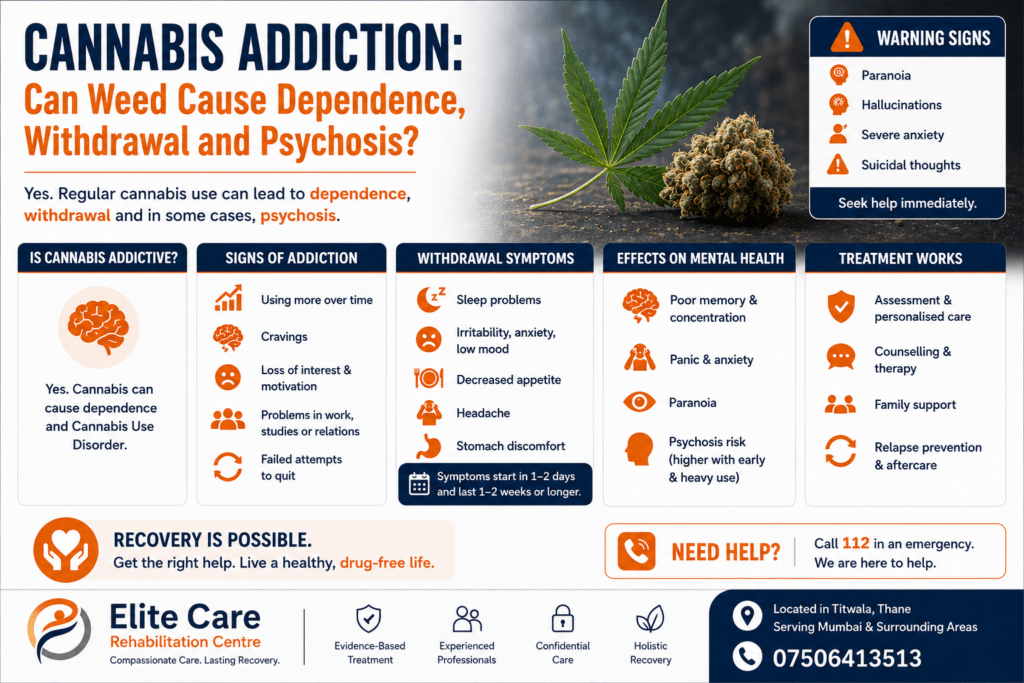
Cannabis addiction can develop even when use begins casually or is considered natural. Families searching for the best rehabilitation centre in India for cannabis-related problems should look beyond promotional claims and ask whether the programme distinguishes occasional use from cannabis use disorder, assesses withdrawal, sleep, anxiety, memory, panic, paranoia and psychosis risk, and considers the person’s age, frequency of use, product strength and use of other substances.
Cannabis does not affect every person in the same way. Some people use it without developing a substance-use disorder, while others experience tolerance, cravings, repeated failed attempts to stop, withdrawal and continuing harm to education, work, relationships or mental health.
Can weed cause dependence, withdrawal and psychosis? Yes. Regular cannabis use can lead to physical dependence and a recognised withdrawal syndrome. Cannabis can also cause panic, paranoia and temporary psychotic symptoms in some people. Its association with longer-lasting psychotic disorders is stronger with earlier and more frequent use, although cannabis does not produce the same outcome in every user.
This guide explains cannabis addiction in an Indian context, including ganja, charas, bhang, weed and marijuana use. It separates common effects from cannabis use disorder and explains when withdrawal or changes in mental state require professional assessment.
What is cannabis?
Cannabis refers to products obtained from the cannabis plant. Its effects depend partly on cannabinoids, including tetrahydrocannabinol, commonly called THC.
THC is mainly responsible for the intoxicating or “high” effect. Cannabis products can differ greatly in THC concentration, preparation, route of use and the presence of other substances.
Common terms used in India include:
- Ganja
- Charas
- Bhang
- Weed
- Marijuana
- Hash or hashish
- Cannabis resin
These terms do not always refer to products of equal strength. The same street name may also be used for products that differ in composition or are mixed with tobacco or other substances.
The broader guide to the types of drug addiction explains why the drug category, product, route and pattern of use change the likely symptoms and treatment needs.
Cannabis use in India and worldwide
According to the UNODC World Drug Report 2026 data platform, cannabis was the most widely used drug covered by its global estimates, with approximately 256 million people reporting past-year cannabis use during 2024.
This global estimate does not show how many people have cannabis use disorder. Use, harmful use and dependence are different categories.
In India, the official National Survey on Extent and Pattern of Substance Use in India estimated that approximately 2.83% of people aged 10–75 were current cannabis users during the survey period. This represented roughly 3.1 crore people.
The survey was conducted during 2018 and its report was released in 2019. These figures should therefore not be presented as an exact 2026 population count.
The survey also distinguished between any cannabis use, dependent use and the larger group requiring help because of harmful or dependent use. It estimated that approximately 0.25% of people aged 10–75 used cannabis in a dependent pattern and around 0.66% required help for harmful or dependent cannabis use.
The report found that bhang use was more common than ganja or charas use, but harmful or dependent use was proportionately more common among people using ganja or charas. This shows why the product and pattern matter more than the general statement, “The person uses cannabis.”
Is cannabis addictive?
Yes, cannabis can be addictive. Cannabis addiction is clinically assessed as cannabis use disorder. It involves difficulty controlling use and continuing despite meaningful harm or risk.
The CDC’s cannabis use disorder guidance reports that approximately three in ten people who use cannabis may have cannabis use disorder. This estimate is based largely on United States data and should not be treated as an India-specific prevalence figure.
The risk is not equal for every user. It tends to be greater when use:
- Begins during adolescence
- Becomes frequent or daily
- Involves higher-THC products
- Is used repeatedly to manage stress, sleep or difficult emotions
- Continues despite mental-health or functional problems
- Occurs alongside other substance use
Calling cannabis addictive does not mean that every person who tries it will become dependent. It means that a recognised disorder can develop and should not be dismissed because the substance is plant-derived.
Cannabis use versus cannabis use disorder
Cannabis use alone does not establish cannabis addiction. Diagnosis depends on control, consequences, risk and functioning.
| Area | Cannabis use without an established disorder | Possible cannabis use disorder |
|---|---|---|
| Control | The person can follow decisions about whether and when to use | Use repeatedly exceeds the person’s plan or attempts to stop fail |
| Priority | Cannabis does not consistently replace important responsibilities | Obtaining, using or recovering from cannabis receives increasing priority |
| Consequences | No continuing pattern of significant harm has been established | Use continues despite problems with health, study, work, relationships or safety |
| Cravings | Cravings are absent or do not repeatedly control behaviour | Strong urges contribute to repeated use or failed attempts to stop |
| Tolerance and withdrawal | May be absent | May occur, although neither symptom alone proves addiction |
A person does not need to experience every listed feature to have cannabis use disorder. The disorder can be mild, moderate or severe depending on the number and pattern of symptoms identified during clinical assessment.
Cannabis addiction symptoms
Cannabis addiction symptoms usually become visible as a pattern over time rather than through one episode of intoxication.
Possible symptoms include:
- Using more cannabis than intended
- Using for longer periods than planned
- Repeated unsuccessful attempts to reduce or stop
- Strong cravings
- Spending substantial time obtaining, using or recovering from cannabis
- Missing education, work or family responsibilities
- Continuing despite arguments or relationship problems
- Giving up valued activities
- Driving or performing risky work while impaired
- Continuing despite anxiety, paranoia, memory problems or another health concern
- Needing more cannabis or a stronger product to produce the earlier effect
- Developing withdrawal after reducing or stopping regular use
Possible weed addiction symptoms or ganja addiction symptoms should not be diagnosed from red eyes, smell, appetite changes or altered behaviour alone. These signs can suggest recent use, but addiction requires a wider pattern of impaired control and harm.
The related article on drug addiction symptoms explains how families can recognise concerning changes without diagnosing a particular substance from appearance alone.
Can weed cause dependence?
Yes. Frequent weed use can cause physical dependence. Dependence means the brain and body have adapted to repeated exposure, making withdrawal more likely when cannabis use is stopped or substantially reduced.
Physical dependence is not identical to addiction. A person may experience tolerance or withdrawal without showing the full pattern of cannabis use disorder.
Addiction involves additional features such as:
- Loss of control
- Compulsive use
- Strong cravings
- Reduced functioning
- Risky use
- Continued use despite consequences
Assessment should therefore ask not only how often the person uses cannabis, but what role it now plays in daily life.
Cannabis tolerance
Tolerance means that the earlier amount of cannabis produces less of the expected effect. A person may respond by using more frequently, taking larger amounts or seeking stronger products.
Signs suggesting tolerance may include:
- Increasing the quantity used in one session
- Changing from occasional to daily use
- Moving to products believed to contain more THC
- Using earlier in the day
- Needing cannabis to feel relaxed, hungry or able to sleep
- Reporting that the earlier amount “does nothing now”
Tolerance does not mean that driving, judgement or mental health are protected. A tolerant user may feel less noticeably intoxicated while attention, reaction time or decision-making remains affected.
Cannabis cravings
A cannabis craving is a strong urge to use. It may appear in response to stress, boredom, certain friends, familiar locations, music, salary day, arguments or a bedtime routine.
Cravings can also be triggered by withdrawal. A person who becomes irritable and unable to sleep after stopping may return to cannabis because it appears to provide immediate relief.
This creates a repeating cycle:
- Regular cannabis use develops.
- The brain and routine adapt to repeated use.
- The person reduces or stops.
- Sleep, mood and cravings become difficult.
- Cannabis is used again to stop the discomfort.
The relief reinforces the belief that cannabis is necessary for normal sleep, calmness or daily functioning.
Cannabis withdrawal symptoms
Cannabis withdrawal is a recognised syndrome. It is more likely after frequent, prolonged or heavy use is stopped abruptly or substantially reduced.
Common cannabis withdrawal symptoms include:
- Irritability
- Anger or aggression
- Anxiety or nervousness
- Restlessness
- Difficulty falling or staying asleep
- Vivid or disturbing dreams
- Reduced appetite
- Low mood
- Cravings
- Headache
- Sweating or chills
- Stomach discomfort
- Shakiness or physical tension
The terms weed withdrawal symptoms and marijuana withdrawal symptoms generally describe the same THC-related withdrawal syndrome, although product strength, frequency and use of other substances can change the experience.
Uncomplicated cannabis withdrawal is not usually associated with the seizure or delirium risk seen in alcohol or benzodiazepine withdrawal. It can still be clinically important because sleep loss, anxiety, depression, aggression or cravings may disrupt functioning and lead to rapid return to use.
Cannabis withdrawal timeline
There is no exact cannabis withdrawal timeline that applies to every person. A peer-reviewed clinical review of cannabis withdrawal reports that symptoms commonly begin within 24–48 hours and are often strongest between days two and six.
Many symptoms improve over one to two weeks. Sleep disturbance, unusual dreams, low mood or cravings can continue for several weeks or longer in some heavy users.
| Period | Possible symptoms | Clinical caution |
|---|---|---|
| First 24–48 hours | Irritability, anxiety, restlessness, reduced appetite, cravings and early sleep difficulty may begin | Symptoms may also reflect nicotine, alcohol, medicines or another drug |
| Days 2–6 | Sleep disturbance, mood changes, cravings and physical discomfort may become more noticeable | Severe depression, aggression, paranoia or psychosis requires assessment |
| One to two weeks | Many acute symptoms begin to settle | Continuing inability to function may indicate another mental or physical condition |
| Following weeks | Sleep problems, vivid dreams, low mood or cravings may continue in some people | Persistent symptoms should not automatically be labelled as withdrawal without reassessment |
The complete guide to drug withdrawal symptoms explains why symptoms and medical risks differ when cannabis is used alongside opioids, stimulants, alcohol or sedatives.
Sleep disturbance after stopping cannabis
Sleep problems are among the most frequently reported cannabis withdrawal symptoms. A person may struggle to fall asleep, wake repeatedly or experience vivid and unpleasant dreams.
Someone who has used cannabis nightly may believe that sleep is impossible without it. During the early withdrawal period, that belief may feel confirmed because sleep temporarily becomes worse.
Sleep disturbance can then increase:
- Irritability
- Anxiety
- Poor concentration
- Fatigue
- Conflict at home
- Cravings
- Risk of returning to cannabis
Families should not provide borrowed sleeping pills or combine sedatives with cannabis. Some sleeping and anxiety medicines can cause their own dependence and withdrawal problems.
Persistent sleep problems need assessment for depression, anxiety, trauma, irregular routines, sleep apnoea, stimulant use and other possible causes.
Irritability, anger and anxiety after stopping
Irritability and anxiety can begin soon after frequent cannabis use stops. The person may become impatient, restless, emotionally reactive or unusually sensitive to ordinary family conversations.
This does not excuse threatening or violent behaviour. It does help explain why confrontation during withdrawal may make the situation worse.
A calm response can include:
- Keeping conversations brief during severe agitation
- Reducing unnecessary noise and conflict
- Maintaining clear safety boundaries
- Encouraging clinical assessment
- Separating children or vulnerable relatives from unsafe behaviour
Severe agitation, violence, suicidal intent or an inability to manage behaviour safely requires urgent help rather than being treated as an expected withdrawal symptom.
Cannabis effects on concentration and memory
Cannabis can affect attention, learning, memory, judgement, coordination and reaction time. The degree of impairment depends on factors such as recent use, THC strength, frequency, age and use of other substances.
The CDC overview of cannabis and brain health states that recent cannabis use can immediately affect thinking, attention, memory, coordination, movement and the perception of time.
Possible cannabis effects on memory and concentration include:
- Forgetting recent conversations
- Losing track of instructions
- Difficulty studying or retaining new information
- Reduced attention during meetings or classes
- Slow decision-making
- Difficulty managing several tasks
- Repeating questions
- Missing deadlines or appointments
These symptoms do not prove permanent brain damage. They can also be influenced by poor sleep, depression, anxiety, attention disorders, alcohol or other drugs.
Assessment should consider whether problems mainly occur during intoxication, continue between episodes of use or persist after a period of abstinence.
Cannabis effects on the brain
Cannabis effects on the brain are influenced by age, frequency, THC exposure, route of use and individual vulnerability.
Short-term effects can include:
- Altered perception of time
- Reduced short-term memory
- Slower reaction time
- Impaired coordination
- Changes in judgement
- Anxiety or panic
- Paranoia
- Confusion at higher levels of intoxication
Frequent use may also become linked with daily routines and emotional regulation. The person may rely on cannabis to eat, sleep, socialise, relax or avoid difficult feelings.
This dependence on cannabis for ordinary functioning can remain important even when the person does not appear heavily intoxicated.
Can cannabis cause panic and paranoia?
Yes. Cannabis can cause intense anxiety, panic and paranoia, particularly after a larger amount, an unfamiliar or stronger product, or use in an already anxious state.
Possible signs include:
- Racing thoughts
- A feeling of losing control
- Fast heartbeat
- Fear of dying
- Feeling watched or followed
- Extreme suspicion
- Misinterpreting ordinary sounds or behaviour
- Refusing help because of fear
Panic and paranoia may settle as intoxication clears, but they should not automatically be assumed to be harmless.
Urgent assessment is appropriate when symptoms are severe, the person cannot be reassured, behaviour becomes unsafe or there are hallucinations, fixed delusions or serious confusion.
Cannabis and psychosis
The relationship between cannabis and psychosis requires careful wording. Cannabis can cause temporary psychotic symptoms during intoxication, and cannabis use is associated with a higher likelihood of psychotic disorders.
The association is stronger among people who begin at an earlier age and use more frequently. This does not mean that every cannabis user will develop schizophrenia or that cannabis is the only possible cause when psychosis occurs.
The CDC guidance on cannabis and mental health describes links with temporary psychosis, paranoia and longer-lasting psychotic disorders. It also notes that the association with schizophrenia is stronger with earlier and more frequent use.
Risk assessment may consider:
- Age when cannabis use began
- Frequency and intensity of use
- Possible use of higher-THC products
- Past episodes of paranoia or psychosis
- A personal or family history of psychotic illness
- Severe sleep deprivation
- Use of stimulants, hallucinogens or unknown products
- Whether symptoms continue after intoxication clears
What are cannabis-induced psychosis symptoms?
Possible cannabis-induced psychosis symptoms include:
- Hearing voices or sounds that others do not hear
- Seeing things that others do not see
- Fixed beliefs that are clearly inconsistent with reality
- Believing that others intend serious harm without supporting evidence
- Markedly disorganised speech
- Severe confusion
- Behaviour that becomes unpredictable or unsafe
- Loss of the ability to distinguish internal experiences from external reality
These symptoms can also result from another substance, a primary psychotic disorder, mania, delirium, neurological illness or another medical problem.
The term cannabis-induced psychosis should therefore be used after clinical evaluation, not as a family diagnosis based on unusual behaviour alone.
Panic, paranoia and psychosis are not the same
| Presentation | Possible experience | When concern increases |
|---|---|---|
| Panic | Intense fear, racing heart, breathlessness and fear of losing control | Chest pain, collapse, severe confusion, self-harm risk or symptoms that do not settle |
| Paranoia | Unusual suspicion or fear that others intend harm | Fixed beliefs, escalating aggression, inability to accept reassurance or unsafe behaviour |
| Psychosis | Hallucinations, delusions, disorganised thinking or marked loss of contact with reality | Psychosis requires urgent clinical assessment, especially when behaviour is unsafe |
Can psychosis appear after stopping cannabis?
Psychosis is not a typical feature of uncomplicated cannabis withdrawal. However, a 2024 systematic review and case series on psychosis associated with cannabis withdrawal described acute psychotic episodes following cessation, mainly among daily or heavy users who had stopped abruptly.
The findings support careful clinical monitoring but do not establish how frequently withdrawal-associated psychosis occurs or prove that withdrawal was the sole cause in every case. Severe sleep loss may also worsen paranoia, mania or an existing psychotic illness.
Hallucinations, fixed delusions, extreme agitation or major confusion during withdrawal should not be dismissed as something the family must simply wait out.
The clinician may need to assess:
- Whether cannabis was the only substance used
- Whether stimulants or hallucinogens were involved
- Whether alcohol or sedatives were also stopped
- Whether symptoms began before cannabis use
- Whether psychosis continues after abstinence
- Whether the person has severe sleep deprivation
- Whether a medical or neurological condition is present
Why adolescents are more vulnerable
Adolescence is a period of continuing brain development. The brain systems involved in attention, judgement, planning and impulse control continue developing into young adulthood.
The CDC guidance on cannabis and teenagers reports that early and frequent cannabis use is associated with greater cannabis-use-disorder risk and with problems involving attention, memory and learning.
Possible warning signs in an adolescent include:
- A sudden fall in attendance or academic performance
- Reduced concentration
- Loss of interest in earlier activities
- Frequent unexplained spending
- Changing sleep patterns
- Using cannabis before school or during the day
- Panic, paranoia or unusual suspicion
- Repeated attempts to stop followed by renewed use
- Driving or riding with an impaired person
None of these signs proves cannabis addiction. Academic problems, depression, bullying, trauma, attention difficulties and family stress can produce similar changes.
Adolescents require developmentally appropriate assessment that includes mental health, education, family conditions, peer influence and safety.
Does being natural make cannabis harmless?
No. Natural origin does not guarantee safety. Opium, tobacco and several poisonous plants are also natural.
Cannabis risk depends on:
- THC concentration
- Quantity
- Frequency
- Age of first use
- Route of use
- Mental and physical health
- Use of alcohol, tobacco or other drugs
- Driving and other safety-sensitive activities
Some cannabis-derived compounds have recognised or investigated medical uses. That does not establish that an unregulated product, frequent non-medical use or self-treatment for anxiety and sleep is safe.
A substance can have a therapeutic role in selected medical circumstances and still carry dependence, impairment or mental-health risks when used differently.
Higher-strength products and delayed effects
The strength of cannabis cannot always be judged from appearance, smell or the amount used. Concentrated products may expose the person to more THC than expected.
Edible cannabis products have additional risks because their effects can take longer to become noticeable. A person may consume more before the first amount has taken effect.
This can result in:
- Extreme anxiety
- Panic
- Paranoia
- Confusion
- Vomiting
- Impaired coordination
- Hallucinations
- Accidental injury
Children can become seriously unwell after accidental ingestion. Cannabis-containing food or drink should never be stored where it can be mistaken for an ordinary household item.
Cannabis mixed with tobacco, alcohol or other drugs
Many people use cannabis with tobacco. When both are stopped together, nicotine withdrawal may contribute to irritability, anxiety, restlessness and concentration difficulty.
Alcohol can increase impairment when combined with cannabis. Sedatives may add drowsiness and poor coordination, while stimulant use can complicate anxiety, paranoia and psychosis.
A complete assessment should ask about:
- Tobacco and nicotine
- Alcohol
- Sleeping pills and anxiety medicines
- Stimulants
- Opioids
- Hallucinogens
- Prescription medicines
- Unknown vape liquids or synthetic products
Focusing only on cannabis can miss a medically dangerous withdrawal syndrome from alcohol or sedatives.
How cannabis use disorder is assessed
Assessment should be confidential, non-judgemental and based on more than a urine result or family accusation.
A clinician may ask about:
- The cannabis products used
- Frequency and approximate amount
- THC strength where known
- How cannabis is taken
- Age when use began
- Time of the most recent use
- Cravings and loss of control
- Attempts to stop
- Tolerance and withdrawal
- Education, work and relationship effects
- Driving or other risky behaviour
- Panic, paranoia or psychotic symptoms
- Depression, trauma and suicide risk
- Alcohol, tobacco and other drug use
- Physical health and prescribed medicines
- Family and living conditions
Clinical diagnosis considers whether cannabis use has become difficult to control and has caused significant distress, functional problems or continuing harm.
What a cannabis drug test can show
A urine test may support evidence of cannabis exposure. It cannot independently determine:
- Whether the person was impaired at a particular time
- The exact amount used
- The strength of the cannabis product
- How frequently cannabis is normally used
- Whether cannabis caused a psychiatric symptom
- Whether cannabis use disorder is present
- Whether residential rehabilitation is required
THC-related metabolites may remain detectable after the noticeable effects have ended, especially in frequent users. Test results therefore require clinical interpretation.
Cannabis addiction treatment
Cannabis addiction treatment should respond to the severity of use, withdrawal, mental health, age, home environment and the person’s willingness and ability to change.
Treatment may include:
- Screening and brief intervention
- Motivational work
- Cognitive behavioural therapy
- Family therapy
- Management of withdrawal symptoms
- Treatment of anxiety, depression or psychosis
- Daily routine and sleep planning
- Relapse-prevention work
- Educational or occupational support
- Continuing follow-up
The WHO’s 2012 recommendation on cannabis dependence states that psychosocial interventions based on cognitive behavioural therapy, motivational enhancement therapy or family therapy can be offered. The recommendation is conditional and was based on low-quality evidence.
The broader guide to drug addiction treatment explains how assessment, mental-health care, counselling, family involvement and continuing support can be combined.
Is there a medicine that cures cannabis addiction?
No medicine should be presented as a universal cure for cannabis addiction. Treatment usually centres on behavioural and psychosocial care.
A qualified clinician may sometimes treat specific symptoms or a separate condition, such as severe anxiety, depression, psychosis or persistent sleep disturbance.
Families should not:
- Give borrowed sleeping tablets
- Use alcohol to manage withdrawal
- Start psychiatric medicine without assessment
- Combine sedating medicines with ongoing cannabis use
- Create an unsupervised medicine schedule
How cannabis withdrawal is managed
The WHO’s 2012 recommendation on drug withdrawal states that cannabis withdrawal is generally managed in a supportive environment and does not recommend one specific medicine as its standard treatment. The recommendation is conditional and was based on very-low-quality evidence. Clinically significant symptoms may still require individual assessment and appropriately supervised treatment.
Management may involve:
- Monitoring mood and behaviour
- Supporting a regular sleep routine
- Hydration and regular meals
- Reducing caffeine where it worsens anxiety or sleep
- Managing cravings
- Reviewing other substance use
- Treating clinically significant symptoms when appropriate
- Planning continuing care before withdrawal ends
Depression, self-harm risk, psychosis or severe functional deterioration requires closer monitoring and specialist assessment.
Does everyone with cannabis addiction need residential rehabilitation?
No. Some people can receive effective treatment through outpatient assessment, counselling and follow-up.
Residential care may be considered when:
- Daily use continues despite repeated outpatient attempts
- The home environment keeps cannabis easily available
- Severe cravings repeatedly lead to renewed use
- There are serious mood or behavioural problems
- Several substances are being used
- The person cannot maintain education, work or self-care
- Family conflict prevents safe outpatient treatment
- Close observation is needed after psychiatric stabilisation
Hospital or emergency psychiatric care may be needed before ordinary rehabilitation when there is severe psychosis, suicidal intent, dangerous agitation, marked confusion or another medical emergency.
The article on detox and rehabilitation explains why withdrawal support and longer behavioural treatment serve different purposes.
How to quit weed addiction safely
There is no single method that suits every person. A safe plan begins by identifying the pattern of cannabis use and the likely withdrawal, psychiatric and social risks.
A structured plan may include:
- Recording the cannabis products, frequency and amount used.
- Identifying tobacco, alcohol, medicines and other drugs.
- Reviewing previous attempts to stop.
- Assessing sleep, anxiety, depression, paranoia and psychosis.
- Choosing the appropriate outpatient, residential or hospital setting.
- Planning for cravings and withdrawal.
- Removing easy access to cannabis where possible.
- Building a daily routine around sleep, food, exercise, work and follow-up.
- Preparing for high-risk people, places and situations.
- Continuing treatment after the initial abstinence period.
The goal is not merely to pass through several uncomfortable days. Treatment should reduce the likelihood that insomnia, stress, social pressure or psychiatric symptoms lead back to cannabis use.
Family response to cannabis addiction
Families can support assessment by providing specific observations rather than labels such as lazy, irresponsible or mad.
Useful information includes:
- How often cannabis appears to be used
- Whether use occurs in the morning or before responsibilities
- Changes in sleep, appetite and concentration
- Attempts to stop and what happened afterwards
- Panic, paranoia or hallucinations
- Changes in education or work
- Driving after use
- Alcohol, tobacco, medicines and other drugs
- Statements about suicide or self-harm
- Previous treatment and why it ended
Families should avoid:
- Public humiliation
- Threatening the person during intoxication
- Secretly adding medicine to food or drinks
- Giving borrowed sleeping or anxiety medicines
- Assuming every disagreement is caused by cannabis
- Allowing an impaired person to drive
- Leaving someone with immediate suicide risk alone
- Trying to argue a severely psychotic person out of fixed beliefs
Relatives should not physically restrain a severely agitated or psychotic person unless it is immediately necessary to prevent serious harm and no safer option is available. Move other people to safety, reduce confrontation and call 112 when the situation cannot be managed safely.
When cannabis-related symptoms become an emergency
Call 112 in India or go to the nearest emergency department when there is:
- Suicidal intent or a recent self-harm attempt
- Hallucinations or fixed delusions with unsafe behaviour
- Severe confusion
- Extreme agitation or violence that cannot be managed safely
- A seizure
- Collapse or loss of consciousness
- Breathing difficulty
- Severe chest pain
- Repeated vomiting with inability to keep fluids down
- Serious injury
- Suspected accidental ingestion by a child
Do not wait for intoxication or withdrawal to finish when the person is medically or psychiatrically unstable.
Frequently asked questions
Is cannabis addictive?
Yes. Some people develop cannabis use disorder, which can involve cravings, impaired control, tolerance, withdrawal and continued use despite harm.
Can weed cause dependence?
Yes. Frequent or prolonged weed use can produce physical dependence. Withdrawal may then occur when use is stopped or substantially reduced.
What are common cannabis addiction symptoms?
Common symptoms include using more than intended, unsuccessful attempts to stop, cravings, neglect of responsibilities, tolerance, withdrawal and continued use despite physical, psychological or relationship problems.
What are common weed withdrawal symptoms?
They include irritability, anxiety, restlessness, sleep difficulty, vivid dreams, reduced appetite, low mood, cravings, headache, sweating and stomach discomfort.
How long does cannabis withdrawal last?
Symptoms commonly begin within 24–48 hours and may become strongest between days two and six. Many improve within one to two weeks, although sleep problems, mood changes or cravings may continue longer.
Can cannabis cause psychosis?
Cannabis can cause temporary psychotic symptoms in some people and is associated with a higher risk of longer-lasting psychotic disorders. The association is stronger with earlier and more frequent use, but not every user develops psychosis.
Is cannabis paranoia the same as psychosis?
No. Paranoia involves intense or unreasonable suspicion. Psychosis may include hallucinations, fixed delusions, disorganised thinking or a marked loss of contact with reality. Severe paranoia can form part of a psychotic episode.
Does cannabis cause schizophrenia?
Cannabis use is associated with schizophrenia and other psychotic disorders, particularly with earlier and more frequent use. This relationship is complex, and cannabis is not the only factor involved.
Can cannabis affect memory?
Yes. Recent cannabis use can affect short-term memory, attention, learning and decision-making. Persistent problems require assessment for cannabis use, sleep disturbance, mental health and other possible causes.
Is ganja harmless because it is natural?
No. Natural origin does not guarantee safety. Ganja can impair judgement and coordination and may contribute to dependence, withdrawal, panic, paranoia or psychosis in vulnerable users.
Can cannabis withdrawal cause seizures?
Seizures are not typical of uncomplicated cannabis withdrawal. A seizure may indicate another substance, poisoning, neurological illness or another medical emergency and requires urgent assessment.
Can a urine test diagnose cannabis addiction?
No. A urine test may support evidence of cannabis exposure, but it cannot independently establish impaired control, addiction severity, intoxication at a particular time or the appropriate treatment setting.
What is the treatment for cannabis addiction?
Treatment may include motivational enhancement, cognitive behavioural therapy, family therapy, withdrawal support, mental-health treatment, relapse prevention and continuing follow-up.
Is home withdrawal from cannabis always safe?
Uncomplicated cannabis withdrawal is often managed outside hospital care, but home management may not be suitable when there is psychosis, suicidal risk, severe aggression, several substances, serious illness or an unsafe living environment.
Does every person with weed addiction need rehabilitation?
No. Treatment intensity should match clinical need. Some people can receive outpatient care, while others need residential structure or hospital treatment because of psychiatric, medical, environmental or multiple-substance risks.
Cannabis addiction is real, but treatment should remain individualised
Cannabis cannot be described accurately as either harmless or inevitably destructive. Many people who use it do not develop addiction, but regular use can lead to tolerance, cravings, withdrawal and cannabis use disorder.
Sleep disturbance, irritability and anxiety after stopping are recognised withdrawal symptoms. Panic and paranoia can occur during intoxication, while hallucinations, delusions and severe loss of contact with reality require urgent psychiatric assessment.
Adolescents, frequent users and people with psychiatric vulnerability require particular care. Assessment should also identify tobacco, alcohol, medicines and other drugs rather than assuming that every symptom comes from cannabis alone.
Effective cannabis addiction treatment combines accurate diagnosis, withdrawal support, behavioural treatment, mental-health care, family guidance and follow-up. The aim is not simply to stop cannabis for a few days, but to restore safe judgement, stable sleep, emotional regulation and daily functioning.
Medical disclaimer: This article provides general educational information and does not replace individual medical assessment, diagnosis or treatment. Call 112 in India or go to the nearest emergency department for suicidal intent, hallucinations with unsafe behaviour, severe confusion, uncontrollable agitation, seizures, collapse, loss of consciousness, breathing difficulty, severe chest pain, serious injury or suspected accidental ingestion by a child.
