
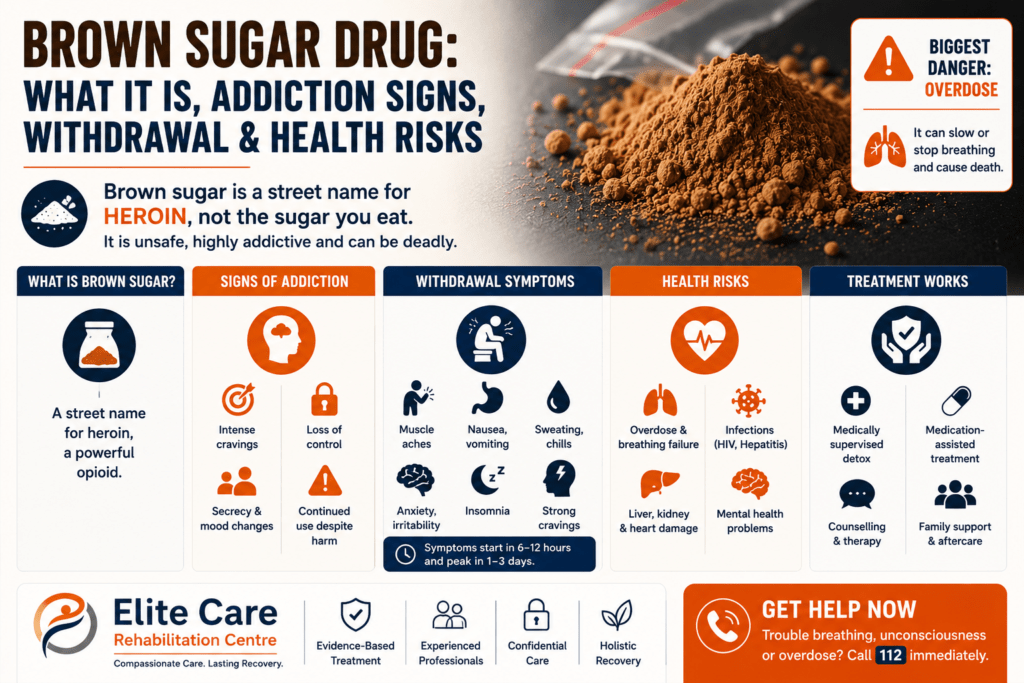
Brown sugar drug is a street term commonly used in India for heroin, often sold as a brown or beige powder whose strength and contents cannot be judged by appearance. Families consulting a Nasha Mukti Kendra in Mumbai should expect the assessment to identify opioid use, physical dependence, withdrawal, overdose risk and opioid use disorder rather than relying only on the street name. A product sold as brown sugar may contain heroin, cutting agents or other substances that change its effects and medical risks.
The most urgent danger is opioid overdose. Brown sugar can slow breathing, reduce consciousness and cause death. Regular use can also lead to tolerance, withdrawal, strong cravings and continued use despite serious harm.
This guide explains what brown sugar means in India, how it relates to heroin, the signs of recent use and addiction, possible withdrawal symptoms, overdose warning signs, long-term health risks and evidence-based treatment.
What is brown sugar drug?
Brown sugar drug is generally a street name for heroin in India. It is not the brown sugar used in food, and it is not a separate, medically standardised drug with a predictable composition.
The Government of India’s Nasha Mukt Bharat Abhiyaan substance-use information lists Brown Sugar, Smack, Chitta, Piece and No. 4 among local names associated with heroin.
These names may help a clinician understand what a person believes they used. They cannot confirm the chemical contents, purity or strength of a particular powder.
The colour may reflect manufacturing impurities or substances added during illicit production and distribution. It cannot reliably indicate purity, strength or safety.
Brown sugar drug in India
Brown sugar is frequently discussed in India as a street opioid. A Press Information Bureau release on opioid dependence distinguishes prescription opioids such as codeine, tramadol, tapentadol and morphine from street opioids such as heroin and brown sugar.
India’s opioid-use pattern also includes opium and pharmaceutical opioids. A person may move between brown sugar, heroin, opium and prescription medicines according to availability, cost or an attempt to avoid withdrawal.
The official National Survey on Extent and Pattern of Substance Use in India, released by NDDTC, AIIMS New Delhi and the Ministry of Social Justice and Empowerment in 2019, identified heroin as an important part of India’s opioid-use pattern. These findings relate to the survey period and should not be presented as a current 2026 prevalence count.
Street terminology also varies by region. Searches for smack drug addiction or chitta addiction may refer to heroin-related opioid use, but the reported name alone cannot prove what was consumed.
Brown sugar and heroin difference
The brown sugar and heroin difference is usually one of street terminology, appearance and uncertain composition rather than two completely separate drug classes.
| Term | Common meaning | What the term cannot confirm |
|---|---|---|
| Brown sugar | A street term commonly used in India for heroin or a product sold as heroin, often appearing as a brown or beige powder | Purity, potency, ingredients or overdose risk |
| Heroin | An illicit opioid also known chemically as diacetylmorphine | The contents or strength of an untested street sample |
| Smack, Chitta, No. 4 or Piece | Local street names commonly associated with heroin | Whether a product contains heroin alone, another opioid or a mixture |
| Opium | A poppy-derived product containing naturally occurring opioid compounds | That it is safer or unable to cause dependence and overdose |
A laboratory analysis is needed to establish what an unknown sample contains. Neither its name, price, colour, smell nor the user’s experience can provide a reliable chemical identification.
Why the contents of brown sugar can be unpredictable
Illicit drugs do not pass through the manufacturing, quality-control and labelling systems used for authorised medicines. Their contents may change between sellers, locations and individual batches.
Street heroin may be mixed with substances intended to increase volume, alter its appearance or change its perceived effects. Some mixtures may expose the person to additional sedating or toxic substances.
An Indian clinical report on adulterants in street heroin described an analysed adulterant containing benzodiazepines and barbiturates alongside caffeine and acetaminophen. The patient developed sedation, weakness, poor balance, slurred speech, cognitive problems and disinhibited behaviour.
This was a clinical case report and does not establish what every brown sugar sample contains. It does demonstrate why clinicians should not assume that all symptoms are caused by heroin alone.
Unexpected drowsiness, confusion, seizures, hallucinations, abnormal behaviour or an unusually prolonged period of intoxication may point to mixed substances, another medical condition or an adulterant.
How brown sugar affects the brain and body
When a product contains heroin, it acts as an opioid. Opioids interact with receptors involved in pain, reward, sedation and breathing.
Possible short-term brown sugar drug effects include:
- Euphoria or a brief feeling of intense relief
- Drowsiness
- Reduced alertness
- Very small pupils
- Slowed speech and movement
- Reduced coordination
- Itching
- Nausea or vomiting
- Constipation
- Slowed or irregular breathing
The experience varies according to the actual contents, amount, tolerance, route of use, physical health and whether alcohol, sleeping pills or other drugs were also taken.
Someone who appears sleepy after using an opioid may be experiencing ordinary sedation, severe intoxication or an evolving overdose. The difference cannot always be judged safely without checking breathing and responsiveness.
Brown sugar drug side effects
Brown sugar drug side effects can affect breathing, digestion, consciousness, coordination and judgement. Some appear soon after use, while others develop after repeated exposure.
Possible immediate side effects include:
- Sleepiness and reduced awareness
- Slow reaction time
- Loss of balance
- Nausea and vomiting
- Itching or flushing
- Difficulty passing urine
- Constipation
- Reduced breathing rate
- Loss of consciousness
Repeated use can be associated with:
- Tolerance
- Physical dependence
- Strong cravings
- Repeated withdrawal
- Declining nutrition and self-care
- Persistent constipation
- Sleep and mood problems
- Financial and relationship harm
- Overdose
Some reported side effects may come from another substance mixed with the heroin. A person whose symptoms are unusual, severe or changing should receive medical assessment rather than being managed according to assumptions about brown sugar.
Signs of recent brown sugar use
Possible signs of recent opioid intoxication include:
- Very small or pinpoint pupils
- Repeatedly falling asleep during conversation
- A drooping head or “nodding” appearance
- Slow, quiet or unclear speech
- Reduced coordination
- Unusual calmness or detachment
- Itching or scratching
- Nausea
- Slowed breathing
- Reduced response to questions or touch
These signs do not confirm brown sugar use. Sedative medicines, head injury, low blood sugar, stroke, infection and other medical conditions can cause similar changes.
Breathing difficulty or inability to wake the person must be treated as an emergency rather than as proof that the person is merely sleeping.
Brown sugar addiction symptoms
Brown sugar addiction symptoms are identified from a continuing pattern, not from one episode of intoxication or one positive drug test.
Possible warning signs include:
- Strong cravings for brown sugar or another opioid
- Using more frequently or in larger amounts than intended
- Repeated unsuccessful attempts to stop
- Using mainly to prevent withdrawal
- Spending substantial time obtaining, using or recovering from the drug
- Missing work, education or family responsibilities
- Giving up important activities
- Keeping drug use secret
- Unexplained spending, borrowing or selling belongings
- Continuing despite overdose, illness or relationship damage
- Using in situations where loss of consciousness could be especially dangerous
- Returning to use soon after detoxification or rehabilitation
The broader guide to drug addiction symptoms explains why physical, behavioural and financial changes should be assessed together instead of being used as proof of a particular drug.
Tolerance, dependence and brown sugar addiction are different
Tolerance
Tolerance means that repeated opioid exposure has reduced the effect of the earlier amount. The person may increase use to experience the desired effect or to prevent withdrawal.
Tolerance does not protect against overdose. It may be incomplete, change rapidly and fall during abstinence.
Physical dependence
Physical dependence means that the body has adapted to regular opioid exposure and withdrawal may develop when use stops or is substantially reduced.
Physical dependence can also occur during correctly supervised opioid treatment. It does not automatically establish an addiction diagnosis.
Opioid use disorder
Brown sugar addiction is clinically assessed as a possible opioid use disorder. The diagnosis considers impaired control, cravings, risky use, harm to daily functioning and continued use despite consequences.
The main opioid addiction guide explains how heroin, opium and pharmaceutical opioid problems are assessed and treated.
Brown sugar drug health risks
The most serious brown sugar drug health risks come from opioid overdose, unpredictable contents, unsafe combinations and complications associated with the way the drug is taken.
Breathing suppression and overdose
Heroin can suppress the part of the brain that regulates breathing. A person may become unconscious while breathing becomes very slow, irregular or absent.
Aspiration
An unconscious person can vomit and inhale the vomit into the lungs. Food, water, coffee or tablets should not be forced into the mouth of someone who is not fully conscious.
Infections and injecting-related harm
Where opioids are injected, possible risks include:
- Skin and soft-tissue infections
- Abscesses
- Damaged veins
- Bloodstream infection
- Heart-valve infection
- Hepatitis B or hepatitis C
- HIV transmission through shared injecting equipment
These complications need direct medical care. Fever, increasing redness, swelling, severe pain, pus, chest symptoms or general weakness should not be ignored.
Injury and impaired judgement
Drowsiness and poor coordination can lead to falls, road accidents, burns, drowning and injuries at work. Driving after opioid use is unsafe.
Constipation and nutritional problems
Persistent opioid use may cause severe constipation. Irregular meals, vomiting, poor self-care and financial problems can also affect nutrition and general health.
Mental-health risks
Depression, anxiety, trauma, shame and social isolation may occur alongside opioid addiction. Suicidal thoughts require urgent assessment, whether they appear during use, withdrawal or a period of personal crisis.
Why alcohol and sleeping pills increase the danger
Alcohol, benzodiazepines, sleeping medicines, barbiturates and other sedating substances can also reduce alertness and suppress breathing.
Combining them with brown sugar can increase the risk of:
- Extreme drowsiness
- Poor balance and falls
- Memory loss
- Vomiting while unconscious
- Slow or absent breathing
- Coma
- Fatal overdose
The person may not disclose every substance used. Families should share all known alcohol, medicine and drug use with the clinical team.
Brown sugar overdose symptoms
The World Health Organization’s opioid-overdose guidance identifies three characteristic signs: very small pupils, unconsciousness and difficulty breathing.
Possible brown sugar overdose symptoms include:
- Inability to wake the person
- Very slow, irregular or absent breathing
- Choking, gurgling or unusual snoring sounds
- Blue, grey or unusually pale lips and fingertips
- A limp body
- Very small pupils
- No meaningful response to speech or touch
- Collapse after known or suspected opioid use
Not every overdose shows every sign. Pupil size may also be affected by other drugs or medical conditions.
What to do during a suspected brown sugar overdose
- Call 112 in India immediately.
- Follow the emergency operator’s instructions.
- If naloxone is available, administer it according to its product instructions.
- Support breathing or provide basic life support if instructed and able to do so.
- If the person is breathing but unconscious, place them on their side when it is safe.
- Remain with the person until emergency assistance arrives.
Naloxone can temporarily reverse an opioid overdose. Its effect may wear off while heroin or another opioid remains active, so emergency medical assessment is still necessary.
Do not make the person walk, put them in a cold shower, induce vomiting or force coffee, food or fluids into their mouth.
Brown sugar withdrawal symptoms
Brown sugar withdrawal symptoms may develop when regular heroin-like opioid use is stopped or substantially reduced.
Common heroin withdrawal symptoms include:
- Yawning
- Watery eyes
- A runny nose
- Sweating
- Restlessness and anxiety
- Dilated pupils
- Goosebumps
- Muscle and joint pain
- Abdominal cramps
- Nausea or vomiting
- Diarrhoea
- Disturbed sleep
- Strong cravings
The symptoms can feel severe and may drive rapid return to use. Vomiting and diarrhoea can cause dehydration, particularly when the person is already physically unwell.
Opioid withdrawal does not usually produce the same seizure or delirium syndrome associated with abrupt withdrawal from alcohol, benzodiazepines or certain other sedatives. However, the brown sugar supply may contain unexpected substances, and some people use several drugs together.
A seizure, severe confusion or hallucination should not be dismissed as ordinary heroin withdrawal.
Brown sugar withdrawal timeline
There is no guaranteed brown sugar withdrawal timeline because the actual substance, strength, pattern of use and additional drugs may be uncertain.
When the product mainly behaves like a short-acting opioid such as heroin, symptoms may begin within several hours after the last use, become more intense over the next two or three days and improve over approximately one week. Sleep disturbance, low mood and cravings can continue for longer.
| Stage | Possible experience | Important caution |
|---|---|---|
| Early phase | Yawning, watery eyes, runny nose, anxiety, sweating and cravings may begin | Another substance may delay, hide or change the symptoms |
| More intense phase | Pain, restlessness, vomiting, diarrhoea, insomnia and strong cravings may become prominent | Dehydration, pregnancy, serious illness and psychological crisis require assessment |
| Physical improvement | Acute physical symptoms may gradually settle | Reduced tolerance can increase overdose risk if opioid use resumes |
| Continuing recovery | Sleep problems, low mood, anxiety and cravings may continue | These symptoms need review because they may also reflect another mental or physical condition |
The complete guide to drug withdrawal symptoms explains why different substances follow different timelines and why mixed-substance withdrawal can be difficult to predict.
When withdrawal needs urgent medical care
Urgent assessment is required when withdrawal is accompanied by:
- A seizure
- Severe confusion
- Hallucinations
- Suicidal intent
- Repeated vomiting with inability to keep fluids down
- Signs of serious dehydration
- Chest pain
- Collapse
- Pregnancy
- Serious physical illness
- Use of alcohol, sleeping pills or other sedatives
- Uncertainty about what the powder contained
A timeline found online cannot determine whether stopping at home is safe.
Why home detox can fail
Families may expect withdrawal to end after a fixed number of days. This overlooks the risk of dehydration, concealed sedative use, severe cravings, mental-health problems and overdose after a return to use.
Home detox may also fail because:
- The person can easily obtain more opioids.
- The amount and timing of the last dose may be uncertain.
- Another drug may be involved.
- Symptoms may be treated with borrowed sleeping pills.
- Medical deterioration may not be recognised.
- No continuing treatment is arranged after withdrawal.
Family members should not create medication schedules, provide alcohol to manage symptoms or give medicines prescribed to another person.
How brown sugar addiction is assessed
A complete assessment looks beyond the word “brown sugar”. It may examine:
- The street name used by the person
- Uncertainty about the powder’s contents
- Frequency and approximate amount
- How the substance was taken
- Time of the most recent use
- Cravings and loss of control
- Tolerance and withdrawal
- Past overdose
- Previous treatment attempts
- Alcohol and sedative use
- Prescription medicines
- Pain and other medical conditions
- Depression, trauma, psychosis and suicide risk
- Pregnancy where relevant
- Housing, employment and family support
The clinical diagnosis considers impaired control, cravings, risky use, disruption of daily responsibilities and continued use despite harm.
A person should not be diagnosed only because relatives found a powder, because a screening test was positive or because withdrawal occurred.
What drug tests can and cannot show
A urine or blood test may help identify recent exposure to certain opioids or other substances. It may not show:
- Every synthetic opioid
- Every adulterant
- The purity of the product
- The exact amount used
- The severity of addiction
- The complete withdrawal risk
- Whether residential care is necessary
Test results should be interpreted with the history, examination and observed symptoms.
Brown sugar addiction treatment
Brown sugar addiction treatment should address both immediate opioid risk and the continuing pattern that makes return to use likely.
The treatment plan may include:
- Medical assessment and stabilisation
- Withdrawal management
- Medication for opioid use disorder where clinically appropriate
- Overdose education and naloxone planning where available
- Individual counselling
- Family counselling
- Psychiatric treatment
- Structured rehabilitation
- Relapse-prevention planning
- Continuing follow-up after discharge
The wider guide to drug addiction treatment explains how medical care, counselling, psychiatric support and rehabilitation can be combined.
Medication-based heroin addiction treatment
Medication is a central evidence-based treatment option for opioid use disorder. Internationally used medicines include:
- Methadone
- Buprenorphine
- Naltrexone for appropriately selected patients after an opioid-free period
The medicine and treatment setting depend on the person’s health, withdrawal state, other substance use, previous treatment response, informed preferences and local clinical availability.
No patient or relative should start, share, stop or change these medicines without qualified medical supervision. Introducing certain opioid-treatment or opioid-blocking medicines at an unsuitable time can precipitate severe withdrawal.
The CDC guidance on opioid-use-disorder treatment states that medication treatment is associated with lower overdose risk and mortality. It also explains that detoxification without medication treatment is not recommended as the sole treatment for opioid use disorder because renewed use, overdose and overdose-death risks remain.
Counselling and rehabilitation
Medication can reduce withdrawal and cravings, but recovery may also require work on:
- Triggers and drug-related routines
- Stress and emotional regulation
- Depression, anxiety or trauma
- Family conflict
- Debt and financial instability
- Employment or education
- High-risk relationships and locations
- Daily structure
- Response to cravings
- Follow-up after discharge
Counselling should support medication rather than replace it when medication is clinically indicated.
A decision not to participate in counselling should not automatically prevent or delay evidence-based medication for opioid use disorder. Psychosocial support should remain available according to the patient’s needs.
Brown sugar de-addiction treatment is more than detox
Brown sugar de-addiction treatment is sometimes understood as completing a few days of withdrawal and returning home. That approach leaves several major risks unaddressed.
After acute withdrawal:
- Cravings may continue.
- Access to the drug may remain unchanged.
- Mental-health problems may still require treatment.
- Family conflict may continue.
- Tolerance may have fallen.
- A return to the previous amount may cause overdose.
Detoxification is an early medical stage. Rehabilitation and continuing care address the behavioural, psychological and social factors connected with repeated opioid use.
Relapse and overdose after reduced tolerance
Overdose risk can increase after a period without opioids because tolerance may fall faster than cravings and learned behaviour.
High-risk periods include:
- After detoxification
- After leaving residential treatment
- After hospital admission
- After release from custody
- After several opioid-free weeks or months
- After medication treatment is interrupted
A person may return to an amount that they previously used without experiencing an immediate overdose. After tolerance has fallen, that same amount may suppress breathing and become fatal.
A lapse or relapse should lead to immediate safety assessment, treatment review and overdose-prevention planning rather than humiliation or automatic discharge from care.
How families can respond
Families can help by providing accurate information and responding quickly to changes in breathing, consciousness or behaviour.
Useful information includes:
- Known street names and substances
- The approximate time of the last use
- Previous overdose
- Previous withdrawal
- Alcohol and sleeping-pill use
- Prescription medicines
- Earlier treatment and why it ended
- Suicidal statements
- Recent illness, injury or infection
Families should avoid:
- Public humiliation
- Physical confrontation during intoxication
- Forcing abrupt withdrawal at home
- Giving borrowed sedatives or pain medicines
- Allowing an intoxicated person to drive
- Leaving an unconscious person alone
- Assuming naloxone removes the need for emergency care
- Stopping prescribed treatment as punishment
Relatives should not physically restrain a severely intoxicated, agitated or psychotic person unless it is immediately necessary to prevent serious harm and no safer option is available. Move other people to safety, avoid confrontation and call 112 when the situation cannot be managed safely.
Frequently asked questions
What is brown sugar drug?
Brown sugar drug is a street term commonly used in India for heroin. The term does not reliably identify the product’s purity, strength or additional ingredients.
Is brown sugar the same as heroin?
Brown sugar is commonly used in India as a street name for heroin. However, a product sold under this name may contain impurities, added substances, another opioid or a mixture. The name and appearance alone cannot confirm its contents.
Is brown sugar safer than heroin?
No. A brown colour or lower assumed purity does not make an opioid product safe. Uncertain strength, adulterants, sedative combinations and reduced tolerance can all contribute to fatal overdose.
What are common brown sugar addiction symptoms?
Possible signs include cravings, increasing use, failed attempts to stop, withdrawal, neglect of responsibilities, unexplained spending and continued use despite overdose or other serious harm.
What are the effects of brown sugar drug?
Possible effects include euphoria, drowsiness, small pupils, itching, nausea, constipation, reduced alertness and slowed breathing. Effects may differ when the product contains other substances.
What are common brown sugar withdrawal symptoms?
They include yawning, watery eyes, a runny nose, sweating, anxiety, restlessness, muscle pain, abdominal cramps, vomiting, diarrhoea, insomnia and cravings.
How long does brown sugar withdrawal last?
When the product behaves like short-acting heroin, withdrawal may begin within several hours, become strongest over the next two or three days and improve over approximately one week. Individual timelines vary, especially when other substances are involved.
Can brown sugar withdrawal cause seizures?
Seizures are not a typical feature of uncomplicated heroin withdrawal. They may indicate sedative or alcohol withdrawal, an adulterant, poisoning, head injury or another medical condition and require urgent assessment.
What are the signs of brown sugar overdose?
Major signs include inability to wake, very slow or absent breathing and very small pupils. Choking or gurgling sounds, collapse and blue or grey lips also require immediate emergency action.
What should be done during a suspected overdose?
Call 112 immediately. Use naloxone according to its product instructions when available, follow the emergency operator’s directions and remain with the person until help arrives.
Can brown sugar addiction be treated with medication?
Yes. Evidence-based opioid-use-disorder medicines used internationally include methadone, buprenorphine and naltrexone for appropriately selected patients. Treatment must be planned and monitored by qualified clinicians.
Is detox enough for brown sugar addiction?
No. Detoxification manages the immediate withdrawal phase but does not fully address cravings, reduced tolerance, triggers, mental health or overdose risk after renewed use.
Can a urine test confirm brown sugar addiction?
No. A test may support evidence of recent opioid exposure, but it cannot independently diagnose addiction, establish product purity or determine the correct treatment setting.
Does relapse mean treatment has failed?
No. Renewed use signals the need for an immediate safety review and adjustment of the treatment plan. It is particularly dangerous after abstinence because opioid tolerance may have fallen.
Brown sugar addiction requires opioid-specific treatment
Brown sugar drug is not a harmless or weaker version of an illicit substance. In India, it is generally a street name for heroin, but its actual contents and strength may be uncertain.
The most immediate danger is overdose from slowed breathing. Repeated use can also lead to tolerance, withdrawal, strong cravings, declining health and continued use despite serious consequences.
Effective brown sugar addiction treatment begins with accurate assessment. It identifies every opioid and other substance involved, checks overdose and withdrawal risk, distinguishes physical dependence from opioid use disorder and connects detoxification with medication, counselling, rehabilitation and continuing care.
Medical disclaimer: This article provides general educational information and does not replace individual medical assessment, diagnosis or treatment. Call 112 in India or go to the nearest emergency department for slow or absent breathing, inability to wake, blue or grey lips, collapse, seizures, severe confusion, suspected overdose, suicidal intent, serious injury or behaviour that cannot be managed safely.
