
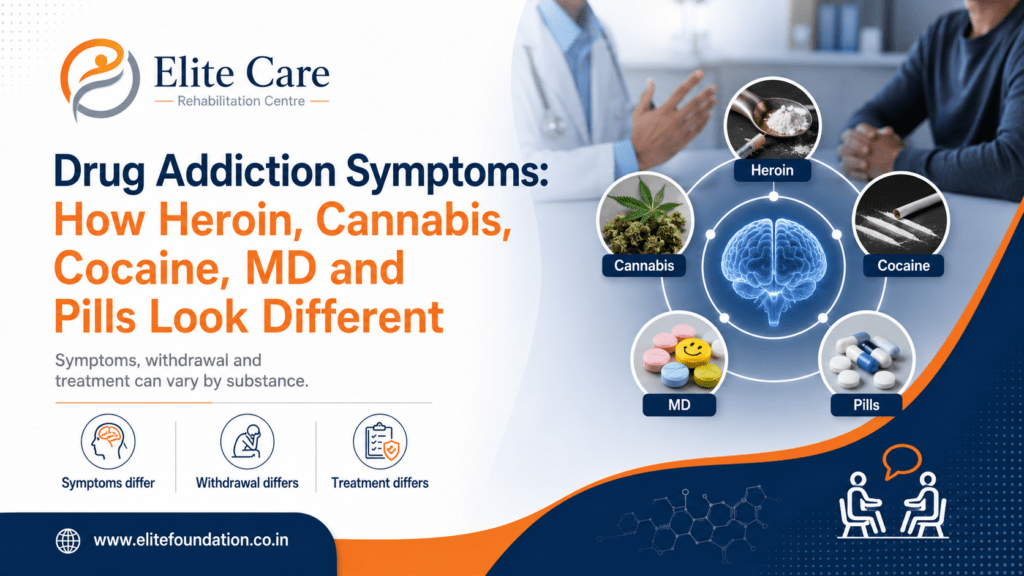
Drug addiction symptoms can differ greatly depending on whether a person is using heroin, cannabis, cocaine, MD or prescription pills. Families approaching a drug rehabilitation centre in Mumbai may notice sleep changes, secrecy, missing money, unusual energy, extreme drowsiness or sudden aggression, but these signs do not identify the substance by themselves. Heroin can suppress breathing, cocaine and MD may cause agitation and sleeplessness, cannabis can affect memory and judgement, while some pills can cause sedation or dangerous withdrawal. Recognition should lead to assessment, not confrontation or a diagnosis made at home.
One person may repeatedly fall asleep during conversations. Another may remain awake for two nights, talk rapidly and become suspicious. Someone using cannabis may appear forgetful or withdrawn, while a person dependent on sleeping pills may look settled until a delayed dose leads to shaking, anxiety or confusion.
These differences matter because intoxication, withdrawal, addiction and overdose are not the same. Each requires a different response.
Drug addiction symptoms are not identical across substances
The term drug addiction symptoms can describe several different kinds of change:
- Effects while a substance is active
- Symptoms that develop as its effects wear off
- Withdrawal after regular use is reduced or stopped
- Longer behavioural patterns associated with addiction
- Medical or psychiatric complications
- Signs of overdose or another emergency
A person can show obvious intoxication without having developed addiction. Another may have a serious substance use disorder while appearing relatively normal between episodes of use.
The earlier guide to the types of drug addiction explains why the substance changes withdrawal risk, overdose danger and treatment. This article focuses on what relatives may notice and how those observations should be interpreted.
How to identify drug addiction without making assumptions
Families often search for how to identify drug addiction after noticing one dramatic change. A single symptom rarely provides a reliable answer.
Red eyes do not automatically prove cannabis use. Small pupils do not confirm heroin use. Weight loss does not establish stimulant addiction. Drowsiness can result from prescribed treatment, sleep deprivation, illness or several different substances.
Concern becomes stronger when several changes form a repeated pattern:
- The behaviour is new or unexplained.
- It appears after particular outings, calls or payments.
- Work, studies, health or relationships are deteriorating.
- The person becomes secretive about money, medicines or whereabouts.
- Attempts to reduce use repeatedly fail.
- Cravings or withdrawal appear when the substance is unavailable.
- Use continues despite accidents, overdose or serious consequences.
Learning how to identify drug addiction means observing the wider pattern, checking immediate safety and arranging a professional assessment. It does not mean accusing the person publicly or attempting to identify an unknown powder by tasting or closely smelling it.
Early physical and behavioural signs of drug addiction
The early signs of drug addiction often affect routine, appearance and behaviour before clear medical illness becomes visible. These changes can also occur with stress, depression, sleep disorders or other health conditions, so they should not be treated as proof by themselves.
Physical signs of drug addiction
- Marked weight or appetite changes
- Unusual drowsiness or prolonged wakefulness
- Poor balance or slurred speech
- Repeated nose irritation or nosebleeds
- Injection marks or recurring skin infections
- Jaw clenching or repetitive movements
- Persistent cough or breathing problems
- Changes in pupil size
- Unexplained sweating, shaking or vomiting
- Frequent injuries or falls
Behavioural signs of drug addiction
- New secrecy about friends, phone calls or travel
- Frequent unexplained absences
- Declining work or academic performance
- Missing cash, medicines or valuables
- Strong mood swings or unusual suspiciousness
- Neglect of meals, hygiene or responsibilities
- Changing social groups around access to drugs
- Risky driving or unexplained accidents
- Repeated failed efforts to reduce use
- Continued use despite physical, emotional or family harm
The following substance-specific signs may reflect intoxication, repeated use, withdrawal or addiction. None can confirm a substance use disorder on its own.
Heroin addiction symptoms
Heroin is an opioid. Its immediate effects can include relaxation, pain relief, euphoria and marked sleepiness. It can also slow breathing to a fatal level.
Possible heroin addiction symptoms and recent-use signs include:
- Repeatedly becoming unusually sleepy or “nodding off”
- Very small pupils
- Slowed movement and speech
- Reduced alertness
- Constipation
- Itching or scratching while intoxicated
- A chronic runny nose when heroin is snorted
- Injection marks, damaged veins or skin infections when injected
- Needing frequent doses to avoid feeling ill
- Strong cravings and loss of control over use
The NIDA overview of opioids explains that heroin belongs to the opioid drug class and that opioid use can lead to addiction and life-threatening overdose.
When heroin use may be an overdose
Call 112 in India immediately when the person:
- Cannot be woken
- Has very slow, irregular or absent breathing
- Makes choking, snoring or gurgling sounds
- Has blue, grey or unusually pale lips or fingertips
- Has a limp body or does not respond to speech or touch
Do not assume that the person is simply sleeping. Do not leave them alone or force food, fluids or tablets into their mouth.
If naloxone is available, administer it according to the product instructions while emergency help is being arranged. Its effect may wear off, so emergency medical care is still required.
Follow the emergency operator’s instructions. If the person is breathing but unconscious, place them on their side when it is safe to do so and remain with them until help arrives.
Heroin withdrawal signs
When heroin is stopped after physical dependence has developed, drug withdrawal symptoms may include:
- Yawning
- Runny nose and watery eyes
- Sweating
- Dilated pupils
- Restlessness and anxiety
- Muscle and bone pain
- Abdominal cramps
- Vomiting or diarrhoea
- Insomnia
- Strong cravings
Heroin withdrawal can be intensely distressing. Dehydration, pregnancy, serious physical illness, severe psychological distress and rapid return to use can create substantial danger. Tolerance may fall after abstinence, making a previously used amount capable of causing overdose.
Cannabis addiction symptoms
Cannabis effects vary according to THC strength, the amount used, whether it was smoked or eaten, previous experience and the use of alcohol or other drugs.
Possible cannabis addiction symptoms and recent-use signs include:
- Red or irritated eyes
- Slower reaction time
- Impaired coordination
- Difficulty following a conversation
- Short-term memory problems
- An altered sense of time
- Increased appetite
- Anxiety, panic or suspiciousness
- Repeated use despite problems at home, work or college
- Difficulty reducing use
These signs are not specific to cannabis. Red eyes, reduced motivation or forgetfulness alone do not establish a cannabis use disorder.
Cannabis addiction symptoms become more meaningful when use has become difficult to control, responsibilities are being neglected and the person continues despite psychological, social or safety problems.
Cannabis withdrawal
After frequent use stops, cannabis withdrawal may include:
- Irritability
- Anxiety
- Restlessness
- Reduced appetite
- Disturbed sleep
- Vivid dreams
- Low mood
- Cravings
Cannabis withdrawal is not usually associated with the same seizure or delirium risk as sedative withdrawal. Severe panic, psychosis, suicidal thoughts or inability to function still require clinical assessment.
High-potency cannabis and edible products
High-potency cannabis products may increase the likelihood or intensity of anxiety, confusion and impairment in some users.
Edible cannabis can have delayed effects. A person may consume more before the first dose has fully taken effect, increasing the risk of severe intoxication.
Severe confusion, collapse, chest pain, dangerous behaviour or inability to remain safe needs urgent medical attention, particularly when the contents of the product are uncertain.
Cocaine addiction symptoms
Cocaine is a stimulant. Its effects can be brief, which may lead to repeated use over several hours.
Possible cocaine addiction symptoms and recent-use signs include:
- Unusually high energy and confidence
- Rapid or excessive speech
- Reduced need for sleep
- Reduced appetite
- Dilated pupils
- Sweating
- A fast pulse or raised blood pressure
- Restlessness or repetitive behaviour
- Irritability, aggression or suspiciousness
- Repeated disappearing and unexplained spending
If cocaine is snorted, there may be frequent nose irritation, nosebleeds, loss of smell or repeated sniffing. Smoking or injecting it creates different physical risks and may produce a more rapid effect.
Cocaine addiction symptoms can be followed by a marked crash involving exhaustion, low mood, increased appetite, disturbed sleep and cravings.
Cocaine-related emergencies
Call 112 or go to the nearest emergency department for:
- Chest pain
- Collapse
- A seizure
- Very high body temperature
- Severe agitation or paranoia
- Sudden weakness, facial drooping or difficulty speaking
- A severe headache with neurological changes
- Suicidal behaviour
A young age does not rule out a cocaine-related heart or brain emergency.
Cocaine withdrawal and the crash
Cocaine withdrawal may not produce the visible shaking or vomiting associated with some other substances. The psychological effects can still be serious.
Possible symptoms include:
- Extreme tiredness
- Long periods of sleep or disrupted sleep
- Low motivation
- Depression
- Irritability
- Difficulty concentrating
- Increased appetite
- Strong cravings
- Suicidal thoughts
A person who becomes severely depressed, psychotic or suicidal during a stimulant crash should not be left alone while urgent help is arranged.
MD drug addiction symptoms
In Indian street terminology, “MD” often refers to mephedrone, also known as 4-MMC, but the abbreviation can also be understood as MDMA. These are different substances, and the street name alone cannot establish what a powder contains.
A 2026 Indian Journal of Psychiatry article on “MD” terminology describes this confusion in Indian addiction practice and explains why clinicians should clarify what the person means instead of assuming the substance’s identity.
Street terminology remains unreliable. A product sold as MD may contain mephedrone, MDMA, another stimulant or a mixture of substances.
Possible signs associated with stimulant-type use of a product sold as MD include:
- Increased energy and talkativeness
- Reduced need for sleep
- Reduced appetite
- Increased confidence or sociability
- Rapid pulse
- Sweating
- Jaw clenching or teeth grinding
- Restlessness
- Taking repeated doses over a short period
- Anxiety, irritability or suspiciousness
- Strong cravings and compulsive use
A concerning pattern may become more noticeable through repeated nights without sleep, unexplained spending, disappearing for long periods, compulsive use and a severe emotional or physical crash afterwards.
MD, MDMA and unknown powders
Mephedrone and MDMA are different substances, although some of their reported effects can overlap. Neither the person’s experience nor the colour, texture or appearance of a powder can confirm its contents.
Families cannot safely identify these substances through a street name. A product sold as MD may contain stimulants, sedatives, synthetic opioids or other compounds.
Do not taste or closely smell an unknown powder. Avoid unnecessary handling, keep available packaging away from children and share relevant information with clinicians or emergency responders.
When stimulant-type MD use becomes an emergency
Urgent medical help is needed for:
- Chest pain
- Collapse
- A seizure
- Very high body temperature
- Severe agitation
- Hallucinations or extreme paranoia
- Loss of consciousness
- Breathing difficulty
- Dangerous or violent behaviour
Move other people to safety, avoid confrontation and call 112 when severely agitated behaviour cannot be managed safely.
Prescription medicine misuse and addiction symptoms
“Pill addiction” is not one pharmacological category. Prescription pill addiction symptoms depend on whether the medicine is an opioid pain medicine, sedative, sleeping pill, anti-anxiety medicine, stimulant or another type of drug.
Sedative and sleeping-pill symptoms
Possible signs include:
- Excessive drowsiness
- Slurred speech
- Poor balance
- Repeated falls
- Memory gaps
- Confusion
- Taking more tablets than prescribed
- Running out of medicine early
- Combining tablets with alcohol or opioids
Suddenly stopping benzodiazepines or certain other sedatives after dependence has developed can cause severe anxiety, tremor, hallucinations, seizures or delirium. Families should not create their own reduction schedule or substitute another tablet.
Prescription opioid symptoms
Opioid pain medicines may cause sleepiness, small pupils, constipation, slowed breathing and withdrawal when a dose is delayed. Overdose risk increases when they are combined with alcohol, sleeping pills or other sedatives.
Prescription stimulant symptoms
Misused stimulant medicines may cause prolonged wakefulness, rapid speech, reduced appetite, agitation, suspiciousness, raised pulse and a later crash involving exhaustion or depression.
Other prescription medicine misuse and addiction symptoms may include:
- Using someone else’s prescription
- Taking larger or more frequent doses than directed
- Crushing or changing how a tablet is taken
- Seeking additional supplies without coordinated medical care
- Using tablets for intoxication rather than the prescribed purpose
- Continuing despite falls, overdose, memory problems or family harm
A genuine prescription does not rule out misuse or addiction. However, physical dependence can occur during appropriate treatment and does not automatically mean the patient has an addiction.
Why pill appearance cannot identify the drug
A colour, logo or shape is not reliable proof of what a tablet contains. Illicit pills may copy legitimate medicines, contain a different dose or include several substances.
Online photographs and identification tools can also be wrong. When someone is unwell, families should describe the symptoms, packaging and known history to clinicians rather than delaying care while trying to identify a pill.
Intoxication, addiction, withdrawal and overdose are different
Intoxication
Intoxication refers to the immediate effects of a drug. These may include sedation, stimulation, altered perception, impaired coordination or confusion.
Addiction
Addiction involves impaired control, cravings and continued use despite harm. A person may not look intoxicated during every conversation but may still have a serious substance use disorder.
Withdrawal
Withdrawal occurs when the body has adapted to a substance and regular use is reduced or stopped. Drug withdrawal symptoms differ greatly by substance.
Overdose or acute toxicity
An overdose or toxic reaction occurs when a substance overwhelms the body or causes a dangerous medical condition. It can happen during first use, after abstinence, after combining substances or after taking an unexpectedly potent product.
This distinction helps families respond appropriately. Addiction needs treatment, but unconsciousness, slow breathing, seizures or chest pain need emergency care first.
Signs of multiple drug use
Signs of multiple drug use may appear confusing because one substance can hide or alter the effects of another.
Examples include:
- Stimulants being used to stay awake after sedatives
- Sleeping pills being used after cocaine or MD
- Heroin or opioid pills being combined with alcohol
- Cannabis being used alongside unknown tablets
- Several prescription medicines obtained from different sources without coordinated medical care
A person may move from agitation to extreme drowsiness or show a mixture of sweating, confusion, poor balance and abnormal breathing.
Signs of multiple drug use are particularly important because intoxication and withdrawal syndromes can overlap. Combining opioids with alcohol or sedatives can greatly increase the risk of unconsciousness and fatal breathing suppression.
Symptoms of drug abuse and warning signs in daily life
The phrase symptoms of drug abuse is still widely searched, although healthcare professionals increasingly use terms such as drug misuse and substance use disorder.
Drug addiction warning signs may also appear through salary disappearing soon after payment, repeated borrowing, missed work, declining studies, unexplained travel, loss of earlier routines, unsafe driving and repeated promises to stop followed by the same pattern.
Occasional use can cause poisoning or accidents, but a substance use disorder involves a repeated pattern of impaired control, cravings, functional harm or continued use despite consequences.
Discuss specific observations rather than making broad accusations. Saying, “You have missed work three times and have been difficult to wake after returning home,” is more useful than calling the person dishonest or irresponsible.
What families should do when they recognise the signs
Choose a time when the person is alert enough to understand the conversation. Use recent, specific observations rather than insults or labels.
“You have been awake for two nights, missed work and become very suspicious. We are worried that a substance or medicine may be affecting your health. We want you to be assessed today.”
Useful steps include:
- Check for emergency symptoms first.
- Record known medicines and substances.
- Share information about the last known use.
- Keep available packaging without handling unknown powders unnecessarily.
- Do not give alcohol or borrowed medicines to manage withdrawal.
- Do not allow an intoxicated person to drive.
- Arrange a professional assessment promptly.
The wider addiction treatment process may include medical assessment, withdrawal management, psychiatric care, counselling and family involvement.
What families should not do
- Do not force a confession during severe intoxication.
- Do not publicly humiliate the person.
- Do not lock someone alone in a room during possible withdrawal.
- Do not give sleeping pills or sedatives without medical advice.
- Do not tell a dependent person to stop suddenly without assessment.
- Do not taste an unknown powder or tablet.
- Do not assume that apparent sleep is harmless.
Relatives should not attempt to physically restrain a severely agitated, intoxicated or psychotic person unless it is immediately necessary to prevent serious harm and no safer option is available. Move other people to safety, avoid confrontation and call 112 when the behaviour cannot be managed safely.
When drug use becomes an emergency
Call 112 in India or go to the nearest emergency department when there is:
- Slow, irregular or absent breathing
- Inability to wake the person
- Blue or grey lips or fingertips
- A seizure
- Severe chest pain
- Collapse
- Very high body temperature
- Severe confusion or hallucinations
- Sudden weakness or difficulty speaking
- Suspected overdose
- Suicidal intent or a recent self-harm attempt
- Extreme agitation or violent behaviour that cannot be managed safely
When drug use becomes an emergency, do not wait for the person to “sleep it off”. Do not leave an unconscious person alone, force anything into their mouth or allow them to drive.
Why assessment matters even when the substance appears known
A street name does not guarantee the chemical content. A tablet may be counterfeit, a powder may contain several drugs and one person may be using alcohol or prescription medicines alongside the reported substance.
Assessment may consider:
- What was used and how it was taken
- When the last dose was used
- Frequency and approximate quantity
- Alcohol, medicines and other drugs
- Previous overdose or withdrawal
- Breathing, pulse, temperature and awareness
- Depression, psychosis and suicide risk
- Pregnancy and physical illness
- Home safety and available support
A test result may support the assessment but cannot establish addiction severity by itself. Some emerging or synthetic substances may not appear on routine drug screens.
Recognition should lead into substance-specific treatment
The appropriate treatment depends on the substance and the wider clinical picture.
- Opioid use disorder should be assessed for evidence-based medication, counselling, overdose prevention and continuing care.
- Sedative dependence may require a medically supervised reduction rather than abrupt stopping.
- Stimulant treatment may focus on sleep restoration, depression, psychosis, behavioural therapy and contingency management.
- Cannabis treatment may address impaired control, anxiety, sleep and functional problems.
- Unknown or multiple substances may require closer medical observation.
The article on drug addiction treatment explains why detoxification is only one part of care.
Globally, treatment access remains limited. During the official presentation of the UNODC World Drug Report 2026, UNODC estimated that about 8%—roughly 1 in 12—of the 63 million people with drug-use disorders in 2024 had access to some form of treatment. This is a global estimate rather than an India-specific figure, but it shows why early recognition must be followed by practical access to care.
Detox and rehabilitation have different purposes
Detoxification manages intoxication, withdrawal or immediate medical instability. Rehabilitation addresses cravings, behaviour, mental health, relationships, access to substances and relapse risk.
The difference between detox and rehabilitation is especially important when the patient appears physically better after several drug-free days. Visible improvement does not confirm that addiction has resolved.
Frequently asked questions
What are the most common drug addiction symptoms?
Common symptoms include cravings, impaired control, secrecy, sleep changes, declining responsibilities, financial problems and continued use despite harm. Physical effects vary according to the drug.
What are the early signs of drug addiction?
Early signs may include new secrecy, unexplained spending, altered sleep, changing social groups, missed work or studies and repeated failed attempts to reduce use. None confirms addiction alone.
How can families recognise heroin addiction symptoms?
Possible signs include marked sleepiness, small pupils, slowed speech, constipation, withdrawal when a dose is delayed and continued use despite harm. Slow breathing or inability to wake is an emergency.
What do cannabis addiction symptoms look like?
They may include impaired memory, reduced coordination, anxiety, difficulty reducing use and continued use despite work, study or family problems. Red eyes or reduced motivation alone do not establish addiction.
What are common cocaine addiction symptoms?
Possible signs include prolonged wakefulness, rapid speech, reduced appetite, sweating, dilated pupils, unexplained spending, irritability and a later crash involving exhaustion or depression.
What does MD mean in India?
In Indian street terminology, MD often refers to mephedrone or 4-MMC, but the abbreviation can also be understood as MDMA. Because street names and product contents are unreliable, the name alone cannot confirm which substance was used.
What are prescription pill addiction symptoms?
They depend on whether the pill is an opioid, sedative or stimulant. Warning signs include taking more than prescribed, running out early, using someone else’s medicine and continuing despite overdose, falls or memory problems.
When do drug withdrawal symptoms need medical assessment?
Assessment is especially important after regular opioid, sedative or multiple-drug use, or when there is pregnancy, severe illness, hallucinations, seizures, psychosis or suicidal thoughts.
Can appearance confirm which drug someone used?
No. Pupil size, red eyes, weight change, drowsiness and agitation have several possible causes. Substance identification requires history, examination and appropriate testing.
When does drug use become an emergency?
It becomes an emergency when there is slow or absent breathing, inability to wake, a seizure, chest pain, collapse, severe overheating, extreme confusion, suspected overdose, suicidal intent or dangerous agitation.
Recognition is the beginning of assessment, not a diagnosis
Drug addiction symptoms provide important warnings, but they need careful interpretation. Heroin may cause sedation and slow breathing, cannabis can affect memory and judgement, cocaine and a product sold as MD may cause prolonged wakefulness or agitation, and prescription pills can produce very different effects depending on their drug class.
The most reliable signs of drug addiction are not based on appearance alone. They involve impaired control, cravings, functional harm and continued use despite consequences.
Recognising the pattern early allows the family to check safety, seek substance-specific assessment and begin treatment before another overdose, dangerous withdrawal or psychiatric crisis occurs.
Medical disclaimer: This article provides general educational information and does not replace individual medical assessment, diagnosis or treatment. Call 112 in India or go to the nearest emergency department for slow or absent breathing, inability to wake, blue or grey lips, seizures, severe chest pain, collapse, severe confusion, hallucinations, very high body temperature, suspected overdose, suicidal intent, serious injury or violent behaviour that cannot be managed safely.
