
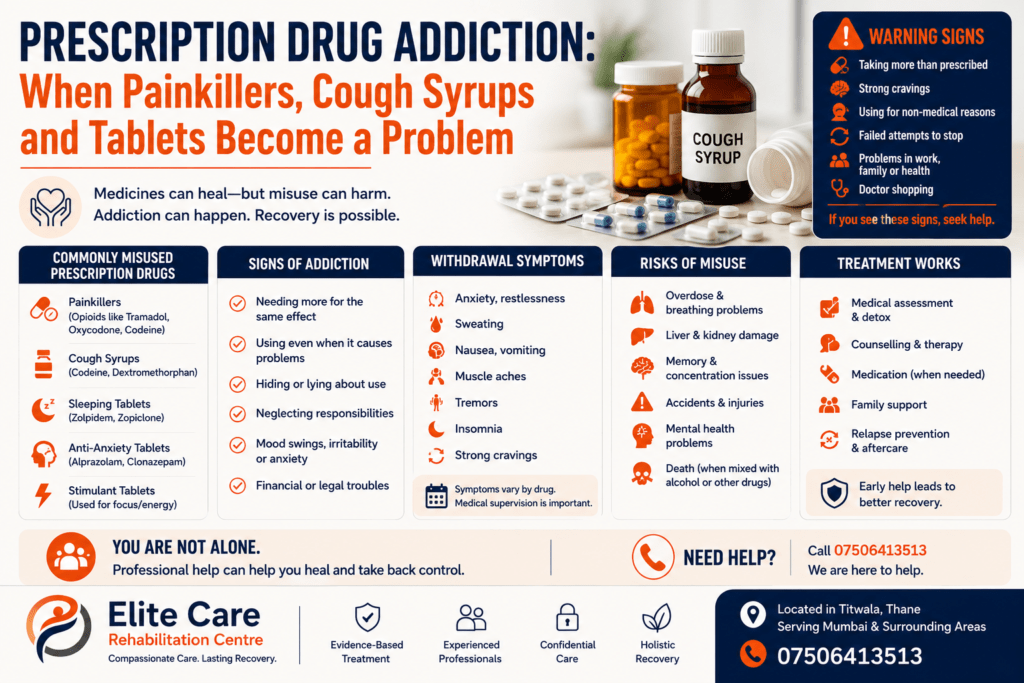
Prescription drug addiction can develop when painkillers, codeine cough syrups, sleeping tablets, anti-anxiety medicines or prescription stimulants begin to be used in ways that are difficult to control. Families looking for a nasha mukti kendra in Thane should expect a medicine-by-medicine assessment that separates prescribed use, physical dependence, misuse and addiction while checking withdrawal, overdose risk, alcohol or drug combinations and the condition for which the medicine was originally prescribed.
Prescription medicines are not inherently dangerous, and taking a medicine for months or years does not automatically mean that a person has an addiction. Many medicines have important medical uses when prescribed appropriately. Concern increases when use moves away from the agreed treatment plan, becomes difficult to control, continues despite harm, or involves repeated self-medication, larger amounts, another person’s prescription or unsafe combinations with alcohol and other drugs.
A person can also become physically dependent on certain medicines while taking them exactly as prescribed. Physical dependence means withdrawal may occur if the medicine is stopped or reduced too quickly. It is not automatically the same as addiction.
When does prescribed medicine become a problem? Warning signs can include repeatedly taking more than prescribed, using tablets for an effect other than the intended medical purpose, obtaining overlapping supplies without informing clinicians, strong cravings, failed attempts to reduce use and continuing despite health, financial, work or relationship consequences.
This guide explains prescription drug misuse involving opioid pain medicines, codeine-containing cough preparations, sleeping medicines, anti-anxiety sedatives and prescription stimulants. It also covers doctor shopping, mixing medicines with alcohol or other drugs, withdrawal risks and how treatment assessment differs according to the medicine involved.
What is prescription drug addiction?
Prescription drug addiction is an umbrella term commonly used when repeated use of a prescribed or prescription-only medicine develops into a substance use disorder.
The clinical diagnosis is not based simply on the fact that a medicine has been taken for a long time. Assessment considers whether use has become difficult to control and whether the person continues despite meaningful harm or risk.
Possible features include:
- Strong cravings
- Using more than intended
- Repeated unsuccessful attempts to reduce or stop
- Spending substantial time obtaining, using or recovering from the medicine
- Neglecting work, education or family responsibilities
- Continuing despite physical or psychological harm
- Using in dangerous situations
- Continuing despite repeated relationship problems
- Developing tolerance
- Experiencing withdrawal after reducing or stopping some medicines
Not every feature needs to be present, and tolerance or withdrawal alone does not establish addiction.
Prescription drug misuse, dependence and addiction are different
The terms prescription drug misuse, prescription drug dependence and prescription drug addiction are often used as though they mean the same thing. They do not.
The National Institute on Drug Abuse definition of prescription drug misuse includes taking a medicine in a manner or dose other than prescribed, taking someone else’s prescription or taking a medicine for an intoxicating effect.
| Term | What it means | Important distinction |
|---|---|---|
| Prescribed use | Taking a medicine according to the agreed clinical plan | Does not automatically imply misuse or addiction |
| Prescription drug misuse | Using a medicine differently from the prescribed directions, taking another person’s medicine or using it for a non-medical effect | Misuse can occur without an established substance use disorder |
| Physical dependence | The body adapts to regular exposure and withdrawal may occur when the medicine is reduced or stopped | Can occur during appropriate medical treatment |
| Addiction or substance use disorder | A pattern involving impaired control, cravings, risky use or continued use despite consequences | Requires broader clinical assessment |
This distinction matters because a patient should not be labelled as addicted merely because a medicine needs to be tapered gradually.
Prescription medicines can have legitimate and important medical uses
Prescription medicines are prescribed because their expected benefits can outweigh their risks for an appropriately selected patient.
Opioids may be used for selected pain conditions. Benzodiazepines have recognised uses in conditions including anxiety and seizures. Sleeping medicines may be prescribed for particular sleep disorders, while stimulants have established roles in conditions such as attention-deficit hyperactivity disorder and narcolepsy.
The presence of addiction potential does not erase these medical uses.
Problems are more likely when:
- The dose is repeatedly changed without medical advice.
- The medicine is taken for a different purpose from the one prescribed.
- Tablets are obtained from friends or relatives.
- Old prescriptions are repeatedly restarted without review.
- Several doctors are approached without disclosing existing prescriptions.
- The medicine is mixed with alcohol or other drugs.
- Use continues despite clear harm.
Prescription drug use in India
India’s official National Survey on Extent and Pattern of Substance Use in India provides useful historical context.
During the 2018 survey period, pharmaceutical opioids accounted for current use among approximately 0.96% of people aged 10–75. The survey also estimated that around 1.08% were current users of sedatives specifically in a non-medical, non-prescription context.
These figures come from a survey conducted in 2018 and reported in 2019. They should not be presented as current 2026 prevalence estimates.
The survey also makes an important distinction: many sedative medicines have legitimate medical uses. Its sedative-use estimates referred specifically to non-prescription and non-medical use rather than every person receiving sedative treatment from a doctor.
Which prescription medicines can become problematic?
Different medicine classes produce different effects, withdrawal syndromes and treatment needs. There is no single condition called “tablet addiction” that should be managed with one standard detox plan.
| Medicine group | Examples of legitimate use | Possible misuse pattern | Important risk |
|---|---|---|---|
| Opioid pain medicines | Selected moderate or severe pain conditions | Extra doses, non-medical use, repeated self-medication or use for euphoria | Breathing suppression and overdose |
| Codeine-containing cough preparations | Selected cough indications where clinically appropriate | Repeated use for opioid effects rather than the intended indication | Opioid dependence, sedation and overdose risk |
| Benzodiazepines and selected dependence-forming sedative-hypnotics | Anxiety, seizures or selected sleep-related indications depending on the medicine | Increasing doses, prolonged self-medication or combining with other depressants | Physical dependence; abrupt withdrawal can be medically dangerous with benzodiazepines and some other dependence-forming sedative-hypnotics |
| Prescription stimulants | ADHD, narcolepsy and selected clinical conditions | Non-prescribed use, extra doses or use for stimulation or performance | Cardiovascular and psychiatric complications |
Opioid painkiller addiction
Some prescription pain medicines are opioids. Depending on the country and clinical setting, examples can include medicines such as morphine, codeine, tramadol and other opioid analgesics.
These medicines can be clinically valuable. They can also cause tolerance, physical dependence and opioid use disorder in some patients.
Possible signs of opioid painkiller addiction include:
- Taking doses earlier than planned
- Regularly taking more than prescribed
- Running out much earlier than expected
- Repeatedly seeking replacement prescriptions
- Strong cravings
- Using primarily to change mood rather than manage the prescribed condition
- Continuing despite excessive sleepiness or previous overdose
- Repeated unsuccessful attempts to reduce use
- Obtaining opioids from several sources
- Using another person’s pain medicine
The article on opioid addiction involving heroin, opium and painkillers explains opioid dependence, overdose and treatment in greater detail.
Pain relief, tolerance and addiction should not be confused
A patient may need a dose review because pain has changed, the medical condition has progressed, tolerance has developed or the medicine is causing side effects.
An increased request for pain relief does not by itself prove addiction.
Assessment should consider:
- The underlying pain condition
- Whether the medicine is still helping
- Functional improvement
- Side effects
- Early refill patterns
- Cravings
- Loss of control
- Use for emotional relief or intoxication
- Other medicines and substances
A patient should not increase an opioid dose independently because the expected pain relief has declined.
Prescription opioid addiction and overdose risk
Opioids can suppress breathing, and overdose can occur even when an opioid was originally prescribed for a legitimate medical reason. Risk varies according to the opioid, dose, tolerance, age, physical health and other medicines or substances being used.
Risk can increase with higher or more frequent doses, taking more than prescribed, reduced tolerance after a period without opioids, certain medical conditions and combining opioids with alcohol, benzodiazepines or other central nervous system depressants.
Possible opioid overdose signs include:
- Inability to wake the person
- Very slow, irregular or absent breathing
- Very small pupils
- A limp body
- Blue, grey or unusually pale lips or fingertips
- Choking, gurgling or unusual snoring sounds
- Collapse or loss of consciousness
Call 112 in India immediately for suspected overdose.
Where naloxone is available, it can temporarily reverse opioid overdose when used according to its instructions. Emergency medical assessment is still necessary because naloxone can wear off while the opioid remains active.
Codeine cough syrup addiction
Codeine is an opioid. Some prescription cough preparations contain codeine, while many other cough syrups do not.
The phrase cough syrup addiction therefore needs clarification. A clinician should identify the exact active ingredients rather than assume that every repeatedly used syrup contains codeine.
With codeine-containing cough preparations, misuse may involve:
- Taking the syrup when there is no continuing clinical indication
- Taking larger quantities than directed
- Using it for sedation or an opioid effect
- Repeatedly obtaining bottles from different sources
- Combining it with alcohol, sleeping medicines or other drugs
- Continuing despite excessive drowsiness or health problems
- Developing cravings or difficulty reducing use
Problematic codeine use is assessed within the opioid-use-disorder framework when the relevant clinical criteria are met. Physical dependence or withdrawal alone does not establish opioid use disorder.
Not every cough syrup has the same risk
A cough preparation may contain codeine, dextromethorphan, antihistamines, decongestants, alcohol or other ingredients depending on the product.
The medical risks therefore depend on the actual formulation.
A family member should not diagnose codeine cough syrup addiction merely because several cough-syrup bottles are present. The product name, active ingredients, dose, frequency and reason for use all need to be established.
Sleeping pill addiction
The term sleeping pill addiction covers several different medicines and should not be treated as one drug category.
Some sleeping medicines can produce tolerance or physical dependence when used regularly. Others carry different patterns of risk.
Possible signs of problematic use include:
- Taking the medicine when sleep is not being attempted
- Taking extra doses during the night
- Using a larger amount because the earlier dose appears less effective
- Using the medicine to manage stress or emotional distress rather than the prescribed condition
- Combining it with alcohol
- Using tablets prescribed to another person
- Repeated unsuccessful attempts to reduce use
- Continuing despite daytime impairment, falls or memory problems
The dedicated guide to sleeping pills addiction treatment covers this category in greater detail.
Anti-anxiety sedatives and benzodiazepine addiction
Benzodiazepines are prescribed for legitimate medical reasons including selected anxiety disorders and seizures. Some are also used in other specific clinical situations.
They can nevertheless produce physical dependence, and misuse or a sedative use disorder can occur.
Possible anti-anxiety medication misuse includes:
- Taking additional doses during stress without medical advice
- Using tablets more frequently than prescribed
- Using someone else’s medicine
- Using them mainly to become sedated
- Combining them with alcohol, opioids or other sedatives
- Obtaining overlapping supplies without telling prescribers
The FDA benzodiazepine safety warning recognises risks of misuse, addiction, physical dependence and withdrawal while also acknowledging their legitimate medical uses.
Physical dependence on benzodiazepines is not automatically addiction
A patient can develop physical dependence while taking a benzodiazepine exactly as prescribed.
If that patient needs gradual dose reduction to avoid withdrawal, this does not by itself mean that they have benzodiazepine addiction.
Addiction assessment instead looks for a wider pattern such as:
- Impaired control
- Strong cravings
- Repeated misuse
- Risky combinations
- Continued use despite harm
- Major functional consequences
Why benzodiazepines should not be stopped suddenly
Regular benzodiazepine use can produce physical dependence. Abrupt discontinuation or overly rapid dose reduction can cause significant withdrawal and, in some patients, serious complications including seizures.
The 2025 Joint Clinical Practice Guideline on Benzodiazepine Tapering advises against abruptly discontinuing benzodiazepines in patients who are likely to be physically dependent. Reduction should be individualised and clinically supervised.
There is no universal taper schedule that families should copy from the internet.
The plan may depend on:
- The specific medicine
- Current dose
- Duration of use
- Previous withdrawal symptoms
- Seizure history
- Alcohol use
- Other sedative medicines
- Physical and mental health
No patient should suddenly stop or rapidly reduce a regularly used benzodiazepine because an article or relative has labelled the medicine addictive.
Prescription stimulant misuse
Prescription stimulants have legitimate medical uses, including treatment of ADHD and narcolepsy for appropriately selected patients.
Prescription stimulant misuse may involve:
- Taking a stimulant without having been prescribed it
- Taking larger or more frequent doses than directed
- Using it mainly to stay awake
- Using it for studying or work performance without medical supervision
- Using it primarily for stimulation or euphoria
- Obtaining tablets from friends or classmates
- Continuing despite palpitations, anxiety or severe sleep loss
Possible effects of excessive stimulant exposure include:
- Rapid heartbeat
- Higher blood pressure
- Reduced appetite
- Insomnia
- Anxiety
- Agitation
- Suspiciousness
- Paranoia
Severe stimulant toxicity can involve chest pain, very high body temperature, severe agitation, seizures or psychosis.
Repeated self-medication can gradually become a problem
Prescription drug misuse does not always begin with an intention to become intoxicated.
A common pattern starts with a real symptom:
- Pain
- Anxiety
- Insomnia
- Cough
- Stress
- Difficulty concentrating
The person may begin using an old prescription whenever the symptom returns. Over time, they may increase the dose, use the medicine more often, combine it with another medicine or avoid returning to the original prescriber.
Repeated self-medication deserves review when:
- The original diagnosis has not been reassessed.
- The medicine is being used for a different symptom.
- The amount has gradually increased.
- The patient feels unable to function without it.
- Withdrawal appears when a dose is missed.
- Use is being hidden from family or clinicians.
- Several prescriptions are being combined.
These findings do not automatically establish addiction, but they are reasons for clinical reassessment.
Taking larger amounts than prescribed
Taking more medicine than prescribed is an important form of prescription drug misuse.
A person may increase the amount because:
- Pain has worsened.
- The original effect has become weaker.
- Anxiety or insomnia is severe.
- They are trying to prevent withdrawal.
- They want stronger sedation or stimulation.
- They are developing impaired control over use.
These possibilities need different responses.
A patient with worsening pain may need reassessment of the pain condition. A patient taking extra doses mainly to prevent withdrawal may have significant physical dependence. Another patient may meet criteria for a substance use disorder.
The correct response is clinical assessment, not an automatic assumption about motive.
Using another person’s prescription
Taking prescription medicine supplied to another person is prescription drug misuse even when the reason appears medical.
Examples include:
- Taking a relative’s pain medicine for back pain
- Borrowing an anxiety tablet during a stressful event
- Using someone else’s sleeping pill
- Taking a friend’s stimulant to study
- Using leftover opioid cough preparation from another household member
The risks include an unsuitable dose, drug interactions, allergy, pregnancy-related risk, an unrecognised underlying condition and use of a medicine that requires monitoring.
What is doctor shopping for prescription drugs?
Doctor shopping commonly refers to deliberately obtaining the same or similar medicines from multiple prescribers without appropriately disclosing the other prescriptions.
Possible warning patterns include:
- Overlapping prescriptions from several clinicians
- Frequent reports that medicine has been lost or stolen
- Repeated early refill requests
- Visiting new clinics when a previous prescriber declines an increase
- Not disclosing other controlled or sedating medicines
However, seeing several doctors does not automatically constitute doctor shopping or addiction.
A patient may legitimately see a general physician, pain specialist, psychiatrist, surgeon and other clinicians. Fragmented healthcare can also result in unintentional duplication.
Concern increases when prescriptions are intentionally concealed or repeatedly obtained from several sources to maintain or increase uncontrolled use.
Signs of prescription drug abuse or misuse
The phrase prescription drug abuse is still widely searched, although clinical writing increasingly prefers terms such as misuse and substance use disorder.
Possible signs of prescription drug abuse or misuse include:
- Taking more than prescribed
- Running out early
- Repeated requests for replacement prescriptions
- Using another person’s medicine
- Visiting multiple prescribers without disclosure
- Using medicine for emotional relief or intoxication
- Combining medicines with alcohol or recreational drugs
- Keeping tablets in several hidden locations
- Increasing secrecy around prescriptions
- Changing pharmacies repeatedly without an obvious reason
- Strong cravings
- Repeated failed attempts to reduce use
- Continuing despite falls, accidents, blackouts or overdose
The broader article on drug addiction symptoms explains why behavioural and physical signs should be assessed together rather than used as proof by themselves.
Prescription drug addiction symptoms
Prescription drug addiction symptoms depend partly on the medicine involved, but the behavioural pattern often includes impaired control.
Possible symptoms include:
- Strong urges to take the medicine
- Taking it earlier than planned
- Using larger quantities than intended
- Repeatedly failing to cut down
- Spending increasing time obtaining medication
- Neglecting responsibilities
- Continuing despite medical harm
- Continuing despite family conflict
- Using in situations where sedation or stimulation is unsafe
- Using primarily to change mood
- Repeatedly obtaining medicines from non-prescribed sources as part of a pattern of uncontrolled use
- Returning to uncontrolled use after attempts to stop
A prescription label does not prevent a substance use disorder from developing, but neither does long-term treatment automatically prove addiction.
Mixing prescription drugs and alcohol
Mixing prescription drugs and alcohol can be particularly dangerous when the medicine also slows the central nervous system.
Alcohol combined with opioids, benzodiazepines or some sleeping medicines can increase:
- Extreme drowsiness
- Poor coordination
- Falls
- Memory problems
- Vomiting while unconscious
- Breathing suppression
- Coma
- Overdose risk
The FDA warns that combining benzodiazepines with opioids, alcohol or other central nervous system depressants can result in severe sedation, breathing problems and death.
The FDA safety information on opioids, opioid cough medicines and benzodiazepines specifically highlights the risks of these combinations.
Mixing tablets with recreational drugs
Prescription medicines may also be used alongside cannabis, cocaine, mephedrone, heroin or other substances.
The resulting symptoms can become difficult to interpret.
For example:
- A stimulant may temporarily reduce the feeling of sedation without preventing opioid-related breathing suppression.
- A benzodiazepine may reduce subjective stimulant anxiety while adding sedation and dependence risk.
- Alcohol can add to the sedative effects of opioids and sleeping medicines.
- An illicit drug may contain an unexpected substance.
Clinical teams therefore need to ask about prescriptions, over-the-counter products, alcohol and recreational drugs rather than focusing only on the medicine the patient considers the main problem.
Prescription drug withdrawal symptoms depend on the medicine
There is no single prescription drug withdrawal syndrome.
Stopping an opioid painkiller, benzodiazepine or stimulant can produce very different symptoms and medical risks.
| Medicine class | Possible withdrawal-related symptoms | Important caution |
|---|---|---|
| Opioids | Restlessness, sweating, yawning, runny nose, muscle pain, abdominal cramps, vomiting, diarrhoea and cravings | Reduced tolerance after abstinence can increase overdose risk if opioid use resumes |
| Benzodiazepines | Anxiety, insomnia, agitation and other withdrawal symptoms | Abrupt withdrawal can become medically dangerous and may cause seizures |
| Other dependence-forming sedative-hypnotics | Symptoms vary according to the medicine, dose and duration | The exact drug must be identified before planning withdrawal |
| Prescription stimulants | Fatigue, low mood, altered sleep, increased appetite and cravings may occur | Severe depression, suicidality or psychosis requires urgent assessment |
The detailed guide to drug withdrawal symptoms and timelines explains why different substances should not be placed on one standard detox schedule.
Why an online withdrawal schedule can be unsafe
A person may know the brand name of a tablet but not its active ingredient, formulation or interaction with other medicines.
Withdrawal planning requires information about:
- The exact medicine
- Current daily amount
- How long it has been used
- Whether use is regular or intermittent
- Previous attempts to stop
- Past seizures or severe withdrawal
- Alcohol use
- Other sedatives
- Opioid use
- Mental health
- Physical health
- Pregnancy where relevant
Families should not create their own opioid, sleeping-pill or anti-anxiety medicine taper based on an internet timetable.
When prescription medicine withdrawal needs urgent assessment
Seek urgent medical assessment when reducing or stopping medication is accompanied by:
- A seizure
- Severe confusion
- Hallucinations
- Suicidal intent
- Severe agitation that cannot be managed safely
- Repeated vomiting with inability to keep fluids down
- Collapse
- Breathing difficulty
- Chest pain
- Pregnancy with significant withdrawal symptoms
- Use of several sedating substances
- Uncertainty about what medicines were taken
How prescription drug addiction is assessed
Prescription drug addiction treatment should begin with a medicine-by-medicine assessment rather than the assumption that every tablet should simply be stopped.
The clinical team may review:
- Every prescription medicine currently taken
- Over-the-counter medicines
- Who originally prescribed each medicine
- The medical condition it was prescribed for
- Current dose and frequency
- Whether the dose has been changed without advice
- Early refill patterns
- Use of another person’s prescription
- Overlapping prescriptions from different doctors
- Cravings and loss of control
- Tolerance
- Withdrawal history
- Past overdose
- Alcohol and recreational drug use
- Pain, anxiety, sleep or ADHD symptoms
- Depression and suicide risk
- Work, financial and family consequences
The assessment should also ask an important question: what untreated or undertreated problem is the person trying to manage with the medicine?
Stopping the tablet without addressing pain, insomnia, anxiety, trauma or another underlying problem can leave the patient with the same reason to self-medicate.
What drug tests can and cannot show
Drug testing may help identify exposure to some prescription medicines, but routine tests have limitations.
A test may not establish:
- Whether the medicine was taken exactly as prescribed
- The severity of addiction
- Why the medicine was taken
- The exact level of impairment at a particular time
- Whether every prescription or synthetic drug was detected
- Whether residential rehabilitation is required
A negative result may also fail to exclude certain medicines depending on the test used.
Toxicology results should therefore be interpreted alongside the medication history, clinical examination, symptoms and prescribing records where appropriately available.
Treatment depends on the prescription drug involved
There is no single medicine or detox protocol for prescription drug addiction.
An effective treatment plan may involve:
- Medical assessment
- Medication reconciliation
- Supervised withdrawal where appropriate
- Treatment of the underlying medical condition
- Medication treatment for opioid use disorder when indicated
- Carefully supervised benzodiazepine reduction when appropriate
- Behavioural treatment
- Psychiatric care
- Family counselling
- Relapse-prevention planning
- Outpatient or residential care depending on clinical need
- Continuing follow-up
The broader guide to understanding drug addiction treatment explains how assessment, medical care, counselling, psychiatric treatment and rehabilitation may fit together.
Treatment for prescription opioid addiction
When opioid pain medicine or codeine misuse has developed into opioid use disorder, evidence-based medication treatment may be appropriate.
The CDC guidance on opioid use disorder treatment identifies buprenorphine, methadone and naltrexone as established medication options in appropriate clinical circumstances.
Medication choice depends on the patient, the opioid involved, current physiological state, other medicines, previous treatment and local clinical availability.
Detoxification alone should not be presented as sufficient treatment for established opioid use disorder because return to opioid use and overdose remain important risks.
No patient should start, share, stop or alter opioid-use-disorder medication without qualified medical supervision.
Treatment for benzodiazepine or sedative problems
Treatment first distinguishes physical dependence from a sedative use disorder.
A patient using a benzodiazepine as prescribed but experiencing withdrawal when a dose is missed may require a carefully supervised medication review rather than being labelled addicted.
Where the risks of continued benzodiazepine treatment outweigh the benefits, the 2025 multidisciplinary guideline supports gradual, patient-specific tapering rather than abrupt discontinuation.
Treatment may also address:
- The original anxiety disorder
- Insomnia
- Trauma
- Alcohol use
- Other sedatives
- Depression
- Behavioural sleep problems
- Fear of withdrawal
Treatment for prescription stimulant addiction
Prescription stimulant misuse is assessed within the broader framework of stimulant use disorder when a disorder is present.
The ASAM and AAAP clinical guideline on stimulant use disorder identifies contingency management as a primary component of stimulant-use-disorder treatment and also supports other behavioural approaches according to patient needs.
There is no routine maintenance medicine directly comparable with methadone or buprenorphine for opioid use disorder.
Qualified clinicians may still treat separate conditions such as ADHD, depression, psychosis or sleep disturbance. A history of stimulant misuse does not mean that every medically indicated psychiatric medicine must automatically be stopped.
Does every person need residential rehabilitation?
No. Prescription drug misuse exists across a wide spectrum.
Some patients need only a medication review, clearer prescribing boundaries and treatment of the original medical problem.
Others may need structured outpatient addiction treatment.
Residential rehabilitation may be considered when:
- Use remains difficult to control despite outpatient care
- Several substances are involved
- There have been repeated overdoses
- The home environment makes continued misuse difficult to interrupt
- Severe psychiatric problems are present
- Functioning has substantially deteriorated
- Repeated attempts to stop have not been maintained
- Close structure is required after medical stabilisation
Hospital treatment may be necessary before rehabilitation when there is overdose, severe sedative withdrawal, seizures, major confusion, psychosis, chest pain, suicidal intent or another medical emergency.
How families can respond to prescription drug misuse
Family members often face a difficult balance because the medicine may genuinely have been prescribed for pain, anxiety, sleep or another health problem.
Useful information to collect includes:
- The exact medicine names
- Prescription labels where available
- Who prescribed them
- Current dose
- Approximate amount actually being taken
- How often supplies run out early
- Other doctors or pharmacies involved
- Alcohol and recreational drug use
- Previous overdose or withdrawal
- Changes in sleep, behaviour and functioning
Families should avoid:
- Calling every long-term prescription an addiction
- Throwing away regularly used sedative medicines without medical advice
- Forcing abrupt withdrawal
- Giving borrowed medication to manage symptoms
- Sharing painkillers or sleeping tablets
- Using alcohol to manage withdrawal
- Secretly changing doses
- Leaving a person with immediate suicide risk alone
- Assuming severe sleepiness is harmless
A calm medication review is usually more useful than an argument over whether the person is “an addict”.
When prescription drug use becomes an emergency
Call 112 in India or go to the nearest emergency department when there is:
- Slow, irregular or absent breathing
- Inability to wake the person
- Blue or grey lips
- A seizure
- Severe confusion
- Hallucinations with unsafe behaviour
- Severe agitation
- Collapse or fainting
- Chest pain
- Very fast or irregular heartbeat with weakness or breathlessness
- Suicidal intent
- A recent self-harm attempt
- Suspected overdose involving several medicines or drugs
Do not wait for the medicine to “wear off” when breathing, consciousness or behaviour is severely abnormal.
Frequently asked questions
Can prescription medicines cause addiction?
Yes. Some prescription medicines have addiction potential, particularly opioids, certain dependence-forming sedatives and stimulants. However, appropriate prescribed use does not automatically lead to addiction, and many patients use these medicines without developing a substance use disorder.
What is prescription drug misuse?
Prescription drug misuse includes taking a medicine differently from the prescribed directions, taking someone else’s prescription or using a medicine for a non-medical intoxicating effect.
Is prescription drug dependence the same as addiction?
No. Physical dependence means withdrawal may occur when some medicines are reduced or stopped. It can develop during appropriate treatment. Addiction additionally involves a wider pattern such as impaired control, cravings and continued use despite harm.
What are common prescription drug addiction symptoms?
Possible symptoms include strong cravings, taking larger amounts than intended, repeated unsuccessful attempts to reduce use, early refills, continued use despite harm and increasing disruption to work, relationships or daily responsibilities.
Can prescription painkillers cause addiction?
Some prescription painkillers are opioids and can cause physical dependence or opioid use disorder. This does not mean that every person receiving an opioid for a legitimate pain condition is addicted.
Can codeine cough syrup cause addiction?
Codeine is an opioid and repeated non-medical use of a codeine-containing cough preparation can lead to physical dependence or opioid use disorder. Physical dependence alone does not establish addiction. Not every cough syrup contains codeine, so the formulation must be identified.
Can sleeping pills become addictive?
Some sleeping medicines can produce dependence or problematic use. Risk differs according to the actual medicine, dose, duration and pattern of use, so “sleeping pill addiction” should not be treated as one identical condition.
Can anti-anxiety medicines cause dependence?
Yes. Benzodiazepines can produce physical dependence even when taken as prescribed. They should not be stopped abruptly in a physically dependent patient without clinical guidance.
Is taking another person’s prescription considered misuse?
Yes. Taking medicine prescribed to someone else is prescription drug misuse even when the reason appears medical. By itself, this does not establish a substance use disorder.
What does doctor shopping mean?
Doctor shopping generally refers to deliberately obtaining overlapping prescriptions from multiple clinicians while failing to disclose the other prescriptions. Seeing several specialists legitimately does not by itself prove doctor shopping or addiction.
Is mixing prescription drugs and alcohol dangerous?
It can be. Alcohol combined with opioids, benzodiazepines or other sedating medicines can increase drowsiness, impaired coordination, breathing suppression, coma and overdose risk.
Can prescription drug withdrawal be dangerous?
Yes, depending on the medicine. Abrupt benzodiazepine withdrawal can cause serious complications including seizures. Some other dependence-forming sedative-hypnotics can also require carefully supervised withdrawal. The exact medicine must be identified before planning reduction.
How long do prescription drug withdrawal symptoms last?
There is no universal timeline. Withdrawal depends on the specific medicine, dose, duration of use, formulation, physical dependence, other substances and individual health.
Can a drug test diagnose prescription drug addiction?
No. Testing may identify exposure to some medicines, but it cannot independently establish impaired control, addiction severity, the reason for use or the appropriate treatment setting.
Is detox enough for prescription drug addiction?
Not necessarily. Withdrawal management addresses physical adaptation but may not treat cravings, underlying pain or anxiety, behavioural patterns, psychiatric conditions or the risk of renewed misuse.
Should a suspected addictive medicine be stopped immediately?
No general rule applies. Some medicines, particularly benzodiazepines after regular use, can cause dangerous withdrawal if stopped abruptly. The medicine should be reviewed by a qualified clinician and any reduction should be planned according to the drug and patient.
What is prescription drug addiction treatment?
Treatment begins by identifying every medicine and substance involved. Depending on the problem, care may include medication review, supervised withdrawal, treatment for opioid use disorder, behavioural therapy, psychiatric care, family support and outpatient or residential rehabilitation.
Prescription medicine problems require medicine-specific treatment
Prescription drug addiction should not be approached with the message that all medicines are dangerous. Opioid pain medicines, cough preparations, selected dependence-forming sedatives and stimulants can all have legitimate medical roles.
The concern is how a particular medicine is being used and what is happening to the person’s control, health and daily functioning.
Repeated self-medication, increasing doses without advice, using another person’s prescription, hiding overlapping prescriptions and combining tablets with alcohol or other drugs are important warning signs. At the same time, physical dependence during legitimate treatment must not automatically be labelled as addiction.
Effective prescription drug addiction treatment starts by identifying the exact medicine, its original medical purpose, the current pattern of use, withdrawal risk and every other substance involved. Opioid problems, benzodiazepine dependence and stimulant misuse require different treatment strategies rather than one standard detox programme.
Medical disclaimer: This article provides general educational information and does not replace individual medical assessment, diagnosis or treatment. Do not abruptly stop a regularly used prescription medicine solely on the basis of online information. Call 112 in India or go to the nearest emergency department for slow or absent breathing, inability to wake, seizures, severe confusion, chest pain, collapse, hallucinations with unsafe behaviour, suicidal intent, suspected overdose or behaviour that cannot be managed safely.
