
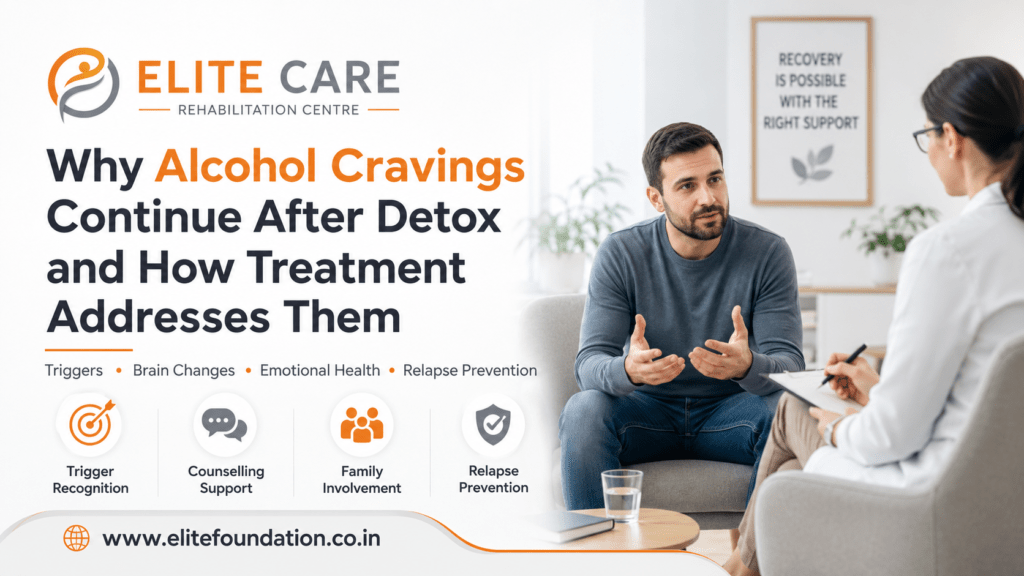
Alcohol cravings after detox are common because detox stabilises withdrawal but does not immediately reverse the brain, emotional and behavioural patterns built around drinking. Families looking for a nasha mukti kendra or a rehab centre in Mumbai should understand that post-detox treatment is where patients learn to recognise triggers, manage urges, address anxiety or depression and reduce relapse risk. Structured rehabilitation connects medical review, counselling, family support and relapse-prevention planning, helping the person move from short-term abstinence towards a more stable recovery.
A patient can complete detox, begin sleeping better and appear physically stronger, yet still experience a powerful desire to drink. This can confuse relatives who believed alcohol would stop feeling important once it had left the body.
The craving does not mean detox was unsuccessful. It shows why withdrawal management and rehabilitation are different parts of treatment.
Why alcohol cravings after detox are common
Detoxification primarily manages the physical effects of stopping alcohol. It helps the person pass through withdrawal while symptoms and possible complications are monitored.
It does not immediately remove every learned association connected with alcohol. The brain may still link drinking with relief, reward, sleep, confidence, socialising or escape from emotional pain.
Repeated heavy drinking can affect brain systems involved in reward, stress, decision-making, memory, motivation and impulse control. The NIAAA resource on addiction, the brain and recovery explains that long-term alcohol exposure can reduce normal reward function and strengthen stress-related systems. These changes do not disappear immediately when withdrawal ends.
This is why medically supervised alcohol detox should connect with continuing treatment. Physical stabilisation creates an opportunity for recovery work rather than completing the process.
Craving is not simply physical withdrawal
During acute withdrawal, the body may react with shaking, sweating, nausea, disturbed sleep, anxiety or a faster pulse. Those symptoms usually receive the most attention during detox.
A craving can remain after these visible signs improve.
It may feel like:
- A strong physical urge to drink
- Repeated thoughts about alcohol
- A belief that one drink will provide relief
- Restlessness that seems difficult to settle
- A sudden emotional pull towards an old drinking routine
- A sense that something is missing
- An urge triggered by a place, smell, person or time of day
- A desire to escape stress, shame, anger or sadness
Some patients describe cravings clearly. Others become irritable, withdrawn or argumentative without recognising that an urge to drink is driving the change.
A craving is not always a withdrawal emergency, but it can become a serious relapse risk when it is ignored or combined with easy access to alcohol.
Why the brain still expects alcohol
Long-term drinking creates repeated connections between alcohol and particular outcomes.
The person may have used alcohol to:
- Fall asleep
- Feel comfortable in social situations
- Reduce anxiety
- Block painful thoughts
- Manage loneliness
- Celebrate
- Handle work pressure
- Avoid withdrawal discomfort
- Feel confident
- Escape an argument or emotional crisis
Over time, these links become familiar and automatic.
When the same situation appears after detox, the brain may produce an urge before the person has consciously decided to drink. Passing the usual shop, receiving a salary, meeting old friends or reaching the evening hour once associated with alcohol can bring the desire back quickly.
NIAAA describes alcohol use disorder as a condition involving lasting brain changes that can leave people vulnerable to relapse. Recovery is also supported by the brain’s ability to adapt, but that process requires time and repeated healthier experiences.
Treatment helps weaken the old connection between a trigger and drinking while strengthening a different response.
Alcohol craving triggers are not always obvious
Some alcohol craving triggers are easy to identify. Others only become clear after counselling, careful observation or a near-relapse.
External triggers
These come from the surroundings:
- Alcohol shops and bars
- Bottles or glasses kept at home
- Drinking companions
- Parties and celebrations
- A particular route home from work
- Advertisements
- Music linked with drinking
- Weekends, holidays or salary days
- Family members who continue drinking
- Seeing another person intoxicated
Internal triggers
These begin within the person:
- Anxiety
- Anger
- Shame
- Boredom
- Loneliness
- Tiredness
- Physical pain
- Low mood
- Excitement
- Feeling rejected
- Difficulty sleeping
- Memories of past drinking
Avoiding every external trigger is rarely possible forever. Recovery also involves learning what to do when difficult feelings or familiar situations appear.
One patient may avoid parties but return to alcohol after an argument at home. Another may cope with work pressure yet struggle during a celebration because alcohol had always been connected with enjoyment.
Why cravings may feel stronger after the crisis has passed
During detox, attention is focused on getting through withdrawal. The patient is in a controlled setting, alcohol is unavailable and support is nearby.
After the immediate danger settles, confidence often rises. The person may feel physically better and begin thinking about home, work and ordinary life.
This is sometimes when cravings become more noticeable. Familiar thoughts return:
- “One drink will not cause a problem.”
- “I have proved that I can stop.”
- “This time I will drink only socially.”
- “I need alcohol to sleep.”
- “No one will know.”
- “I deserve it after what I have been through.”
These thoughts can feel reasonable in the moment. Post-detox alcohol treatment examines them before they turn into decisions.
Craving, withdrawal and emergency symptoms are different
A strong urge to drink can cause distress, but it should not be confused with severe alcohol withdrawal.
The alcohol withdrawal timeline explains that shaking, sweating, seizures, hallucinations and confusion can occur as alcohol levels fall.
Severe disorientation, a seizure, reduced consciousness, breathing difficulty or unstable physical signs require immediate clinical attention. Alcohol withdrawal delirium, commonly called delirium tremens, is an emergency.
Cravings after detox usually belong to the next stage of treatment. The response focuses on relapse prevention, emotional regulation, treatment review and reducing access to alcohol.
What research says about cravings and relapse
Craving is not a perfect predictor. Someone can experience a strong urge and remain abstinent, while another person may drink again without reporting a dramatic craving.
Even so, research treats craving as an important clinical signal.
An Indian outpatient study reported that higher craving was associated with fewer abstinent days during follow-up. The finding does not prove that craving alone caused the drinking, but it supports assessing urges regularly rather than assuming they disappear after detox. The published Indian study on craving and alcohol-treatment outcomes provides further detail.
Research examining day-to-day stress and drinking risk has also found links between stressful events, increased craving and a greater likelihood of drinking soon afterwards. These findings support treating stress, routines and emotional health as part of alcohol cravings treatment.
What alcohol cravings treatment involves
There is no single exercise that permanently removes every craving.
Treatment builds several layers of protection so that an urge is less likely to turn into drinking.
Reviewing the pattern of cravings
The first step is understanding how the urge appears.
A therapist or treating professional may explore:
- What happened immediately before the craving
- Where the patient was
- Who was present
- What the patient was thinking
- Which emotion was strongest
- Whether the person was hungry, angry, lonely or tired
- How intense the urge felt
- What action followed
- What helped it reduce
- Whether alcohol was easily available
This information may be recorded over several days. Patterns often become visible only after different episodes are compared.
An alcohol use disorder assessment can also identify severity, mental-health concerns and the level of continuing support required.
Learning to recognise the craving earlier
Many relapses appear sudden only because the early changes were missed.
The process may have started hours or days before the first drink:
- Sleep became poor.
- Treatment sessions were skipped.
- The person began contacting an old drinking friend.
- Thoughts about controlled drinking returned.
- Anger or secrecy increased.
- Alcohol became easier to access.
- The craving was acted upon.
Treatment helps the patient recognise this pattern before alcohol is purchased or consumed.
The aim is not to fear every difficult emotion. It is to notice when several warning signs are gathering together.
Behavioural treatment changes the response to triggers
Behavioural therapies help people identify situations and thought patterns that support drinking, then practise different responses.
The NIAAA guidance on alcohol treatment describes cognitive behavioural therapy, motivational approaches, family counselling and other evidence-based options used in alcohol treatment.
A session may examine a thought such as:
“I cannot attend this event without drinking.”
Rather than simply telling the patient that the thought is wrong, treatment may explore:
- What makes the event difficult
- Whether attendance is necessary
- Who can provide support
- How alcohol will be avoided
- Which non-alcoholic option will be used
- How the patient will leave if cravings increase
- What happened during similar situations in the past
The patient gradually moves from a general promise not to drink towards specific plans for predictable risks.
How to stop alcohol cravings in the moment
People often search for a quick way to make an urge disappear. No technique works instantly for everyone, but several practical steps can create distance between the craving and the decision to drink.
Name what is happening
A simple statement such as “This is a craving” can separate the urge from an automatic command.
The person is not agreeing to drink. They are recognising a temporary high-risk state.
Delay action
Decisions do not need to be made at the strongest point of the urge.
The patient can contact a counsellor, support person or relative and wait in a safer place while the intensity changes.
Leave the triggering setting
Remaining outside an alcohol shop, sitting with drinking friends or staying alone with alcohol at home makes the situation harder.
Moving to a supervised or alcohol-free setting can reduce both opportunity and emotional pressure.
Check basic needs
Hunger, exhaustion, dehydration and poor sleep can make emotional control more difficult.
Eating, resting or drinking water does not treat alcohol use disorder, but neglecting basic needs can weaken an already strained coping plan.
Use the prepared response
Treatment may help the patient create a short list of actions:
- Call a named person
- Attend a treatment session or support meeting
- With the patient’s agreement, arrange temporary support with cash or payment access during high-risk periods
- Move away from alcohol
- Review the reasons for stopping
- Engage in a planned activity
- Inform the rehabilitation team
The plan needs to be prepared before the craving becomes intense.
Avoid self-prescribing
Old detox medicines, sleeping tablets and tablets suggested by friends are not reliable craving treatment.
Any medicine used for alcohol use disorder should follow a proper clinical review.
The role of prescribed treatment
Certain prescribed medicines can help some patients reduce the urge to drink, maintain abstinence or reduce the likelihood of returning to heavy drinking.
They are not suitable for everyone. Medical history, liver health, other medicines, treatment goals and the possibility of opioid use can affect the decision.
Medication does not replace counselling, family work or changes in routine. It may provide additional support while those areas are addressed.
Drug names, doses and schedules are not included here because treatment selection requires individual medical assessment.
Why residential rehabilitation can help after detox
A patient leaving detox may understand the risks but still be surrounded by the same cues that supported drinking.
A residential programme provides a period in which alcohol is not freely available and recovery skills can be practised repeatedly.
That period may include:
- Individual counselling
- Group sessions
- Psychiatric review
- Craving monitoring
- Structured sleep and meal routines
- Family discussions
- Work on anger and stress
- Relapse-prevention exercises
- Planning for work and social situations
- Preparation for discharge
The difference between detox and rehabilitation becomes clear here. Detox helps the body stabilise. Rehabilitation helps the patient build a different response to stress, temptation and familiar drinking situations.
Post-detox alcohol treatment should address mental health
Craving may be intensified by untreated depression, anxiety, trauma, grief, psychosis or severe sleep disturbance.
Alcohol may have been functioning as self-medication long before admission.
Once drinking stops, the original emotional difficulty can become more visible. The patient may believe recovery has made life worse when the deeper problem has simply reappeared without alcohol covering it.
Treating only the craving while ignoring the emotional illness can leave a major relapse pathway open.
Alcohol cravings in recovery can change over time
Cravings do not follow the same pattern for every patient.
For one person, the first weeks may be the hardest. Another may feel stable for months and then experience an intense urge after bereavement, job loss or contact with former drinking companions.
The nature of the craving may also change. Early urges can be linked with physical discomfort and sleep problems. Later cravings may be connected with memory, celebration, social pressure or a belief that controlled drinking is now possible.
Recovery support should therefore continue even when urges have become less frequent.
Why willpower alone is unreliable
Determination matters, but it is affected by tiredness, stress, emotion, opportunity and repeated exposure to triggers.
Someone may make a sincere promise in the morning and struggle by evening when:
- Salary has been received
- A family argument has occurred
- Friends are drinking
- Sleep has been poor
- Treatment has been missed
- Alcohol is available nearby
- No one knows the craving has returned
A treatment plan reduces the number of decisions that depend on willpower at the worst possible moment. The patient knows who to contact, where to go and what signs mean that support needs to increase.
The family’s role in managing alcohol cravings
Relatives cannot remove every craving, and they should not be made responsible for policing the patient every minute.
Helpful responses include:
- Listening without immediately arguing
- Taking a reported craving seriously
- Encouraging contact with the treatment team
- Keeping alcohol out of the home
- Avoiding offering “just one drink”
- Supporting attendance at follow-up sessions
- Watching for secrecy and isolation
- Maintaining clear boundaries around violence or unsafe behaviour
- Participating in family counselling
- Following the agreed relapse plan
Humiliation, repeated reminders of past mistakes and treating a craving as proof of weak motivation can make honest disclosure less likely.
A reported urge is a signal to use the treatment plan, not a reason to shame the patient.
Family members also need boundaries
Support should not become enabling.
Relatives do not need to:
- Give money without knowing how it will be used
- Cover repeated alcohol-related absences
- Lie to employers or extended family
- Accept violence
- Bring alcohol to stop agitation
- Provide unprescribed medicines
- Pretend that a return to drinking has not occurred
Treatment can help families distinguish compassion from actions that allow alcohol use to continue without consequences.
The wider addiction treatment process often includes work with relatives because recovery affects the whole household.
What alcohol relapse prevention looks like in practice
Alcohol relapse prevention is not a single promise made at discharge.
Personal triggers
The patient needs to understand which people, places, emotions and routines carry the greatest risk.
Early warning signs
These may include missed appointments, secrecy, romanticising past drinking, carrying extra cash, contacting old friends or withdrawing from supportive relatives.
Immediate responses
The plan should state who will be contacted, where the patient can go and how access to alcohol will be reduced.
Continuing treatment
Counselling, psychiatric review, medication follow-up and support meetings need clear schedules.
Family communication
Relatives should understand what can be shared and what action to take when risk increases.
Response to a lapse
The plan should explain what happens if alcohol is consumed rather than assuming that a lapse will never occur.
Alcohol relapse after detox is not always sudden
The first drink is often the final visible step in a longer process.
Possible earlier changes include:
- Stopping counselling
- Refusing family involvement
- Becoming overconfident
- Sleeping poorly
- Spending more time alone
- Returning to old routes or social groups
- Keeping cravings secret
- Questioning whether treatment was necessary
- Planning an occasion where drinking will be allowed
- Keeping alcohol “for guests”
Recognising these changes gives the patient and treatment team an opportunity to respond before regular drinking resumes.
What if the person drinks again?
A return to alcohol needs a timely response, but shame and panic can make the situation harder to assess.
The immediate questions are:
- How much was consumed?
- Is the patient intoxicated or medically unwell?
- Has regular drinking restarted?
- Are other substances involved?
- Is there a risk of self-harm, violence or unsafe driving?
- Has the patient stopped treatment?
- What triggered the episode?
A setback does not prove that treatment cannot work. It may reveal an untreated trigger, insufficient follow-up or the need for stronger support.
The patient may require renewed assessment, medication review, greater supervision or readmission depending on the pattern and risks.
When cravings require urgent attention
Cravings deserve prompt professional contact when the patient:
- Says they are about to drink
- Has already arranged alcohol
- Leaves treatment unexpectedly
- Becomes severely agitated
- Expresses suicidal thoughts
- Threatens violence
- Plans to drive after drinking
- Combines alcohol with sedatives or opioids
- Has restarted daily drinking
- May face withdrawal after another abrupt stop
A craving alone is not usually a medical emergency. The surrounding behaviour and risks determine how urgently the treatment plan needs to change.
Questions to ask a post-detox treatment programme
Before choosing continuing care, useful questions include:
- How are cravings assessed?
- Does counselling include trigger identification?
- Is psychiatric review available?
- Can prescribed craving treatment be considered?
- How does the programme involve the family?
- What happens when a patient reports a strong urge?
- How are sleep, anxiety and depression addressed?
- Is there a written relapse-prevention plan?
- What follow-up is arranged after discharge?
- How does the programme respond if drinking restarts?
A credible programme should be able to explain how it treats the period after detox, not only how it manages withdrawal.
Frequently asked questions
Why do alcohol cravings continue after detox?
Detox manages withdrawal and physical stabilisation. Brain changes, learned habits, emotional problems and alcohol-related cues can remain. These factors may continue producing urges after alcohol has left the body.
How long do alcohol cravings after detox last?
There is no fixed duration. Cravings may be frequent during early recovery and later appear around stress, social events or familiar drinking situations. Their intensity and frequency often change as treatment progresses.
Do cravings mean the person will relapse?
No. A craving increases risk but does not force the person to drink. Early disclosure, a prepared coping plan, treatment and reduced access to alcohol can help prevent the urge from becoming a relapse.
How can alcohol cravings be managed?
Managing alcohol cravings may involve recognising triggers, leaving high-risk settings, contacting support, behavioural therapy, psychiatric treatment, family involvement and prescribed care where clinically appropriate.
Can medicines stop alcohol cravings?
Certain prescribed treatments may reduce urges or support abstinence for some patients. Suitability depends on medical history, other medicines and individual treatment goals. A clinician must make that decision.
Why is rehabilitation needed after detox?
Detox does not address every trigger, behaviour or mental-health concern connected with drinking. Rehabilitation gives the patient time to practise coping skills, receive counselling and prepare for life after discharge.
What should the family do when the patient reports a craving?
Take it seriously without shaming the person. Encourage immediate use of the agreed treatment plan, reduce access to alcohol and contact the treating professional when risk is increasing.
Is a relapse the end of recovery?
No. A return to drinking means the treatment plan needs reassessment. It may reveal an untreated trigger, insufficient follow-up or the need for a different level of care.
Treatment turns a craving into information
Alcohol cravings after detox can feel discouraging, especially when the patient and family expected detoxification to remove every desire to drink.
The craving is not proof that recovery has failed. It may point towards stress, depression, an old routine, a social trigger, poor sleep or overconfidence.
Effective post-detox alcohol treatment combines medical review, psychological care, family involvement, trigger management and alcohol relapse prevention. Over time, the patient learns that an urge can be noticed, discussed and managed without automatically returning to alcohol.
Medical disclaimer: This article provides general educational information and does not replace individual medical assessment, diagnosis or treatment. Seek urgent assistance when alcohol use or cravings are accompanied by seizures, severe confusion, loss of consciousness, breathing difficulty, suspected overdose, violent behaviour, unsafe driving or thoughts of self-harm.
