
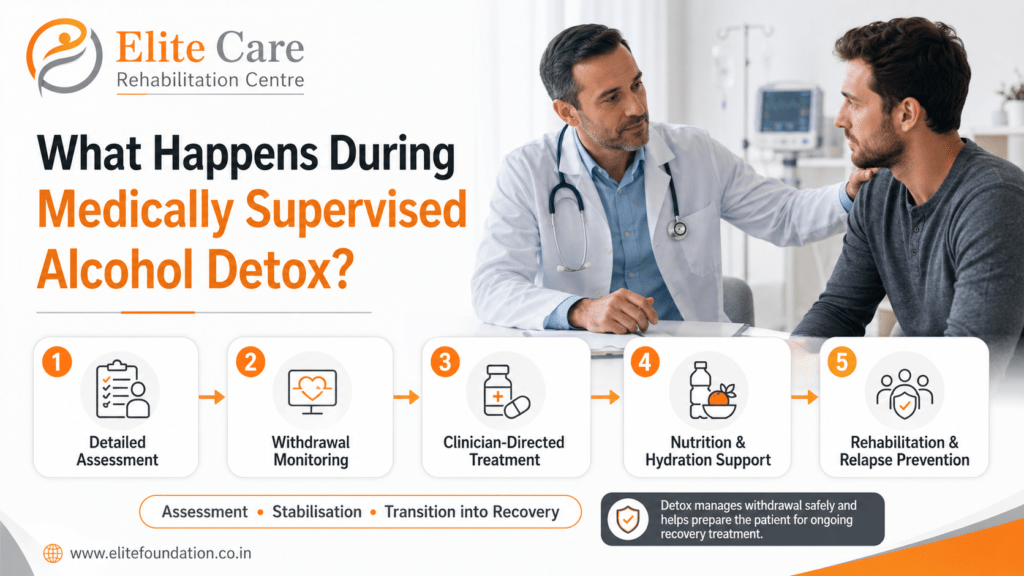
Medically supervised alcohol detox is a structured process for managing withdrawal after heavy or dependent drinking. Families searching online for a nasha mukti kendra Titwala often want to know what happens after admission, whether the person will remain awake and aware, how symptoms are monitored and when rehabilitation begins. Care normally starts with a detailed assessment, followed by observation, clinician-directed treatment, nutritional support and regular review. Detox does not end when shaking stops; once physical stability improves, counselling and relapse-prevention work begin.
The experience is not identical for every patient. One individual may arrive anxious, exhausted and unable to sleep. Another may already be shaking, vomiting or struggling to remember when the last drink was taken. Someone else may still have alcohol in the bloodstream while early withdrawal is beginning.
A well-run programme does not rely on a fixed schedule copied from another patient. The drinking history, previous withdrawal, current symptoms, physical health, mental state and use of other substances guide each decision.
Medically supervised alcohol detox in simple terms
Medical alcohol detox helps the body move through withdrawal under professional observation.
The purpose is not to make the person unconscious for several days or remove alcohol from the blood through a special procedure. Alcohol leaves the body naturally. Treatment focuses on managing the nervous system’s response as alcohol levels fall, identifying complications early and supporting the patient until the acute phase settles.
The process usually has three connected stages:
- Assessment – understanding the drinking pattern, withdrawal risk and overall health.
- Stabilisation – monitoring symptoms and providing treatment according to clinical need.
- Transition into rehabilitation – beginning work on cravings, behaviour, mental health and relapse risk once the patient is stable.
The ASAM guideline on alcohol withdrawal management recommends matching withdrawal care to the patient’s clinical risk and planning the next stage of treatment before discharge.
What happens before admission?
The alcohol detox process often begins before the person enters the facility.
A family member may speak with the centre and provide basic information about:
- The usual drinking pattern
- When alcohol was last consumed
- Whether drinking happens in the morning or at night
- Previous attempts to stop
- Past seizures, hallucinations or severe confusion
- Current medicines
- Other substance use
- Existing physical illnesses
- Mental-health concerns
- Recent falls or injuries
This initial conversation helps the centre prepare, but it does not replace an in-person alcohol detox assessment.
Information can also be incomplete. Families may not know the real quantity consumed, and the patient may minimise drinking because of shame, fear or poor memory. For this reason, treatment decisions are not based on one answer alone.
The broader pattern of alcohol dependence can reveal risks that a single day’s drinking total does not show. Morning drinking, shaking when alcohol is delayed and using alcohol to feel steady are particularly important details.
Arrival and the initial alcohol detox assessment
After admission, the first priority is to understand the patient’s current condition.
The conversation is usually practical rather than judgmental. Staff need accurate information to distinguish early withdrawal from intoxication, medication effects, anxiety or another illness.
Questions may cover:
- How long the current drinking pattern has continued
- The amount and type of alcohol usually consumed
- The timing of the last drink
- Whether drinking has recently increased or decreased
- Morning or overnight alcohol use
- Previous detoxification attempts
- Earlier seizures or delirium
- Blackouts and falls
- Food and fluid intake
- Sleep during the previous few nights
- Prescribed and non-prescribed medicines
- Sedatives, sleeping tablets, opioids or other substances
- Depression, psychosis or suicidal thoughts
- Current family and social circumstances
A separate alcohol use disorder assessment may also examine loss of control, consequences of drinking and the support needed after withdrawal.
The questions can feel detailed, but each one has a purpose. A previous withdrawal seizure, for example, can change the level of observation required even when current symptoms appear mild.
The physical examination
Withdrawal does not affect only the hands or sleep. It can influence circulation, hydration, temperature, awareness and behaviour.
Depending on the setting and clinical need, the initial review may include:
- Pulse
- Blood pressure
- Temperature
- Breathing
- Oxygen level
- Hydration
- Tremor
- Sweating
- Alertness
- Orientation to time and place
- Ability to hold a conversation
- Walking and balance
- Signs of injury
- Symptoms of liver or heart illness
Nutrition also deserves attention. Long periods of heavy drinking are often accompanied by irregular meals, vomiting or poor self-care.
Where tests are clinically indicated and available, they may help identify problems involving blood sugar, electrolytes, liver health, infection or other medical conditions. Treatment should not be delayed when urgent withdrawal symptoms are already present.
How withdrawal risk is estimated
A patient can look settled at admission and still have a concerning history.
Clinicians therefore consider both what is happening now and what may happen next.
Risk tends to be higher when there is:
- A previous withdrawal seizure
- Earlier alcohol withdrawal delirium
- Several past withdrawal episodes
- Long-term, regular heavy drinking
- Drinking throughout the day
- Serious physical illness
- Older age
- Pregnancy
- Marked shaking, sweating or agitation
- A very fast pulse or unstable blood pressure
- Poor nutrition or dehydration
- Dependence on sedatives
- Recent head injury
- Severe depression, psychosis or self-harm risk
The alcohol withdrawal timeline provides a useful picture of when certain symptoms often appear. It cannot predict an individual course, which is why history and repeated observation remain central.
Are withdrawal scales used?
Some programmes use a structured withdrawal scale to record symptoms such as shaking, sweating, anxiety, nausea, agitation and sensory disturbances.
The score can help staff compare the patient’s condition across different reviews. A rising score suggests that symptoms are becoming more active, while a falling score can support the wider clinical impression that withdrawal is settling.
A scale is not a complete risk-prediction tool.
Many questions depend on the patient describing symptoms accurately. That becomes difficult when someone is confused, severely unwell, heavily sedated or unable to communicate. ASAM notes that widely used withdrawal scales have limitations and should not replace clinical judgement or the patient’s history.
What happens during the first few hours?
The early hours are often quieter than families expect.
A patient may rest, eat a small meal, receive fluids and undergo repeated observation. Others arrive already restless, nauseated or visibly shaky.
Staff watch for changes rather than assuming that the condition seen at admission will remain the same. Early symptoms can include:
- Anxiety
- Tremor
- Sweating
- Headache
- Nausea
- Poor appetite
- Sensitivity to light or sound
- Restlessness
- Difficulty sleeping
- A faster pulse
The timing is not always easy to calculate. Someone may have continued taking small drinks before admission, or the reported last-drink time may be uncertain.
How alcohol withdrawal monitoring works
Alcohol withdrawal monitoring is more than asking whether the patient feels better.
Staff may review:
- Changes in tremor
- Pulse and blood pressure
- Temperature
- Food and fluid intake
- Vomiting
- Sleep
- Anxiety and agitation
- Awareness of place and time
- Hallucinations
- Ability to walk safely
- Response to prescribed treatment
- Signs of excessive sedation
The frequency of these checks depends on the patient’s risk and condition. Someone with active symptoms or a difficult withdrawal history needs closer observation than a low-risk patient whose condition is steadily improving.
Is medicine always given during alcohol detox?
Not every patient receives the same treatment, and medication is not automatically required for every mild symptom.
The decision depends on:
- Present withdrawal severity
- Risk of seizures or delirium
- Previous withdrawal history
- Physical health
- Liver function
- Pregnancy
- Other medicines
- Sedative or opioid use
- The ability to monitor the response safely
When medicine is needed, clinicians consider the symptoms, medical history and response to earlier treatment. Each dose is documented, and staff watch for uncontrolled withdrawal, breathing problems or excessive drowsiness.
Drug names, doses and schedules are not provided here because withdrawal treatment requires direct clinical supervision.
Why borrowed medicines are not a substitute for supervised detox
Families sometimes arrive with tablets left from an earlier detox or medicines borrowed from a relative.
That information should be disclosed immediately.
Old or borrowed medicines can create several risks:
- Alcohol may still be present in the body.
- The patient may already have taken another sedating substance.
- Liver illness can alter how medicine is processed.
- Drowsiness can hide worsening confusion.
- Breathing can become slower.
- The dose may not match the current withdrawal severity.
- The original prescription may have been written for a different condition.
In supervised care, staff know what has been administered and can respond if alertness, breathing or withdrawal symptoms change.
Food, fluids and nutritional support
Heavy drinking can disrupt eating long before admission.
Some patients have had very little food for several days. Others arrive dehydrated after sweating or vomiting. Weakness, dizziness and difficulty concentrating may reflect more than withdrawal alone.
During detox, support can include:
- Regular fluids
- Small, tolerable meals
- Observation of vomiting
- Attention to swallowing and consciousness
- Correction of nutritional concerns under clinical direction
- Monitoring for signs that require further medical evaluation
ASAM discusses nutritional deficiencies in alcohol withdrawal and notes the importance of addressing them as part of supportive care.
Food and fluids do not replace withdrawal treatment. They support the body while the wider clinical plan manages the risks.
Sleep during medically supervised alcohol detox
Poor sleep is extremely common during withdrawal.
A patient may feel exhausted yet remain unable to settle. Dreams can be vivid, and repeated waking can worsen anxiety. Others sleep after admission but need observation because drowsiness may come from exhaustion, alcohol still in the body or another substance.
The goal is not simply to make the patient sleep for as long as possible.
Staff need to distinguish ordinary rest from reduced consciousness, excessive sedation or worsening confusion. This is another reason why unsupervised sleeping tablets are unsafe.
Sleep often improves gradually rather than returning to normal immediately. Problems may continue after the most active withdrawal symptoms have settled.
Anxiety, agitation and emotional distress
Detox can be frightening even when the patient understands what is happening.
Anxiety may come directly from withdrawal. Shame, fear of admission, concern about work and uncertainty about the future can add to it.
Communication matters. A calm explanation of what is being checked and what will happen next can reduce unnecessary fear.
Agitation needs closer attention when it is increasing, accompanied by hallucinations or combined with loss of orientation. What looks like anger may actually be a sign that the brain is struggling to process the surroundings.
Psychiatric review becomes particularly important when there are:
- Suicidal thoughts
- Psychosis
- Severe depression
- Violent behaviour
- Extreme suspiciousness
- A history of self-harm
- Trauma-related symptoms
Detoxification and mental-health care should not be treated as unrelated processes.
What happens if hallucinations develop?
Alcohol withdrawal hallucinations can involve seeing, hearing or feeling things that are not present.
Some patients remain aware of the surroundings and understand that the experience is unusual. Others become confused and unable to tell what is real.
Staff assess awareness, orientation, behaviour and physical signs rather than using the word “hallucination” as a complete diagnosis.
Hallucinations may arise from withdrawal, another substance, psychiatric illness, infection or a different medical problem. Worsening agitation, fever, seizures or disorientation increases the urgency.
How seizures are handled
A withdrawal seizure can occur even when earlier symptoms did not seem dramatic.
Any seizure needs immediate clinical attention. Nearby hazards are moved away when safe, the patient is protected from injury and emergency procedures are followed according to the facility’s capabilities.
After the event, observation continues because another seizure or more severe withdrawal can follow.
Relevant details include:
- How long the seizure lasted
- Whether more than one occurred
- The patient’s breathing afterwards
- Any fall or head injury
- Level of consciousness
- Previous seizure history
- Possible causes other than withdrawal
A seizure should never be dismissed as an expected part of detox.
What happens if delirium tremens is suspected?
Severe confusion with disturbed awareness can indicate alcohol withdrawal delirium, commonly called delirium tremens.
Warning signs can include:
- Not knowing where one is
- Failing to recognise familiar people
- Severe agitation
- Hallucinations
- Heavy sweating
- Fever
- A very fast pulse
- Unstable blood pressure
- Attempts to leave without understanding the danger
This is an emergency. When the patient needs care beyond the facility’s clinical capacity, immediate medical escalation is required.
What families are told during detox
Families often want constant updates, especially during the first night.
Communication must still respect privacy, consent and clinical priorities. The centre may explain:
- Whether the patient is stable
- Whether active withdrawal has begun
- What is being monitored
- Whether food and fluids are being tolerated
- Whether psychiatric concerns have emerged
- Whether the treatment setting remains appropriate
- When participation in rehabilitation may begin
Exact medical details are normally shared according to consent and applicable privacy rules.
Families can help by providing accurate information about medicines, drinking history, previous seizures, recent behaviour and earlier treatment.
What appears unimportant to a relative may be clinically useful. An unexplained fall, several nights without sleep or an old withdrawal seizure can alter the risk assessment.
How long does alcohol detox take?
There is no single answer.
The most active withdrawal period commonly unfolds during the first few days, but the duration depends on the drinking pattern, previous withdrawal, physical health and treatment response.
Some patients begin stabilising relatively quickly. Others require a longer period of observation because symptoms persist, medical concerns are present or severe withdrawal remains possible.
“How long does alcohol detox take?” can also refer to two different things:
- The time needed for acute withdrawal to settle
- The full length of residential alcohol detox and rehabilitation
These are not the same.
Detox may occupy only the early part of admission. Counselling, psychiatric care, family work and relapse-prevention treatment continue after the immediate physical symptoms have improved.
How staff decide that detox is progressing well
Progress is assessed from the overall pattern rather than one visible symptom.
Positive signs can include:
- Stable physical observations
- Reduced agitation
- Clearer thinking
- Better orientation
- Improved food and fluid intake
- No new seizures or hallucinations
- Safer walking
- More settled sleep
- Reduced need for withdrawal treatment
- Ability to participate in conversation
- Readiness to engage with the rehabilitation plan
A patient can feel physically better and still remain vulnerable to returning to alcohol. This is why the next stage should begin before the motivation created by the withdrawal crisis fades.
Detox and rehabilitation are different but connected
Detoxification manages the body’s immediate response to stopping alcohol.
Rehabilitation addresses the broader condition that made stopping difficult.
The difference between detox and rehabilitation becomes clearer once the patient is physically stable. Withdrawal symptoms may have improved, yet cravings, depression, family conflict and drinking-related habits remain.
The next phase may include:
- Individual counselling
- Psychiatric review
- Craving-management planning
- Work on triggers
- Family sessions
- Structured daily activities
- Sleep and routine rebuilding
- Relapse-prevention planning
- Preparation for discharge
- Continuing follow-up
ASAM explicitly recommends using the withdrawal-management period to engage patients with ongoing alcohol use disorder treatment and create a smooth transition to the next provider or service.
What begins after physical stabilisation?
Once concentration and sleep begin improving, the patient can participate more fully in treatment.
Early conversations may explore:
- What led to admission
- Previous attempts to stop
- Situations connected with drinking
- Family concerns
- Work and financial pressures
- Mental-health symptoms
- Fear about returning home
- Beliefs about controlled drinking
- Available support after discharge
The wider addiction treatment process is not completed in several days. Recovery usually requires continued work after the withdrawal crisis has passed.
The NIAAA guidance on alcohol treatment describes care as a combination of evidence-based behavioural treatment, prescribed treatment where appropriate and continuing support. It also stresses that treatment is not one-size-fits-all and can be delivered at different levels of intensity.
Why detox should not end with immediate discharge
The first alcohol-free days can create false confidence.
Once nausea and shaking improve, someone may conclude that the drinking problem was not serious. The patient may want to return home immediately, believing willpower will now be enough.
Without further work, the same triggers remain:
- Access to alcohol
- Drinking companions
- Family conflict
- Poor sleep
- Stress
- Untreated anxiety or depression
- Loneliness
- No plan for cravings
A treatment programme connects detox with rehabilitation before these pressures return.
The previous discussion of alcohol detox at home explains why getting through withdrawal is not the same as treating alcohol dependence.
What to expect during alcohol detox as a family member
For relatives, detox can feel slow. Much of the important work involves observation, repeated review and waiting to see how symptoms change.
Not every hour includes a visible intervention. A quiet period of stable monitoring is valuable.
Families can support the process by:
- Sharing accurate information
- Avoiding arguments about past behaviour
- Not bringing alcohol or unapproved medicines
- Respecting rest and treatment routines
- Participating when family sessions are arranged
- Preparing for changes needed after discharge
- Understanding that detox is not a cure
It is also normal for relatives to feel relieved, angry, frightened and exhausted at the same time. Family support may need its own guidance rather than placing the full responsibility for recovery on one person.
Common misunderstandings about supervised alcohol detox
“Detox means keeping the patient asleep”
The aim is safe stabilisation, not continuous unconsciousness. Excessive drowsiness can itself require assessment.
“Once the blood alcohol level falls, the danger is over”
Withdrawal symptoms can develop or worsen after alcohol levels drop. Repeated monitoring remains important.
Questions to ask before choosing a detox programme
Before admission, useful questions include:
- Is a medical assessment completed?
- Who supervises withdrawal treatment?
- Is observation available during the night?
- How are medicines prescribed and recorded?
- How does the programme respond to seizures or delirium?
- What emergency-transfer pathway is available?
- Is psychiatric assessment offered?
- How are nutrition and hydration concerns handled?
- What treatment begins after detox?
- How is the family involved?
- What follow-up is arranged after discharge?
Clear answers help distinguish a structured alcohol detox treatment programme from accommodation that uses the word “detox” without the necessary clinical systems.
Frequently asked questions
What happens during medically supervised alcohol detox?
Care begins with assessment of drinking, withdrawal history, physical health, mental state and other substances. Symptoms are then monitored, treatment is provided according to clinical need, and complications are addressed or escalated. Rehabilitation begins once the patient is stable enough to participate.
Is medically supervised alcohol detox painful?
Withdrawal can be uncomfortable, with shaking, sweating, nausea, anxiety and poor sleep. Supervision allows symptoms to be monitored and treated rather than leaving the patient and family to manage them alone.
Will the patient be conscious during detox?
Most patients remain conscious. Drowsiness can occur from exhaustion, alcohol, other substances or prescribed treatment. Staff monitor awareness because reduced consciousness or excessive sedation may signal a problem.
Is medicine compulsory during alcohol detox?
Not every low-risk patient requires the same medication approach. The decision depends on symptoms, withdrawal history and the likelihood of complications.
Can medically supervised detox prevent every seizure?
Treatment and monitoring reduce risks, but no programme should promise that every complication can be prevented. The advantage is that warning signs and emergencies can be identified and managed more quickly.
How long does medically supervised alcohol detox take?
The active withdrawal phase often lasts several days, although timing varies. When the patient has entered a residential rehabilitation programme, treatment normally continues after detox so that counselling, psychiatric care and relapse-prevention work can begin.
What happens after alcohol detox?
The focus moves from physical stabilisation to treatment of alcohol use disorder. Counselling, mental-health care, family involvement, trigger management and discharge planning may follow.
Can someone leave once the shaking stops?
The disappearance of tremor does not confirm that withdrawal is complete or that returning home is advisable. Readiness depends on the full clinical picture and the continuing treatment plan.
Medically supervised alcohol detox is the beginning, not the finish
What happens during alcohol detox is more organised than many families expect. The patient is assessed, observed and treated according to changing needs rather than being placed on a single standard schedule.
The immediate goal is physical and mental stability. The larger purpose is to create a safe opening for recovery.
When medically supervised alcohol detox connects directly with counselling, psychiatric support, family work and relapse prevention, the admission becomes more than a few alcohol-free days. It becomes the first structured step towards treating the condition that made alcohol difficult to stop.
Medical disclaimer: This article provides general educational information and does not replace individual medical assessment, diagnosis or treatment. Alcohol withdrawal can become dangerous. Seek urgent medical assistance for seizures, severe confusion, hallucinations with poor awareness, breathing difficulty, chest pain, loss of consciousness, suspected overdose, violent behaviour or thoughts of self-harm.
