
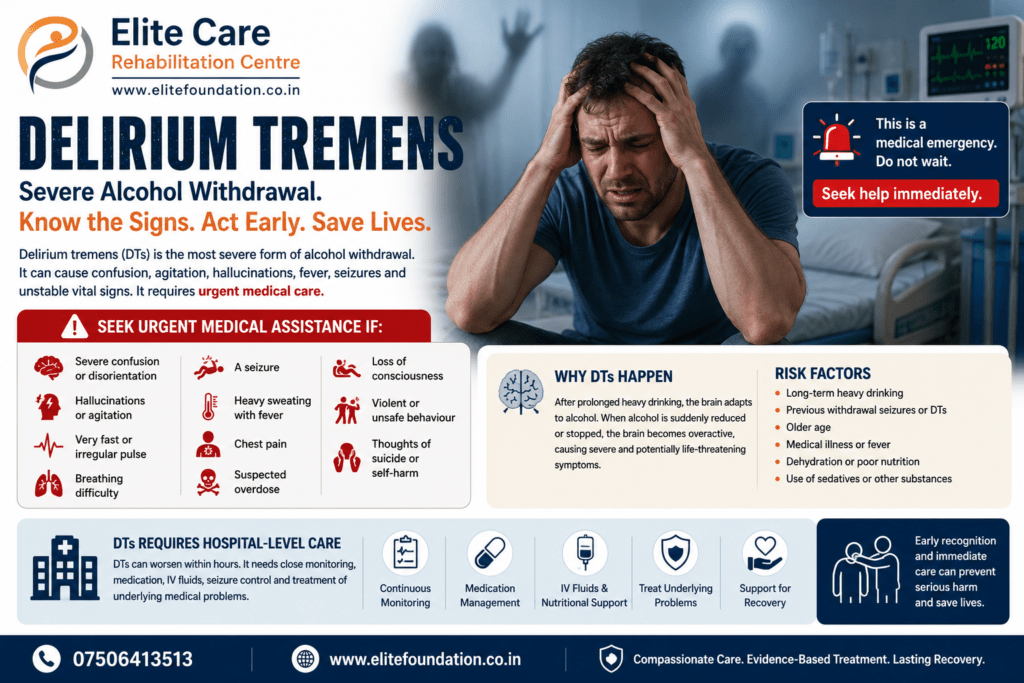
Delirium tremens is a severe form of alcohol withdrawal that can cause confusion, agitation, hallucinations, fever, seizures and unstable vital signs. Families searching for a nasha mukti kendra in Titwala should know that suspected delirium tremens needs emergency medical assessment and hospital-level care. It is not managed through routine rehabilitation admission alone. Early warning signs can worsen within hours, particularly after prolonged heavy drinking or a previous complicated withdrawal. Prompt recognition, close monitoring and treatment of the withdrawal and related medical problems can reduce the risk of serious harm.
Delirium tremens requires urgent medical care
Call emergency medical services or take the person to the nearest hospital emergency department. Do not attempt to transport them alone if they are violent, unconscious, actively seizing or unable to remain safe.
Seek urgent medical assistance when a person who recently stopped or sharply reduced alcohol develops:
- Severe confusion or disorientation
- Hallucinations with agitation or poor awareness
- A seizure
- Loss of consciousness
- A very fast or irregular pulse
- Heavy sweating with fever
- Breathing difficulty
- Chest pain
- Violent or unsafe behaviour
- Suspected overdose
- Thoughts of suicide or self-harm
Do not wait for the condition to fit a complete symptom list. After a seizure, urgent assessment and monitored observation are required. The person should not simply be left to sleep at home.
Part 4 of the alcohol education series
This article continues our alcohol topical authority series.
Part 1 explains how alcohol dependence affects control over drinking, physical health, relationships, withdrawal and long-term recovery.
Part 2 covers alcohol use disorder assessment, including diagnostic severity, physical health, mental health and the choice of treatment setting.
Part 3 describes the alcohol withdrawal timeline, including early symptoms, seizures, hallucinations and risks that can continue beyond the third day.
This fourth article focuses on delirium tremens, its warning signs, major risk factors and the emergency treatment used when severe withdrawal develops.
What is delirium tremens?
Delirium tremens, often shortened to DT or DTs, is the most severe form of alcohol withdrawal. Current clinical guidance generally uses the term alcohol withdrawal delirium.
The condition combines severe withdrawal with delirium. Delirium is a sudden change in attention, awareness and thinking. Someone may not know where they are, recognise familiar people or understand what is happening around them.
Symptoms often change during the day. A person may appear calmer for a short period and then become severely agitated or confused. This fluctuation is one reason why a single conversation cannot confirm that the danger has passed.
Tremor, heavy sweating, a fast pulse, raised blood pressure, fever and disturbed sleep may occur alongside confusion. Hallucinations are common but are not required for the diagnosis.
A 2018 peer-reviewed review reported that delirium tremens occurs in less than 1% of the general population and in about 2% of people with alcohol dependence. These figures are study-based estimates rather than a prediction for one person. The same review describes the condition as potentially fatal when it is not recognised and managed promptly. The clinical review of delirium tremens assessment and management provides further detail.
Delirium is more than severe anxiety or shaking
Early alcohol withdrawal can cause tremor, sweating, anxiety, nausea and poor sleep. These symptoms can be distressing, but they do not automatically mean that delirium tremens has developed.
The key change is delirium. Attention becomes poor, awareness is disturbed and thinking is disorganised. Someone may struggle to follow a simple conversation or repeatedly lose track of where they are.
They might attempt to leave the room without understanding the risk, pull at medical equipment or react to people and objects that are not present. Fear can become intense because the surroundings no longer make sense.
Severe agitation alone is not enough to diagnose delirium tremens. Panic, intoxication, head injury, infection, low blood sugar and psychiatric illness can cause similar behaviour. A medical examination is needed to identify the cause.
Delirium tremens warning signs families may notice
Attention may change before memory problems become obvious. Someone may lose track of a question, become distracted by things others cannot see or give answers that do not fit the conversation.
As awareness worsens, the date, location or reason for medical observation may no longer be clear. Even familiar people can seem unknown or threatening.
Sleep often becomes severely disrupted. Someone may remain awake for long periods and become more confused at night. At other times, alertness can drift in and out.
Important delirium tremens symptoms can include:
- Rapidly changing confusion
- Severe restlessness or agitation
- Shaking of the hands or body
- Heavy sweating
- Fever
- A very fast pulse
- Raised or unstable blood pressure
- Visual, auditory or tactile hallucinations
- Fear, suspiciousness or attempts to escape
- Poor awareness of surroundings
- Recent or repeated seizures
These signs can change quickly. A short period of calm does not always mean that the delirium has resolved.
What causes delirium tremens?
Alcohol slows activity in parts of the central nervous system. With prolonged heavy drinking, the brain adjusts by increasing activity in systems that oppose alcohol’s slowing effect.
When alcohol is suddenly stopped or sharply reduced, alcohol’s suppressing effect falls away. The nervous system can remain overactive, causing tremor, sweating, anxiety, a fast pulse and seizures.
In some people, this overactivity progresses into severe withdrawal with delirium. The brain can no longer maintain normal attention and awareness while the body is under intense physical stress.
This explanation is useful, but it does not mean that every confused person with a drinking history has delirium tremens. Infection, liver-related brain dysfunction, head injury, low blood sugar, medication effects and withdrawal from another substance must also be considered.
When can delirium tremens begin?
A delirium tremens timeline is less exact than many online charts suggest.
Early withdrawal symptoms often begin within 6 to 24 hours after alcohol is stopped or significantly reduced. Withdrawal seizures commonly occur during the first 8 to 48 hours.
Alcohol withdrawal delirium usually appears later than tremor, nausea and anxiety. The American Society of Addiction Medicine describes onset around 72 to 96 hours in its general timeline, while another section notes that it can begin within 24 to 48 hours or as late as three to five days after alcohol reduction.
For families, the practical message is simpler: delirium tremens often develops after the early phase of withdrawal and can begin several days after the last drink. Reaching 72 hours does not prove that the risk has passed. The ASAM guideline on alcohol withdrawal management explains the variable timing and need for continued assessment.
The 2018 clinical review describes delirium tremens as usually lasting about three to four days, although some episodes can continue for up to eight days. Duration depends on the response to treatment, medical complications and whether another condition is also causing delirium.
Delirium tremens risk factors
Not everyone with alcohol dependence develops delirium tremens. Some histories and clinical findings increase concern.
Previous delirium tremens
A past episode is one of the strongest warning signs. The details matter: when it occurred, whether intensive care was needed and what complications developed.
Previous alcohol withdrawal seizures
A seizure during an earlier withdrawal increases concern during later attempts to stop. A seizure in the current episode also raises the risk of progression to severe withdrawal and delirium.
Repeated withdrawal episodes
Several cycles of stopping, withdrawing and returning to alcohol can make later episodes harder to predict. A previously mild withdrawal does not guarantee that the next one will remain mild.
Long-term heavy and regular drinking
Risk is generally greater when alcohol has been consumed heavily and regularly over a prolonged period, especially where drinking occurs throughout the day or begins in the morning.
Marked nervous-system overactivity
A very fast pulse, heavy sweating, raised blood pressure, fever and severe agitation suggest that the body is under significant stress.
Older age
People over 65 may have more medical conditions, different withdrawal patterns and greater sensitivity to complications.
Serious physical illness
Heart disease, liver disease, kidney problems, infection, head injury and poor nutrition can increase risk or make withdrawal harder to manage.
Other substances
Sedatives, sleeping medicines and opioids can change the appearance and safety of withdrawal. Stopping more than one substance at the same time can produce overlapping symptoms.
Poor support or delayed access to emergency care
Outpatient withdrawal may be unsafe when reliable observation is unavailable or emergency services cannot be reached quickly.
ASAM recommends assessing the full combination of withdrawal history, current symptoms, medical illness, age and other substance use rather than relying on one score.
Alcohol withdrawal hallucinations are not always delirium tremens
Hallucinations can occur during withdrawal while someone remains aware of where they are. They may recognise that the voice, image or sensation is unusual, even though it feels real.
This differs from delirium, where awareness and attention are disturbed. Someone with delirium tremens may not understand where they are or may act on a hallucination because they cannot judge what is real.
The distinction is clinically useful, but families should not try to make it at home. Alcohol withdrawal hallucinations need assessment because they can progress and because other medical or psychiatric conditions may cause similar experiences.
Hallucinations accompanied by severe confusion, fever, seizures or unstable physical signs require urgent medical attention.
Alcohol withdrawal seizures can occur before delirium
Alcohol withdrawal seizures often develop before delirium tremens. They can appear without dramatic earlier symptoms, which means a mild-looking start does not rule out serious risk.
A typical withdrawal seizure can involve loss of consciousness and movements of the whole body. Any first seizure needs medical evaluation because head injury, epilepsy, infection, low blood sugar and other causes must be considered.
After any seizure, monitored observation is important. Another seizure can follow, and the risk of progression to delirium is higher.
If a seizure occurs:
- Do not restrain the person.
- Do not place anything in their mouth.
- Move nearby hazards away when it is safe to do so.
- Cushion the head if possible.
- Once the seizure stops, place the person on their side if they are breathing normally.
- Seek emergency medical assistance.
How doctors diagnose alcohol withdrawal delirium
There is no single blood test or scan that confirms delirium tremens.
Diagnosis depends on the timing of alcohol reduction, the withdrawal history, current physical signs and evidence of delirium. Clinicians also look for other causes because delirium tremens is not the only reason someone may become confused.
Assessment may include:
- The drinking pattern and time of the last drink
- Past withdrawal, seizures or delirium tremens
- Prescribed medicines and other substances
- Pulse, blood pressure, temperature and breathing
- Hydration and nutritional status
- Attention, orientation and awareness
- Recent falls or head injury
- Signs of infection
- Blood sugar and electrolyte concerns
- Liver, kidney or heart-related illness
- Risk of suicide, violence or accidental harm
A withdrawal symptom scale can be helpful during ordinary alcohol withdrawal. Once someone is delirious, tools that require reliable answers become less useful. Monitoring must focus on agitation, awareness, vital signs, fluid balance and the response to treatment.
Conditions that can resemble delirium tremens
Confusion in someone who drinks heavily should never be assumed to be withdrawal without assessment.
Head injury
Falls are common during intoxication. Bleeding inside the skull can cause headache, vomiting, confusion, weakness or reduced consciousness.
Infection
Pneumonia, urinary infection, meningitis and sepsis can cause delirium and fever.
Low blood sugar
Poor food intake and liver problems can affect blood sugar. Severe hypoglycaemia can cause sweating, unusual behaviour, seizures and unconsciousness.
Liver-related encephalopathy
Advanced liver illness can disturb brain function. It may occur even when alcohol use has not stopped.
Medicine or mixed-substance effects
Sedatives, opioids, stimulants and other substances can cause intoxication, withdrawal or dangerous interactions.
Psychiatric illness
Psychosis can involve hallucinations and suspiciousness, but delirium also causes impaired attention and awareness. The two need different assessment.
Finding another illness does not rule out withdrawal. More than one condition can occur at the same time.
Delirium tremens emergency treatment
Delirium tremens treatment takes place in a hospital or another setting equipped for close medical monitoring. Some patients require intensive care.
The first task is to stabilise breathing, circulation and immediate safety. Pulse, blood pressure, temperature, oxygen levels and awareness need repeated review.
Doctors use carefully selected medicines to reduce nervous-system overactivity and control severe withdrawal. The choice, amount and route depend on the individual’s condition and response. Medicine names and dosing instructions are not included here because treatment must be adjusted under direct medical supervision.
Fluids and nutrition may need attention, particularly after prolonged poor intake, vomiting or heavy sweating. Blood tests can identify low electrolytes, blood sugar changes, infection and organ-related problems.
A quiet, well-lit setting can reduce confusion. Staff may need to provide repeated orientation and prevent falls or accidental removal of medical equipment.
Underlying problems must be treated at the same time. Managing withdrawal alone will not correct pneumonia, head injury, heart rhythm problems or severe liver disease.
The patient’s condition can change quickly, so treatment is reviewed repeatedly rather than delivered as one fixed dose or schedule.
Why routine residential admission is not enough
A rehabilitation centre and an acute medical unit serve different purposes.
Residential rehabilitation can provide structure, counselling and follow-up after medical stability has been achieved. It should not be used as a substitute for emergency care during alcohol withdrawal delirium.
A setting without hospital-level monitoring may be unable to manage unstable blood pressure, breathing problems, severe fever, repeated seizures or rapidly changing consciousness.
Emergency-transfer procedures should therefore be clear before admission. A responsible facility should recognise when a patient’s needs are beyond its medical capacity.
Once the emergency has settled, residential or outpatient treatment may help address alcohol use disorder, cravings, mental health and the risk of another withdrawal episode.
What research tells us about frequency and outcomes
Delirium tremens is uncommon compared with mild alcohol withdrawal, but its severity makes early recognition important.
The 2018 review estimated its prevalence at below 1% in the general population and close to 2% among people with alcohol dependence. It reported that the usual episode lasts three to four days, though some continue for as long as eight days.
The review also notes that deaths are often related to associated illnesses, electrolyte disturbances and heart rhythm problems rather than confusion alone. This is why emergency treatment must examine the whole medical condition, not only control agitation.
Research on severe alcohol withdrawal has also found that a previous withdrawal seizure, previous delirium tremens and major physical illness raise the likelihood of serious complications. No single risk factor predicts every case, which supports the need for a combined medical assessment.
India’s treatment gap affects emergency risk
The 2019 national substance-use survey estimated that about 16 crore people in India consumed alcohol. Approximately 5.7 crore were described as experiencing alcohol-related problems, while around 2.9 crore showed dependence.
A 2024 National Academy of Medical Sciences report also noted that only about one in 38 people with alcohol dependence had ever received treatment. It cited an estimated treatment gap of 86.3% for alcohol-use disorders in the 2015–16 National Mental Health Survey.
These figures relate to their survey periods and should not be treated as exact 2026 population counts. They show how often alcohol-related illness remains untreated until a family faces a withdrawal crisis or another medical emergency.
The NAMS report on alcohol and substance-use disorders in India discusses the need for stronger screening, treatment access and referral across the health system.
Practical emergency planning in Thane and Titwala
For families in Thane, the distance to emergency medical care can affect whether outpatient withdrawal is safe. Someone with a history of delirium tremens, seizures or serious illness may need a setting with faster access to hospital treatment.
In Titwala, families should ask how a rehabilitation facility identifies medical emergencies and what happens when a patient develops severe confusion, fever, a seizure or breathing difficulty.
The presence of medical staff at a centre does not automatically mean it can provide intensive or emergency care. The facility should have clear limits, monitoring arrangements and hospital-transfer procedures.
Travel planning also matters after discharge. Follow-up must be practical enough to continue, especially when someone has co-occurring physical or mental-health conditions.
Local convenience is useful only when the level of care matches the clinical need.
What happens after delirium tremens settles
Recovery from delirium does not mean that alcohol dependence has been treated.
Sleep, concentration and physical strength often improve gradually. Memory of the episode may remain incomplete, while relatives can continue to feel distressed by what they witnessed.
A review should examine why the withdrawal became severe. Relevant questions include whether there were earlier seizures, repeated withdrawals, poor nutrition or delayed medical assessment.
Treatment for alcohol use disorder can begin or continue once thinking is stable enough. Care may include medical treatment, psychological therapy, family involvement and relapse-prevention planning.
Avoiding another abrupt, unsupported withdrawal is an important part of future safety. The plan should include what to do if drinking returns, who needs to know and when medical assessment is required.
Frequently asked questions
What are the first delirium tremens warning signs?
Early warning signs can include worsening tremor, heavy sweating, a very fast pulse, fever, severe agitation and a new change in attention or awareness. Someone may become disoriented or react to hallucinations. Any seizure, severe confusion or loss of consciousness requires urgent medical assistance.
What causes delirium tremens?
Delirium tremens develops when a nervous system that has adapted to prolonged heavy alcohol use becomes severely overactive after alcohol is stopped or sharply reduced. Previous complicated withdrawal, serious illness, older age and sedative dependence can increase risk. Other illnesses can also contribute to delirium.
When does delirium tremens usually begin?
Alcohol withdrawal delirium often begins later than early shaking, anxiety and nausea. It can appear after the first day and may develop three to five days after the last drink. Reaching 72 hours does not confirm that the danger has ended.
Are alcohol withdrawal hallucinations the same as delirium tremens?
Not always. Hallucinations can occur while someone remains aware of their surroundings. Delirium tremens involves delirium, which means impaired attention, awareness and thinking. Both need medical assessment because the symptoms can worsen or have another medical cause.
Do alcohol withdrawal seizures always lead to delirium tremens?
No. Many people who have a withdrawal seizure do not develop delirium. A seizure does raise concern, however, and urgent assessment with monitored observation is needed because further seizures or severe withdrawal can follow.
How long does delirium tremens last?
A 2018 clinical review described a usual duration of three to four days, though some episodes lasted up to eight days. Duration depends on treatment response, physical illness and whether another condition is also causing delirium.
What does delirium tremens emergency treatment involve?
Emergency treatment involves hospital monitoring, control of severe nervous-system overactivity, fluid and nutritional care, correction of medical problems and protection from falls or accidental harm. Some patients require intensive care. Treatment is adjusted to the individual and should not follow a home schedule.
Delirium tremens is an emergency, not a stage to watch at home
Delirium tremens is more than severe shaking or anxiety. The defining change is delirium: disturbed attention, awareness and thinking, often combined with marked physical signs of withdrawal.
The condition is uncommon, but delay can be dangerous. Previous delirium tremens, withdrawal seizures, repeated withdrawal and serious illness make early assessment especially important.
The safest response is based on the individual’s history and current condition, not on a timeline found online. Emergency medical care comes first. Longer alcohol treatment begins after physical and mental stability return.
Medical disclaimer: This article provides general educational information and does not replace individual medical assessment, diagnosis or treatment. Delirium tremens and severe alcohol withdrawal are medical emergencies. Seek urgent medical assistance for seizures, hallucinations with confusion, breathing difficulty, chest pain, loss of consciousness, severe agitation, suspected overdose, violent behaviour or thoughts of self-harm.
