
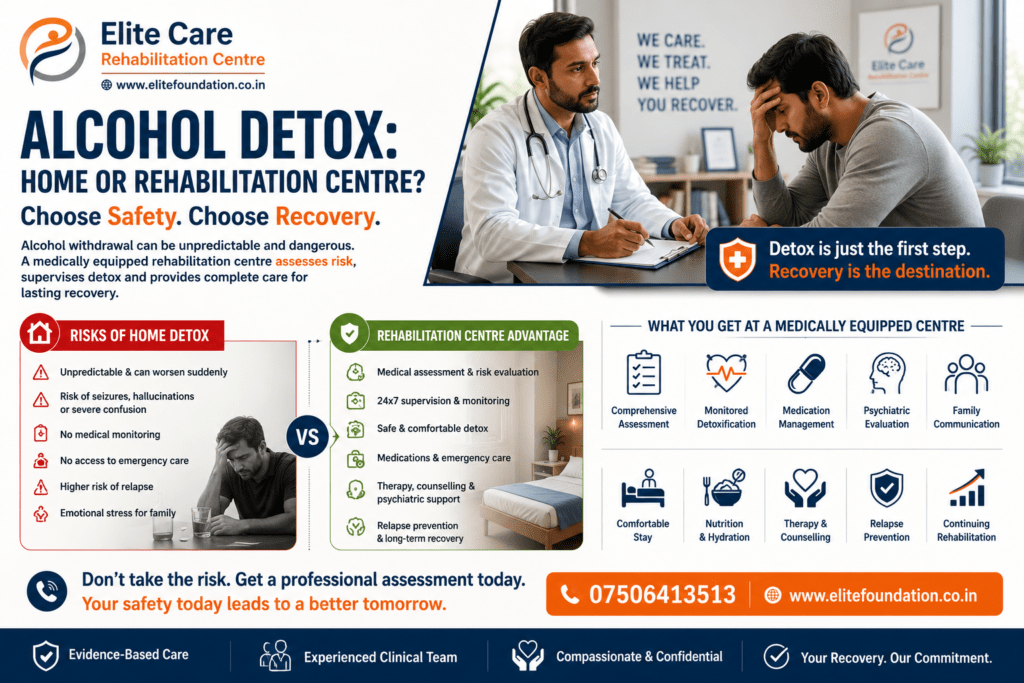
Can alcohol detox be managed at home? When drinking has become regular, heavy or difficult to control, trying to stop without medical support can expose the person to shaking, vomiting, hallucinations, seizures or severe confusion. A medically equipped rehabilitation centre in Thane can first assess withdrawal risk, supervise detoxification where suitable and continue treatment through counselling, psychiatric support and relapse prevention. This gives families a safer, more organised alternative to watching unpredictable symptoms at home without knowing when the situation is becoming dangerous.
The first few hours can be deceptive. Someone may feel restless, sweaty or unable to sleep but still speak normally and insist that everything is under control. That early appearance says little about what may follow.
For relatives, the safest practical approach is to arrange a clinical review before alcohol is suddenly stopped. Once the history and present condition are understood, the centre can decide whether supervised residential detoxification is suitable or whether an urgent medical problem needs stabilisation first.
Why alcohol detox at home is often underestimated
Families usually think of detox as a short period of discomfort. They expect shaking, irritation, poor sleep and perhaps a few difficult days.
Alcohol withdrawal can be more complicated.
After prolonged drinking, the brain adapts to alcohol’s repeated presence. When the alcohol level falls sharply, the nervous system may become unusually active. Anxiety, tremors, sweating, nausea and a faster pulse can appear. In a more serious episode, hallucinations, seizures or delirium may follow.
Symptoms do not always progress in a neat order. A person who looks reasonably well in the morning may become much more unsettled later. Another may hide drinking, take sleeping tablets or understate symptoms because they do not want to be admitted.
This uncertainty is one of the strongest reasons not to rely on an unsupported home attempt.
The ASAM guideline on alcohol withdrawal management explains that treatment placement depends on withdrawal history, current symptoms, medical health, psychiatric risk, other substances and the support available around the patient.
A rehabilitation centre gives families a safer starting point
Relatives should not be expected to decide whether withdrawal will remain mild.
At a clinically equipped rehabilitation centre, the first step is usually a structured review. Staff examine the pattern of drinking, previous withdrawal, current health, prescribed medicines and the stability of the home environment.
That assessment may identify risks which are not obvious from appearance alone.
Someone may have had a seizure during an earlier attempt to stop. Another person may be drinking during the night to prevent shaking. Poor food intake, liver problems, depression, sleeping tablets or recent falls can all change the treatment plan.
Where residential detoxification is clinically suitable, the centre can offer:
- Supervision through the day and night
- Controlled access to alcohol and medicines
- Individual treatment rather than a copied detox schedule
- Monitoring of changing withdrawal symptoms
- Support with food, fluids and rest
- Psychiatric or psychological evaluation
- Family communication
- A clear response when symptoms worsen
- Continuing rehabilitation after physical stability
The practical advantage is not simply that someone is kept away from alcohol. Withdrawal care moves directly into treatment for the drinking problem itself.
What “medically equipped” should mean
Not every facility using the words “rehabilitation” or “detox” provides the same level of clinical care.
Before admission, ask how the programme handles alcohol withdrawal. A suitable centre should be able to explain:
- Who completes the initial assessment
- Which qualified professional supervises detoxification
- How medicines are prescribed and administered
- Whether observation is available at night
- How pulse, blood pressure, temperature and awareness are reviewed when required
- What happens if vomiting, confusion or agitation increases
- How psychiatric emergencies are handled
- Which symptoms exceed the centre’s treatment capacity
- What emergency-transfer arrangements are in place
- How rehabilitation continues once detox is complete
Clear limits are a sign of safe practice. No rehabilitation centre should claim that every alcohol-related emergency can be managed within the same setting.
Drinking history matters more than one day’s quantity
There is no single number of drinks that tells a family whether home detox will be safe.
The wider pattern offers more useful information.
Concern rises when someone:
- Drinks every day
- Starts drinking in the morning
- Wakes at night to drink
- Shakes or sweats when alcohol is delayed
- Uses alcohol to settle anxiety or tremors
- Has repeatedly tried to stop and returned to drinking
- Has experienced hallucinations, seizures or severe confusion
- Cannot give a reliable account of how much is consumed
- Uses sedatives, sleeping tablets, opioids or other substances
These signs may point towards alcohol dependence, but the final decision cannot be made from drinking quantity alone.
Age, nutrition, pregnancy, heart health, liver function, mental state and earlier withdrawal episodes can all influence risk.
When residential detoxification is more suitable than home
Some situations make a supervised residential setting particularly valuable.
Previous withdrawal complications
A past seizure, withdrawal delirium or episode of severe confusion deserves careful attention.
A mild earlier detox does not guarantee that the next attempt will follow the same course.
Morning or round-the-clock drinking
Needing alcohol soon after waking often suggests that the body has adapted to regular use. Trying to manage this pattern at home can become difficult as soon as discomfort begins.
Repeated failed attempts
Many people stop for a day or two, struggle with anxiety or sleep and then return to alcohol.
The problem is not always a lack of determination. The withdrawal attempt may have ended before treatment had a chance to begin.
Easy access to alcohol
At home, alcohol may remain available. Friends may bring it, the person may leave to purchase it or a relative may provide a drink when the shaking becomes distressing.
A controlled residential environment removes this uncertainty.
Unstable family circumstances
Serious conflict, violence, poor communication or the absence of a dependable caregiver can make home observation unreliable.
Mental-health concerns
Depression, trauma, psychosis, suicidal thinking and severe anxiety may need psychiatric support alongside detoxification.
Physical illness
Liver disease, heart problems, kidney illness, poor nutrition, infection or recent injury can complicate withdrawal.
An alcohol use disorder assessment brings these factors together before the treatment setting is decided.
Why a calm beginning does not prove that home detox is safe
Alcohol withdrawal often unfolds over time.
During the early hours, a person may mainly complain of anxiety, restlessness, nausea or poor sleep. Tremors and sweating can become more noticeable as the alcohol level falls.
Seizures may occur during the first two days, sometimes without a long period of visibly severe symptoms. Hallucinations can develop while the person still knows where they are. Severe confusion may appear later.
The detailed alcohol withdrawal timeline explains why a timeline is useful for education but cannot confirm that an individual is safe.
At home, deterioration can be missed because:
- Everyone is asleep
- The person hides symptoms
- Alcohol use continues secretly
- Relatives mistake confusion for tiredness
- Agitation is treated as bad behaviour
- No one can check physical signs
- The caregiver needs to leave for work
- Transport is not available
- Emergency care is far away
Residential supervision reduces several of these gaps.
What happens after admission for alcohol detox
A proper detox programme does not begin with the same medicine plan for everyone.
The drinking pattern is discussed
Staff may ask when drinking begins, how much is usually consumed, whether alcohol is used at night and when the last drink occurred.
Past attempts to stop are especially important. Seizures, hallucinations or delirium during an earlier withdrawal can change how closely the person needs to be observed.
Current health is reviewed
The assessment may cover:
- Pulse and blood pressure
- Temperature
- Hydration
- Food intake
- Alertness and orientation
- Recent falls or head injuries
- Existing liver, heart or kidney problems
- Pregnancy
- Mental-health symptoms
- Current medicines
- Other substance use
A person may have more than one problem at the same time. Confusion could be related to withdrawal, infection, low blood sugar, head injury or liver illness.
Treatment is prescribed individually
Withdrawal medicines require clinical judgement. Age, liver health, other substances and the response to treatment can affect what is suitable.
For that reason, medicine names, dosages and home schedules are not included here. A plan written for one patient may be unsafe for another.
Symptoms are observed over time
A single calm conversation is not enough.
Attention, behaviour, hydration, sleep and physical signs may change as withdrawal progresses. Residential care makes those changes easier to notice.
Food and fluids are supported
Heavy drinking is often accompanied by irregular meals, vomiting and poor hydration.
A structured setting helps restore a routine while staff watch for problems that need additional treatment.
Why sleeping tablets and borrowed medicines can create another emergency
A common home response is to give the person something that will make them sleep.
The tablet may come from an old prescription, another family member or a previous detox attempt. This can be dangerous even when the person appears calmer afterwards.
Sedation can hide worsening confusion. Alcohol combined with sleeping medicines, opioids or sedatives may reduce alertness and breathing.
Other risks include:
- The dose may be unsuitable
- The person may have already taken something else
- Alcohol may still be present in the body
- Liver function may affect how the medicine is processed
- Secret drinking may continue
- Relatives may mistake unconsciousness for ordinary sleep
Within an organised programme, medicines are recorded, administered according to the clinical plan and reviewed when the condition changes.
Giving alcohol to control shaking is not a safe detox plan
Some families provide another drink whenever tremors, anxiety or sweating begin.
The symptoms may settle temporarily, but dependence continues. It also becomes harder to know when withdrawal genuinely started.
An informal alcohol taper can quickly lose structure. The person may drink more than agreed, obtain alcohol elsewhere or become distressed when the amount is reduced.
Where a clinician recommends a particular withdrawal approach, it should follow an individual assessment. It should not be copied from an online schedule or improvised by relatives.
Emergency symptoms still need immediate escalation
The main message remains that families should approach a medically capable rehabilitation service rather than attempt detox alone.
A few situations, however, need emergency stabilisation without delay:
- An active or repeated seizure
- Severe confusion or disorientation
- Hallucinations with poor awareness
- Loss of consciousness
- Breathing difficulty
- Serious chest pain
- Suspected overdose
- Severe dehydration
- A significant head injury
- Dangerously unstable physical signs
- Violent behaviour that cannot be safely managed
- Immediate risk of suicide or self-harm
Do not attempt to transport someone alone if they are actively seizing, unconscious, violent or unable to remain safe.
Severe delirium tremens is a medical emergency. Once the acute danger has been stabilised, rehabilitation should continue so that the underlying alcohol use disorder is not left untreated.
Detoxification does not complete the recovery process
The visible withdrawal symptoms may settle within days. The reasons drinking continued often remain unchanged.
The person may still struggle with:
- Cravings
- Poor sleep
- Depression
- Anxiety
- Family conflict
- Work pressure
- Social drinking cues
- Debt
- Loneliness
- A belief that alcohol can now be controlled
An isolated detox leaves these issues waiting at home.
Residential rehabilitation provides time to work on them before the person returns to the same environment. Counselling, psychiatric support, family work and relapse-prevention planning can begin once the individual is physically and mentally able to participate.
The NIAAA guide to types of alcohol treatment explains that effective care may combine behavioural treatment, medicines and continuing support at different levels of intensity.
What rehabilitation works on after detox
Understanding triggers
Work stress, conflict, social groups, celebrations, loneliness and boredom can all become linked with drinking.
Recognising a trigger early gives the person more time to respond before the urge becomes overwhelming.
Managing cravings
Cravings are not proof that treatment has failed. They are part of the condition and need a practical plan.
Treating mental-health problems
Alcohol may have been used to manage anxiety, depression, trauma or sleep difficulties.
Leaving these concerns untreated can increase relapse risk.
Rebuilding daily structure
Regular sleep, meals, therapy, exercise and purposeful activities replace the disorder of active drinking.
Working with the family
Relatives often need help understanding the difference between support and enabling.
Family sessions may address boundaries, communication, trust and the response to future warning signs.
Preparing for discharge
Recovery becomes more realistic when follow-up is arranged before the person returns home.
The plan may include counselling, psychiatric review, family support and action to take if drinking resumes.
Why repeated detox attempts often fail at home
A person may stop several times and still return to alcohol.
Each attempt can look like a failure of motivation. In reality, the treatment may have focused only on getting through several alcohol-free days.
After the discomfort passes, the person returns to:
- The same triggers
- The same friends
- The same emotional difficulties
- Easy access to alcohol
- Untreated anxiety or depression
- No strategy for cravings
- No follow-up
Residential care creates distance from these patterns long enough for meaningful treatment to begin.
It also gives professionals time to observe mood, sleep, behaviour and motivation after intoxication and acute withdrawal have settled.
What relatives should ask before choosing a centre
A family comparing rehabilitation centres in Thane should ask direct, practical questions.
How is withdrawal risk assessed?
The answer should cover drinking history, previous detox attempts, seizures, medical illness, medicines and other substances.
Who supervises the detoxification process?
Ask which qualified professionals are responsible and how often the patient is reviewed.
Is observation available at night?
Withdrawal does not follow office hours. Overnight arrangements should be explained clearly.
How are medicines stored and administered?
Treatment should be individualised, documented and monitored.
What happens if symptoms worsen?
A credible programme should explain which complications it can manage and when escalation is required.
Is psychiatric support available?
Alcohol dependence frequently coexists with depression, anxiety, psychosis, trauma or suicidal thinking.
What follows detoxification?
The centre should offer a structured rehabilitation programme rather than treating the disappearance of shaking as the end of care.
How does the family remain involved?
Communication, consent, progress discussions and discharge planning should be clear from the beginning.
What if the person refuses rehabilitation?
Fear of admission is common.
The person may be worried about work, reputation, withdrawal discomfort or loss of independence. Some believe that they can stop whenever they choose, even after several unsuccessful attempts.
A conversation is usually more productive when the individual is relatively sober and calm.
Relatives can:
- Describe specific incidents rather than use insulting labels
- Explain their concern about withdrawal safety
- Arrange an assessment before the next crisis
- Prepare a list of medicines and medical conditions
- Ask the centre what documents are required
- Discuss practical concerns such as work or family duties
- Set clear boundaries around violence and unsafe behaviour
- Avoid promising that treatment will be effortless
The aim is not to win an argument. It is to help the person accept a safer next step.
India continues to face a major alcohol-treatment gap
A 2024 National Academy of Medical Sciences report summarised earlier national substance-use data. It referred to approximately 16 crore alcohol users, around 5.7 crore people with problematic alcohol use and nearly 2.9 crore people showing dependence.
The same report stated that only about one in 38 people with alcohol dependence had ever received treatment. It also cited an 86.3% treatment gap for alcohol-use disorders from the National Mental Health Survey.
These numbers come from earlier survey periods and should not be treated as exact 2026 population estimates. They illustrate how often families delay professional treatment until a withdrawal crisis, injury or serious behavioural problem develops.
The NAMS report on alcohol and substance-use disorders in India highlights the need for stronger treatment access, professional training and referral systems.
Seeking help earlier gives the family more time to compare facilities, plan admission and begin treatment before the situation becomes an emergency.
Choosing a rehabilitation centre in Thane
Location influences family visits, counselling sessions and follow-up after discharge.
Clinical capability matters more.
A nearby facility is useful only when its treatment systems match the patient’s needs. Ask about detox supervision, staff availability, psychiatric support, medicine management and emergency arrangements.
For people travelling from Titwala and nearby areas, practical distance also matters. Relatives may need to attend assessments, family sessions or discharge discussions.
The strongest programme is not the one making the biggest promises. It is the one that assesses honestly, explains its limits and provides a clear plan from detoxification through longer recovery.
Frequently asked questions
Can alcohol detox be managed at home?
Unsupported home detox is not recommended when physical dependence or withdrawal risk may be present. The person should first be assessed by a medically capable rehabilitation service. Residential detoxification may then be advised according to the history, symptoms and home circumstances.
Why is a rehabilitation centre safer than attempting detox alone?
A clinically equipped centre can provide assessment, controlled medicines, supervision and continuing addiction treatment. At home, relatives may miss changes or be unable to respond when symptoms worsen.
Does everyone need residential admission?
Not every person requires the same setting. The decision depends on withdrawal history, medical and mental health, other substances and the reliability of home support. Families should not make that choice without professional assessment.
Can a rehabilitation centre manage severe withdrawal?
A centre can manage withdrawal within its defined clinical capacity. Seizures, delirium, reduced consciousness and other acute emergencies may require immediate stabilisation before rehabilitation resumes.
Can sleeping tablets be used during home detox?
Old prescriptions and borrowed tablets can interact with alcohol, reduce breathing or hide deterioration. Withdrawal medicines require individual prescribing and monitoring.
How long does alcohol detox take?
The active phase often develops over the first few days, although the course differs between patients. Sleep problems, fatigue, anxiety and cravings may continue after the main physical symptoms settle.
Is detox enough to stop future drinking?
No. Detoxification addresses withdrawal. Rehabilitation is needed to work on cravings, triggers, mental health, family difficulties and relapse prevention.
What happens if drinking restarts after discharge?
A return to alcohol should lead to early reassessment rather than shame or delay. The follow-up plan may need to be strengthened or changed.
Rehabilitation turns withdrawal care into meaningful treatment
The weakness of home detox is not only the absence of equipment. It leaves the family trying to manage a medical and behavioural problem without a structured system.
A medically equipped rehabilitation centre can assess the risks, supervise detoxification where suitable and continue treatment after the immediate symptoms fade.
That continuity matters. Several alcohol-free days do not address the thinking, emotions, habits and circumstances that kept the drinking going.
For families facing alcohol dependence, the practical message is clear: arrange professional rehabilitation assessment before attempting detox at home. The right support at the beginning can prevent avoidable risk and create a more realistic path towards lasting recovery.
Medical disclaimer: This article provides general educational information and does not replace individual medical assessment, diagnosis or treatment. Alcohol withdrawal can be dangerous. Seek urgent assistance for seizures, severe confusion, hallucinations with poor awareness, loss of consciousness, breathing difficulty, chest pain, suspected overdose, violent behaviour or thoughts of self-harm.
