
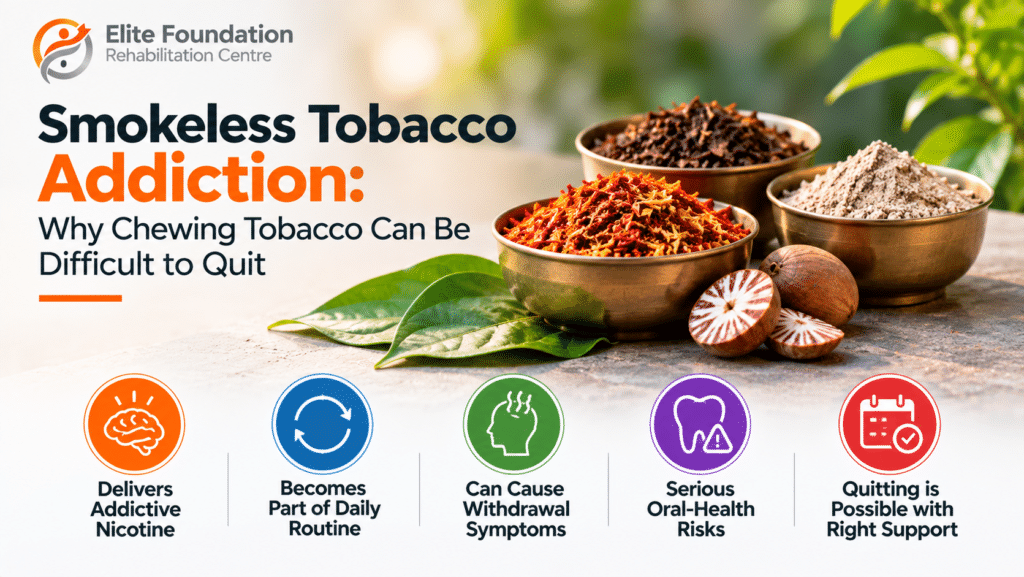
Smokeless tobacco addiction can make khaini, gutkha and zarda difficult to quit. Cravings after meals, restlessness at work and repeated use despite mouth problems are warning signs. For families seeking a de-addiction centre, professional support can help address nicotine dependence and related addiction concerns.
The nicotine-dependence treatment service for vaping covers a related form of dependence. Chewing tobacco needs its own oral-health assessment and quitting plan; outpatient care is usually the first step.
A person may use chewing tobacco for years without considering it an addiction. A small portion of khaini after morning tea, zarda mixed into paan or gutkha during work can become such a familiar routine that the next use hardly feels like a decision. The difficulty becomes clearer when somebody tries to stop. Their mouth feels unusually empty, concentration becomes difficult or they begin looking for another packet despite having decided to quit.
Quick answer: Chewing tobacco can be difficult to quit because it delivers addictive nicotine and becomes closely associated with daily routines. Withdrawal may cause cravings, irritability, restlessness and poor concentration. Counselling and appropriate cessation medicines can improve the likelihood of quitting. Smokeless tobacco also causes serious health harm, including oral cancer, even though it produces no cigarette smoke.
For families searching for khaini addiction treatment or help quitting gutkha in Mumbai, Thane or Kalyan, understanding the specific tobacco product matters. Khaini, tobacco-containing gutkha, zarda and other preparations can differ in their ingredients, nicotine delivery and associated health risks. Products containing areca nut introduce additional concerns, even when tobacco is absent.
This article explains why chewing tobacco becomes addictive, the warning signs of dependence, oral-health risks, withdrawal, treatment research and practical ways to stop. It also covers what to do about suspicious mouth changes and how families can support someone who repeatedly returns to tobacco.
What is smokeless tobacco addiction?
Smokeless tobacco addiction refers to a pattern of tobacco use in which nicotine dependence, cravings and difficulty controlling consumption develop without tobacco being smoked.
Products may be chewed, held inside the mouth, placed against the gums or used in other ways, depending on the preparation.
Nicotine is absorbed through tissues in the mouth and enters the bloodstream. Repeated exposure can produce physical dependence, leading to discomfort when nicotine use stops.
Over time, the behaviour may become associated with specific activities. Someone may automatically reach for khaini after eating, use zarda while working or keep a packet available throughout the day.
The dependence has two important components: the body’s adaptation to nicotine and the daily routines that repeatedly encourage tobacco use.
Clinical assessment considers cravings, frequency, loss of control, withdrawal, unsuccessful attempts to quit and continued use despite health or personal consequences.
Common types of smokeless tobacco used in India
India has several forms of smokeless tobacco. Understanding the product is important because people sometimes use different names for mixtures with different ingredients.
| Product | Common characteristics | Important health concern |
|---|---|---|
| Khaini | Usually a mixture of tobacco and slaked lime, commonly placed in the mouth. | Nicotine dependence, oral disease and cancer risk. |
| Gutkha | Typically contains tobacco, areca nut, slaked lime and flavouring ingredients. | Nicotine dependence, oral cancer and areca-related oral submucous fibrosis. |
| Zarda | Flavoured or processed tobacco, sometimes mixed with paan. | Nicotine exposure, oral tissue injury and cancer risk. |
| Tobacco-containing paan | Betel quid prepared with tobacco and other ingredients. | Nicotine dependence and oral-health risks. |
| Mawa | May contain tobacco, areca nut and slaked lime, depending on preparation. | Risks depend on ingredients; tobacco and areca nut are important concerns. |
| Mishri or tobacco tooth powder | Tobacco used for oral application in certain communities. | Nicotine exposure and oral-health harm. |
| Pan masala without tobacco | May contain areca nut and flavouring ingredients but no tobacco. | Areca nut can cause serious oral harm even without nicotine. |
| Supari | Areca nut, which may be used alone or in mixtures. | Carcinogenic risk and oral submucous fibrosis; not identical to nicotine addiction. |
Product names and ingredients are not always used consistently. A tobacco-free label should not be interpreted as proof that a preparation is harmless.
Similarly, a preparation containing areca nut but no nicotine may create a repeated habit without being the same as nicotine dependence. The distinction matters when planning treatment.
Why is chewing tobacco so addictive?
Chewing tobacco can deliver substantial nicotine through the lining of the mouth.
The amount absorbed depends on the tobacco preparation, nicotine content, acidity or alkalinity, how long the product remains in the mouth and how frequently it is used.
Slaked lime in some preparations increases alkalinity and can influence nicotine availability and absorption.
Unlike cigarette smoking, which involves a distinct smoking episode, some smokeless products can remain in the mouth for an extended period.
A user may also take several portions throughout the day.
When nicotine exposure becomes frequent, the body adapts. Reducing or stopping use may produce cravings and other withdrawal symptoms.
Taking another portion of tobacco can temporarily relieve that discomfort, reinforcing the behaviour.
Someone may then describe the product as necessary for concentration, relaxation or completing a working day.
The wider relationship between nicotine, reward and physical dependence is explained in Elite Foundation’s article on nicotine addiction and why cravings become strong.
Why chewing tobacco becomes part of daily routines
Dependence is rarely maintained by nicotine alone.
Think of a person who has used khaini after lunch for fifteen years. The meal ends, and their hand reaches towards the familiar packet. The action has become closely associated with finishing food.
Another person may chew tobacco while driving a commercial vehicle or working long shifts.
During a break, colleagues may share tobacco or offer it without thinking much about the health implications.
Some people use it while handling stressful work. Others associate the taste or sensation in the mouth with feeling alert.
These situations can continue triggering cravings even after the strongest physical withdrawal symptoms have improved.
A successful quitting plan therefore needs to address what happens after meals, during travel, at work and in social settings.
What are the signs of chewing tobacco addiction?
The most useful warning signs are difficulty controlling tobacco use and discomfort when nicotine is unavailable.
- Using tobacco soon after waking: feeling a need for khaini or another nicotine-containing product early in the morning.
- Frequent cravings: repeatedly thinking about the next portion during work or family activities.
- Increasing consumption: using more frequently than intended.
- Withdrawal symptoms: becoming irritable, restless or distracted when tobacco is unavailable.
- Unsuccessful attempts to quit: stopping for a few days before returning to the product.
- Keeping supplies nearby: worrying about running out or making special arrangements to obtain tobacco.
- Continued use despite oral problems: using tobacco despite gum irritation, mouth lesions or advice to stop.
- Concealing consumption: hiding packets, spending or the frequency of use because of family conflict or embarrassment.
These signs should be considered together. Daily use is relevant, but addiction cannot be diagnosed from the number of packets purchased alone.
Can someone become dependent on khaini without using it all day?
Yes. The severity of dependence is influenced by more than the number of hours spent using tobacco.
Some people use khaini only during particular situations but experience strong cravings when those situations occur.
For example, somebody may avoid tobacco while at home but feel unable to complete a working shift without it.
Another may use tobacco frequently yet report less severe withdrawal during a short period without access.
The pattern of cravings, control, withdrawal and consequences helps clinicians understand the person’s dependence.
Even occasional smokeless tobacco use carries health risks and should not be described as safe merely because it is less frequent.
Is smokeless tobacco safer than cigarettes?
Smokeless tobacco avoids the inhalation of cigarette smoke and many toxic chemicals produced by burning tobacco.
However, the absence of smoke does not make chewing tobacco a safe product.
Smokeless tobacco contains nicotine and can expose users to carcinogenic substances, including tobacco-specific nitrosamines.
Some Indian preparations also contain areca nut, which has additional carcinogenic properties.
Chewing tobacco is an established cause of cancers affecting the mouth and is associated with other serious health problems.
The product-specific risks differ from those of cigarette smoking, but replacing cigarettes with khaini or gutkha is not equivalent to ending tobacco dependence.
For someone using both cigarettes and chewing tobacco, cessation care should address both products.
Can khaini, gutkha and zarda cause mouth cancer?
Yes. Smokeless tobacco causes oral cancer and is also associated with cancers of the oesophagus and pancreas.
Risk varies according to the product, composition, duration and pattern of use, but the absence of cigarette smoke does not remove the carcinogenic exposure.
Somebody who habitually keeps tobacco against the cheek or gum may repeatedly expose the same area to irritating and harmful substances.
Repeated contact can contribute to oral tissue changes, although the precise cause of an individual lesion requires professional examination.
Not every white patch, ulcer or painful area is cancer. Equally, a persistent mouth lesion should not be dismissed because it is painless.
Stopping tobacco is important, but somebody who already has a suspicious lesion needs medical or dental assessment as well.
What does research say about smokeless tobacco and oral cancer?
The International Agency for Research on Cancer, part of the World Health Organization, has examined the global burden of oral cancer associated with smokeless tobacco and areca nut.
An IARC-led analysis published in October 2024 estimated that approximately 120,200 oral-cancer cases worldwide in 2022 were attributable to smokeless tobacco or areca nut consumption.
That represented 30.8% of oral-cancer cases globally, or approximately one in three.
The analysis also estimated that nearly 88% of the attributable cases occurred in South-Central Asia.
These are population-level estimates. They are not the probability that an individual khaini or gutkha user will develop cancer.
Another important distinction is that the estimate combines exposure to smokeless tobacco and areca nut. It should not be described as the burden caused by nicotine or chewing tobacco alone.
The findings are especially relevant in India because several commonly used oral preparations contain tobacco, areca nut or both.
How common is smokeless tobacco use in India?
Smokeless tobacco has historically represented a substantial part of tobacco use in India.
The Government of India’s Global Adult Tobacco Survey, second round, conducted in 2016–17, estimated that 21.4% of adults aged 15 years and above were current users of smokeless tobacco.
This represented approximately 199.4 million people at the time of the survey.
The estimated prevalence was 29.6% among men and 12.8% among women.
These figures describe the 2016–17 survey period. They should not be presented as verified prevalence figures for 2026.
They nevertheless illustrate why chewing tobacco, oral cancer prevention and access to tobacco-cessation services remain important public-health concerns in India.
What is oral submucous fibrosis?
Oral submucous fibrosis is a potentially malignant disorder in which the tissues inside the mouth develop progressive fibrosis and reduced flexibility.
It is strongly associated with areca nut use, including products containing supari or areca nut mixtures.
Early symptoms may include burning sensations, discomfort when eating spicy food or changes in the mouth’s lining.
As the condition progresses, the tissues can become tight and mouth opening may become restricted.
Someone may find it increasingly difficult to open the mouth fully, eat comfortably or undergo a dental examination.
Oral submucous fibrosis can occur even when the areca nut preparation does not contain tobacco.
It requires professional assessment because the condition can persist and carries an increased risk of oral cancer.
Is tobacco-free pan masala safe?
No. A product being free from tobacco or nicotine does not establish that it is safe.
Many pan masala preparations contain areca nut.
Areca nut is carcinogenic to humans and is associated with oral submucous fibrosis and oral cancer.
For somebody who wants to stop gutkha, switching to an areca-containing tobacco-free mixture may remove nicotine exposure from that product but continue an important oral-health risk.
It may also preserve the habit of repeatedly keeping a preparation inside the mouth.
A quitting plan should therefore identify all ingredients and avoid assuming that every tobacco-free substitute is harmless.
What are the warning signs of oral disease?
People who use smokeless tobacco should pay attention to persistent changes inside the mouth.
Warning signs include:
- A mouth ulcer that does not heal.
- Persistent white or red patches on the tongue, cheek or gums.
- Unexplained bleeding from an area inside the mouth.
- Increasing difficulty opening the mouth.
- Persistent burning or pain inside the mouth.
- A lump, swelling or thickened area in the mouth or neck.
- Difficulty chewing or swallowing that has no clear explanation.
- Numbness or changes in sensation in part of the mouth.
- A loose tooth or gum problem that cannot be explained by an ordinary dental cause.
These symptoms may arise from different conditions, not all of them cancer.
An ulcer lasting more than two weeks, persistent red or white patches, unexplained swelling or restricted mouth opening should prompt an examination by a dentist, oral medicine specialist or ENT clinician. Seek earlier care when symptoms are severe, rapidly worsening or otherwise concerning.
Do not wait for a lesion to become painful. Some potentially serious oral conditions may cause little discomfort initially.
Can chewing tobacco damage teeth and gums?
Yes. Smokeless tobacco can contribute to oral-health problems beyond cancer.
These may include gum recession, local tissue irritation, tooth staining, periodontal disease and other changes affecting the teeth and gums.
Some preparations are repeatedly held against the same area of the mouth, increasing local contact with tobacco and other ingredients.
However, a person’s specific dental problem may also involve hygiene, infection, diet or unrelated medical conditions.
Dental assessment helps identify the cause and determine appropriate treatment.
Stopping tobacco is valuable, but it does not replace dental care when gum disease, damaged teeth or suspicious lesions are already present.
Does smokeless tobacco affect the heart?
Nicotine can affect heart rate, blood pressure and other cardiovascular processes.
Some forms of smokeless tobacco have also been associated with cardiovascular disease and increased risk of death from heart disease or stroke.
The magnitude of risk varies between products and populations, and evidence is less uniform than for conventional cigarette smoking.
These uncertainties should not be interpreted as proof of cardiovascular safety.
People with hypertension, heart disease or other cardiovascular concerns should tell their healthcare professional about every tobacco product they use.
Is chewing tobacco dangerous during pregnancy?
Yes. Tobacco exposure during pregnancy raises concerns for maternal and fetal health.
Nicotine can affect fetal development. Smokeless tobacco use has also been associated with adverse pregnancy outcomes, including premature delivery and stillbirth.
The type of product and other health circumstances influence risk.
Pregnant people who use khaini, zarda or other smokeless tobacco should seek maternity-specific cessation support.
Do not independently begin prescription medicines or nicotine replacement during pregnancy without appropriate professional guidance.
What happens when someone stops chewing tobacco?
When physical nicotine dependence has developed, stopping smokeless tobacco may cause withdrawal symptoms.
Common experiences include:
- Strong cravings for tobacco.
- Irritability or frustration.
- Restlessness and anxiety.
- Difficulty concentrating.
- Disturbed sleep.
- Increased appetite.
- Temporary low mood.
Symptoms may begin within hours after nicotine exposure decreases and can become more uncomfortable during the first few days.
For many people, the strongest symptoms gradually ease over the following weeks.
The course differs according to nicotine exposure, individual dependence and other health factors.
Someone using chewing tobacco frequently may also feel an urge to keep something in the mouth during activities previously associated with tobacco.
For more detail about physical symptoms and their course, see the guide to nicotine withdrawal symptoms and their typical timeline.
Why cravings can continue after physical withdrawal improves
After quitting, a person may no longer feel constantly irritable but still experience a sudden urge following lunch or during a familiar work break.
The craving may be connected with a learned association rather than the return of acute physical withdrawal.
For example, a driver who previously used khaini at every tea stop may feel an urge whenever the vehicle stops near a roadside stall.
The situation has become a reminder of tobacco use.
Changing the routine, preparing an alternative activity and recognising the trigger may help reduce the influence of these associations.
Behavioural support can be particularly useful when a person repeatedly returns to tobacco in predictable situations.
How to quit chewing tobacco: practical first steps
Stopping smokeless tobacco is more manageable when the plan addresses both nicotine dependence and the daily circumstances associated with use.
- Identify every product used. Include khaini, gutkha, zarda, tobacco-containing paan, mishri and any cigarettes or nicotine vapes.
- Understand the daily pattern. Note when tobacco is used, how frequently it is taken and which situations produce the strongest cravings.
- Choose a quitting goal. Decide whether to stop immediately or prepare for a specific quit date with appropriate support.
- Remove routine access. Avoid storing unnecessary tobacco packets in frequently used places such as the car, work bag or bedside drawer.
- Prepare for difficult moments. Identify what normally happens after meals, during travel, while working and when feeling stressed.
- Consider appropriate treatment. Discuss counselling and suitable cessation medicines with a qualified healthcare professional when dependence is significant.
- Arrange an oral-health examination. Persistent patches, ulcers or restricted mouth opening require assessment regardless of whether quitting has started.
- Plan follow-up. Review cravings, withdrawal, setbacks and any changes needed to maintain tobacco abstinence.
The purpose of these steps is to create a plan that fits the person’s circumstances rather than expecting one instruction to stop tobacco to resolve years of dependence.
Should somebody quit khaini suddenly or reduce it gradually?
Some people prefer to stop on a specific day. Others feel more comfortable making a planned reduction before their quit date.
The appropriate approach depends on dependence, previous experiences and access to treatment.
A gradual plan should have a clear endpoint. Repeatedly reducing and increasing tobacco use without a defined goal may allow dependence to continue indefinitely.
A person who has repeatedly returned to tobacco during abrupt attempts may benefit from discussing a structured plan and appropriate cessation treatment.
Neither method eliminates the need to address cravings and the familiar situations connected with tobacco use.
What does the latest evidence say about smokeless tobacco treatment?
A major review published in April 2025 examined randomised studies testing interventions to help people stop smokeless tobacco use.
The 2025 Cochrane review of smokeless tobacco cessation treatments included 43 studies involving 20,346 participants.
It evaluated counselling, brief advice and several medicines, including varenicline, nicotine replacement therapy and bupropion.
The review found that counselling and brief advice probably improved quitting outcomes compared with minimal or no support.
Varenicline also probably improved cessation rates compared with placebo.
Nicotine replacement therapy may help, although the certainty of evidence for that comparison was lower.
The evidence did not establish a clear benefit of bupropion for smokeless tobacco cessation.
These findings are relevant to clinical treatment because they examine stopping smokeless tobacco specifically rather than relying only on studies involving cigarettes.
How effective is counselling for chewing tobacco addiction?
Behavioural counselling addresses the situations, beliefs and habits that contribute to continued tobacco use.
Someone may understand that khaini is harmful yet continue using it after every meal because the routine has become deeply familiar.
Another person may use tobacco whenever work becomes stressful.
A counsellor can help identify these situations, prepare alternative responses and review what happens when cravings appear.
The 2025 Cochrane review found moderate-certainty evidence that counselling probably increases the likelihood of stopping smokeless tobacco compared with minimal support.
Across the studies contributing to that comparison, the relative likelihood of quitting was approximately 1.76 times higher with counselling.
That is a study-level comparison, not a guarantee of success for an individual.
The review also found that brief advice from a healthcare professional probably helped more people quit than receiving no support.
This is useful in India, where a first conversation about tobacco may happen during a dental appointment, general medical consultation or visit to a tobacco-cessation clinic.
Can varenicline help people stop chewing tobacco?
Varenicline is a prescription medicine used to support tobacco cessation.
It acts on nicotinic acetylcholine receptors and can help reduce nicotine cravings and withdrawal-related difficulties in appropriately selected patients.
The 2025 Cochrane review included two randomised studies involving 508 participants that compared varenicline with placebo for smokeless tobacco cessation.
The pooled results favoured varenicline, with a relative risk for quitting of approximately 1.35.
The certainty of this evidence was rated moderate.
The World Health Organization’s 2024 adult tobacco-cessation guideline also recommends varenicline as a pharmacological option for adults using smokeless tobacco who want to quit.
However, prescription suitability depends on medical history, age, pregnancy status, potential adverse effects, other medicines and availability in India.
Varenicline should not be started without appropriate medical advice.
Does nicotine replacement therapy work for khaini or gutkha addiction?
Medicinal nicotine replacement therapy may help selected adults stop smokeless tobacco.
Common formulations include nicotine patches, gum and lozenges.
These products deliver nicotine without continued exposure to tobacco preparations containing carcinogenic constituents.
For someone who uses khaini frequently, an appropriate medicine may reduce some withdrawal discomfort while behavioural support addresses the daily routine.
The 2025 Cochrane review included 11 studies involving 2,826 participants evaluating nicotine replacement therapy for smokeless tobacco cessation.
The pooled results suggested a modest improvement in quitting, with a relative risk of approximately 1.18 compared with placebo or no medication.
The certainty of evidence was low.
WHO’s 2024 adult guideline recommends nicotine replacement as a pharmacological option for smokeless tobacco users who want to quit, while acknowledging the evidence limitations.
Product selection and dosing require attention to the person’s tobacco use and medical circumstances.
Using tobacco while taking medicinal nicotine or combining products without proper guidance can complicate nicotine exposure and treatment.
Does bupropion help with smokeless tobacco cessation?
Bupropion has an established role in smoking-cessation treatment for certain adults.
However, evidence for smokeless tobacco cessation is different.
In the 2025 Cochrane review, two trials involving 293 participants did not establish a clear benefit of bupropion over placebo for stopping smokeless tobacco.
The evidence was rated low certainty.
This should not be interpreted as proof that the medicine can never help an individual with other clinical indications.
It means that current randomised evidence does not clearly support bupropion as an effective treatment specifically for smokeless tobacco cessation.
Medication choices should follow a clinician’s assessment rather than assumptions based on cigarette-smoking treatment.
Why Indian smokeless tobacco users need more research
The 2025 Cochrane review identified an important limitation.
Although a large proportion of the world’s smokeless tobacco users live in South and Southeast Asia, most included trials were conducted elsewhere.
Of the 43 studies, 33 took place in North America, while five took place in India and one involved participants from Bangladesh, India and Pakistan.
The review also found insufficient evidence to determine reliably whether different smokeless tobacco products respond differently to particular cessation interventions.
This matters because khaini, gutkha and zarda are not identical to every smokeless product studied in North American research.
The evidence supports counselling and appropriate treatment, but clinicians should still consider the particular preparation, nicotine exposure, oral-health concerns and individual circumstances.
What should someone use instead of chewing tobacco?
Some people want a substitute because they miss having something in the mouth after meals or during work.
Suitable options depend on dental health, swallowing safety and personal preference.
For some adults, ordinary sugar-free chewing gum or another safe, non-tobacco oral activity may help interrupt a familiar routine.
However, these behavioural substitutes are not the same as evidence-based medical treatment for nicotine dependence.
Products containing areca nut or supari should not be recommended as harmless replacements.
Likewise, replacing khaini with another tobacco product does not resolve tobacco dependence.
A person with oral lesions, jaw problems or difficulty swallowing may need professional advice before using chewing products of any kind.
Why people return to tobacco after quitting
Returning to chewing tobacco after an earlier quit attempt is common enough to deserve a practical response.
The person may encounter a familiar situation, experience a strong craving or accept tobacco from a colleague.
Someone who previously used khaini during every work break may feel an urge when returning to the same workplace.
The important question is what happened immediately before use resumed.
Was nicotine withdrawal inadequately managed? Did the person keep tobacco available? Was the social environment difficult to change?
Understanding the circumstances may help strengthen the cessation plan.
A return to tobacco should not be treated as proof that future attempts are pointless, although continued use maintains health risks.
How family members can support someone quitting chewing tobacco
Families may become frustrated when somebody repeatedly promises to stop using gutkha or khaini and then purchases another packet.
Repeated criticism may increase conflict without changing nicotine dependence.
A more constructive approach is to ask what makes stopping difficult and whether professional cessation support would help.
Family members can encourage appropriate dental examinations, support agreed tobacco-free routines and avoid offering or purchasing tobacco for the person.
Reasonable boundaries around spending and shared household safety can be maintained.
Support does not mean ignoring the health risks or taking responsibility for every decision made by the person using tobacco.
It means responding to dependence through practical help rather than shame alone.
What if someone uses cigarettes and chewing tobacco together?
Some people smoke cigarettes and use smokeless tobacco at different times of day.
For example, a person may smoke with friends in the evening but use khaini during working hours.
Stopping cigarettes while continuing khaini removes one source of exposure but does not end nicotine dependence or the health risks associated with smokeless tobacco.
Similarly, reducing khaini while continuing to smoke may leave nicotine withdrawal and tobacco-related health risks unresolved.
A cessation plan should identify every product being used.
For a broader explanation of stopping combustible tobacco, Elite Foundation’s article on how to quit smoking and stay smoke-free discusses behavioural and medical cessation support.
The goals should be adapted to the products the person actually uses.
Can young people become addicted to smokeless tobacco?
Yes. Nicotine dependence can develop during adolescence.
Young people may first encounter smokeless tobacco through peers, work environments, household exposure or curiosity.
The absence of smoke can make the product appear less serious, but nicotine exposure during brain development raises additional concerns.
Parents should look at repeated use, cravings, withdrawal and difficulty stopping rather than assuming that one discovered packet establishes addiction.
Treatment for minors requires age-appropriate clinical assessment.
Adult cessation medication recommendations should not simply be applied to children or teenagers.
Does chewing tobacco addiction require residential rehabilitation?
For nicotine dependence alone, residential rehabilitation is usually not required.
Most adults seeking to stop chewing tobacco can begin with outpatient healthcare, a tobacco-cessation clinic, dental services or behavioural counselling.
Suitable medicines may also be considered following medical assessment.
Residential care may be relevant when another significant substance-use disorder, severe psychiatric condition, safety concern or major functional difficulty requires that level of treatment.
The decision should be based on the person’s overall clinical needs.
Heavy khaini use or several unsuccessful attempts to quit do not independently establish the need for residential admission.
Where can someone get help for chewing tobacco addiction in Mumbai and Thane?
People seeking khaini addiction treatment or help quitting gutkha in Mumbai, Thane, Kalyan, Dombivli or Titwala can begin with a general physician, dentist, tobacco-cessation clinic or qualified healthcare professional experienced in nicotine dependence.
A useful initial assessment identifies the product, frequency of use, cravings, withdrawal and any symptoms affecting the mouth.
Where oral lesions, restricted mouth opening or persistent pain are present, a dental or oral-medicine examination is important.
For people with co-occurring mental-health concerns or another addiction, a broader assessment may be appropriate.
Elite Foundation’s physical rehabilitation facility is situated in Titwala, Thane, serving families from Mumbai and nearby areas. Anyone enquiring about smokeless-tobacco-specific services should confirm the availability of the relevant assessment and treatment before travelling or considering admission.
The appropriate service should be selected according to clinical needs, rather than assuming that every nicotine-dependent person requires a residential programme.
Free tobacco-cessation support in India
India’s National Tobacco Control Programme provides access to tobacco-cessation support through the National Tobacco QuitLine.
The toll-free number is 1800-112-356.
The Ministry of Health and Family Welfare also provides an mCessation initiative, which can be accessed through a missed call to 011-22901701.
These services can provide an accessible starting point for people who want to stop chewing tobacco, cigarettes or other tobacco products.
They do not replace urgent dental or medical assessment when concerning physical symptoms are present.
Frequently asked questions about smokeless tobacco addiction
What is smokeless tobacco addiction?
Smokeless tobacco addiction involves dependence on nicotine-containing tobacco used without smoking. Signs may include cravings, difficulty controlling use, withdrawal symptoms and repeated consumption despite health or other problems.
Is khaini addictive?
Yes. Khaini generally contains tobacco and slaked lime. It can deliver nicotine through the mouth and produce physical dependence.
Can gutkha cause addiction?
Yes. Tobacco-containing gutkha can cause nicotine dependence. Its areca nut content also raises important oral-health concerns, including oral submucous fibrosis and cancer risk.
Is zarda harmful?
Yes. Zarda contains tobacco and can deliver addictive nicotine. It can expose the mouth to harmful substances and contribute to tobacco-related disease.
Why is chewing tobacco difficult to quit?
Nicotine dependence can cause cravings and withdrawal. Repeated use after meals, during work or in social situations also creates familiar behavioural triggers that may remain influential after physical withdrawal improves.
What are the signs of chewing tobacco addiction?
Common signs include frequent cravings, use soon after waking, difficulty stopping, irritability without tobacco and continued consumption despite recognising harm.
Can chewing tobacco cause mouth cancer?
Yes. Smokeless tobacco causes oral cancer. The risk depends on the product and exposure history, and persistent oral lesions should be examined by a qualified professional.
Can gutkha cause oral submucous fibrosis?
Yes. Areca nut, commonly found in gutkha, is strongly associated with oral submucous fibrosis. Symptoms may include burning, tightness inside the mouth and reduced mouth opening.
Is tobacco-free pan masala safe?
Not necessarily. Pan masala containing areca nut can cause serious oral-health harm even without tobacco or nicotine.
Is supari safer than tobacco?
Supari is areca nut, which is carcinogenic and associated with oral submucous fibrosis. It should not be recommended as a harmless substitute for chewing tobacco.
Does chewing tobacco affect the heart?
Nicotine can influence heart rate and blood pressure. Some smokeless tobacco products have also been associated with cardiovascular disease, although risks vary across products and populations.
What happens when someone stops khaini?
Nicotine withdrawal may cause cravings, irritability, restlessness, anxiety, disturbed sleep and difficulty concentrating. Symptoms often improve over the following weeks.
How long does chewing tobacco withdrawal last?
Symptoms may begin within hours of reduced nicotine exposure and are often more uncomfortable during the first several days. The course varies, and learned cravings can persist after acute withdrawal improves.
How can I stop chewing tobacco naturally?
Changing routines, identifying triggers and using safe alternatives to familiar behaviours may help. However, these strategies should not replace evidence-based counselling or medication when dependence is significant.
What is the most effective treatment for khaini addiction?
Evidence supports behavioural counselling and, for appropriately selected adults, treatments such as varenicline or nicotine replacement therapy. The best approach for an individual depends on dependence, medical history, oral-health concerns and treatment availability.
Does counselling work for chewing tobacco addiction?
Yes. A 2025 Cochrane review found moderate-certainty evidence that counselling probably improves smokeless tobacco cessation rates compared with minimal support.
Can nicotine gum help someone stop khaini?
Medicinal nicotine gum may help some adults manage withdrawal while stopping smokeless tobacco. Product selection and dosing should follow appropriate medical or product guidance.
Can varenicline help people stop gutkha?
Varenicline has shown benefit in randomised studies of smokeless tobacco cessation. However, evidence across specific Indian products is limited, and individual prescribing decisions require medical assessment.
Does bupropion help with chewing tobacco cessation?
The 2025 Cochrane review did not establish a clear cessation benefit for bupropion specifically in smokeless tobacco users. It should not be assumed that all cigarette-smoking medicines have identical evidence for chewing tobacco.
Can I replace gutkha with tobacco-free pan masala?
A tobacco-free product may remove nicotine exposure from that preparation, but areca-containing pan masala can still cause serious oral-health harm. It is not a harmless substitute.
Will mouth problems disappear after quitting tobacco?
Stopping tobacco can reduce ongoing exposure, but existing oral disease may require treatment. Persistent ulcers, white or red patches, restricted mouth opening and other concerning changes need professional examination.
Does a white patch in the mouth mean cancer?
No. White patches have several possible causes. Some can be potentially malignant, so a persistent patch should be assessed by a dentist, oral-medicine specialist or ENT clinician rather than diagnosed at home.
Can chewing tobacco affect pregnancy?
Yes. Smokeless tobacco use during pregnancy raises concerns for maternal and fetal health. Pregnant people should seek maternity-specific cessation advice.
Can teenagers become addicted to chewing tobacco?
Yes. Nicotine dependence can develop during adolescence. Treatment should be age-appropriate, and adult medication advice should not be applied unchanged to minors.
Is smokeless tobacco addiction treated at a rehabilitation centre?
Nicotine dependence alone is usually managed through outpatient healthcare, cessation counselling and suitable medication. Residential treatment is considered only when broader clinical circumstances justify that level of care.
What should I do if I start chewing tobacco again?
Review the circumstances that led to use, including cravings, routines and social pressure. Strengthening the treatment plan and seeking additional support may help with another attempt.
Is there a free chewing tobacco quitline in India?
Yes. India’s National Tobacco QuitLine supports tobacco cessation and can be contacted on 1800-112-356. The mCessation initiative also offers support through 011-22901701.
Quitting chewing tobacco means addressing more than nicotine cravings
Smokeless tobacco addiction often develops through repeated nicotine exposure and familiar daily routines.
A person may use khaini after meals, zarda while working or gutkha during travel. These patterns can become established over many years, making the next use feel almost automatic.
The absence of cigarette smoke does not mean the product is harmless. Smokeless tobacco causes serious oral-health harm, including cancer, while areca nut introduces additional concerns even when tobacco is absent.
Research provides useful guidance for treatment. The 2025 Cochrane review found that counselling and varenicline probably help more people stop smokeless tobacco, while nicotine replacement may also be effective for selected adults.
The findings also highlight the need for more research involving Indian smokeless tobacco preparations, which differ from some products studied elsewhere.
A realistic quitting plan identifies nicotine exposure, addresses the routines connected with tobacco, considers suitable cessation treatment and includes an oral-health assessment when concerning symptoms are present.
Most people can begin through outpatient services, dental care or a tobacco-cessation clinic. More intensive treatment depends on separate psychiatric, substance-use or safety concerns.
Stopping chewing tobacco is not simply about keeping the next packet away. It is about changing the repeated pattern of nicotine use while protecting long-term oral and general health.
Medical and safety disclaimer: This article provides general educational information and does not replace individual medical, dental, psychiatric or addiction-medicine assessment. Smokeless tobacco products vary in their ingredients, nicotine delivery and health risks. Tobacco-free products containing areca nut can also cause serious oral disease. Research findings describe outcomes in studied populations and do not guarantee successful cessation for every individual. Nicotine replacement and prescription cessation medicines should be used according to appropriate product guidance and qualified clinical advice, particularly during pregnancy, for minors and for people with significant medical or psychiatric conditions. Persistent mouth ulcers, white or red patches, unexplained bleeding, restricted mouth opening or suspicious lumps require professional examination. Stopping tobacco does not replace evaluation of existing oral lesions. Serious symptoms or immediate safety concerns require urgent medical attention.
