
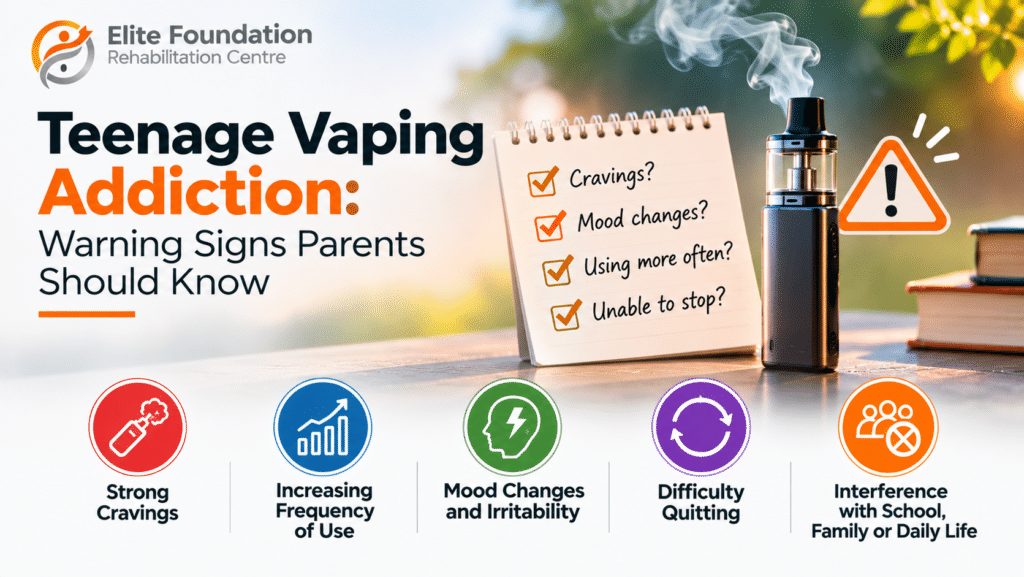
Teenage vaping addiction can be difficult for parents to recognise. Unlike conventional cigarettes, vaping devices may be small, discreet and easy to conceal. A teenager might use nicotine regularly without the familiar smell of tobacco smoke. The strongest warni
Teenage vaping addiction can appear as strong nicotine cravings, irritability without a vape and repeated failed attempts to stop. Parents in Mumbai and Thane seeking a vyasan mukti kendra can find guidance from a centre located in Titwala, Thane.
Families looking for vaping addiction treatment in Mumbai and Thane should start with an age-appropriate assessment of nicotine use, withdrawal and safety. Most teenagers do not need residential admission for nicotine dependence alone.
Unlike conventional cigarettes, vaping devices may be small, discreet and easy to conceal. A teenager might use nicotine regularly without the familiar smell of tobacco smoke. Parents may first notice changes in behaviour rather than clear evidence of nicotine use. Their child may become restless during a long family outing, spend money without explaining why or appear distracted when unable to take a break.
These observations can raise concern, particularly when vaping has already been confirmed. However, examination pressure, poor sleep, emotional difficulties and ordinary changes during adolescence can produce similar behaviour.
Quick answer for parents: The strongest warning signs of teenage vaping addiction are cravings, withdrawal symptoms, difficulty controlling nicotine use, repeated unsuccessful attempts to stop and continued vaping despite problems. Begin with a calm conversation, establish appropriate boundaries and seek professional support when dependence is suspected.
For example, a parent may discover a vape in a school bag after noticing that their teenager has become unusually impatient during family outings. Instead of assuming that every recent argument was caused by nicotine, it is more useful to find out when vaping began, how frequently the device is used and what happens when nicotine is unavailable.
Parents across Mumbai, Thane, Kalyan, Titwala and neighbouring areas may also be concerned about school discipline, peer pressure and India’s restrictions on e-cigarettes. These concerns matter, but the priority is understanding the teenager’s health, nicotine exposure and need for support.
This guide explains how to recognise dependence, what parents should do after finding a vape and what recent clinical research says about teenage vaping cessation. It also examines systematic reviews published in July and September 2026, which highlight both promising interventions and important gaps in treatment evidence for children and teenagers.
What is teenage vaping addiction?
Teenage vaping addiction refers to a pattern of e-cigarette use that becomes difficult to control, particularly when the device contains nicotine.
Nicotine acts on receptors involved in brain signalling, reward and reinforcement. Repeated exposure can lead to physical dependence, making nicotine cravings and withdrawal symptoms noticeable when use stops or decreases.
Behavioural habits can develop alongside physical dependence. A teenager may become accustomed to vaping while gaming, talking with friends, preparing for examinations or dealing with uncomfortable emotions.
Eventually, reaching for the device may feel like an ordinary part of these activities.
A clinical assessment considers cravings, impaired control, withdrawal symptoms, unsuccessful attempts to stop and the effects of vaping on everyday life.
Experimenting with a vape is different from having established dependence. Still, early signs deserve attention because nicotine use can become difficult to control before someone recognises the problem.
What are the warning signs of vaping addiction in teenagers?
The clearest warning signs involve nicotine cravings and changes in the teenager’s ability to control vaping.
- Strong nicotine cravings: repeatedly feeling an urge to vape, particularly after going without nicotine.
- Difficulty stopping: attempting to quit but returning to vaping despite wanting to stop.
- Withdrawal symptoms: irritability, anxiety, restlessness or poor concentration when nicotine is unavailable.
- Increasing use: vaping more frequently than originally intended.
- Preoccupation with vaping: worrying about access to the device or opportunities to use it.
- Continued use despite consequences: vaping despite recognised health concerns, family conflict or interference with responsibilities.
- Concealing nicotine use: hiding devices or minimising vaping because of embarrassment or fear of punishment.
- Repeated use in familiar situations: feeling a strong urge during gaming, study breaks or social gatherings.
Several signs occurring together provide a stronger reason for concern than one isolated behaviour.
For example, poor concentration alone cannot establish nicotine dependence. Poor concentration combined with confirmed vaping, strong cravings and repeated unsuccessful attempts to quit creates a clearer picture.
For a broader explanation of dependence, see the guide to vaping addiction and signs of nicotine dependence.
Warning signs versus ordinary teenage behaviour
Parents sometimes struggle because several possible symptoms of nicotine dependence resemble common difficulties experienced during adolescence.
The following comparison explains why the wider circumstances matter.
| What parents notice | Possible vaping-related concern | Other considerations |
|---|---|---|
| Irritability | Nicotine withdrawal can cause frustration or restlessness. | Sleep problems, stress, family conflict or mental-health concerns. |
| Difficulty concentrating | Nicotine cravings can interrupt attention. | Examinations, learning difficulties or inadequate sleep. |
| Unexplained spending | Money may be used to obtain vaping products. | Ordinary purchases or other financial concerns. |
| Hiding an electronic device | The object may be a vaping device. | Its actual purpose and whether it has been used. |
| Restlessness without nicotine | May indicate cravings or withdrawal. | Anxiety or another source of discomfort. |
| Repeated unsuccessful attempts to quit | Suggests difficulty controlling nicotine use. | Level of dependence and support available. |
This table is educational rather than diagnostic. Dependence is assessed through nicotine use, symptoms, impaired control and consequences, not a checklist of general teenage behaviour.
What to do if you find a vape in your teenager’s bag
Discovering a vape can be upsetting, particularly when parents believed their child had never used nicotine.
The first response matters. A calm conversation is more likely to establish what has happened than an argument conducted while everyone is distressed.
- Confirm what you found. Identify whether the object appears to be a vaping device without experimenting with or inhaling from it.
- Choose a private moment. Avoid confronting the teenager publicly or in front of friends and relatives.
- Ask about actual use. Find out when vaping started, how frequently the device is used and whether the teenager knows what it contains.
- Discuss cravings and withdrawal. Ask whether they have tried stopping and what happens when nicotine is unavailable.
- Explain the concern. Discuss nicotine dependence and adolescent health without exaggerated threats.
- Agree on boundaries and support. Set reasonable expectations and consider professional assessment when signs of dependence are present.
One possible opening is to describe what was found, explain the health concern and invite the teenager to describe their experience.
Parents can listen carefully while remaining firm about the household’s expectations regarding nicotine use.
What should parents say during the first conversation?
The first discussion should establish facts rather than demand an immediate confession.
Useful questions include:
- When did you first try vaping?
- Do you know whether the device contains nicotine?
- How often have you been using it?
- Have you tried stopping?
- Do you experience cravings or feel uncomfortable without it?
- Is vaping connected with friends, stress or another situation?
Some teenagers will answer openly. Others may be embarrassed, afraid of punishment or uncertain about what they have used.
A parent does not need to agree with the behaviour to hear the explanation.
What if the teenager denies vaping?
Denial may reflect embarrassment, fear or genuine disagreement about what happened.
Describe the evidence without adding assumptions about addiction, frequency or other substance use.
If the conversation becomes unproductive, returning to the subject later may help.
Where concerns remain significant, an appropriately qualified counsellor or healthcare professional can support a more constructive discussion.
Should parents punish a teenager for vaping?
Parents can establish consequences for breaking family or school rules.
However, punishment alone does not treat nicotine dependence.
A teenager who experiences strong cravings or withdrawal may struggle to stop despite understanding the health concerns.
Repeated threats can increase secrecy without solving that difficulty.
A constructive response combines clear boundaries with education, reasonable supervision and support appropriate to the level of nicotine use.
Should parents monitor their teenager’s phone or purchases?
Parents are responsible for protecting minors, while trust and privacy also influence family communication.
Monitoring may be appropriate in some situations, depending on the teenager’s age and the seriousness of the concern.
Constant surveillance, however, may increase conflict and concealment.
It is useful to explain why a boundary is necessary, what behaviour is being addressed and when the arrangement will be reviewed.
Where communication has broken down, family counselling may help establish safer and more workable expectations.
Why teenagers may begin vaping
Teenagers start vaping for different reasons.
Curiosity, friendship groups, social media content, flavours and the belief that vaping is less harmful than smoking can all influence the decision.
Stress may also contribute.
A student preparing for examinations may try nicotine after hearing that it improves concentration. Another may vape before meeting friends because the activity appears socially acceptable.
These reasons can overlap.
Understanding why vaping began helps parents identify what continues to encourage it.
Why nicotine is particularly concerning during adolescence
Adolescence is a period of ongoing brain development.
Nicotine influences brain systems involved in reward, attention, learning and reinforcement.
Exposure during adolescence raises particular concerns because these systems are still developing into young adulthood.
Repeated nicotine exposure can also produce physical dependence, cravings and withdrawal.
Some teenagers experience early dependence symptoms before becoming daily users.
For somebody who has never smoked, beginning vaping creates nicotine exposure without removing any existing harm from cigarette smoking.
Can nicotine salts increase the risk of dependence?
Some vaping liquids contain nicotine salts rather than freebase nicotine.
Certain formulations allow relatively high nicotine concentrations to be inhaled with less harshness, depending on the device and liquid.
A teenager may therefore absorb substantial nicotine without experiencing the sensation associated with strong cigarette smoke.
Actual delivery depends on nicotine concentration, device characteristics, puff duration and frequency of use.
Advertised puff counts are not reliable measurements of nicotine absorbed by an individual.
The pattern of use and symptoms of dependence are more informative than the device’s appearance.
Can teenage vaping affect concentration and school performance?
Nicotine can influence attention in the short term, but dependence can also produce concentration difficulties when nicotine levels fall.
A teenager may begin believing vaping is necessary for studying because they become distracted without it.
For a dependent user, the apparent improvement after vaping may partly reflect relief from withdrawal.
Sleep disturbance, repeated vaping breaks and anxiety can add to academic difficulties.
School performance also depends on factors such as teaching, learning difficulties, emotional stress and adequate sleep.
A decline in marks should prompt parents to understand the student’s circumstances rather than assume vaping explains everything.
Can teenage vaping cause anxiety or mood changes?
Nicotine use and withdrawal can influence mood.
When nicotine levels decrease, a dependent teenager may experience anxiety, restlessness, irritability or difficulty concentrating.
Using nicotine again may temporarily reduce withdrawal discomfort, creating the impression that vaping is necessary for relaxation.
Some teenagers experience anxiety or depression independently of vaping.
For instance, a student with social anxiety may start vaping with friends and gradually associate nicotine with feeling comfortable in a group.
Stopping nicotine may address dependence, while the anxiety still requires attention.
Persistent low mood, panic symptoms, self-harm concerns or substantial changes in functioning deserve appropriate mental-health assessment.
Does vaping affect teenage sleep?
Nicotine exposure and withdrawal can disturb sleep.
A teenager who vapes frequently may experience restlessness or difficulty sleeping when nicotine is unavailable overnight.
Poor sleep can then affect concentration, patience and emotional regulation the following day.
Late-night phone use, examination pressure and irregular sleep routines may also contribute.
Understanding the teenager’s overall routine is more helpful than automatically attributing every sleep problem to nicotine.
What happens when a teenager stops vaping?
When physical nicotine dependence has developed, stopping or substantially reducing vaping may cause withdrawal symptoms.
Common symptoms include cravings, irritability, anxiety, restlessness, difficulty concentrating, sleep disturbance and changes in appetite.
Symptoms may begin within hours of reduced nicotine exposure and are often more troublesome during the first several days.
Many people experience gradual improvement over the following weeks.
The teenager may also miss familiar activities connected with vaping, such as taking puffs during gaming or meeting friends.
These learned associations may continue after acute physical withdrawal has improved.
For a detailed explanation, see Elite Foundation’s guide to nicotine withdrawal symptoms and their timeline.
How can parents help a teenager stop vaping?
A realistic quitting plan begins by understanding when and why nicotine is used.
A teenager may vape while travelling, studying, gaming or spending time with certain friends.
Those situations can be addressed individually rather than relying on a general instruction to stop.
Useful elements of a plan include:
- Identifying nicotine products and frequency of use.
- Recognising cravings and withdrawal symptoms.
- Agreeing on a clear quitting goal.
- Preparing for situations where friends may offer a vape.
- Finding alternative responses to stress.
- Arranging suitable follow-up and professional support where required.
The teenager’s age, developmental needs, mental health and previous quitting experiences should guide the plan.
Can counselling help teenagers quit vaping?
Behavioural counselling can help teenagers understand what maintains nicotine use.
For some, peer pressure is the main concern. Others use vaping during examination stress, boredom or difficult family situations.
Age-appropriate support can address these situations while helping the teenager practise responses to cravings.
There is also direct trial evidence for certain vaping-specific behavioural programmes.
A 2024 randomised clinical trial published in JAMA studied 1,503 adolescents aged 13–17 in the United States.
The researchers evaluated a tailored, interactive text-message programme offering coping-skills training and social support.
At the seven-month assessment, 37.8% of adolescents assigned to the programme reported no vaping during the preceding 30 days, compared with 28.0% in the assessment-only control group.
The main outcome was self-reported, and approximately 70.8% completed the seven-month assessment.
The findings are encouraging, but they concern a particular programme and population. They do not establish that every text-message intervention or generic health reminder will produce similar outcomes in India.
Can varenicline help teenagers stop vaping?
Varenicline is a prescription medicine used for smoking cessation in appropriately selected adults. Researchers have also investigated its use for nicotine vaping cessation.
A 2025 JAMA randomised clinical trial included 261 participants aged 16–25 who vaped nicotine daily or nearly daily and did not regularly smoke cigarettes.
The mean participant age was 21.4 years. This matters because the study predominantly involved young adults rather than younger school-age teenagers.
Participants receiving varenicline alongside behavioural counselling achieved higher biochemically verified vaping-abstinence rates than those receiving placebo with comparable support.
Continuous abstinence during the final four weeks of treatment was 51% with varenicline compared with 14% with placebo.
For the extended assessment through 24 weeks, the corresponding figures were 28% and 7%.
These findings provide promising evidence for selected older adolescents and young adults.
They do not establish routine prescribing suitability for younger teenagers.
Medication decisions require consideration of age, medical history, potential adverse effects, approval status and availability in India.
Parents should never independently obtain or administer prescription cessation medicines to a minor.
What did the July 2026 Cochrane review find?
On 3 July 2026, Cochrane published an updated systematic review examining interventions intended to prevent or stop e-cigarette use among children and adolescents.
The 2026 Cochrane review of adolescent e-cigarette interventions included three eligible randomised studies.
Two studies evaluated school-based prevention approaches, while the third examined a community-based text-message programme for adolescents already using e-cigarettes.
The evidence ranged from very low to moderate certainty.
The review found that the community-based text-message intervention probably helped adolescents stop current vaping. Evidence for the school-based prevention approaches was much less certain.
The authors identified substantial gaps in the research and noted that more trials were underway.
The practical message is that structured behavioural programmes show promise, but the evidence remains too limited to establish one consistently effective intervention for every child or teenager.
What did the September 2026 healthcare review find?
A separate review published on 30 September 2026 in Archives of Disease in Childhood examined vaping-cessation interventions delivered through healthcare settings to people younger than 18.
The September 2026 review of healthcare-based vaping cessation in under-18s included eight sources.
Five addressed cessation interventions, while three evaluated screening approaches. All were conducted in North America.
The five cessation interventions used multiple components, combining behavioural and pharmacological approaches. Nicotine replacement therapy appeared in four sources.
Reported quit rates ranged from 16.7% to 37%, but studies used different definitions and measurements of abstinence. Biochemical confirmation was limited.
The reviewers found that uptake of cessation support was generally low.
Importantly, no included study tested a structured, multicomponent cessation pathway within routine clinical encounters. The review also identified no pharmacotherapy trial conducted specifically in an exclusively under-18 population.
This reinforces the importance of interpreting the 2025 varenicline trial correctly. Its participants were aged 16–25, and most were young adults.
The reviewers concluded that healthcare-based vaping cessation for children and teenagers remains an early-stage area of research.
What do the 2026 reviews mean for parents?
The research offers encouragement without supporting exaggerated treatment promises.
Some structured behavioural interventions may help teenagers stop vaping. Medication trials involving older adolescents and young adults have also reported promising outcomes.
However, evidence specifically for younger children, routine clinical pathways and paediatric medication treatment remains limited.
Parents should avoid assuming that every teenage vaping problem requires medicine or that a particular counselling programme has been proven effective for all children.
The most practical starting point is an age-appropriate assessment followed by suitable behavioural support and monitoring.
Where a separate anxiety disorder, depression or another substance-use problem is present, those needs should be considered together.
Is nicotine replacement therapy suitable for teenagers?
Nicotine replacement therapy includes medicinal patches, gum and lozenges.
These products have an established evidence base for smoking cessation among eligible adults.
Evidence for adolescents who exclusively vape is less developed.
In selected circumstances, an appropriately qualified healthcare professional may consider nicotine replacement for a teenager with significant dependence, taking account of age, product labelling and relevant prescribing guidance.
Parents should not estimate nicotine replacement doses by comparing advertised vape puff counts with a fixed number of cigarettes.
Different devices can deliver substantially different amounts of nicotine.
For minors, medication decisions require individual clinical assessment.
Can a teenager stop vaping without medication?
Yes. Some teenagers can stop with education, behavioural strategies, family involvement and appropriate follow-up.
The required level of support depends on the extent of nicotine exposure and the difficulty experienced when attempting to stop.
A teenager who experimented occasionally may need a different response from someone who uses nicotine repeatedly throughout the day and becomes distressed without it.
Medication is not automatically necessary in every case.
What if the teenager returns to vaping after quitting?
Returning to vaping after a period without nicotine can happen.
The episode may follow a stressful examination, contact with friends who vape or an activity strongly associated with previous nicotine use.
Parents may feel disappointed, especially when the teenager previously agreed to stop.
The more useful question is what happened before vaping resumed.
Was the teenager experiencing withdrawal? Did someone offer a device? Was anxiety, social pressure or another problem involved?
Understanding these circumstances can improve the next attempt.
Repeated unsuccessful attempts justify considering more structured professional support.
How can parents help with peer pressure?
Peer influence can make vaping seem socially important.
A teenager may worry about being excluded if friends use nicotine and they refuse.
Parents can discuss realistic ways to decline an offer without giving a long explanation.
It may also help to identify friends or trusted adults who will support the teenager’s decision not to vape.
If the pressure involves bullying or intimidation, school involvement may be necessary.
The aim is to make refusing nicotine practical in real situations rather than relying only on warnings about future health risks.
How should schools respond to teenage vaping?
Schools have responsibilities concerning safety, student welfare and enforcement of school rules.
However, a disciplinary violation and a clinical diagnosis are different matters.
A teenager who has developed nicotine dependence may require healthcare support alongside reasonable school consequences.
Parents and schools can work together to address repeated vaping, concentration problems and peer influences.
Public embarrassment can discourage disclosure and future help-seeking.
School counsellors may also help identify anxiety, bullying or other concerns contributing to nicotine use.
Can vaping devices contain substances other than nicotine?
Yes. Vaping products differ in composition, and some contain substances other than nicotine.
Unregulated products may have unreliable labels or unknown ingredients.
Parents should not assume every device contains only nicotine and flavourings.
If a teenager develops unusual symptoms after using an unidentified product, the treating healthcare professional should be told what is known about the device and exposure.
Persistent cough, chest discomfort or breathlessness requires appropriate medical assessment.
Severe breathing difficulty, seizures, collapse or another immediate danger requires emergency care.
What if a child accidentally swallows vaping liquid?
Nicotine-containing vaping liquids can cause poisoning, particularly in children.
Accidental swallowing may be dangerous. Exposure through the skin or eyes can also require medical attention.
Symptoms of poisoning can include vomiting, dizziness, weakness and changes affecting the nervous or cardiovascular system.
Serious exposure may cause seizures or collapse.
Seek prompt medical advice if exposure is suspected.
Do not induce vomiting or attempt home detoxification.
For severe symptoms or immediate danger, call emergency services or attend the nearest emergency department.
Are nicotine-free vapes safe for teenagers?
A product genuinely containing no nicotine would not create physical nicotine dependence through nicotine exposure.
However, its aerosol may still contain potentially harmful substances.
Repeated use can also become an established behavioural habit.
When a product comes from an unregulated source, the actual contents may differ from its label.
A nicotine-free claim is therefore not proof of safety for children or teenagers.
What does Indian law say about teenage vaping?
India’s Prohibition of Electronic Cigarettes Act, 2019 prohibits specified activities involving qualifying e-cigarettes.
These include production, manufacture, import, export, transport, sale, distribution and advertising, along with statutory restrictions concerning storage of stock.
The definition of an electronic cigarette can include qualifying devices that produce an aerosol for inhalation whether or not nicotine is present, subject to statutory exclusions.
The Act does not separately identify mere personal vaping as a standalone offence. This does not authorise prohibited supply activities or override other applicable laws.
India’s tobacco-control framework also restricts tobacco sales to minors and near educational institutions.
Legal restrictions matter, but they should not become a substitute for medical assessment when a teenager has developed nicotine dependence.
Where can parents seek help for teenage vaping addiction in Mumbai and Thane?
Families looking for teenage vaping addiction support in Mumbai, Thane, Kalyan or Titwala can begin with a paediatrician, adolescent-health clinician or qualified mental-health professional experienced in substance-use concerns.
An assessment should establish whether nicotine dependence is present, what happens during withdrawal and whether anxiety, depression or another difficulty is contributing.
For parents concerned about how cravings develop, Elite Foundation’s guide to nicotine addiction and why cravings become strong explains the mechanisms of dependence in greater detail.
The rehabilitation centre associated with this website is physically located in Titwala, Thane. Families travelling from Mumbai or other surrounding areas should confirm the availability of age-appropriate assessment and services for minors before making treatment arrangements.
Outpatient support, safeguarding arrangements and the teenager’s clinical needs should take priority over selecting a residential programme simply because nicotine use has been discovered.
Does teenage vaping addiction require residential rehabilitation?
Usually not for nicotine dependence alone.
Many teenagers can receive suitable care through outpatient assessment, behavioural counselling and family involvement.
A broader level-of-care assessment may be appropriate when serious psychiatric symptoms, another substance-use disorder, significant safety concerns or major difficulties with everyday functioning are present.
Repeated vaping or arguments about nicotine do not independently justify residential admission.
For minors, any treatment decision must consider safeguarding, consent, confidentiality, development and relevant legal requirements.
How family counselling can help
Vaping can become a repeated source of conflict in a household.
Parents may feel worried or disappointed, while the teenager may feel criticised or reluctant to speak openly.
Family counselling can improve communication and help establish workable boundaries.
It may also help parents recognise when withdrawal is contributing to behaviour and when a separate emotional difficulty requires attention.
Support does not mean ignoring unsafe choices.
It means creating a better opportunity for the teenager to participate in a realistic cessation plan.
How parents can reduce the risk of vaping before it starts
Prevention works best as an ongoing conversation rather than a single frightening warning.
Children can learn what vaping devices are, why nicotine causes dependence and why the absence of cigarette smoke does not establish safety.
Parents can discuss realistic situations in which friends may offer a vape and help their child practise a comfortable way to decline.
It also helps to ask what teenagers are hearing about vaping online or within friendship groups.
Correcting misinformation is easier when the conversation allows questions.
Clear family rules, supportive communication and attention to stress or peer difficulties can help create an environment where concerns are discussed before nicotine use becomes established.
Frequently asked questions about teenage vaping addiction
What are the first signs of teenage vaping addiction?
Early signs may include strong cravings, irritability without nicotine, difficulty stopping and repeated vaping despite recognising problems. No single behaviour establishes addiction.
How do I know if my teenager is addicted to vaping?
Look at nicotine-use frequency, cravings, withdrawal symptoms and difficulty controlling use. A qualified healthcare professional can assess the wider pattern.
Can a 13-year-old become addicted to vaping?
Yes. Nicotine dependence can develop during adolescence, including among younger teenagers. Exposure during brain development is a particular concern.
Can a teenager become addicted after trying vaping once?
One episode does not establish addiction. Repeated nicotine exposure increases the opportunity for dependence to develop, and some young people experience early symptoms before daily use.
Why do teenagers start vaping?
Curiosity, peer influence, online content, flavours, perceived lower risk and attempts to cope with stress can contribute. The reasons differ between teenagers.
What are common teen vaping addiction symptoms?
Cravings, irritability when nicotine is unavailable, difficulty stopping, repeated use and interference with daily routines are important concerns.
Can teenage vaping affect brain development?
Nicotine exposure during adolescence can affect developing brain systems involved in attention, learning, mood and impulse control.
Can vaping make teenagers anxious?
Nicotine use and withdrawal can influence anxiety and restlessness. Persistent anxiety may also reflect a separate mental-health concern that deserves assessment.
Does vaping affect school performance?
Cravings, withdrawal and disturbed sleep may interfere with concentration. Academic difficulties can also arise for other reasons, so the full circumstances matter.
What should I do if I find a vape in my child’s bag?
Confirm what you found, speak privately and calmly, ask about use and cravings, explain the health concern and establish reasonable boundaries. Seek age-appropriate support when dependence is suspected.
Should parents punish teenagers for vaping?
Proportionate consequences may be appropriate, but punishment alone does not treat nicotine dependence. Communication, clear expectations and suitable support are important.
What if my teenager denies vaping?
Describe the evidence without making assumptions about frequency or dependence. If communication remains difficult, a qualified counsellor may help.
Can counselling help teenagers stop vaping?
Some structured behavioural interventions have promising results. A 2024 randomised trial found improved self-reported vaping abstinence with a tailored text-message programme among US adolescents.
What did the July 2026 Cochrane review find?
It included three eligible randomised studies and found limited evidence ranging from very low to moderate certainty. One community-based text-message programme probably helped adolescents stop current vaping.
What did the September 2026 healthcare review find?
It found that healthcare-based cessation interventions for under-18s remain at an early stage. Important gaps involve routine clinical pathways and medication trials conducted specifically in children and teenagers.
Can varenicline help teenagers quit vaping?
A 2025 trial involving 261 participants aged 16–25, with a mean age of 21.4, found improved vaping abstinence with varenicline plus behavioural support. The results do not establish routine prescribing suitability for younger teenagers.
Can teenagers use nicotine patches?
Nicotine replacement may be considered for selected adolescents under qualified clinical guidance, depending on age, dependence and relevant prescribing requirements. Parents should not determine doses independently.
Can teenagers quit vaping without medication?
Yes. Some teenagers can stop with behavioural strategies, family support and appropriate follow-up. Treatment should reflect the level of dependence and individual needs.
How long does teenage vaping withdrawal last?
Symptoms may begin within hours and are often most troublesome during the first few days. Many improve over the following weeks, although learned cravings can continue longer.
What if my teenager starts vaping again?
Review what happened before use resumed and whether cravings, peer pressure or stress contributed. Repeated unsuccessful attempts may indicate a need for more structured support.
Are nicotine-free vapes safe for teenagers?
A nicotine-free claim does not establish that inhaling the aerosol is harmless. Product composition and labelling reliability remain important concerns.
Is teenage vaping illegal in India?
India’s 2019 law prohibits specified activities involving qualifying e-cigarettes, including manufacture, import, sale and distribution. Personal vaping alone is not identified as a standalone offence under that Act, although other applicable laws may matter.
Does a teenager need residential rehabilitation to stop vaping?
Usually not for nicotine dependence alone. Age-appropriate outpatient assessment and behavioural support are generally suitable starting points.
Can parents seek professional guidance before their teenager agrees to counselling?
Yes. Parents can obtain advice about communication, boundaries and safeguarding. Direct treatment of minors must follow applicable consent and confidentiality requirements.
When should parents seek emergency medical care?
Severe breathing difficulty, serious chest pain, seizures, collapse, suspected significant nicotine poisoning or another immediate danger requires urgent medical care. In India, call 112 or attend the nearest emergency department.
Helping teenagers move away from nicotine dependence
Teenage vaping addiction often develops without the familiar warning signs of cigarette smoking.
A parent may find a device before understanding how frequently nicotine is being used.
That discovery is a starting point for understanding the situation. The more important questions concern cravings, withdrawal, difficulty stopping and the effects on everyday life.
Parents can maintain firm boundaries while creating opportunities for the teenager to explain what is happening.
Research offers reasons for encouragement. A 2024 randomised trial found improved self-reported cessation with a structured text-message programme, while a 2025 trial reported promising medication results among selected older adolescents and young adults.
The July and September 2026 reviews show that evidence for younger teenagers remains limited. More research is needed to identify effective age-specific treatments and practical healthcare pathways.
For families, this means selecting support according to the teenager’s actual needs rather than relying on general promises about counselling, medication or rehabilitation.
Most teenagers can begin with appropriate outpatient assessment and behavioural support. Where significant mental-health difficulties, other substance-use problems or safety concerns are present, the care plan may need to be broader.
The goal is to help the young person understand nicotine dependence, address the circumstances maintaining vaping and develop a realistic path away from nicotine use.
Medical and safety disclaimer: This article provides general educational information and does not replace individual paediatric, psychiatric, psychological or addiction-medicine assessment. Behavioural changes in teenagers may have several causes and cannot independently diagnose nicotine dependence. Treatment must consider age, development, medical history, mental health, consent, confidentiality and safeguarding needs. Findings from adolescent behavioural trials and studies involving older adolescents and adults do not guarantee successful cessation or establish routine prescribing suitability for younger children. Prescription medicines and nicotine replacement should not be administered to minors without appropriate qualified clinical guidance and consideration of relevant approval and prescribing requirements. The discussion of Indian e-cigarette legislation is general information rather than legal advice. Persistent respiratory symptoms, significant psychological distress and suspected poisoning require appropriate medical assessment. Severe breathing difficulty, serious chest pain, seizures, collapse or an immediate risk of self-harm requires urgent emergency care.
ng signs are cravings, difficulty stopping, irritability when vaping is unavailable and continued use despite problems at home or school. Discovering a device is a reason to ask questions, but the pattern of nicotine use matters more than the device alone.Parents may first notice changes in routine rather than obvious signs of smoking. Their child becomes restless during a long family outing, spends money without explaining why or appears distracted when they cannot take a break. These observations may be connected with vaping, particularly if nicotine use is already known. They can also reflect examination pressure, poor sleep, emotional difficulties or ordinary changes during adolescence.
Quick answer for parents: If you suspect teenage vaping addiction, look for repeated nicotine use, strong cravings, withdrawal symptoms and difficulty following through on attempts to stop. Speak calmly, find out what the teenager has been using, establish reasonable boundaries and seek age-appropriate healthcare support when dependence is suspected. Severe physical symptoms or an immediate safety risk require urgent medical attention.
For example, a parent may discover a vape in a school bag after noticing that their teenager has become unusually impatient during family outings. Instead of assuming that every recent argument was caused by nicotine, it is more useful to find out when vaping began, how frequently the device is used and what happens when nicotine is unavailable.
Families searching for teenage vaping addiction treatment in Mumbai or Thane often want to know whether counselling can help, whether medication is suitable and whether rehabilitation is necessary. Information about vaping addiction treatment in Mumbai and Thane can be a starting point, but treatment for minors requires specific attention to age, consent, safeguarding and clinical suitability. Most teenagers with nicotine dependence can begin with outpatient assessment and behavioural support rather than residential admission.
Parents in Mumbai, Thane, Kalyan and nearby areas may also be concerned about school discipline, peer pressure and the legal restrictions on e-cigarettes in India. These issues matter, but the immediate priority is to understand the teenager’s health and the reason vaping has become part of everyday life.
This guide explains the warning signs, the difference between experimentation and dependence, what parents should do after finding a vape and what the latest research says about teenage vaping-cessation treatment. It also examines newer systematic reviews published in July and September 2026, which show both promising early findings and important gaps in adolescent healthcare.
What is teenage vaping addiction?
Teenage vaping addiction refers to a pattern of e-cigarette use that becomes difficult to control, particularly when the device delivers nicotine.
Nicotine acts on brain systems involved in reward, attention and reinforcement. Repeated exposure can lead to physical dependence, which becomes noticeable when nicotine levels fall and the person experiences cravings or withdrawal symptoms.
Behavioural habits develop alongside physical dependence. A teenager may become accustomed to vaping while gaming, speaking with friends, studying or dealing with uncomfortable emotions.
Eventually, the device can become part of a routine that feels difficult to interrupt.
Clinical assessment considers cravings, impaired control, unsuccessful attempts to stop, withdrawal and continued use despite consequences.
Experimenting with a vape once is different from having established dependence. Still, nicotine dependence can develop before a teenager recognises that the behaviour is becoming difficult to control.
What are the warning signs of vaping addiction in teenagers?
The most useful warning signs involve changes in nicotine use and the teenager’s ability to control it.
- Strong nicotine cravings: repeatedly feeling an urge to vape, especially after going without nicotine for several hours.
- Difficulty stopping: making genuine attempts to quit but returning to vaping.
- Withdrawal symptoms: irritability, restlessness, anxiety or poor concentration when nicotine is unavailable.
- Increasing use: vaping more frequently than originally intended.
- Preoccupation with the device: worrying about access to vaping products or opportunities to use them.
- Continued use despite problems: vaping despite recognised health concerns, family conflict or interference with responsibilities.
- Concealing nicotine use: hiding devices or minimising vaping because of embarrassment or fear of consequences.
- Repeated use in familiar situations: feeling a strong need to vape during study breaks, gaming sessions or social gatherings.
Several of these signs occurring together are more concerning than one isolated observation.
For instance, poor concentration by itself does not establish nicotine dependence. Poor concentration combined with confirmed vaping, cravings and repeated unsuccessful attempts to quit creates a stronger reason to seek assessment.
The broader mechanisms of dependence are explained in the separate guide to vaping addiction and signs of nicotine dependence.
Warning signs versus ordinary teenage behaviour
Parents sometimes feel uncertain because several possible vaping-related symptoms resemble common adolescent difficulties.
The table below helps explain what an observation may mean and why the wider circumstances matter.
| What parents notice | Possible vaping-related concern | What else to consider |
|---|---|---|
| Irritability | Nicotine withdrawal may cause frustration or restlessness. | Poor sleep, stress, family conflict or mental-health concerns. |
| Difficulty concentrating | Cravings and withdrawal can interrupt attention. | Examinations, sleep problems or learning difficulties. |
| Unexplained spending | Money may be used to obtain vaping products. | Ordinary purchases or other financial concerns. |
| Hiding an electronic device | May indicate vaping or experimentation. | The device’s actual purpose and whether it was used. |
| Restlessness without nicotine | May indicate cravings or physical dependence. | Anxiety or another cause of discomfort. |
| Repeated failed attempts to quit | Suggests that vaping has become difficult to control. | The level of dependence and support available. |
This is an educational comparison rather than a diagnostic test. Dependence is assessed through the overall pattern of nicotine use, symptoms and consequences.
What to do if you find a vape in your teenager’s bag
Discovering a vape can be upsetting, particularly when a parent believed their child had never used nicotine.
The first response matters. A calm discussion may reveal information that is lost during an argument.
- Confirm what you found. Identify whether the object appears to be a vaping device without attempting to inhale from or experiment with it.
- Choose a private moment. Avoid confronting the teenager publicly or while emotions are running high.
- Ask about actual use. Find out when vaping started, how frequently it occurs and whether the teenager knows what the product contains.
- Ask about cravings. Has the teenager tried stopping? Do they feel uncomfortable when unable to vape?
- Explain the concern. Discuss nicotine dependence, adolescent health and vaping risks without making exaggerated claims.
- Agree on boundaries and support. Set reasonable expectations and consider professional assessment when dependence is suspected.
One useful opening is to explain what was found, state the health concern and invite the teenager to describe what has happened.
Parents do not need to approve of vaping in order to listen. Clear boundaries and respectful conversation can exist together.
What should parents say during the first conversation?
The first conversation should establish facts rather than demand an immediate confession.
Parents might ask when vaping began, whether nicotine is involved and how the teenager feels when they cannot use the device.
Some teenagers will answer openly. Others may be embarrassed, frightened or uncertain about what they have been using.
It helps to avoid turning the discussion into a lecture about every possible consequence of nicotine use.
Instead, address the immediate concern: understanding the behaviour and deciding what support is needed.
If the teenager admits vaping, acknowledge the openness while remaining clear about health and household boundaries.
What if the teenager denies vaping?
Denial may reflect fear of punishment, embarrassment or an unwillingness to discuss the subject.
It can also mean the parent has misunderstood the situation.
Describe the actual observation rather than adding assumptions about frequency, addiction or other substance use.
If the conversation becomes unproductive, returning to it later may be more useful than arguing repeatedly.
Where concerns remain significant, a qualified healthcare professional or counsellor can help create a setting in which the teenager may feel more comfortable discussing nicotine use.
Should parents punish a teenager for vaping?
Parents can establish consequences for breaking household or school rules. The important distinction is between setting a boundary and assuming punishment alone will resolve dependence.
A teenager experiencing nicotine withdrawal may struggle to stop even after accepting that vaping is harmful.
Repeated threats can increase secrecy without addressing cravings or the reasons behind use.
A constructive response combines clear expectations with education and suitable support.
For occasional experimentation, a conversation and reasonable supervision may be sufficient. Repeated nicotine use with withdrawal or unsuccessful quit attempts calls for a more structured response.
Should parents monitor their teenager’s phone or purchases?
Parents have responsibilities concerning the safety of minors, but trust and privacy also influence communication.
Monitoring may be appropriate in some circumstances, depending on the teenager’s age, the seriousness of the concern and any immediate risks.
Constant surveillance, however, can shift attention away from the underlying problem and encourage concealment.
Explain why particular boundaries are being introduced and review them as circumstances change.
Where conflict has become severe, family counselling may help establish expectations that protect safety while allowing the teenager to participate in decisions about treatment.
Why teenagers may begin vaping
Teenagers start vaping for different reasons.
Some are curious. Others want to fit into a friendship group or believe that vaping is less harmful than smoking cigarettes.
Social media content, flavours and the appearance of vaping devices may influence perceptions.
Stress is another possible factor.
A student preparing for examinations may try nicotine after hearing that it improves concentration. Another may vape before meeting friends because the activity has become associated with confidence or belonging.
Understanding the original reason for vaping helps parents identify what may continue to encourage use.
Why nicotine is particularly concerning during adolescence
Adolescence is a period of ongoing brain development.
Nicotine acts on receptors and neural pathways involved in reward and other functions. Exposure during adolescence raises concerns about attention, learning, mood and susceptibility to dependence.
Brain development continues into young adulthood, making this a particular concern for younger users.
Nicotine dependence can develop before a teenager begins vaping every day.
A young person who uses nicotine only in certain social situations may still experience cravings or begin finding those situations difficult without the device.
The absence of cigarette smoke does not remove nicotine’s addictive properties.
Can nicotine salts increase dependence risk?
Some vaping liquids use nicotine salts rather than freebase nicotine.
Certain formulations allow relatively high nicotine concentrations to be inhaled with less harshness, depending on the device and liquid.
This can make the amount of nicotine being absorbed less obvious to the user.
The actual exposure depends on nicotine concentration, device characteristics, puff duration and frequency of use.
Advertised puff counts are not reliable measurements of nicotine absorbed by the body.
For parents, the more useful questions concern how often vaping occurs, whether cravings have developed and whether the teenager can comfortably stop.
Can vaping affect a teenager’s concentration and school performance?
Nicotine can influence attention in the short term, but dependence can create concentration difficulties when nicotine levels fall.
A teenager may believe that vaping is necessary for studying because they become distracted without it.
In a dependent user, the temporary improvement after vaping may partly reflect relief from withdrawal.
Sleep disturbance, repeated vaping breaks and anxiety can further interfere with schoolwork.
Parents should also consider other explanations for academic difficulties, including learning concerns, bullying, emotional stress and inadequate sleep.
A decline in marks is a reason to understand the student’s circumstances, not proof of addiction.
Can teenage vaping cause anxiety or mood changes?
Nicotine use and withdrawal can influence mood.
When nicotine levels decrease, a dependent teenager may experience anxiety, restlessness, irritability or difficulty concentrating.
Using nicotine again can temporarily reduce withdrawal discomfort, creating the impression that vaping is necessary for relaxation.
However, some teenagers have anxiety or depression that began before vaping.
For example, a student experiencing social anxiety may begin vaping with friends and eventually associate nicotine with feeling more comfortable in a group.
Stopping nicotine may help address dependence, but persistent anxiety can require separate treatment.
Self-harm concerns, significant depression, panic symptoms or major deterioration in everyday functioning deserve professional assessment.
Does vaping affect teenage sleep?
Nicotine exposure and withdrawal may influence sleep.
Some teenagers who vape report difficulty sleeping, restlessness or discomfort when going without nicotine overnight.
Poor sleep can then affect concentration, patience and emotional regulation the following day.
Examination pressure, excessive late-night screen use and irregular routines may also contribute.
A useful assessment considers all these factors rather than attributing every sleep difficulty to vaping.
What happens when a teenager stops vaping?
A teenager who has developed physical nicotine dependence may experience withdrawal after stopping or substantially reducing vaping.
Recognised symptoms include cravings, irritability, anxiety, restlessness, sleep disturbance and difficulty concentrating.
Symptoms can begin within hours of reduced nicotine exposure and are often more uncomfortable during the first several days.
Many people experience gradual improvement over subsequent weeks.
The teenager may also miss the familiar action of holding the device or vaping during social activities.
These learned associations can remain influential after the strongest physical symptoms improve.
The separate guide to nicotine withdrawal symptoms and their timeline explains these changes in greater detail.
How can parents help a teenager stop vaping?
A quitting plan works better when the teenager understands the goal and can participate in decisions.
Start by identifying the nicotine products being used and when vaping normally occurs.
A student may vape during gaming sessions, while travelling to college or after meeting a particular group of friends.
Those situations can be addressed individually rather than relying on a general instruction to stop.
Useful elements of a plan may include recognising cravings, changing familiar routines, preparing for social pressure and arranging follow-up.
Where dependence is significant, a clinician experienced in adolescent health can assess the need for more structured behavioural or medical treatment.
Can counselling help teenagers quit vaping?
Behavioural counselling can help teenagers explore nicotine use, cravings and the situations that maintain vaping.
Some teenagers need support managing peer pressure. Others may be coping with anxiety, examination stress or family conflict.
Counselling can help separate these concerns and develop more effective responses.
There is also direct trial evidence for certain vaping-specific behavioural interventions.
A 2024 randomised clinical trial published in JAMA studied 1,503 adolescents aged 13–17 in the United States.
The researchers tested a tailored, interactive text-message programme that provided behavioural coping strategies and social support.
At seven months, 37.8% of participants assigned to the programme reported no vaping during the preceding 30 days, compared with 28.0% in the assessment-only control group.
The programme improved self-reported cessation outcomes, although approximately 70.8% completed the seven-month assessment.
The findings are encouraging but apply to a particular intervention and a US study population. They do not establish that generic messages or every digital programme will produce the same results among Indian teenagers.
Can varenicline help teenagers stop vaping?
Varenicline is a prescription medicine used for smoking cessation in appropriately selected adults. Researchers have also examined its effectiveness for nicotine vaping cessation.
A 2025 JAMA randomised clinical trial included 261 participants aged 16–25 who vaped nicotine daily or nearly daily and did not regularly smoke cigarettes.
The mean participant age was 21.4 years. This is important because the study population consisted predominantly of young adults rather than younger school-age teenagers.
Participants receiving varenicline together with behavioural counselling achieved higher biochemically verified vaping-abstinence rates than those receiving placebo and comparable support.
Continuous abstinence during the final four weeks of treatment was 51% with varenicline compared with 14% with placebo. During the extended assessment through 24 weeks, the figures were 28% and 7%.
These results provide promising evidence for selected older adolescents and young adults.
They do not establish routine prescribing suitability for 13- or 14-year-olds, nor do they remove the need to consider medical history, adverse effects, regulatory approval and availability in India.
Parents should never independently administer varenicline or another prescription cessation medicine to a minor.
What did the July 2026 Cochrane review find?
On 3 July 2026, Cochrane published a systematic review examining interventions intended to prevent or stop electronic cigarette use among children and adolescents.
The 2026 Cochrane review of adolescent e-cigarette interventions included only three eligible randomised studies.
Two studies evaluated school-based prevention approaches. The third investigated a community-based text-message intervention for adolescents who were already vaping.
The evidence ranged from very low to moderate certainty.
The review found that a structured, community-based text-message programme probably helped reduce current vaping among adolescents in the study examined.
For school-based prevention, the findings were much less certain.
The authors also identified substantial gaps in the research and noted that numerous additional studies were underway.
The practical message is that some behavioural programmes show promise, but the evidence remains too limited to identify one consistently effective approach for every child or teenager.
What did the September 2026 healthcare review find?
A second review, published on 30 September 2026 in Archives of Disease in Childhood, examined vaping-cessation interventions delivered through healthcare settings to people younger than 18.
The September 2026 review of healthcare-based vaping cessation in under-18s included eight sources: five concerned cessation interventions and three examined screening approaches.
All five cessation interventions involved multiple treatment components, combining behavioural approaches with pharmacological elements. Nicotine replacement therapy appeared in four sources.
Reported quit rates ranged from 16.7% to 37%, but the definitions and measurement of abstinence varied substantially between studies. Biochemical verification was limited.
The researchers found that uptake of cessation support was generally low.
Importantly, no included study tested a structured, multicomponent cessation pathway within routine clinical encounters, and the review identified no pharmacotherapy trial conducted specifically in an under-18 population.
This helps explain why the 2025 varenicline study involving participants aged 16–25 cannot simply be treated as a dedicated paediatric trial.
The reviewers concluded that healthcare-based vaping cessation for children and teenagers remains at an early stage of development.
What do these studies mean for parents?
The research is encouraging without being definitive.
Structured behavioural interventions, including certain text-message programmes, may help teenagers stop vaping.
Medication studies involving older adolescents and young adults have also reported promising outcomes.
However, the July and September 2026 reviews show that evidence for younger teenagers and routine healthcare treatment pathways remains limited.
Parents should therefore avoid two extremes: assuming that there is no useful support, or believing that a medicine or programme has been proven suitable for every child.
Age-appropriate assessment, behavioural support, family participation and follow-up remain practical foundations of care while stronger evidence develops.
Is nicotine replacement therapy suitable for teenagers?
Nicotine replacement therapy includes medicinal patches, gum and lozenges.
These products are well established for helping eligible adults stop cigarette smoking.
The evidence for treating adolescents who exclusively vape is less developed.
In selected circumstances, a qualified healthcare professional may consider nicotine replacement for a teenager with significant dependence, taking account of age, clinical guidance, product labelling and local prescribing requirements.
Parents should not estimate nicotine replacement doses from a vaping device’s advertised puff count.
Different vaping products can deliver very different amounts of nicotine, making simple conversions unreliable.
For minors, any medication decision requires appropriately qualified clinical guidance.
Can a teenager stop vaping without medication?
Yes. Some teenagers can quit with appropriate behavioural support, family involvement and changes in daily routines.
The necessary level of support depends on the extent of nicotine exposure, cravings, withdrawal and previous attempts to stop.
A teenager who experimented only occasionally may need education and supervision.
Someone who vapes repeatedly throughout the day and becomes distressed when unable to do so may benefit from a structured cessation programme.
Medication is not the starting point for every case.
What if the teenager returns to vaping after quitting?
Returning to nicotine after a period without vaping can happen.
The teenager may encounter a familiar social situation, experience a strong craving or return to an activity closely associated with the device.
Parents may feel disappointed, especially when the teenager had previously agreed to stop.
A useful response is to examine what happened before vaping resumed.
Was the teenager experiencing withdrawal? Did friends offer a device? Was anxiety or another emotional concern involved?
These answers can help improve the next cessation plan.
Repeated unsuccessful attempts should prompt consideration of additional professional support rather than increasingly severe punishment alone.
How can parents respond to peer pressure?
Peer influence is a common concern during adolescence.
A teenager may fear exclusion if friends are vaping and they choose not to participate.
Parents can discuss practical ways of declining offers, moving away from a situation or spending time with friends who respect their decision.
It helps to make these conversations realistic.
Simply instructing a teenager to avoid every friend who vapes may not address the social pressure they experience at school or in their wider community.
When peer pressure involves intimidation or bullying, the school or another appropriate authority may need to become involved.
How should schools support teenagers who vape?
Schools may become involved when vaping occurs on campus, affects concentration or breaches school rules.
Disciplinary policies are relevant, but they should not replace attention to nicotine dependence and student wellbeing.
A teenager who has developed withdrawal symptoms may need healthcare support alongside reasonable school consequences.
Parents and schools can work together to establish appropriate boundaries, address repeated use and protect the student’s privacy where possible.
Public embarrassment may discourage future disclosure and help-seeking.
School counsellors can also help identify whether anxiety, peer pressure, bullying or other concerns are contributing.
Can vaping products contain substances other than nicotine?
Yes. Vaping products differ in composition, and some may contain substances other than nicotine.
Unregulated products may have unreliable labels or unknown ingredients.
Parents should not assume that every device contains only nicotine, flavourings and harmless ingredients.
If the teenager develops unusual symptoms after using a product of unknown composition, tell the treating healthcare professional what is known about the device and exposure.
Persistent coughing, chest discomfort or breathlessness needs appropriate medical assessment.
Severe breathing difficulty, collapse, seizures or other immediately dangerous symptoms require emergency care.
What if a child accidentally swallows vaping liquid?
Nicotine-containing liquids can cause poisoning, particularly in children.
Accidental swallowing can be dangerous. Nicotine exposure through the skin or eyes may also require medical attention.
Symptoms of poisoning can include vomiting, dizziness, weakness and other neurological or cardiovascular effects. Serious exposure can cause seizures or collapse.
Seek prompt medical advice if exposure is suspected.
Do not induce vomiting or attempt home detoxification.
If the child has severe symptoms or immediate danger is present, call emergency services or attend the nearest emergency department.
Are nicotine-free vapes safe for teenagers?
A product genuinely containing no nicotine would not create physical nicotine dependence through nicotine exposure.
However, the aerosol may still contain potentially harmful substances.
Repeated use can also become part of a behavioural routine.
When products are unregulated, the actual contents may differ from what the label claims.
A nicotine-free label is therefore not proof that vaping is harmless for children or teenagers.
Does teenage vaping lead to cigarette smoking?
Research has found associations between adolescent vaping and later cigarette smoking.
However, association alone cannot establish that vaping directly causes every subsequent episode of smoking.
Shared social influences, risk-taking behaviour and other factors may contribute.
The practical health message remains clear: a teenager who has never smoked should not be encouraged to start nicotine vaping.
There is no existing cigarette-smoke exposure to remove, while nicotine use introduces dependence and aerosol-related risks.
What does Indian law say about teenage vaping?
India’s Prohibition of Electronic Cigarettes Act, 2019 restricts specified activities involving qualifying electronic cigarettes.
These include production, manufacture, import, export, transport, sale, distribution and advertising, along with statutory restrictions concerning storage of stock.
The law’s definition can cover qualifying devices that create aerosol for inhalation whether or not nicotine is present, subject to statutory exclusions.
Personal vaping alone is not listed as a separate offence under that Act. This distinction does not authorise prohibited supply activities or override other applicable laws.
India’s tobacco-control legislation also restricts the sale of tobacco products to minors and near educational institutions.
Parents should be aware of the legal environment while keeping the teenager’s healthcare needs central to the response.
Where can parents seek teenage vaping addiction help in Mumbai and Thane?
Families seeking help for teenage vaping addiction in Mumbai, Thane, Kalyan or Titwala can begin with a paediatrician, adolescent-health clinician or qualified mental-health professional experienced in substance-use concerns.
The first assessment should establish whether nicotine dependence is present, what withdrawal symptoms occur and whether anxiety, depression or another issue is contributing to the behaviour.
For families researching a vyasan mukti kendra, it is important to ask whether the provider offers age-appropriate assessment, what safeguarding arrangements are in place and whether outpatient treatment or referral is available.
The rehabilitation facility associated with this website is physically located in Titwala, Thane. Families travelling from elsewhere in Mumbai or surrounding areas should confirm the availability and suitability of services for minors before making treatment arrangements.
A centre’s location or general addiction-treatment experience does not, by itself, establish that a residential programme is suitable for a teenager.
Clinical suitability, consent, confidentiality and the availability of adolescent-specific care should guide the decision.
Does teenage vaping addiction require residential rehabilitation?
Usually not for nicotine dependence alone.
Many teenagers can receive suitable care through outpatient assessment, age-appropriate counselling and family involvement.
A broader level-of-care assessment may be appropriate when there are serious psychiatric symptoms, another substance-use disorder, major safety concerns or significant difficulties with everyday functioning.
Repeated vaping or arguments about nicotine do not independently justify residential admission.
For minors, any admission decision must consider developmental needs, safeguarding, consent and relevant legal requirements.
How family counselling can help
Nicotine use can become a repeated source of conflict in a household.
Parents may feel disappointed or frightened, while the teenager may feel criticised or unwilling to speak openly.
Family counselling can help improve communication and establish reasonable expectations.
It can also help parents recognise when withdrawal is contributing to behaviour and when a separate emotional difficulty requires attention.
Family support does not mean removing all consequences or overlooking unsafe behaviour.
It means giving the teenager a better opportunity to participate in a realistic plan for stopping nicotine use.
How parents can reduce the risk of vaping before it starts
Prevention works best as an ongoing conversation rather than one frightening warning.
Children can learn what vaping devices are, why nicotine can cause dependence and why the absence of cigarette smoke does not establish safety.
Parents can discuss situations in which friends might offer a vape and help their child practise a comfortable way to decline.
It is also useful to ask what teenagers are hearing about vaping online and within friendship groups.
Correcting misinformation works better when the conversation leaves room for questions.
Clear family rules, supportive communication and attention to stress or peer difficulties can help create an environment in which concerns are discussed before nicotine use becomes established.
Frequently asked questions about teenage vaping addiction
What are the first signs of teenage vaping addiction?
Early concerns may include repeated nicotine cravings, difficulty going without a vape, irritability between uses and attempts to stop that do not succeed. A device or mood change alone is not enough for diagnosis.
How do I know if my teenager is addicted to vaping?
Look at how frequently nicotine is used, whether cravings or withdrawal occur and whether the teenager has difficulty controlling vaping. A qualified healthcare professional can assess the wider pattern.
Can a 13-year-old become addicted to vaping?
Yes. Nicotine dependence can develop during adolescence, including among younger teenagers. Nicotine exposure during brain development is a particular concern.
Can a teenager become addicted after trying vaping once?
One episode does not establish addiction. Repeated nicotine exposure increases the opportunity for dependence to develop, and some young people report early symptoms before daily use.
Why do teenagers start vaping?
Curiosity, friends, social media, flavours, perceived lower risk and attempts to manage stress may all contribute. The reasons differ between teenagers.
What are common teen vaping addiction symptoms?
Cravings, irritability without nicotine, difficulty stopping, repeated use and interference with everyday routines are important warning signs.
Can vaping affect teenage brain development?
Nicotine exposure during adolescence can affect developing brain systems involved in attention, learning, mood and impulse control. Brain development continues into young adulthood.
Can vaping make my teenager anxious?
Nicotine use and withdrawal can influence anxiety and restlessness. Persistent anxiety may also be a separate mental-health concern that deserves assessment.
Can teenage vaping affect school performance?
Cravings, withdrawal and disturbed sleep may interfere with concentration. However, school difficulties have several possible causes, so the wider circumstances matter.
What should I do if I find a vape in my child’s bag?
Confirm what you found, speak privately and calmly, ask about use and cravings, explain the health concern and establish reasonable boundaries. Seek age-appropriate professional support if dependence is suspected.
Should I punish my teenager for vaping?
Reasonable consequences may be appropriate, but punishment alone will not treat nicotine dependence. A balanced approach includes clear boundaries, communication and suitable support.
What if my teenager denies using a vape?
Discuss the evidence calmly rather than making assumptions about addiction or frequency. If communication becomes difficult, a qualified counsellor may help.
Can counselling help teenagers stop vaping?
Yes, some structured behavioural interventions show promising results. A 2024 randomised trial of an interactive text-message programme found improved self-reported vaping abstinence among US adolescents.
What did the July 2026 Cochrane review find?
The review included three eligible randomised studies. Evidence ranged from very low to moderate certainty. One community-based text-message intervention probably reduced adolescent vaping, but the research base remained limited.
What did the September 2026 review find?
The healthcare-focused scoping review found that vaping cessation for under-18s remains an early-stage area of research. It identified limited evaluation of routine clinical pathways and no dedicated pharmacotherapy trial in an exclusively under-18 population.
Can varenicline help teenagers quit vaping?
A 2025 trial involving 261 participants aged 16–25, with a mean age of 21.4, found improved vaping abstinence with varenicline plus behavioural support. These findings do not establish routine prescribing suitability for younger teenagers.
Can teenagers use nicotine patches?
Medicinal nicotine replacement may be considered for selected adolescents under appropriately qualified clinical guidance, depending on age, dependence and applicable prescribing requirements. Parents should not choose doses independently.
Can a teenager quit vaping without medication?
Yes. Some teenagers can stop with behavioural support, changes in routine, family involvement and follow-up. The level of treatment should reflect the actual dependence and clinical circumstances.
How long does teenage vaping withdrawal last?
Withdrawal may begin within hours and is often most troublesome during the first few days. Many symptoms gradually improve over the following weeks, although cravings connected with familiar routines may continue longer.
What if my teenager starts vaping again?
Find out what led to the return to vaping and review whether stronger support is needed. Repeated unsuccessful attempts can be a sign that professional cessation care would be useful.
Are nicotine-free vapes safe for teenagers?
No vaping product should be assumed harmless simply because it claims to contain no nicotine. Aerosol constituents and product-labelling uncertainty remain relevant.
Is teenage vaping illegal in India?
India’s 2019 law prohibits specified activities involving qualifying e-cigarettes, including manufacture, import, sale and distribution. The statute does not list personal vaping alone as a separate offence. Other applicable laws and school rules may also matter.
Does a teenager need a rehabilitation centre to stop vaping?
Usually not residential rehabilitation for nicotine dependence alone. Outpatient assessment and age-appropriate behavioural support are generally suitable starting points.
Can parents seek help before the teenager agrees to counselling?
Yes. Parents can seek professional guidance on communication, safeguarding and how to encourage the teenager to participate. Any direct treatment of a minor must follow applicable consent and confidentiality requirements.
When should parents seek urgent medical attention?
Severe breathing difficulty, serious chest pain, seizures, collapse, suspected significant nicotine poisoning or other immediate dangers require urgent medical care. In India, call 112 or attend the nearest emergency department.
Helping teenagers move away from nicotine dependence
Teenage vaping addiction often develops without the familiar warning signs of cigarette smoking. A parent may discover a device before understanding how frequently nicotine is being used.
That discovery is a starting point for understanding the situation. The more important questions concern cravings, withdrawal, difficulty stopping and the effects of nicotine use on everyday life.
Parents can respond with clear boundaries while creating opportunities for the teenager to explain what is happening.
The evidence for treatment is developing. A 2024 randomised trial found improved self-reported cessation with a structured text-message programme. A 2025 trial reported promising medication results among selected older adolescents and young adults.
The July and September 2026 reviews, however, show that research for children and younger teenagers remains limited. There is still a need for better trials, age-specific treatment evidence and evaluation of practical healthcare pathways.
For families, this means seeking treatment suited to the teenager rather than relying on a general promise about counselling, medicine or rehabilitation.
Most teenagers can begin with age-appropriate outpatient assessment and behavioural support. When significant mental-health concerns, other substance-use problems or safety risks are present, the care plan may need to be broader.
The goal is to help the young person understand nicotine dependence, address the circumstances maintaining vaping and develop a realistic way to stop.
Medical and safety disclaimer: This article provides general educational information and does not replace individual paediatric, psychiatric, psychological or addiction-medicine assessment. Behavioural changes in teenagers may have multiple causes and cannot independently diagnose nicotine dependence. Treatment must consider age, development, medical history, mental health, consent, confidentiality and safeguarding needs. Findings from adolescent behavioural trials and studies involving older adolescents and adults cannot guarantee successful cessation or establish routine medicine suitability for younger children. Prescription medicines and nicotine replacement must not be administered to minors without appropriate qualified clinical guidance and consideration of applicable approval and prescribing requirements. The discussion of Indian e-cigarette legislation is general information, not legal advice. Persistent respiratory symptoms, significant psychological distress or suspected poisoning require medical assessment. Severe breathing difficulty, serious chest pain, seizures, collapse or immediate risk of self-harm requires urgent emergency care.
