
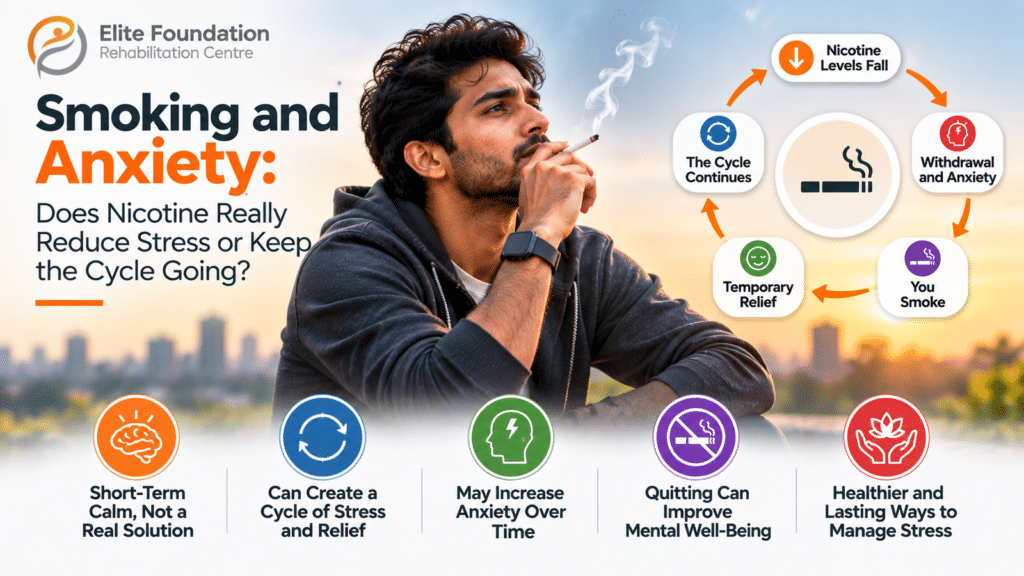
Does smoking relieve anxiety, or does nicotine make stress harder to manage? A cigarette can produce a temporary feeling of calm, particularly for someone who smokes regularly. Part of that relief may come from reducing nicotine withdrawal symptoms rather than resolving the underlying cause of anxiety. When nicotine levels fall again, tension, irritability and cravings can return. This creates a cycle in which smoking appears to solve discomfort that nicotine dependence is partly contributing to.
Consider an office worker who smokes before leaving home, during a morning tea break and after a difficult meeting. Each cigarette seems to make the working day more manageable. Yet when smoking is delayed, the person becomes restless and distracted. The next cigarette brings relief, strengthening the belief that nicotine is necessary for handling pressure. The workplace stress is real, but withdrawal may be adding another layer of discomfort.
Quick answer: Smoking can temporarily relieve discomfort caused by nicotine withdrawal, but it is not an evidence-based treatment for anxiety disorders. Once withdrawal and learned smoking routines are addressed, many people experience improved mental wellbeing. Persistent anxiety still requires its own assessment and, when appropriate, treatment.
Understanding this distinction matters for people who smoke because they feel stressed and for families concerned about nicotine dependence. Elite Care Rehabilitation Centre, located in Titwala, Thane, provides addiction-related information and support to individuals and families from Mumbai and surrounding areas. When smoking occurs alongside anxiety, depression or another substance-use concern, the appropriate response begins with understanding the person’s overall needs rather than assuming every symptom comes from nicotine.
A person may smoke after an exhausting commute, during financial worries or before an uncomfortable social gathering. Eventually, the cigarette becomes associated with emotional relief. Stopping can feel difficult because the person must manage both nicotine withdrawal and the situations that previously prompted smoking.
This article examines the relationship between smoking and anxiety, explains why nicotine can feel calming and reviews research on mental health after quitting. It also addresses a common fear: whether an unsuccessful quit attempt might make anxiety or depression worse.
Does smoking actually reduce anxiety?
Smoking can produce a short-lived sense of relief, but the reason behind that feeling matters.
Nicotine acts on receptors in the brain and influences neurotransmitter systems associated with reward, attention and mood.
In someone who has developed nicotine dependence, the concentration of nicotine decreases between cigarettes. This can trigger withdrawal symptoms, including restlessness, irritability, tension and anxiety.
Smoking again delivers nicotine and temporarily reduces some of those symptoms.
The person feels better, which reinforces the belief that cigarettes are helping them manage stress.
Yet relief from withdrawal is different from treating the cause of anxiety. A difficult family situation, financial problem or underlying anxiety disorder remains even after the cigarette has been finished.
The US Centers for Disease Control and Prevention (CDC) recognises this distinction. Its smoking-cessation guidance explains that the short-term improvement in mood after smoking can reflect relief from nicotine withdrawal rather than effective treatment for anxiety or depression.
For a person who smokes regularly, understanding this difference can change how they approach future cravings.
How nicotine and anxiety become connected
Nicotine dependence can create a repeating pattern of discomfort followed by temporary relief.
| Stage | What may happen |
|---|---|
| Nicotine levels fall | Several hours pass after smoking, and nicotine exposure decreases. |
| Withdrawal develops | Restlessness, cravings, irritability or anxiety become noticeable. |
| The person smokes | Another cigarette delivers nicotine and reduces some withdrawal discomfort. |
| Temporary relief follows | Smoking feels calming and becomes associated with emotional relief. |
| The pattern repeats | Nicotine levels decline again, and similar discomfort may return. |
This cycle helps explain why someone may feel calm immediately after smoking but increasingly uncomfortable when cigarettes are unavailable.
Not every cigarette is smoked because of withdrawal. Social situations, boredom, enjoyment and familiar routines can also contribute.
For someone who already experiences anxiety, the withdrawal cycle can make ordinary stress more difficult to interpret.
Why smoking feels relaxing during a stressful day
A cigarette break often includes several activities besides smoking.
The person may leave a noisy workplace, move away from a difficult conversation, spend a few minutes alone or briefly stop concentrating on a demanding task.
That change of environment can provide relief in its own right.
Imagine a person who steps outside after an uncomfortable meeting. During the break, they are away from the immediate source of stress. They take their time, speak with a colleague and smoke a cigarette.
When they return to work feeling calmer, they may attribute the entire improvement to nicotine.
In reality, the break, change of surroundings and temporary withdrawal relief may all have contributed.
This distinction creates a practical opportunity during quitting: the person can continue taking genuine breaks without making cigarette smoking part of them.
Can nicotine itself make anxiety worse?
Nicotine is a psychoactive stimulant. It can influence heart rate, blood pressure, alertness and activity within the nervous system.
Some of these effects may contribute to sensations that resemble anxiety, such as feeling physically activated, tense or restless.
Nicotine dependence also introduces withdrawal-related discomfort when exposure decreases.
Still, the relationship between nicotine and anxiety differs between individuals.
One person may have experienced anxiety long before smoking began. Another may notice most of their anxiety when they cannot smoke for several hours.
A third person may have work-related stress, poor sleep and nicotine withdrawal occurring together.
A clinical assessment considers these possibilities instead of deciding that nicotine is responsible for every anxious feeling.
Smoking and anxiety disorders are not the same condition
Feeling anxious during nicotine withdrawal does not establish that someone has an anxiety disorder.
Anxiety disorders involve patterns of symptoms that may persist independently of nicotine use and can interfere with work, relationships, sleep or everyday activities.
Generalised anxiety disorder, panic disorder and social anxiety disorder can also occur in people who smoke.
For example, someone with social anxiety may smoke before attending a gathering because holding a cigarette feels familiar or provides a reason to step away from conversations.
The cigarette may help the person feel temporarily occupied, while the underlying fear of social judgement remains.
Another person may feel anxious mainly when a meeting prevents them from taking their usual smoking break.
These situations call for different clinical questions. Recognising whether anxiety is related to withdrawal, an independent condition or both can guide more suitable treatment.
What does research say about quitting smoking and mental health?
Research provides reassuring evidence for people who worry that stopping cigarettes will damage their mental wellbeing.
A 2021 Cochrane systematic review on smoking cessation and mental health included 102 studies involving more than 169,500 participants.
The researchers compared mental-health outcomes among people who stopped smoking with those who continued smoking.
Smoking cessation was associated with improvements in anxiety, depression, stress and combined anxiety-depression symptoms.
For anxiety specifically, the review included evidence from 15 studies involving 3,141 participants. The findings favoured smoking cessation, although the certainty of evidence for this outcome was rated low.
The evidence concerning depression was rated very low certainty, while the evidence for combined anxiety and depression symptoms was rated moderate certainty.
Some studies included people with existing mental-health conditions, making the review relevant beyond otherwise healthy smokers.
These findings support smoking cessation, but the largely observational evidence cannot establish that quitting directly caused every improvement. An existing anxiety disorder may still require separate treatment after smoking stops.
What did the 2025 research find about successful and unsuccessful quit attempts?
A common fear is that trying to stop smoking, and then returning to cigarettes, will leave someone feeling more anxious or depressed than before.
Newer research has examined this concern directly.
A May 2025 systematic review and meta-analysis published in BMJ Open, titled What if I fail? Unsuccessful smoking cessation attempts and symptoms of depression and anxiety, included 62 studies involving 36,150 participants.
The researchers examined changes in anxiety and depressive symptoms among adults who successfully stopped smoking and those who made unsuccessful quit attempts.
Follow-up ranged from six weeks to four years, allowing the review to examine outcomes beyond the immediate withdrawal period.
Successful quitting was associated with greater reductions in anxiety and depressive symptoms than unsuccessful quitting.
Importantly, unsuccessful quit attempts were not associated with worsening mental health overall in the studies examined. Most reported unchanged or improved symptoms among people whose attempts were unsuccessful.
That is a useful finding for somebody who is reluctant to try because they fear the emotional consequences of not succeeding immediately.
The evidence has limitations. There was substantial variation between studies, including differences in participants, treatments and follow-up periods. The review rated the certainty of evidence as low for depression and very low for anxiety.
The findings therefore cannot guarantee that every unsuccessful quit attempt will be emotionally comfortable. Some individuals may experience significant distress, particularly during acute withdrawal or when an existing mental-health condition becomes worse.
What the research offers is reassurance that an unsuccessful attempt is not generally associated with lasting deterioration in mental health across the studied populations.
Does failing to quit smoking make anxiety worse?
Not necessarily. The 2025 review found little evidence that an unsuccessful quit attempt worsened anxiety or depressive symptoms overall.
There is an important difference between immediate distress and longer-term mental-health outcomes.
Someone attempting to quit may feel irritable, anxious or discouraged during the first few days. Returning to smoking may also bring frustration or disappointment.
Those experiences are real, but they do not establish that the attempt has caused a lasting deterioration in mental health.
The studies in the 2025 review generally assessed outcomes at least six weeks after a quit attempt, rather than focusing only on the most uncomfortable withdrawal days.
A person who has returned to cigarettes may benefit from reviewing what made quitting difficult, adjusting treatment and trying again with better support.
The purpose is to understand the difficulties rather than treating one unsuccessful attempt as evidence that quitting is harmful or impossible.
Can quitting smoking improve anxiety over time?
Many people report improved emotional wellbeing after smoking cessation, particularly once early nicotine withdrawal has settled.
One possible reason is that they no longer experience repeated periods of nicotine-related discomfort between cigarettes.
A person who previously became restless during long meetings may eventually find it easier to concentrate without worrying about the next opportunity to smoke.
Others describe feeling more confident after changing a habit that previously controlled parts of their routine.
The 2021 Cochrane review and 2025 BMJ Open review both found associations between successful cessation and better mental-health outcomes.
These findings are encouraging, but individual responses differ. Quitting smoking is a valuable health goal even when an anxiety disorder continues to require counselling, medication or other professional care.
Why anxiety can temporarily increase after quitting cigarettes
Anxiety is a recognised symptom of nicotine withdrawal.
When regular nicotine exposure stops, the nervous system begins adjusting. During this period, someone may feel tense, restless, unusually worried or easily frustrated.
Poor sleep and difficulty concentrating can make the experience more uncomfortable.
Consider someone who normally smokes before travelling to work. During the first few mornings without cigarettes, the journey may feel unexpectedly stressful.
The familiar cigarette is missing, nicotine levels have fallen and the person has not yet established another way to manage the journey.
Withdrawal-related anxiety often becomes noticeable during the early days and gradually improves. Significant or persistent anxiety deserves further assessment, especially if it existed before quitting.
How long does anxiety last after quitting smoking?
The duration differs between individuals.
Nicotine withdrawal may begin within hours of the last cigarette. Symptoms are often most troublesome during the first week, particularly the first three days.
For many people, withdrawal-related anxiety gradually improves over the following weeks.
However, anxiety related to an existing disorder may continue beyond the nicotine-withdrawal period.
Sleep difficulties, high caffeine intake, work stress and other medical concerns can also influence recovery.
For a detailed discussion of the withdrawal timeline, read Elite Foundation’s guide to nicotine withdrawal symptoms after quitting smoking or vaping.
When anxiety remains severe or affects everyday functioning, professional assessment is more helpful than waiting for a particular day on the calendar.
How to distinguish nicotine withdrawal anxiety from a separate anxiety condition
The timing of symptoms can provide useful clues, although it cannot establish a diagnosis by itself.
Withdrawal-related anxiety often appears after nicotine exposure decreases and may occur alongside cravings or irritability.
A separate anxiety condition may involve persistent worry, panic or avoidance that continues independently of nicotine use.
| Feature | Withdrawal-related anxiety | Possible separate anxiety condition |
|---|---|---|
| Timing | Often follows stopping or substantially reducing nicotine exposure. | May occur independently of nicotine use. |
| Other symptoms | Cravings, restlessness, irritability, poor concentration or sleep disturbance. | Persistent worry, panic symptoms, avoidance or ongoing fear. |
| Typical course | Often improves as nicotine withdrawal settles. | May continue beyond the withdrawal period. |
| Common triggers | Periods without nicotine and familiar smoking routines. | Social situations, uncertainty, perceived threats or other individual triggers. |
| Appropriate response | Smoking-cessation support and withdrawal management. | Professional assessment and suitable mental-health treatment. |
This table is educational, not a diagnostic test. Nicotine withdrawal and an anxiety disorder can occur together. A person may experience both during the same period.
A qualified clinician may consider when anxiety first appeared, its relationship with smoking, associated symptoms, sleep, other substance use and medical history.
Can smoking cause panic attacks?
Smoking and panic symptoms can occur together. Nicotine’s stimulating effects may contribute to sensations such as increased heart rate or restlessness that can feel uncomfortable to somebody prone to panic.
However, panic attacks have several possible contributing factors, and nicotine cannot be assumed to be the cause in every case.
A panic attack may involve sudden intense fear, trembling, palpitations, sweating, dizziness or difficulty breathing.
Some of these symptoms overlap with medical conditions requiring urgent assessment.
Chest pain, fainting, severe breathing difficulty or unusual new symptoms should not be dismissed as nicotine withdrawal or anxiety.
Repeated panic attacks deserve appropriate clinical evaluation. Smoking cessation can be part of the person’s care without replacing treatment for panic disorder.
Why morning cigarettes can feel necessary
Regular smokers go several hours without nicotine while sleeping.
By morning, nicotine levels have fallen, and cravings or withdrawal discomfort may already be present.
Smoking soon after waking can temporarily relieve that discomfort.
This makes the first cigarette feel particularly important, even before the person has faced any major stress during the day.
Time to the first cigarette is one indicator healthcare professionals may consider when assessing nicotine dependence.
If someone becomes anxious shortly after waking and repeatedly feels better after smoking, withdrawal may be contributing to their experience.
Appropriate cessation treatment can help address this pattern without requiring the person to endure severe cravings without support.
Why tea and coffee breaks can feel stressful without cigarettes
Tea breaks often become associated with smoking through years of repetition.
The person may have a cigarette with morning tea, after lunch or during a break from work.
Eventually, reaching that familiar moment can create an urge to smoke even when the person was feeling relatively comfortable beforehand.
The discomfort may be interpreted as stress. In reality, the person is also responding to an established association between a particular activity and cigarettes.
Changing the setting of a tea break or temporarily introducing another activity may help weaken the association.
The aim is not to avoid tea permanently. It is to become comfortable with the routine without needing a cigarette.
Can caffeine increase anxiety after quitting smoking?
Yes. Some people notice that their usual coffee or strong tea makes them feel more restless after they stop smoking.
Components of cigarette smoke can increase the activity of enzymes involved in caffeine metabolism.
When cigarette smoking stops, caffeine may be processed more slowly. The same quantity can therefore have a stronger or longer-lasting effect.
This change is associated with smoke exposure rather than nicotine itself.
Someone who stops cigarettes and uses medicinal nicotine replacement may still experience altered caffeine metabolism.
If jitteriness, poor sleep or anxiety increases after quitting, reviewing caffeine consumption may be worthwhile.
Persistent symptoms should receive appropriate assessment, particularly when the person has an existing anxiety disorder.
Can vaping nicotine create a similar anxiety cycle?
Nicotine-containing vaping products can also produce dependence and withdrawal symptoms.
Some devices are used frequently throughout the day, making it difficult to recognise how often nicotine is being delivered.
A student may take puffs while studying and begin associating vaping with concentration. Later, they may become restless when unable to use the device.
That discomfort may partly reflect nicotine withdrawal rather than evidence that vaping is necessary for academic performance.
Families concerned about these patterns can review Elite Foundation’s vaping addiction treatment information.
The clinical evidence concerning nicotine vaping as a smoking-cessation intervention is a separate question from whether somebody who vapes has developed dependence. In India, the relevant restrictions on qualifying e-cigarettes must also be considered.
Can chewing tobacco also be connected with anxiety?
Nicotine dependence is not limited to cigarette smoking.
In India, products such as khaini, zarda and tobacco-containing gutkha can deliver nicotine.
Someone may use chewing tobacco during work pressure, difficult conversations or periods of boredom.
Repeated use can create a familiar response to discomfort, while withdrawal may cause restlessness or irritability when nicotine is unavailable.
Smokeless tobacco is not an evidence-based treatment for anxiety. It also carries serious risks, including oral disease and certain cancers.
For someone using several tobacco products, an assessment should consider the whole pattern of nicotine exposure rather than only cigarette smoking.
Can smoking and depression occur together?
Smoking and depression frequently occur together, although the reasons for this relationship are complex.
Some people begin smoking before experiencing depression. Others smoke while already dealing with low mood or other mental-health difficulties.
Nicotine withdrawal can temporarily affect mood, but it does not explain every episode of depression among smokers.
The 2021 and 2025 systematic reviews found that successful smoking cessation was associated with improvements in depressive symptoms.
These findings do not make quitting a substitute for depression treatment.
Persistent sadness, loss of interest, major changes in functioning or worsening depression should receive appropriate mental-health assessment.
Smoking cessation and depression treatment can be pursued together through a coordinated care plan.
Should someone with an anxiety disorder quit smoking?
In general, having an anxiety disorder is not a reason to continue smoking cigarettes.
Stopping smoking can provide substantial physical-health benefits, and research does not suggest that continued smoking is generally necessary to protect mental wellbeing.
The quitting plan may need additional support when anxiety symptoms are severe or the person has a complex psychiatric history.
For example, someone with panic disorder may benefit from a treatment plan that anticipates temporary withdrawal-related sensations and identifies what to do if panic symptoms increase.
The clinician may recommend suitable smoking-cessation treatment while continuing care for the existing anxiety condition.
A coordinated approach is particularly useful when the person takes regular psychiatric medication or has previously experienced significant difficulties during quit attempts.
Why some psychiatric medicines need review when smoking stops
Cigarette smoke contains substances that can influence the metabolism of certain medicines.
When smoking stops or restarts, the concentration or clinical effect of some prescribed medicines may change.
Clinical guidance identifies clozapine, olanzapine and theophylline among medicines that may require review when smoking habits change.
The effect is associated with components of tobacco smoke rather than nicotine itself.
Consequently, someone who stops cigarettes but continues medicinal nicotine replacement may still experience changes in the metabolism of smoke-affected medicines.
This matters because medication-related symptoms can sometimes be confused with anxiety or nicotine withdrawal.
The prescribing clinician should be informed when cigarette smoking stops, restarts or changes substantially. Patients should not adjust medication doses independently.
What treatments help when smoking and anxiety occur together?
Treatment should address the actual problems the person is experiencing.
For nicotine dependence, evidence-based options for eligible adults include behavioural counselling and pharmacological smoking-cessation treatment.
The World Health Organization’s 2024 tobacco-cessation guideline recommends behavioural interventions and medicines such as nicotine replacement therapy, varenicline, bupropion and cytisine, subject to suitability and availability.
These treatments are used to support tobacco cessation. They are not substitutes for evidence-based treatment of anxiety disorders.
When persistent anxiety is present, psychological therapies such as cognitive behavioural therapy, appropriate medication or other clinician-led approaches may be considered.
For a person living with both nicotine dependence and an anxiety disorder, addressing the two problems together may prevent withdrawal discomfort from being mistaken for deterioration of the underlying condition.
Can nicotine replacement therapy help with withdrawal-related anxiety?
Nicotine replacement therapy, or NRT, can reduce nicotine withdrawal symptoms and cravings among eligible adults trying to stop smoking.
Options may include medicinal nicotine patches, gum and lozenges.
For someone who feels highly restless whenever nicotine levels fall, an appropriate replacement regimen may make the transition away from cigarettes easier.
The distinction is important: NRT may reduce anxiety connected with nicotine withdrawal, but it does not independently treat generalised anxiety disorder or panic disorder.
Product instructions and qualified clinical guidance should inform treatment, particularly during pregnancy, adolescence or when medical conditions complicate cessation.
How counselling can help someone who smokes because of stress
Counselling can help somebody understand what happens before they reach for a cigarette.
A person may notice that smoking usually follows criticism at work, an argument with a family member or a period of uncertainty.
Rather than treating every urge as the same problem, the discussion can explore the specific situation and the person’s response to it.
For example, someone who thinks, “I cannot handle this meeting without smoking,” may begin examining whether they are anticipating the meeting itself, experiencing nicotine withdrawal or relying on a familiar coping routine.
Behavioural strategies can then be practised in realistic situations.
When anxiety symptoms are persistent or clinically significant, counselling for tobacco cessation may need to be combined with dedicated mental-health treatment.
Practical ways to manage stress without smoking
Changing a long-established smoking routine takes practice. It is often easier when the person has a clear response planned for the situations in which cigarettes previously felt necessary.
- Identify the actual source of discomfort. Ask whether the urge follows nicotine withdrawal, an upsetting event, a familiar break or an ongoing anxiety symptom.
- Keep the break, change the behaviour. Step away from a stressful situation without making smoking part of the routine.
- Use a suitable calming activity. Gentle walking, comfortable breathing or another familiar activity may help reduce temporary tension.
- Review caffeine and sleep. Excessive caffeine and poor sleep can add to restlessness during quitting.
- Treat difficult withdrawal. Seek advice about evidence-based cessation medicines when cravings are frequent or disruptive.
- Address persistent anxiety separately. Professional mental-health support is important when symptoms continue beyond the expected withdrawal period or affect daily life.
These approaches are supportive measures, not interchangeable clinical treatments. Structured cessation support and appropriate anxiety treatment may still be needed.
For a more detailed smoking-cessation plan, see Elite Foundation’s guide on how to quit smoking and stay smoke-free.
Can breathing exercises help when smoking cravings feel like anxiety?
Comfortable, unhurried breathing can provide a short pause during a craving or stressful moment.
That pause may help someone respond deliberately instead of automatically reaching for cigarettes.
For example, a person who normally smokes after a tense phone call could sit comfortably for a few minutes, notice the urge and allow the immediate feeling to settle before deciding what to do next.
Breathing exercises should not be presented as a cure for nicotine addiction or panic disorder.
Some people with panic symptoms become more uncomfortable when focusing intensely on their breathing. Alternative grounding techniques or professional guidance may be more appropriate.
Severe breathing difficulty, chest pain or fainting requires medical attention rather than relaxation exercises alone.
Does exercise help with smoking-related stress?
Physical activity can support general mental and physical wellbeing.
A short walk may provide a practical alternative when someone previously used smoking as a reason to leave a stressful environment.
Exercise can also support sleep and daily functioning, both of which may influence how manageable withdrawal feels.
Its role is supportive. It does not replace appropriate medication for nicotine dependence or treatment of a significant anxiety disorder.
Individuals with medical conditions affecting exercise tolerance should seek guidance about suitable activity.
Why sleep problems can make anxiety feel worse after quitting
Nicotine withdrawal can disrupt sleep, and poor sleep can make it harder to manage emotions the following day.
Someone who sleeps badly may feel less patient at work and find ordinary tasks unusually demanding.
That can create an uncomfortable combination of tiredness, stress and smoking cravings.
Protecting sleep may therefore be an important part of a quit attempt.
A regular sleep schedule, suitable evening routines and attention to caffeine intake may help.
Nicotine replacement can also affect sleep in some individuals. Vivid dreams or disturbed sleep may occur with certain patch regimens, so changes should follow product instructions or clinical guidance.
Why social smoking may feel connected with confidence
Some people smoke before attending gatherings or during conversations that make them uncomfortable.
The cigarette may provide something familiar to hold, an activity to focus on or a reason to step outside.
For somebody with social anxiety, that routine can feel reassuring.
However, smoking does not directly address the fear of embarrassment, criticism or social judgement.
If nicotine dependence also develops, the person may begin experiencing cravings during situations where smoking is not possible.
Persistent social anxiety can benefit from appropriate psychological assessment and treatment rather than relying on nicotine to navigate social events.
Can someone feel emotionally overwhelmed during a quit attempt?
Yes. The early withdrawal period can make emotional reactions feel more intense.
Minor frustrations may become difficult to tolerate, while a difficult day can create repeated urges to smoke.
The person is also adjusting to situations that were previously followed by a cigarette.
Family members may notice impatience or changes in mood during this period.
Understanding withdrawal can make these changes easier to discuss, but it does not excuse threatening, abusive or unsafe behaviour.
If emotional distress becomes severe, daily functioning deteriorates or an existing psychiatric condition worsens, professional care is appropriate.
How families can support someone quitting cigarettes
Support often begins with understanding what the person finds difficult.
A spouse may notice irritability during the first week. A colleague may observe someone taking more frequent breaks. Children may find that a parent is temporarily distracted.
Families can encourage the person to follow their cessation plan, maintain smoke-free shared spaces and avoid repeatedly offering cigarettes.
It can also help to recognise that cravings may occur even when somebody is strongly motivated to stop.
Criticism and repeated accusations are unlikely to resolve withdrawal-related distress.
At the same time, family members can maintain clear boundaries around harmful or unsafe behaviour.
When smoking occurs alongside significant anxiety, depression or another substance-use problem, professional guidance may help the family understand how to respond.
Smoking, anxiety and pregnancy
Smoking during pregnancy exposes the developing fetus to nicotine and harmful substances produced by tobacco combustion.
Someone who is pregnant may feel anxious about quitting because they worry that withdrawal will create additional stress.
These concerns deserve supportive, pregnancy-specific care.
Continuing smoking should not be presented as medically necessary for emotional stability.
A qualified maternity healthcare professional can assess tobacco exposure, anxiety symptoms and suitable cessation options.
Medication recommendations developed for other adults should not be applied unchanged during pregnancy.
Smoking and anxiety among teenagers
Young people can experience nicotine dependence, and withdrawal may contribute to irritability, restlessness or difficulty concentrating.
Smoking may also occur alongside peer pressure, social anxiety or other emotional difficulties.
Parents should avoid treating every mood change as evidence of smoking.
When repeated tobacco use, cravings or unsuccessful attempts to stop are present, a supportive discussion and age-appropriate assessment are useful.
Adult smoking-cessation medication recommendations cannot be assumed suitable for every adolescent.
Does smoking-related anxiety require residential rehabilitation?
For nicotine dependence or anxiety alone, residential rehabilitation is generally not required.
Many people can receive suitable help through outpatient healthcare, smoking-cessation services and mental-health treatment.
The presence of anxiety does not automatically establish a need for residential admission.
More intensive care may be appropriate when severe psychiatric symptoms, another substance-use disorder, significant safety concerns or major difficulties with functioning are present.
The decision should follow an individual clinical assessment rather than being based on cigarette consumption or the presence of occasional anxiety.
Where to get help for smoking and anxiety in India
People seeking tobacco-cessation support can contact India’s National Tobacco QuitLine.
The Ministry of Health and Family Welfare lists the toll-free number as 1800-112-356.
For mental-health support, India’s Tele-MANAS service is available on 14416 and provides access to mental-health counselling and related support.
These services address different needs. Someone experiencing nicotine dependence and significant anxiety may benefit from both.
Where there is imminent danger, serious medical illness or immediate risk of self-harm, urgent emergency care is necessary. In India, call 112 or attend the nearest emergency department.
Frequently asked questions about smoking and anxiety
Does smoking relieve anxiety?
Smoking may temporarily relieve nicotine withdrawal discomfort, creating a feeling of calm. It does not reliably treat an anxiety disorder or resolve the original source of stress.
Can nicotine cause anxiety?
Nicotine affects the nervous system and can contribute to restlessness or physiological stimulation. Nicotine withdrawal can also cause anxiety. Other medical and psychological factors may be involved.
Why does a cigarette make me feel calm?
For a nicotine-dependent smoker, another cigarette can temporarily reduce withdrawal discomfort. Taking a break from a stressful environment may also contribute to the feeling of relief.
Does smoking increase stress over time?
Nicotine dependence can create repeated periods of craving, withdrawal discomfort and temporary relief. These experiences may add stress to everyday routines even when smoking feels calming in the moment.
Can quitting smoking improve mental health?
Research suggests that it can. The 2021 Cochrane review found associations between smoking cessation and improvements in anxiety, depression and stress compared with continued smoking. Individual outcomes vary, and separate mental-health conditions may still need treatment.
What did the 2025 smoking-cessation review find?
The review included 62 studies involving 36,150 participants. Successful quitters experienced greater reductions in anxiety and depressive symptoms than unsuccessful quitters. Unsuccessful attempts were not associated with worsening mental health overall, although the evidence had substantial limitations and variation.
Can an unsuccessful quit attempt make anxiety worse?
Temporary withdrawal anxiety or disappointment may occur. However, the 2025 review did not find that unsuccessful quit attempts were associated with worse mental health overall at the follow-up periods studied. Individual experiences can still differ.
Can anxiety become worse immediately after quitting smoking?
Yes. Anxiety is a recognised withdrawal symptom and may temporarily increase during the first days after stopping nicotine. Severe or persistent symptoms deserve assessment.
How long does anxiety last after quitting cigarettes?
Withdrawal-related anxiety often improves over the first several weeks. Anxiety caused by a separate disorder may persist and require treatment.
How can I tell nicotine withdrawal from an anxiety disorder?
Withdrawal-related anxiety often follows reduced nicotine exposure and occurs with cravings or irritability. An independent anxiety condition may continue regardless of nicotine use. The patterns can overlap, and professional assessment may be needed.
Why do I feel anxious when I cannot smoke for a few hours?
Nicotine levels decline between cigarettes. In someone with dependence, this can contribute to cravings, restlessness and anxiety until withdrawal is managed or nicotine is used again.
Does smoking help with panic attacks?
Smoking is not an evidence-based treatment for panic attacks. It may temporarily relieve withdrawal discomfort, while nicotine’s stimulating effects can also produce uncomfortable physical sensations. Recurrent panic symptoms require appropriate assessment.
Can smoking trigger a panic attack?
Nicotine can influence sensations such as heart rate and restlessness, but panic attacks have several possible contributing factors. Smoking history alone cannot establish the cause.
Is smoking linked with generalised anxiety disorder?
Smoking and generalised anxiety disorder can occur together. Their relationship is complex, and the presence of one does not independently establish the cause of the other.
Why do I smoke more during stress?
Stress may activate familiar smoking routines and cravings. If nicotine dependence has developed, smoking may temporarily relieve withdrawal discomfort and reinforce the behaviour.
Can smoking worsen depression?
Smoking and depression are associated, but the relationship has several possible explanations. Tobacco is not a treatment for depression. People experiencing depressive symptoms should receive appropriate clinical support.
Will quitting smoking cure an anxiety disorder?
Quitting may improve general mental wellbeing, but it cannot be guaranteed to cure an anxiety disorder. Psychological therapy, medication or other treatment may still be required.
Can vaping nicotine help anxiety?
Nicotine vaping may temporarily relieve withdrawal discomfort in someone who is dependent. It is not an established treatment for anxiety and can maintain nicotine dependence.
Can chewing tobacco reduce stress?
Chewing tobacco may temporarily reduce nicotine withdrawal discomfort, but it does not treat the underlying cause of anxiety. Smokeless tobacco also carries serious health risks.
Can nicotine patches help with anxiety when quitting smoking?
Nicotine replacement can reduce withdrawal-related cravings and discomfort for eligible adults. It does not independently treat generalised anxiety disorder, panic disorder or other mental-health conditions.
Can I continue anxiety medication while quitting smoking?
Many people receive mental-health treatment while stopping cigarettes. However, cigarette-smoke exposure affects the metabolism of certain medicines, so prescribing clinicians should be informed about substantial changes in smoking.
Why does coffee make me feel more anxious after quitting?
Stopping cigarette smoking can slow caffeine metabolism. The same amount of tea or coffee may therefore produce stronger or longer-lasting effects, including jitteriness and disturbed sleep.
Can exercise help with smoking cravings and anxiety?
Physical activity can support wellbeing and may provide a useful alternative during some cravings. It should complement, rather than replace, appropriate cessation or mental-health treatment.
Should someone with anxiety try quitting smoking again after an unsuccessful attempt?
Often, yes. The 2025 review provides reassurance that unsuccessful quit attempts were not associated with worsening mental health overall in the studies examined. Reviewing previous difficulties and obtaining suitable support may help with a further attempt.
Is nicotine withdrawal anxiety dangerous?
Nicotine withdrawal anxiety is generally uncomfortable rather than medically dangerous. Severe distress, suicidal thoughts, serious physical symptoms or deterioration in an existing psychiatric condition requires professional assessment and, when necessary, urgent care.
Can counselling help with both smoking and anxiety?
Yes. Smoking-cessation counselling can address nicotine-related habits and triggers, while appropriate psychological treatment can address an anxiety disorder. Coordinated care may be beneficial when both are present.
When should someone seek professional help?
Professional assessment is appropriate when anxiety persists, becomes severe, interferes with daily functioning or occurs alongside repeated unsuccessful quit attempts and other significant mental-health concerns. Immediate safety risks require urgent care.
Understanding smoking and anxiety without relying on cigarettes for relief
Smoking can feel calming, particularly when cigarettes have become part of how somebody responds to stress.
Yet the temporary relief experienced by nicotine-dependent smokers may partly come from reducing withdrawal discomfort. That helps explain why nicotine can appear helpful while dependence continues to create difficulties between cigarettes.
The distinction between withdrawal-related anxiety and an independent anxiety disorder is therefore important. One may improve as nicotine withdrawal settles, while the other may require ongoing mental-health care.
Research offers reassurance. The 2021 Cochrane review found that smoking cessation was associated with better mental-health outcomes compared with continued smoking. The 2025 systematic review added evidence that successful quitting was associated with greater improvements in anxiety and depression than unsuccessful quitting.
Importantly, the newer review found that unsuccessful quit attempts were not associated with worsening mental health overall. This may help people who have avoided quitting because they fear that an unsuccessful attempt will harm their emotional wellbeing.
These findings should be considered alongside their limitations and the fact that individual experiences differ. Withdrawal can be uncomfortable, existing psychiatric conditions may persist and some people need additional treatment during cessation.
Appropriate withdrawal management, behavioural counselling and mental-health care can make smoking cessation more manageable. Most people can receive support without residential admission, while those with significant psychiatric illness, other substance-use conditions or safety concerns may need a broader assessment.
Quitting cigarettes is not a guaranteed treatment for anxiety. It is an important health goal that can be pursued without assuming continued smoking is necessary for emotional stability.
Medical and safety disclaimer: This article provides general educational information and does not replace individual medical diagnosis, psychological assessment or treatment. Smoking, nicotine dependence and anxiety can influence one another, but symptoms may also arise from unrelated medical or psychiatric conditions. Findings from the 2021 and 2025 systematic reviews describe associations across studied populations and do not guarantee improvement or the absence of distress for every individual. Nicotine withdrawal can temporarily increase anxiety, and existing mental-health disorders may require independent treatment. Nicotine replacement and prescription cessation medicines should be used according to appropriate product guidance and qualified healthcare advice, especially during pregnancy, for adolescents and for individuals with significant medical or psychiatric conditions. Changes in smoking can affect the metabolism of certain prescribed medicines, so treating clinicians should be informed when smoking stops or restarts. Severe depression, suicidal thoughts, serious physical symptoms or immediate safety concerns require prompt or urgent medical care.
