
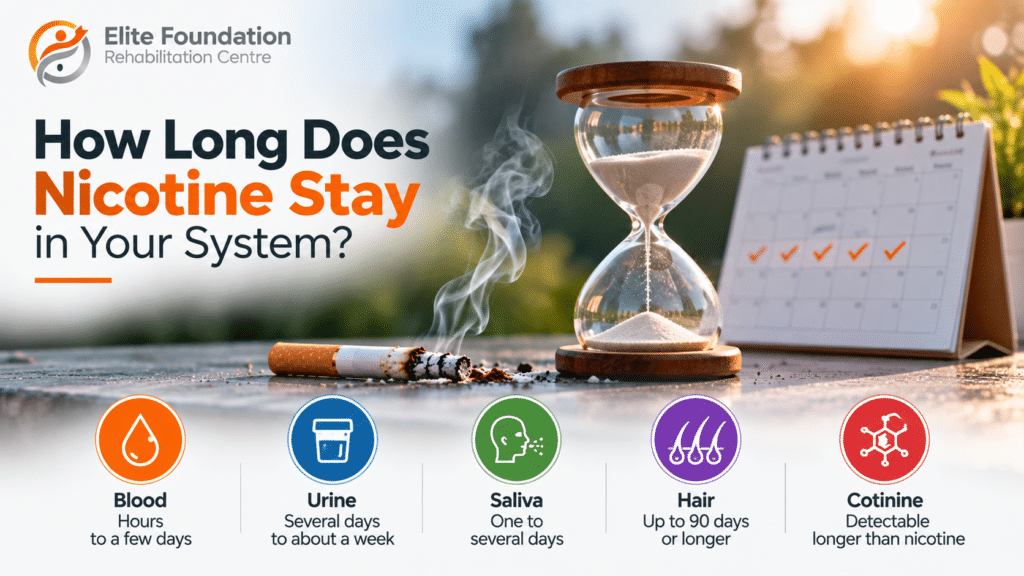
How long does nicotine stay in your system after you stop smoking or vaping? Nicotine itself is processed relatively quickly, with an elimination half-life of approximately two hours in many adults. Cotinine, the main substance produced when the body metabolises nicotine, remains detectable for longer. This is why a blood or urine test may identify recent nicotine exposure several days after the last cigarette or vape. The precise detection period depends on the substance measured, the test used and how the individual’s body processes nicotine.
There is also an important difference between a substance being detectable and a laboratory reporting a positive result. A highly sensitive test may measure a small amount of cotinine that another test would report as below its positive threshold. For that reason, a statement such as “nicotine disappears from urine after seven days” cannot apply reliably to every person or laboratory.
The question often arises when somebody has recently stopped cigarettes, chewing tobacco or vaping and wants to understand what is happening inside the body. A person may have a low or undetectable nicotine concentration while cotinine remains measurable. Cravings and irritability may continue even after both substances have fallen substantially because nicotine withdrawal and laboratory clearance are different processes.
Elite Care Rehabilitation Centre, located in Titwala, Thane, provides information and support for individuals and families dealing with nicotine dependence and related addiction concerns across Mumbai and surrounding areas. Families considering support through the Elite Foundation rehabilitation centre may also want to understand whether a positive nicotine test means somebody has returned to tobacco use. The answer requires careful interpretation because cotinine can come from several nicotine-containing products.
This includes vaping. A person who has stopped cigarettes but continues using a nicotine-containing e-cigarette may still test positive for cotinine. The same applies to someone using medicinal nicotine patches or gum. For families exploring vaping addiction treatment, it is worth knowing that routine nicotine tests generally reveal exposure rather than identify the particular product responsible.
This article explains how long nicotine and cotinine may remain detectable in blood, urine, saliva and hair. It also examines laboratory cut-offs, specialised tobacco biomarkers, the effects of nicotine replacement therapy and why a negative test does not necessarily mean that withdrawal or cravings have ended.
How long does nicotine stay in your system?
Nicotine has a relatively short elimination half-life, usually around two hours, although the rate varies. A half-life describes the time needed for the amount of a substance in the body to decrease by approximately half through elimination.
For example, if a particular amount of nicotine is present in the body, roughly half may remain after one half-life. The amount continues falling through subsequent half-lives as nicotine is metabolised and eliminated.
However, the process is not a countdown that ends at the same hour for everybody. The amount initially absorbed, ongoing nicotine use, individual metabolism and laboratory sensitivity affect what can still be measured.
Cotinine remains for longer because the body eliminates it more slowly. Consequently, most questions about whether nicotine use can be detected several days later are actually questions about cotinine.
Nicotine vs cotinine: what is the difference?
Nicotine is the substance absorbed when somebody uses cigarettes, nicotine-containing vapes, smokeless tobacco or medicinal nicotine replacement.
The liver processes much of this nicotine into other substances. Cotinine is its principal metabolite, meaning a substance formed during nicotine metabolism.
Although related, nicotine and cotinine have different elimination patterns.
The US Centers for Disease Control and Prevention’s cotinine laboratory documentation describes an estimated nicotine half-life of approximately 0.5–3 hours and a typical cotinine half-life of around 15–20 hours.
That cotinine figure is useful, but it is not a fixed biological rule. The scientific review Biochemical Verification of Tobacco Use and Abstinence: 2019 Update describes a wider cotinine half-life range of approximately 8 to more than 30 hours, influenced by genetic, hormonal and other differences between individuals.
This variation helps explain why two people who stop using nicotine at the same time may receive different laboratory results several days later.
Nicotine is generally a marker of more recent exposure. Cotinine provides a longer detection window and is widely used when a laboratory needs to assess nicotine exposure over the preceding days.
Nicotine detection times: blood, urine, saliva and hair
Detection windows depend on the sample collected, the substance measured and the laboratory’s analytical sensitivity. The following table provides general expectations rather than guaranteed periods for positive or negative results.
| Sample or marker | General detection pattern | What affects interpretation? |
|---|---|---|
| Nicotine in blood | Usually measurable over a relatively short period, commonly hours after exposure. | Rapid metabolism, timing of the sample and laboratory sensitivity. |
| Cotinine in blood | Can remain detectable for several days; around a week may be relevant after substantial exposure. | Starting concentration, metabolism and reporting thresholds. |
| Cotinine in urine | Often detectable for several days to around one week, sometimes longer after heavy or sustained exposure. | Urine concentration, assay sensitivity, nicotine use and cut-offs. |
| Cotinine in saliva | Generally detectable for several days after nicotine exposure. | Sample collection, recent exposure and test sensitivity. |
| Nicotine or cotinine in hair | May reflect exposure over weeks or months, depending on hair length and the segment analysed. | Hair characteristics, external contamination and analytical method. |
| NNAL in urine | May persist for two months or longer after certain tobacco exposures. | Tobacco-specific exposure, testing method and substantial individual variation. |
A detection window is not a guaranteed period during which every test will remain positive. A substance may still be measurable at a low concentration while falling below another laboratory’s threshold for reporting a positive result.
The distinction is important because detection and reporting are separate decisions. One laboratory may identify a very small concentration, while another uses a higher cut-off intended to distinguish active nicotine use from lower-level exposure.
The time needed to fall below either threshold depends partly on the amount present when nicotine use stops and how quickly the person eliminates cotinine.
What do laboratory cut-offs mean in nicotine testing?
A laboratory cut-off is the concentration used to classify or report a test result for a particular purpose.
Some tests report an exact concentration, such as nanograms per millilitre (ng/mL). Others classify results as positive or negative according to a predefined threshold.
For example, a sensitive laboratory might measure a small concentration of cotinine in a blood sample. A different laboratory using a higher positive cut-off could classify a similar concentration as below its positive threshold.
Both may be functioning correctly according to their respective methods.
The purpose of testing matters. Research involving second-hand smoke exposure may require a highly sensitive method. A clinical programme distinguishing active tobacco use from environmental exposure may use another threshold.
The 2019 biochemical verification review explains that cotinine clearance varies substantially and that allowing approximately six to seven days before assessing smoking abstinence can reduce the risk of incorrectly classifying former smokers as current smokers in certain protocols.
Mayo Clinic Laboratories also provides reference information describing heavy tobacco users after two weeks of complete abstinence. Its serum nicotine and cotinine reference findings fall below 3.0 ng/mL, while the corresponding urine reference information uses different concentration thresholds.
These laboratory reference findings are useful examples, not universal rules requiring everyone to test negative after exactly one or two weeks.
How long does nicotine stay in your blood?
After nicotine enters the bloodstream, the body begins distributing and metabolising it. Nicotine concentrations can fall substantially over several hours once exposure stops.
A blood test measuring nicotine itself is therefore most relevant to relatively recent exposure.
For a longer window, laboratories often measure cotinine.
Blood cotinine may remain measurable for several days. Following substantial or sustained nicotine exposure, reaching a particular laboratory threshold can take longer, especially in people who eliminate cotinine more slowly.
Mayo Clinic Laboratories reports that heavy tobacco users who have abstained for two weeks generally show serum nicotine and cotinine concentrations below its stated reference values. This provides laboratory context but does not mean every individual has an identical clearance rate.
Blood results should be interpreted alongside the timing of the last exposure and information about nicotine replacement, vaping and other nicotine products.
How long does nicotine stay in urine?
Urine testing frequently measures cotinine and other nicotine metabolites rather than nicotine alone.
In many people, urine cotinine remains detectable for several days after nicotine exposure stops. A period of approximately three to seven days is often used as a broad reference for routine testing, although this does not define the limits of sensitive testing.
Heavy daily smokers and frequent users of nicotine-containing products may have higher starting concentrations. Some can therefore remain above a laboratory’s reporting threshold for longer.
Urine concentration also changes according to normal physiological factors. Two samples collected from the same person at different times may contain different cotinine concentrations.
For example, a concentrated morning urine sample may produce a different numerical result from a more dilute sample collected later. This does not necessarily indicate that new nicotine was used between the tests.
Because laboratories use different methods and thresholds, it is more accurate to discuss an approximate range than promise that every urine cotinine result will be negative after a particular number of days.
Why does urine cotinine sometimes remain detectable longer?
Cotinine is eliminated more slowly than nicotine, and concentrations in urine can be higher than those found in blood.
The CDC notes that urine cotinine concentrations tend to be several times higher than serum concentrations.
This allows urine testing to detect exposure effectively, but it also means that results require specimen-specific interpretation.
Frequent nicotine use can maintain cotinine concentrations while exposure continues. Once nicotine use stops, the starting concentration and individual elimination rate influence how quickly the measured amount falls.
A person who has used nicotine frequently for years may therefore have a different testing pattern from someone who has used a nicotine product occasionally.
Laboratory findings should be considered alongside this history rather than used to estimate an exact number of cigarettes or vaping puffs.
How long does nicotine stay in saliva?
Saliva is another sample used to assess nicotine exposure.
Cotinine is often preferred because it remains measurable longer than nicotine itself.
Saliva cotinine may be detected over several days following nicotine use. Its elimination half-life is broadly similar to cotinine measured in blood and urine, although concentrations differ between sample types.
Saliva testing is convenient because it does not require a blood draw. It can therefore be useful in certain research and cessation-monitoring settings.
However, recent exposure, collection conditions and assay sensitivity can influence the result.
A saliva cotinine test generally establishes nicotine exposure rather than whether somebody smoked, vaped or used medicinal nicotine.
Can nicotine be detected in hair?
Hair testing can provide a longer-term view of exposure than most routine blood, urine or saliva tests.
Nicotine and cotinine may become incorporated into growing hair. Laboratories can sometimes analyse particular hair segments to assess exposure over weeks or months.
The interpretation is more complicated than simply counting backwards from the hair length.
Hair characteristics, cosmetic treatments, environmental contamination and differences in laboratory methods can affect findings.
As a result, hair testing cannot precisely identify the day of the last cigarette or provide a dependable count of nicotine products used.
It is more commonly relevant to specialised investigations and research than ordinary nicotine-withdrawal management.
Why cotinine is usually measured instead of nicotine
The main advantage of cotinine is its longer detection window.
Somebody who smoked a cigarette the previous day may have relatively little nicotine remaining in the bloodstream when a sample is collected. Cotinine may still be present at a measurable concentration.
This makes cotinine useful for assessing recent nicotine exposure in clinical and research settings.
The review Biochemical Verification of Tobacco Use and Abstinence: 2019 Update examines cotinine and other biomarkers, including their elimination rates, appropriate cut-offs and limitations when evaluating tobacco abstinence.
One particularly important finding is how widely cotinine clearance can vary. The review describes half-lives ranging from approximately eight hours to more than thirty hours.
Its discussion of abstinence verification shows why two people with similar initial cotinine concentrations can fall below the same laboratory threshold on different days.
The result is that cotinine is a useful exposure marker, but it is not a precise clock measuring the time since the last cigarette.
What affects how long nicotine stays in your system?
Several factors influence the concentrations of nicotine and cotinine measured after use stops.
Amount of nicotine absorbed
A person who absorbs a larger amount of nicotine may begin with higher metabolite concentrations. The time required to reach a specific laboratory threshold can therefore differ from somebody with limited exposure.
Frequency of nicotine use
Repeated smoking, vaping or smokeless tobacco use can maintain nicotine-related concentrations while exposure continues.
Daily use over a prolonged period produces a different exposure pattern from one isolated episode.
Genetic differences in metabolism
Nicotine metabolism is influenced by enzymes, particularly CYP2A6. Genetic differences affecting these enzymes can alter how rapidly nicotine is processed.
This contributes to differences between individuals even when their reported nicotine use is similar.
Hormonal factors and pregnancy
Hormonal influences can alter nicotine metabolism. Pregnancy can also change how nicotine and its metabolites are processed.
General detection estimates therefore have limitations when applied to pregnant individuals or people with substantial hormonal changes.
Liver and kidney function
The liver performs much of nicotine metabolism, while the kidneys contribute to eliminating nicotine-related compounds.
Medical conditions affecting these organs may influence testing or interpretation.
Laboratory method and reporting threshold
Even when two people have identical concentrations, their results may be reported differently if different tests or cut-offs are used.
Understanding the laboratory method is essential before interpreting an unexpected positive or negative result.
Does nicotine from vaping stay in your body longer than nicotine from cigarettes?
Once nicotine has been absorbed, it follows broadly the same metabolic pathways regardless of whether it came from smoking, vaping, chewing tobacco or medicinal nicotine replacement.
The product does not create an entirely different nicotine molecule.
What changes is the amount absorbed and how often nicotine enters the body.
A person using a high-concentration nicotine vape repeatedly throughout the day may have substantial exposure. Someone who smokes cigarettes infrequently may have a different profile.
The opposite is also possible.
Vaping device design, nicotine formulation and inhalation behaviour all influence nicotine delivery. Laboratory tests therefore measure the resulting exposure rather than the product’s appearance.
Can a nicotine test tell whether somebody smoked or vaped?
Routine nicotine or cotinine testing generally cannot distinguish cigarette smoking from nicotine-containing vaping.
Both deliver nicotine, and the body converts that nicotine into the same principal metabolites.
Medicinal nicotine replacement also produces cotinine.
Some specialised biomarkers can provide additional information about tobacco exposure, but they are not perfect product identifiers.
This matters in families and treatment programmes. A positive cotinine test should lead to a careful review of actual nicotine exposure rather than an immediate assumption that somebody has secretly smoked cigarettes.
Can nicotine patches or gum cause a positive cotinine test?
Yes. Nicotine patches, gum and lozenges deliver medicinal nicotine, which the body metabolises into cotinine.
Someone following a nicotine replacement treatment plan may therefore test positive even while successfully avoiding cigarette smoke.
This distinction is particularly important when the purpose of testing is to verify tobacco abstinence rather than complete nicotine abstinence.
Different programmes may have different requirements. Some are concerned mainly with avoiding combustible tobacco, while others have specific restrictions concerning nicotine exposure.
Healthcare professionals should know which nicotine-containing treatments a patient is using before interpreting results or making treatment decisions.
What does a positive cotinine test mean?
A positive result means that the laboratory has identified a cotinine concentration meeting its positive reporting threshold.
The result supports recent nicotine exposure within the test’s relevant detection period.
The source may be cigarette smoking, vaping, smokeless tobacco or medicinal nicotine. Low levels can also arise from environmental exposure, depending on the assay.
The measured concentration, sample type and reason for testing help determine what the result means clinically.
A positive cotinine result is evidence about exposure. Diagnosis of nicotine addiction requires assessment of symptoms and behaviour.
What does a negative nicotine test mean?
A negative result generally indicates that the measured substance was below the laboratory’s reporting threshold.
That can occur because exposure has stopped, enough time has passed for the concentration to decline or the amount present is too low for the particular test to report as positive.
A negative result from a routine nicotine screen does not necessarily establish that somebody has never used cigarettes or vaping products.
It is also possible for a person to test negative while continuing to experience cravings associated with previous nicotine dependence.
Can second-hand smoke cause a positive cotinine result?
Yes. People exposed to second-hand tobacco smoke can absorb nicotine and develop measurable cotinine concentrations.
These concentrations are often lower than those associated with active daily smoking.
The CDC and Mayo Clinic Laboratories recognise that passive exposure can produce detectable cotinine.
Whether a sample is classified as positive depends on the threshold used and the context of testing.
This is one reason a low-level result should be interpreted carefully rather than used as conclusive evidence of deliberate tobacco use.
Can a cotinine test show exactly how many cigarettes someone smoked?
No. Cotinine provides information about nicotine exposure, not a precise cigarette count.
Nicotine absorption differs between cigarettes, between people and according to how each product is used.
The same person may also obtain nicotine from several sources.
A laboratory concentration cannot reliably be converted into a specific number of cigarettes, vaping puffs or tobacco portions.
Quantitative testing can still be useful, particularly when interpreted alongside a documented exposure history.
Is nicotine included in a standard drug test?
Not necessarily. Standard drug-screening panels vary according to their purpose and the substances ordered.
Nicotine and cotinine are not automatically included in every drug test.
Some surgical, insurance, employment or cessation programmes request them separately.
The term “drug test” therefore does not identify which biomarkers are being measured.
For medical testing, the ordering professional should be able to explain which substances are included and why the information is required.
Why do some doctors test nicotine before surgery?
Smoking can affect wound healing and increase complications associated with certain surgical procedures.
Some surgical teams therefore assess tobacco exposure before an operation and may use biochemical testing when appropriate.
Requirements vary between procedures, hospitals and clinicians.
A person using nicotine replacement therapy should explain this to the surgical team, as the treatment may produce positive cotinine results even after cigarettes have been stopped.
Stopping prescribed cessation treatment without guidance or concealing nicotine use can complicate care.
The better approach is to discuss current nicotine exposure, smoking history and the intended interpretation of testing with the treating team.
Can drinking more water remove nicotine faster?
Drinking water supports normal hydration, but excessive consumption does not reliably speed nicotine metabolism or guarantee a negative cotinine result.
The body processes nicotine through established metabolic pathways, particularly in the liver.
Increasing water intake does not bypass these processes.
Extreme water consumption can also cause health problems, including dangerous reductions in blood sodium concentration.
Normal hydration is sensible. Unverified detox drinks, cleansing products and excessive water intake should not be presented as treatments for nicotine dependence or dependable ways to change test results.
Can exercise, sweating or sauna use eliminate nicotine?
Regular physical activity can support general health and may help some people manage cravings during smoking cessation.
However, sweating through intense exercise or sauna use has not been established as a reliable method for rapidly eliminating nicotine metabolites.
The principal metabolic process occurs inside the body and is not controlled simply by increasing perspiration.
Trying to force faster clearance through overheating or dehydration can introduce unnecessary health risks.
The useful goal is to stop harmful tobacco exposure and manage dependence through an appropriate cessation plan.
Does quitting nicotine suddenly clear it faster?
When all nicotine intake stops, nicotine concentrations generally decline as the body metabolises and eliminates the substance.
However, not everyone who stops smoking immediately stops all nicotine exposure.
Some people use medicinal nicotine replacement to help manage cravings and prevent a return to cigarettes.
In that situation, the person has stopped smoking but continues receiving nicotine through treatment.
The most appropriate quitting strategy should be selected for sustainable cessation and individual health needs rather than simply achieving the fastest negative laboratory result.
Nicotine leaving the body is not the same as withdrawal ending
Nicotine can decline substantially within hours, while withdrawal symptoms may continue for days or weeks.
Cravings, irritability, anxiety, difficulty concentrating, sleep disturbance and increased appetite can develop as the nervous system adjusts to reduced nicotine exposure.
These symptoms often become more noticeable during the first few days and gradually ease over the following weeks.
The end of acute withdrawal does not necessarily mean every craving disappears. Familiar routines can continue influencing behaviour long after nicotine levels have fallen.
Someone might feel comfortable throughout the day but suddenly remember cigarettes while drinking evening tea or meeting a friend with whom they previously smoked.
For a detailed explanation of the physical and emotional changes involved, read Elite Foundation’s guide to nicotine withdrawal symptoms and their typical timeline.
Can someone still have nicotine addiction after nicotine leaves the body?
Yes. Addiction involves more than the concentration of nicotine currently present in blood or urine.
Physical dependence, repeated use, difficulty controlling consumption and learned behavioural patterns all contribute to the wider clinical picture.
A person may have a negative nicotine test and still experience cravings whenever a familiar situation arises.
Someone who previously smoked after every meal, for example, may continue thinking about cigarettes at that time even after the strongest physical withdrawal has eased.
These behavioural associations are part of why recovery from dependence can take longer than the elimination of nicotine itself.
The wider mechanisms are explained in Elite Foundation’s article on nicotine addiction, cravings and difficulty quitting.
What are anabasine and NNAL in tobacco testing?
Nicotine and cotinine are not the only substances laboratories can measure when assessing tobacco exposure.
Specialised testing sometimes uses minor tobacco alkaloids or tobacco-specific compounds to answer questions that routine cotinine testing cannot.
Anabasine: a marker that may help identify tobacco exposure
Anabasine is a minor alkaloid found in tobacco.
It is generally absent from pharmaceutical nicotine replacement products. Consequently, urinary anabasine testing may help distinguish tobacco use from medicinal nicotine exposure in appropriate circumstances.
However, its usefulness is limited when products contain tobacco-derived nicotine with residual tobacco alkaloids. Some vaping liquids may also contain such substances.
Anabasine is therefore an additional biomarker rather than a universally reliable test for cigarette smoking.
NNAL: a longer-lasting tobacco-related biomarker
NNAL is a metabolite of the tobacco-specific nitrosamine NNK. It is useful in certain specialised assessments of exposure to tobacco-related carcinogenic compounds.
Unlike cotinine, which is commonly measured over a period of days, NNAL has a much longer elimination period.
The 2019 biochemical verification review reports that urinary NNAL can remain detectable for two months or longer after tobacco use stops in certain circumstances. Its long persistence can help researchers examine intermittent or earlier tobacco exposure.
This does not mean that everybody will have a positive NNAL test for two months. The starting exposure, individual elimination, analytical method and reporting threshold all affect the result.
NNAL is also not a routine nicotine-screening marker. It is more relevant when a laboratory needs specialised information about tobacco-specific exposure.
Why these biomarkers should not be confused
Cotinine indicates nicotine exposure from several possible sources. Anabasine may help identify exposure to tobacco-derived compounds. NNAL offers a longer window for certain tobacco-specific nitrosamine exposures.
Each marker answers a somewhat different question.
The 2019 review also notes that product composition can complicate distinctions between cigarettes, smokeless tobacco and vaping products, particularly when tobacco-derived nicotine or other tobacco constituents are present.
For that reason, specialised biomarker results require interpretation by qualified laboratory or clinical professionals.
How nicotine tests can support smoking-cessation care
Nicotine-related laboratory tests can be useful when objective information about exposure is needed for treatment or a particular medical decision.
For instance, a clinician may need to understand whether tobacco exposure has continued during a cessation programme.
Testing may also help interpret an unexpected clinical result or provide information before certain procedures.
However, nicotine dependence cannot be understood through a laboratory number alone.
Cravings, withdrawal, daily routines, motivation, previous quit attempts and current tobacco use all remain relevant.
A patient using nicotine patches may have measurable cotinine while making significant progress by remaining free from cigarette smoke.
The role of testing is to inform care, not replace clinical judgement or become a reason for shaming somebody experiencing dependence.
When should someone seek medical advice?
Medical advice may be useful when a nicotine test result is unexpected, the interpretation affects healthcare decisions or withdrawal symptoms are difficult to manage.
Pregnant people, adolescents and individuals using several nicotine products may need more individual guidance.
Those taking certain prescription medicines should also tell their clinicians when cigarette smoking stops or restarts.
Components of tobacco smoke can affect the metabolism or clinical effects of medicines such as clozapine, olanzapine and theophylline. These effects arise from smoke exposure rather than nicotine itself, so switching from cigarettes to medicinal nicotine replacement does not necessarily maintain the previous medicine requirements.
Significant anxiety, depression, repeated unsuccessful quit attempts or withdrawal interfering with daily functioning may justify appropriate cessation or mental-health support.
Chest pain, severe breathlessness, fainting, new neurological symptoms or other serious concerns should never be dismissed as routine nicotine clearance.
Frequently asked questions about nicotine detection
How long does nicotine stay in your system after one cigarette?
Nicotine itself has a short half-life, often around two hours. Cotinine remains longer and may be detectable for several days depending on the amount absorbed, individual metabolism and test sensitivity. One cigarette does not create the same exposure in every person.
How long does nicotine stay in your system after vaping?
Nicotine from vaping is processed through broadly the same pathways as nicotine from cigarettes. Detection depends on the amount delivered, frequency of vaping and the laboratory marker being measured.
How long does nicotine stay in urine?
Urine cotinine is often detectable for several days and can remain measurable for around a week or longer after substantial exposure. The laboratory’s detection limit and positive cut-off are important.
How long does cotinine stay in the blood?
Cotinine can remain measurable for several days. People with substantial previous nicotine exposure may take around a week or sometimes longer to fall below a particular laboratory threshold.
How long does nicotine stay in saliva?
Saliva cotinine may remain detectable for several days. The actual window depends on nicotine exposure, the assay and the concentration considered positive.
Can nicotine stay in hair for months?
Hair testing can reflect nicotine exposure over weeks or months depending on the segment analysed. It does not reliably identify the exact date of the last cigarette or vape.
What is cotinine?
Cotinine is the principal metabolite formed when the body processes nicotine. It remains detectable longer than nicotine itself and is widely used to assess recent exposure.
What is the half-life of nicotine?
Nicotine has a typical elimination half-life of approximately two hours. The CDC reports an estimated range of around 0.5–3 hours.
What is the half-life of cotinine?
The CDC describes a typical cotinine half-life of around 15–20 hours. Research also reports a wider range of approximately 8 to more than 30 hours because of differences in metabolism.
What is the difference between detectable and positive?
Detectable means a laboratory method can measure the substance. Positive means the concentration meets the reporting threshold for that test. A low measurable concentration may fall below another laboratory’s positive cut-off.
Why can two laboratories give different nicotine test results?
Laboratories may measure different substances, use different methods or apply different reporting thresholds. Sample concentration and collection timing also influence results.
Can a cotinine test detect vaping?
It can detect nicotine exposure associated with a nicotine-containing vape. A routine cotinine result generally cannot establish that vaping, rather than another nicotine source, was responsible.
Will nicotine gum make a cotinine test positive?
Yes. Nicotine gum, patches and lozenges can produce cotinine. The result may remain positive despite successful cigarette abstinence.
Can second-hand smoke show up in a nicotine test?
Yes. Second-hand tobacco smoke can produce measurable cotinine, generally at lower concentrations than regular active smoking. Interpretation depends on the test and cut-off.
Can drinking water flush nicotine out faster?
There is no reliable evidence that excessive water intake rapidly clears nicotine metabolites or guarantees a negative test. Unusually high water intake can cause health problems.
Does sweating remove nicotine faster?
Exercise and sweating are not established ways to rapidly clear cotinine. Normal metabolism is the main process involved in nicotine elimination.
Can you test negative for nicotine and still have cravings?
Yes. Withdrawal and learned behavioural triggers can continue after nicotine concentrations have fallen below a laboratory’s detection or reporting threshold.
Will a blood test show nicotine after one week?
Nicotine itself generally falls substantially sooner, but cotinine may remain measurable depending on previous exposure, metabolism and the laboratory method.
Are urine nicotine tests more accurate than saliva tests?
Both can provide useful information. Accuracy depends on sample collection, analytical method, biomarker and the question the test is intended to answer. Neither is universally superior.
Why is my cotinine test still positive after quitting?
Possible explanations include residual cotinine from previous exposure, ongoing medicinal nicotine use, exposure from another nicotine product or the laboratory’s sensitivity. The ordering professional should interpret the result alongside the history.
Can a cotinine test tell how many cigarettes someone smoked?
No. Cotinine concentrations are affected by nicotine absorption, product characteristics, metabolism and frequency of use. They cannot reliably identify an exact cigarette count.
Does a standard drug test include nicotine?
Not necessarily. The contents of drug-screening panels vary. Nicotine or cotinine testing may be requested separately for specific clinical or administrative purposes.
Can nicotine tests detect chewing tobacco?
Yes. Tobacco-containing products such as khaini, zarda and tobacco-containing gutkha deliver nicotine and can produce measurable cotinine.
Can NNAL stay in the body for two months?
Yes. Research indicates that urinary NNAL may remain detectable for two months or longer after certain tobacco exposures. It is a specialised tobacco-related biomarker rather than a routine nicotine screen, and the detection period varies.
What does anabasine indicate in a nicotine test?
Anabasine can provide additional evidence of exposure to tobacco-derived compounds and may help distinguish certain tobacco use from pharmaceutical nicotine replacement. Interpretation can be complicated by tobacco-derived nicotine products and test limitations.
How long after quitting does nicotine withdrawal stop?
Withdrawal often becomes more troublesome during the first few days and generally improves over the following weeks. Learned cravings may continue beyond the early withdrawal period.
Does a negative cotinine test mean someone is no longer addicted?
No. A negative test describes the measured concentration relative to the laboratory threshold. Nicotine dependence involves behavioural and clinical factors beyond laboratory detection.
Should I stop nicotine patches before a medical test?
Do not independently stop prescribed or recommended cessation treatment simply to change a test result. Explain your nicotine replacement use to the treating clinician and ask how the test will be interpreted.
Understanding nicotine clearance without confusing it with recovery
Nicotine and cotinine remain in the body for different lengths of time. Nicotine is processed relatively quickly, while cotinine provides a longer window for assessing recent exposure.
That window also depends on the laboratory. A small concentration may still be detectable even after it has fallen below another test’s positive threshold. Differences in metabolism, including the broad variation in cotinine half-life, explain why people do not all receive negative results on the same day.
Blood, urine, saliva and hair testing serve different purposes. Specialised tobacco biomarkers such as anabasine and NNAL can provide further information when clinically relevant, but they require careful interpretation.
Most importantly, laboratory detection is not the same as addiction or recovery. Somebody using nicotine replacement may have positive cotinine results while successfully avoiding cigarettes. Another person may test negative but continue experiencing cravings connected with established daily routines.
For individuals trying to stop cigarettes, vaping or smokeless tobacco, a meaningful treatment plan considers exposure, withdrawal, physical health and behavioural dependence together.
Laboratory results can inform clinical decisions. They should not replace an understanding of the person’s circumstances or become a reason to assume that progress has failed.
Medical and safety disclaimer: This article provides general educational information and does not replace individual medical diagnosis, professional laboratory interpretation or treatment. Nicotine and cotinine detection windows are approximate and depend on exposure, metabolism, specimen type, laboratory methods and reporting thresholds. A positive result does not independently diagnose nicotine addiction or identify a particular product, while a negative result does not establish lifelong abstinence or the absence of dependence. Nicotine replacement therapy and prescription cessation medicines should be used according to appropriate product guidance and professional advice. Pregnant people, adolescents and individuals with significant medical or psychiatric conditions may require additional assessment. Excessive water consumption, unverified detox products and extreme physical methods should not be used to manipulate nicotine elimination or laboratory results. Serious symptoms and immediate safety concerns require appropriate urgent medical care.
